
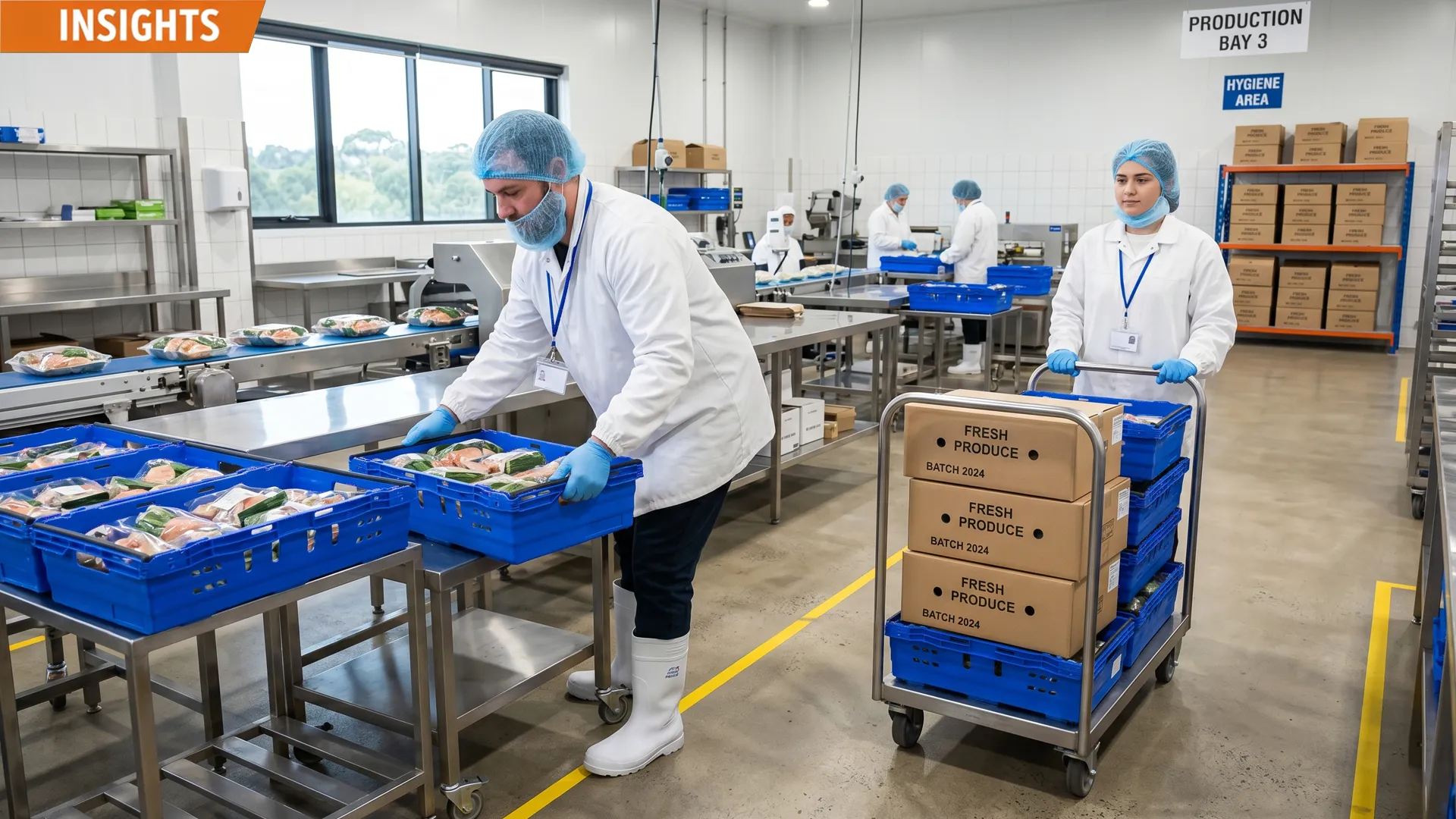
Manual handling in food production is often underestimated for one simple reason:
the work can look routine.
A worker may be:
- lifting trays
- carrying tubs
- moving cartons
- stacking product
- turning with loads
- reaching across benches
- or repeating line-side handling tasks
and none of it may look especially dramatic in isolation.
But in fast-paced food production, manual handling risk rarely comes from one movement alone.
It usually builds through combinations such as:
- repetition
- pace
- awkward reach
- fatigue
- wet conditions
- constrained work areas
- and handling tasks that continue longer than the body is coping with well
Across Victoria, many food manufacturers rely on workers to keep moving steadily while also maintaining:
- hygiene discipline
- line consistency
- PPE compliance
- safe movement through wet areas
- and practical control under production pressure
That means manual handling in food production needs to be reviewed differently from the simple question:
“Is the item heavy?”
The stronger question is:
“What is the worker being asked to do, how often, under what conditions, and how sustainable is it across the shift?”
That is where many sites miss the real risk.
Because a task can be:
- familiar
- common
- and technically manageable
while still building significant strain or injury exposure over time.
That is why good employers review manual handling early, practically, and in the real context of the production environment.
For the broader hub article, see our Food Production Safety in Victoria pillar guide on hygiene, PPE, wet-floor risk, repetitive work, fatigue, and safer worker onboarding in fast-paced sites.
Why Manual Handling Risk Is Easy to Miss in Food Production
Many manual handling risks in food production do not look severe at first glance.
That is because they often involve:
- moderate loads
- smaller items
- repeated tray movement
- shorter carries
- bench-level handling
- and normal line-side transfer work
The problem is that those tasks may still become risky when combined with:
- high frequency
- awkward body position
- long time on feet
- wet or less stable flooring
- fast pace
- and reduced recovery between movements
This matters because sites sometimes look for the obvious warning signs only:
- very heavy lifts
- dramatic strain
- or clear worker complaints
But food production manual handling often becomes a problem much earlier through:
- repeated smaller loads
- awkward turning
- reach distance
- posture drift
- and the gradual physical effect of doing the same thing too many times under the wrong conditions
That is why employers should not judge manual handling risk only by the weight of the item.
They should also judge it by the total demand the task places on the worker across the shift.
Why Fast Pace Makes Manual Handling More Dangerous
Manual handling becomes harder to control when pace increases.
That is because workers have less time to:
- position themselves properly
- reset posture
- adjust grip
- move around obstacles carefully
- or slow down in wet or tighter areas
In food production, this matters a great deal.
A handling task that is manageable at one speed may become more exposed at another.
This is especially true where workers are:
- lifting repeatedly on a moving line
- carrying items through active zones
- stacking at speed
- turning with product
- or handling containers in areas where the floor conditions are changing
Fast pace can quietly change:
- how workers lift
- how they turn
- how they carry
- and how carefully they move through the site
That is why pace should be reviewed as part of manual handling risk, not as a separate productivity issue.
10 Practical Things Employers Should Review Early
1. Whether the Task Is Repetitive Even If the Load Is Not Heavy
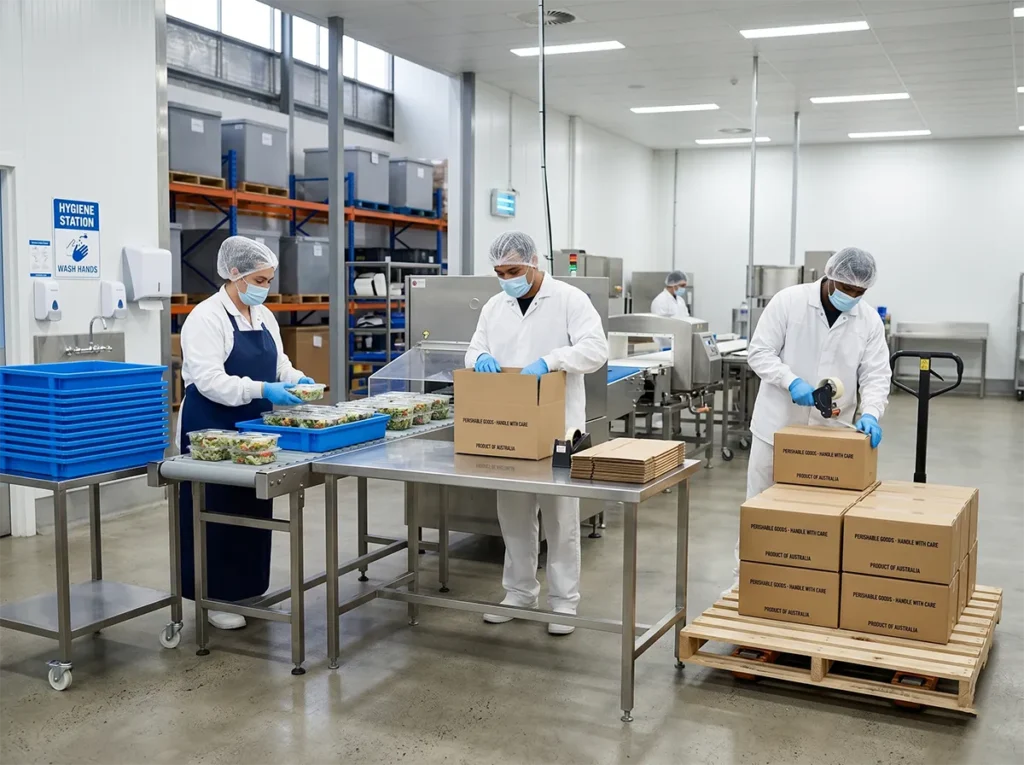
This is one of the most common blind spots.
A task may not involve a heavy single lift, but still create risk because it requires:
- repeated lifting
- repeated reaching
- repeated turning
- repeated carrying
- or repeated placement of product, trays, tubs, or cartons
This matters because repetition increases total physical demand.
A worker may cope with one movement easily and still be overloaded by:
- the number of times it repeats
- the limited recovery between repetitions
- and the long period across which the body is being asked to do it
Good employers review:
- frequency
not just - load weight
That is a stronger manual handling review.
Our article on repetitive work in food manufacturing: what employers should review before injuries build explains why repeated movements often deserve earlier review even when the task looks routine or light.
2. Whether Workers Are Reaching Too Far or Too Often
Manual handling risk is not only about lifting from the floor.
It also includes:
- repeated forward reach
- side reach
- awkward pick points
- stretching to access items
- and workstation layouts that place the product just far enough away to increase strain over time
This matters because repeated reach can affect:
- shoulders
- upper back
- wrists
- posture quality
- and how long the worker can keep performing the task comfortably and safely
A layout that seems workable in theory may still be creating unnecessary strain if it asks the worker to keep reaching further than they should for the full shift.
3. Whether Turning and Carrying Are Happening Under Pace Pressure
A lift is only part of the task.
The rest of the movement matters too.
Employers should review whether workers are:
- lifting and turning quickly
- carrying while navigating tight areas
- transferring loads through active pathways
- or moving product while also trying to keep up with line rhythm or shift pressure
This matters because turning and carrying often become riskier when:
- the body is rushed
- the route is less clear
- the floor is damp
- or the task is being repeated too often to allow good movement discipline every time
Manual handling should be reviewed as the full movement sequence, not just the pick-up point.
4. Whether Wet Floors Are Making Handling Tasks Less Stable
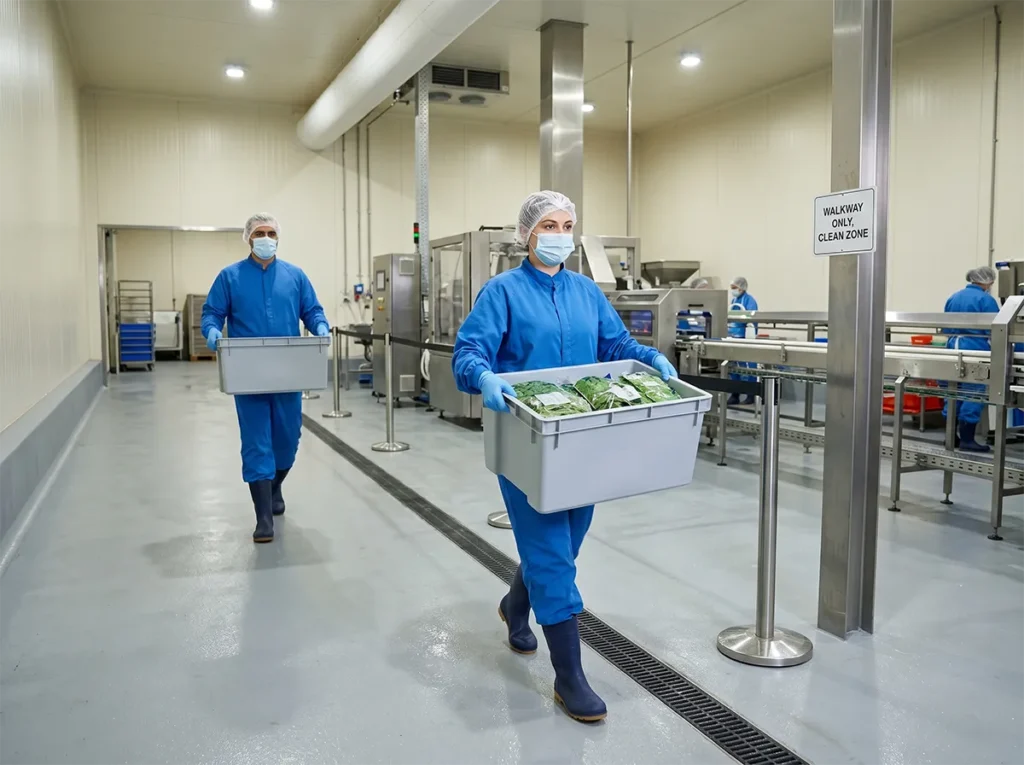
Food production environments often involve:
- washdowns
- drain areas
- moisture near lines
- and floor conditions that change during the shift
That matters because a handling task that is manageable on a stable dry floor may become much riskier in a damp or slippery area.
Workers may still need to:
- lift
- carry
- turn
- or stack
while their movement confidence is already reduced by the floor condition.
This is where food production manual handling differs from many general industrial settings.
The worker is not only handling the load.
They are handling the load inside a more variable movement environment.
Our article on wet floors, washdowns and drain areas: what food production sites should review early looks at why floor conditions need stronger review when workers are also carrying, turning, or handling product under pace pressure.
5. Whether Workstation Height and Layout Are Supporting Good Movement

A task becomes harder when the workstation is asking the body to work in the wrong position.
That may include:
- too-low surfaces
- too-high benches
- awkward item placement
- poor stacking height
- limited room to move
- or setup that encourages repeated bending, twisting, or raised-arm work
This matters because sites sometimes focus on the worker’s technique while overlooking the fact that the setup itself is making good technique harder to sustain.
A stronger review asks:
- does the workstation support safer handling?
or - is it quietly driving poor movement quality?
That question is often very revealing.
6. Whether Fatigue Is Changing Lift Quality Later in the Shift
A worker may handle the task well early in the shift and much less well later on.
This is one of the most important things to review.
Fatigue can change:
- lift setup
- body position
- grip control
- turning quality
- willingness to reset properly
- and how carefully the worker moves through the task once tiredness builds
This matters because some manual handling problems are not visible at hour one.
They appear at:
- hour six
- hour eight
- or the third long shift in a demanding week
Good employers review how the task looks later, not just how it starts.
Our article on managing worker fatigue during long packing and production shifts explains why fatigue often changes movement quality, concentration, and physical control later in the shift.
7. Whether Workers Are Spending Too Long in the Same Physical Pattern
Manual handling becomes more risky when the body is held in the same pattern too long.
That may include:
- repeated standing with little variation
- the same carry route
- repeated lift height
- the same loading side
- or repeated use of the same body position across hours
This matters because even if the lift itself is moderate, the lack of variation can still increase:
- discomfort
- fatigue
- movement stiffness
- and reduced ability to keep handling well as the shift continues
Task variation and rotation deserve real review here.
Not as a box-tick, but as a question of whether the body demand is genuinely changing enough to help.
8. Whether New and Temporary Workers Understand the Real Handling Conditions
A worker may have general factory or warehouse experience and still be unfamiliar with:
- food production pace
- wet-area movement
- repetitive tray or tub handling
- tighter workstation control
- or the practical rhythm of the site
That means new and temporary workers may:
- move less efficiently
- tire earlier
- or misjudge how demanding the task becomes across the full shift
Good employers do not assume these workers will immediately understand:
- how to pace themselves
- how to move safely with loads
- or where the site’s real handling pressure points sit
They show it clearly.
Our article on bringing new workers into food production: how to reduce hygiene and safety risk on day one explains why early guidance and visible first-shift support matter when workers are new to the physical demands of fast-paced food production.
9. Whether Early Signs of Strain Are Being Noticed Soon Enough
A site does not need to wait for injury reports to know manual handling may be becoming a problem.
Useful early warning signs include:
- workers stretching the same area repeatedly
- slower posture reset
- visible stiffness
- altered lift technique
- awkward turning
- reduced confidence while carrying
- or workers quietly changing the way they complete the task
These signs matter because they often appear before formal reporting does.
Good employers treat these signals as operational information, not background noise.
That allows the site to review:
- the task
- the pace
- the setup
- or the recovery structure
before strain builds further.
10. Whether the Site Is Treating Manual Handling as a Routine Fact Instead of a Reviewable Risk
This is often the biggest issue.
In food production, sites may say:
- “there’s always lifting here”
- “that’s just part of packing”
- or “everyone does that movement”
That may be true.
But common does not mean controlled.
A stronger site keeps asking:
- what exactly are workers lifting, carrying, reaching, and turning with?
- how often?
- under what pace?
- on what floor conditions?
- and how sustainable is that pattern across the shift?
That is how routine handling stays reviewable.
Once manual handling becomes accepted as “just the job”, the site often stops seeing the parts of the task that most need improvement.
What Better Manual Handling Control Usually Looks Like in Practice
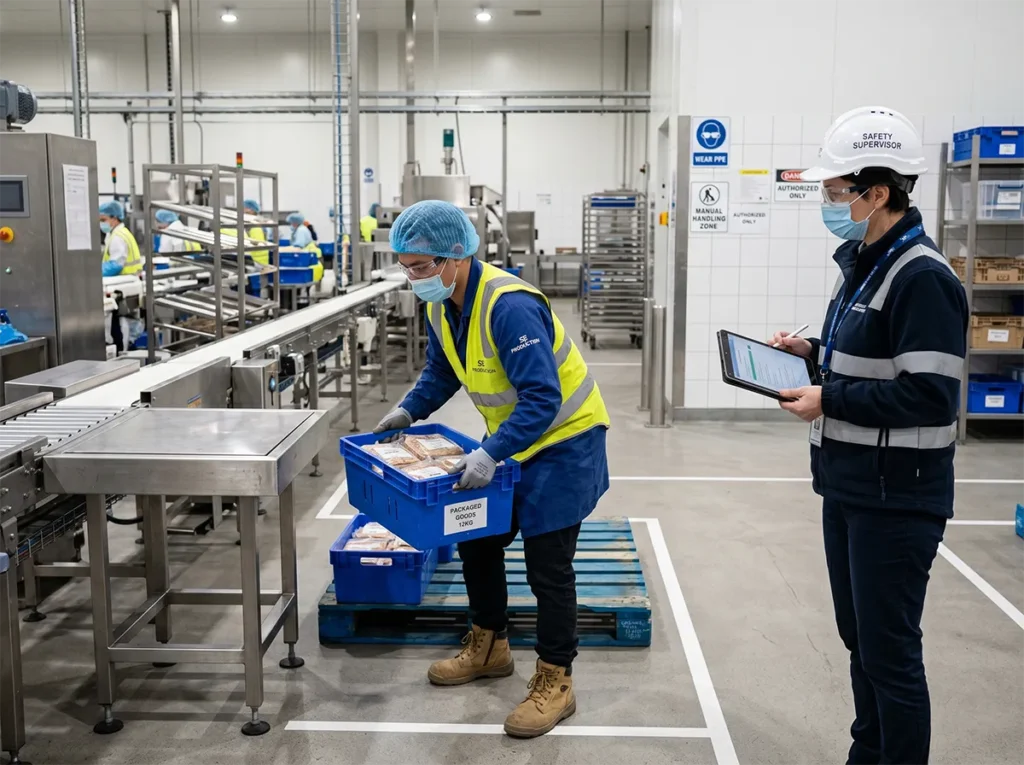
When manual handling is being managed well, the site usually feels:
- more stable
- more readable
- less awkward
- and easier for workers to move through without unnecessary strain
In practice, that often means:
- the full movement sequence is being reviewed
- pace and posture are being considered together
- workstation layout supports better handling
- wet-area effects are not being ignored
- fatigue is being noticed earlier
- and supervisors are treating early strain signs as useful information, not personal weakness
It should not feel like:
- workers are just expected to keep lifting, carrying, or turning the same way indefinitely
- the task is treated as safe simply because no one has formally reported it yet
- or the site only reviews handling after discomfort has already become difficult to hide
Good control usually makes the task feel more sustainable before the strain becomes visible enough to force a change.
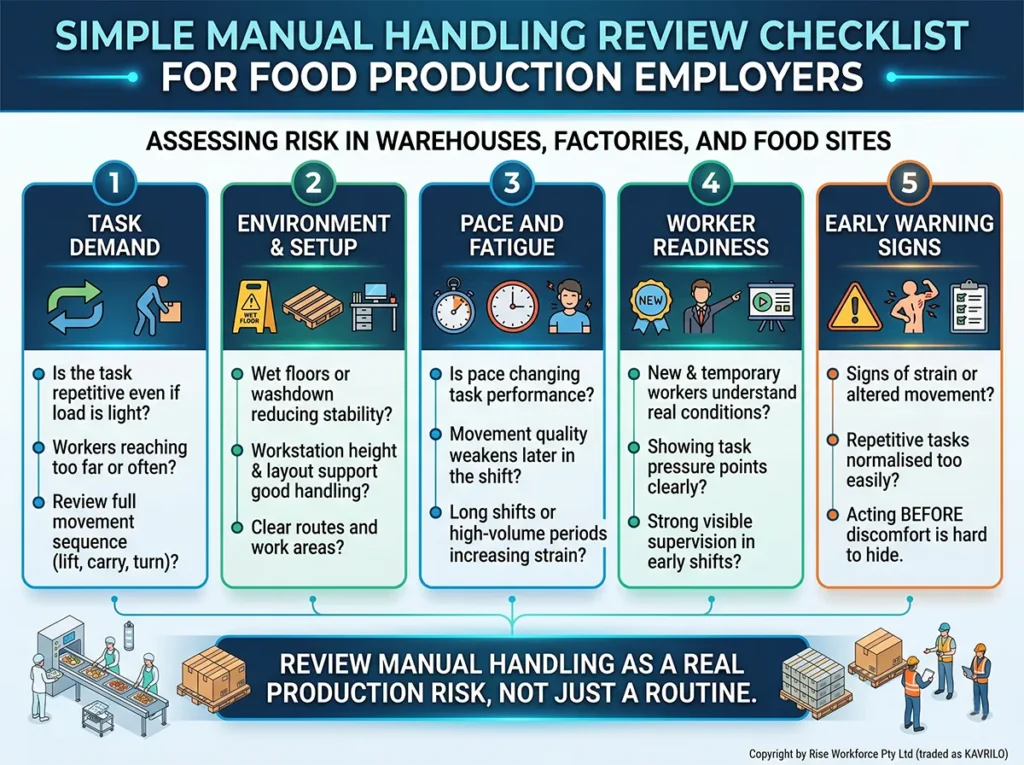
A Simple Manual Handling Review Checklist for Food Production Employers
Here is a practical checklist employers can use when reviewing manual handling risk in food production.
Task Demand
- Is the task repetitive even if the load is not heavy?
- Are workers reaching too far or too often?
- Are lifting, carrying, and turning being reviewed as one full movement sequence?
Environment and Setup
- Are wet floors or washdown conditions reducing movement stability?
- Does the workstation height and layout support good handling?
- Are routes, carry paths, and work areas easy enough to move through safely?
Pace and Fatigue
- Is pace changing how the task is being performed?
- Does movement quality weaken later in the shift?
- Are long shifts or high-volume periods increasing strain?
Worker Readiness
- Do new and temporary workers understand the real handling conditions?
- Are they being shown the task pressure points clearly enough?
- Is visible supervision strong enough in the early shifts?
Early Warning Signs
- Are workers showing early signs of strain or altered movement?
- Are repetitive handling tasks being normalised too easily?
- Is the site acting before discomfort becomes harder to hide?
This kind of checklist helps employers review manual handling as a real production risk, not just a routine part of food-site work.
Final Word
Manual handling risks in food production are often missed because the task can look routine while the strain is building quietly in the background.
For employers in Victoria’s food manufacturing sector, stronger outcomes usually come from:
- reviewing repetition and pace together
- paying more attention to reach, turning, and carry routes
- including wet-area conditions in the handling risk review
- noticing how fatigue changes movement quality
- and acting on early warning signs before the task becomes much harder to control
That is what helps reduce:
- awkward movement
- fatigue-driven handling mistakes
- preventable strain
- hidden physical overload
- and the false confidence that comes from seeing familiar tasks as low-risk simply because they are common
Because in food production, a handling task does not need to look dramatic to become unsafe over time.
It only needs to be repeated under the wrong conditions for too long.
Need Practical Labour Hire Support for Warehousing and Manufacturing in Melbourne’s South-East?
KAVRILO is building its approach around safety-aware workforce support, stronger local responsiveness, and clearer operational discipline for warehouse and industrial environments, including food production settings where hygiene discipline and day-one worker readiness matter.
Whether your site needs better shift coverage, stronger day-one worker readiness, or more dependable labour coordination in hygiene-sensitive environments, KAVRILO is focused on practical workforce support that fits controlled production sites.
Need warehouse and factory labour hire support with stronger day-one readiness and more dependable workforce support for controlled production environments? Talk to KAVRILO about practical labour support across Melbourne’s South-East.
Article Disclaimer
This article is provided for general information only and does not constitute legal, workplace relations, safety, taxation, payroll or other professional advice. Please seek advice specific to your circumstances before acting on this information.
Please read our Website Disclaimer for more information.