
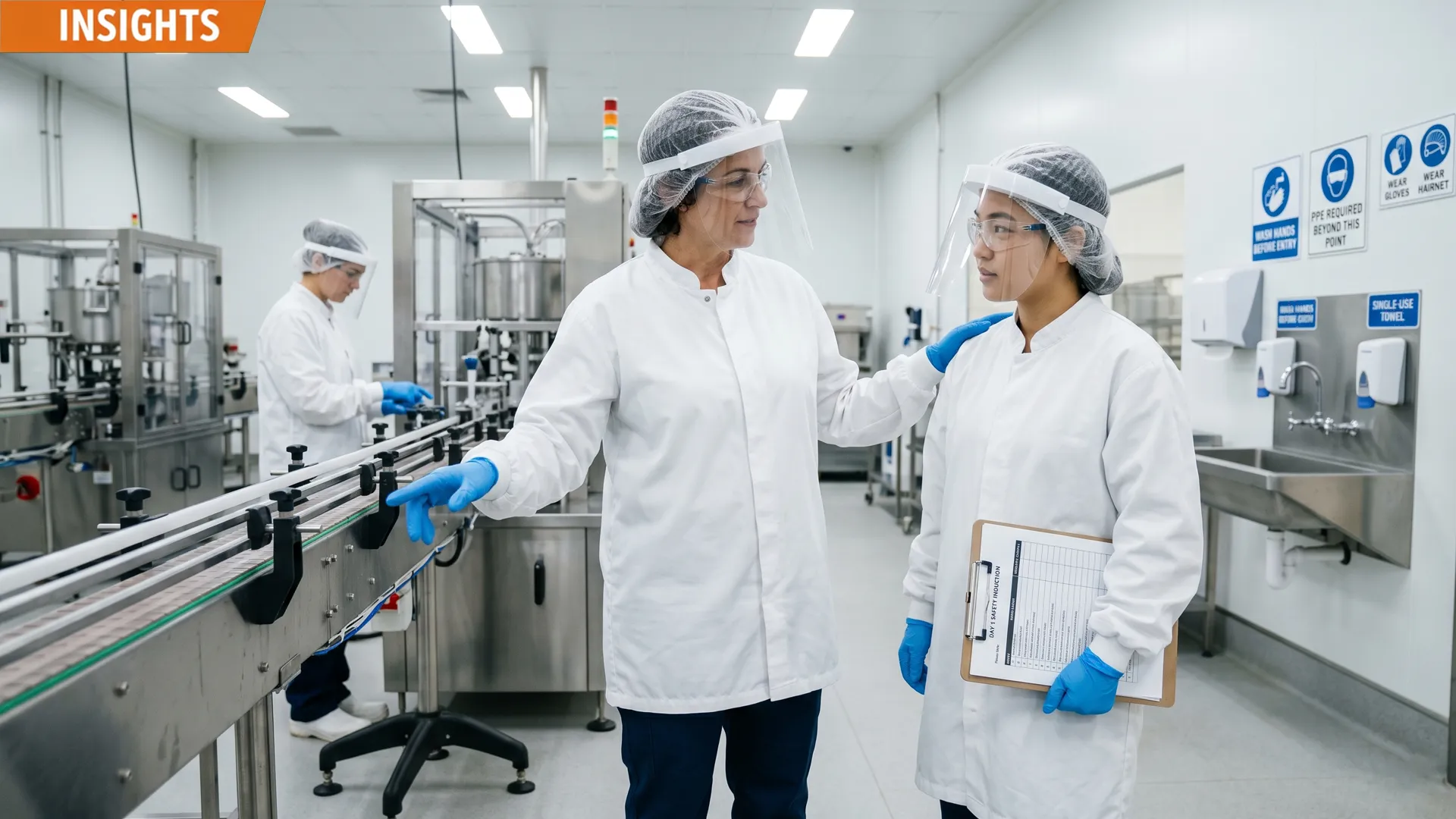
A new worker can enter a food production site with the best intentions and still be underprepared for what the environment actually requires.
That is not always because they are careless.
It is often because food production asks for tighter discipline from the beginning than many other industrial settings.
Across Victoria, employers in food manufacturing often bring in:
- new starters
- temporary workers
- casual labour
- leave-cover workers
- peak-period support
- and workers transitioning from other warehouse or factory environments
That can be necessary and useful.
But it also creates a very practical safety question:
How do you bring someone into a hygiene-sensitive, fast-paced production site without asking them to guess what matters?
Because on day one, a new worker may still be unclear on:
- hygiene entry
- PPE expectations
- movement rules
- zone discipline
- washdown conditions
- contamination-sensitive behaviour
- and who to ask when something feels uncertain
In food production, that uncertainty matters more.
It can affect:
- worker safety
- food safety
- product integrity
- supervision pressure
- and how stable the first shift feels once active work begins
That is why day-one control matters so much.
Good employers do not assume a worker will simply “pick it up” because they have general industrial experience.
They make the site readable, structured, and harder to misunderstand from the moment the worker arrives.
That is how hygiene and safety risk gets reduced early.
For the broader hub article, see our Food Production Safety in Victoria pillar guide on hygiene, PPE, wet-floor risk, repetitive work, fatigue, and safer worker onboarding in fast-paced sites.
Why Day One Matters So Much in Food Production
A first shift always matters.
But in food production, it carries more weight because the worker is entering an environment where:
- safety and hygiene overlap
- behavioural mistakes may affect both people and product
- site entry is more controlled
- PPE has stricter meaning
- and routine factory habits from elsewhere may not transfer safely
That means day one is not just an introduction.
It is a control point.
A weak first shift can lead to:
- poor hygiene habits settling in early
- weak understanding of PPE
- unsafe movement through production areas
- rushed assumptions around washdowns or wet floors
- and workers staying quiet about uncertainty because they do not want to look unprepared
That is why food manufacturers need stronger day-one structure than many general industrial sites.
The goal is not to overwhelm the worker.
It is to make the important things clear early enough that the worker is not left building their own version of how the site works.
Where Day-One Risk Usually Starts Building
Day-one risk in food production often begins through:
- rushed entry
- unclear site introduction
- weak explanation of hygiene sequence
- assumption that PPE is self-explanatory
- poor communication with multilingual workers
- limited time for practical questions
- or the worker being sent into active production too quickly
These are common problems because employers are often already busy when the new worker arrives.
That is understandable.
But it still creates risk.
A worker who looks settled may still be unclear on:
- where they can and cannot go
- what counts as correct PPE use
- how floor conditions change across the site
- how pace affects behaviour
- and what to do if something does not look right
That is why the strongest sites do not judge readiness by whether the worker looks calm.
They judge it by whether the worker has actually been shown enough to work inside the site’s hygiene and safety system properly.
10 Practical Ways to Reduce Hygiene and Safety Risk on Day One
1. Make Site Entry Feel Structured From the Start
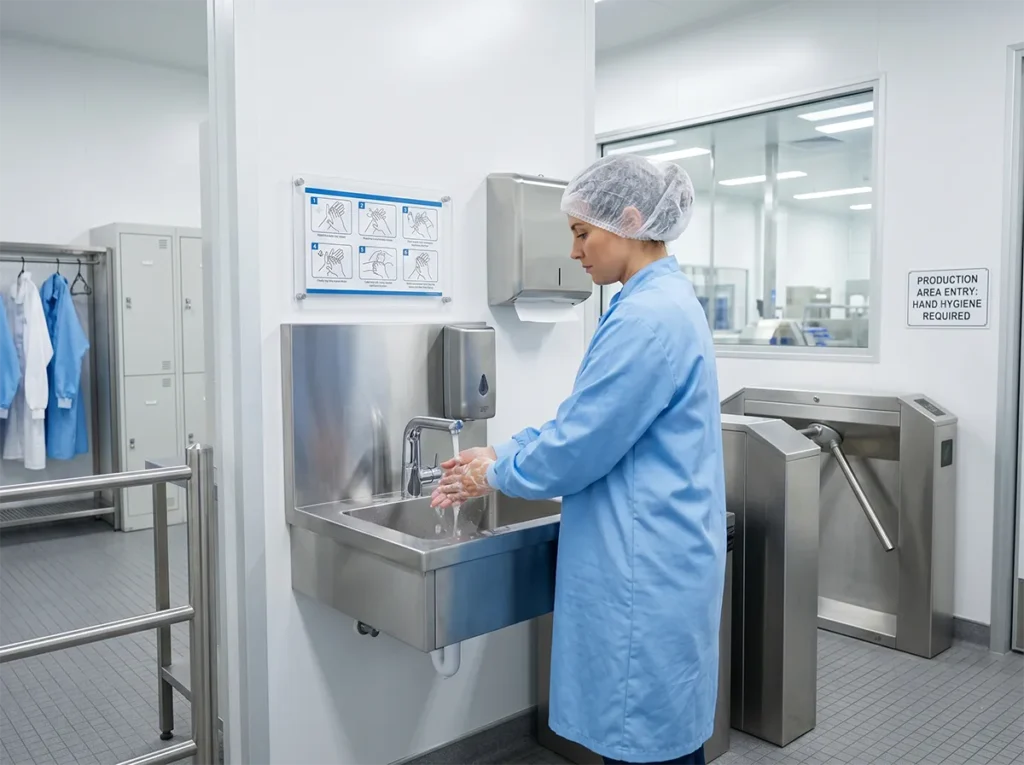
Food production day-one control begins before work starts.
That means the worker should understand:
- where to report
- what the entry sequence is
- what PPE or hygiene items apply
- when hand hygiene or clothing requirements begin
- and who is responsible for taking them into the site properly
This matters because the first few minutes often shape how seriously the worker interprets everything else.
If entry feels rushed or vague, the site is already teaching the worker that control may be looser than it should be.
A structured start helps do the opposite.
Our article on food production site entry rules: what new workers need to understand before shift start explains why stronger entry control is one of the most important day-one foundations in hygiene-sensitive sites.
2. Explain That PPE Is About Food Safety as Well as Worker Safety
A new worker may be familiar with PPE from another site.
That does not mean they understand PPE in food production.
Employers should make clear:
- what must be worn
- how it should be worn
- when it should be changed
- and why it matters to both worker safety and food safety
This is important because food-production PPE is not just personal protection.
It is also part of:
- hygiene discipline
- product protection
- and the site’s visual control system
A worker who misunderstands PPE often misunderstands the environment more broadly.
Our article on why PPE in food production protects both worker safety and food safety looks more closely at why protective clothing matters for both people and product in controlled manufacturing environments.
3. Show the Worker the Real Risk Points, Not Just the Rules
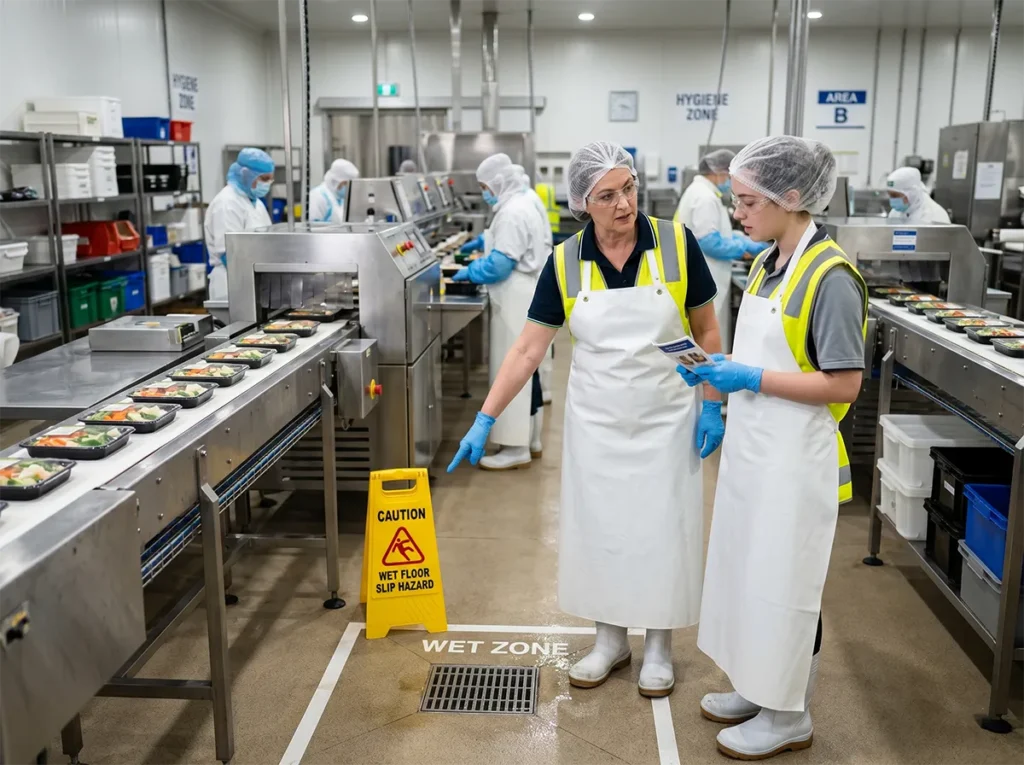
General rules are important, but day-one onboarding works better when the worker is shown the site’s actual pressure points.
That may include:
- wet areas
- washdown zones
- drain areas
- tighter movement points
- product-sensitive zones
- line-side behaviour expectations
- and any places where a small mistake has wider consequences
This matters because workers learn the site more clearly when they can connect:
- the rule
to - the real place where it matters
That makes the environment easier to understand and harder to misread.
4. Do Not Assume General Factory Experience Transfers Automatically
A worker may have experience in:
- warehousing
- packing
- processing
- manufacturing
- or general factory work
That can be helpful.
But food production still has different expectations around:
- hygiene
- PPE
- contamination-sensitive behaviour
- washdowns
- movement discipline
- and product-area conduct
That is why employers should avoid treating previous industrial experience as full day-one readiness.
It is useful background, not proof that the worker understands this site.
Our article on why food production safety is different from general warehouse safety explains why workers entering food production often need tighter day-one control than in many general industrial environments.
5. Make Induction Work for Multilingual Workers
Many food production sites rely on multilingual teams.
That is normal, but it means day-one communication must be stronger.
A worker may nod through a fast explanation and still not clearly understand:
- hygiene rules
- PPE expectations
- movement controls
- contamination-sensitive behaviour
- or who to speak to when something is unclear
Employers should make sure the induction is:
- simple enough
- practical enough
- visible enough
- and reinforced enough
that the worker can actually follow the site, not just sit through the briefing.
Our article on how to run safer food production inductions for non-English speaking workers looks at how employers can make hygiene and safety expectations much clearer on multilingual sites.
6. Show What Good Behaviour Looks Like on This Site
It is not enough to tell a new worker what not to do.
It also helps to show:
- what correct movement looks like
- what good PPE discipline looks like
- what careful behaviour in wetter areas looks like
- how workers are expected to behave near production lines
- and what “normal” safe conduct should actually look like on this site
This matters because many day-one errors happen when workers are trying to interpret the environment through observation alone.
A stronger site removes more of that guesswork.
7. Keep First-Shift Supervision Visible Enough
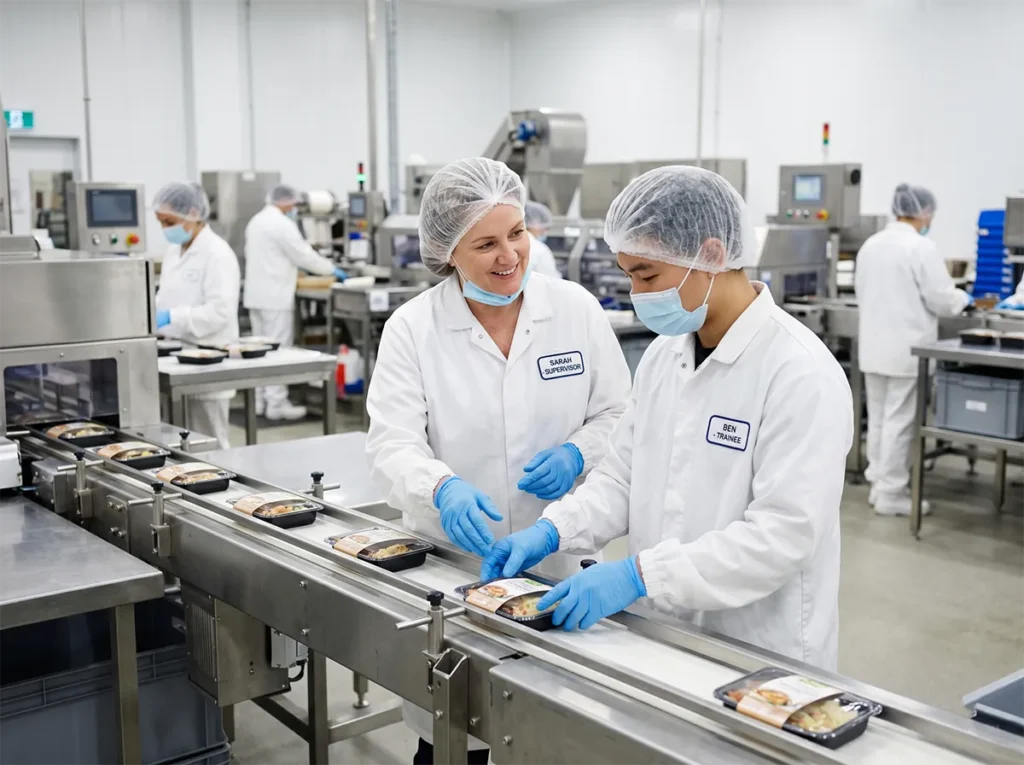
A new worker should not be left to “settle in” without knowing:
- who is supervising them
- who answers hygiene or safety questions
- who corrects uncertainty
- and who they should approach when something does not seem right
This matters because first-shift hesitation often stays unspoken if the worker cannot identify clear support quickly.
Visible supervision helps reduce:
- guessing
- weak habits
- silent confusion
- and early behavioural drift away from the site standard
A stronger day one usually includes more visible early support, not less.
8. Treat Wet Areas and Movement Conditions as Part of the Onboarding
Food production workers often enter sites where:
- moisture is normal
- washdown conditions change during the shift
- drain areas affect footing
- and movement needs more caution than in drier industrial settings
These conditions should be explained as part of day-one readiness.
A worker who is unfamiliar with the site may not yet understand:
- which routes are riskier
- where footing changes
- how pace should adjust
- and why carrying or turning behaviour needs more control in certain areas
This matters because wet-area misunderstanding creates both:
- immediate slip risk
- and weaker confidence in the site’s overall control
Our guide to wet floors, washdowns and drain areas: what food production sites should review early explains why routine wet conditions need much stronger explanation and review in fast-paced food manufacturing environments.
9. Make Questions Easy to Ask Early
A new worker should not have to choose between:
- asking a question
or - risking a mistake
That is especially important in food production, where a worker may be unsure about:
- hygiene sequence
- PPE use
- line behaviour
- movement between zones
- or what counts as acceptable conduct around product-facing areas
Good employers make sure workers know:
- it is normal to ask
- who to ask
- and that uncertainty should be raised early rather than hidden
This helps prevent silence from becoming risk.
10. Do Not Mistake a Quiet Worker for a Ready Worker
Some new workers appear calm and compliant on day one.
That can be a strength.
But it can also hide uncertainty.
A quiet worker may still be:
- unclear on the site layout
- uncertain about hygiene rules
- unsure how strict the environment really is
- or reluctant to admit they have not fully understood the briefing
That is why employers should not treat quiet behaviour as proof of understanding.
Readiness should be judged by:
- what was shown clearly
- what the worker can repeat or follow
- and whether supervision is catching uncertainty early enough
This is one of the simplest ways to avoid preventable day-one risk.
What Better Day-One Readiness Usually Looks Like in Practice
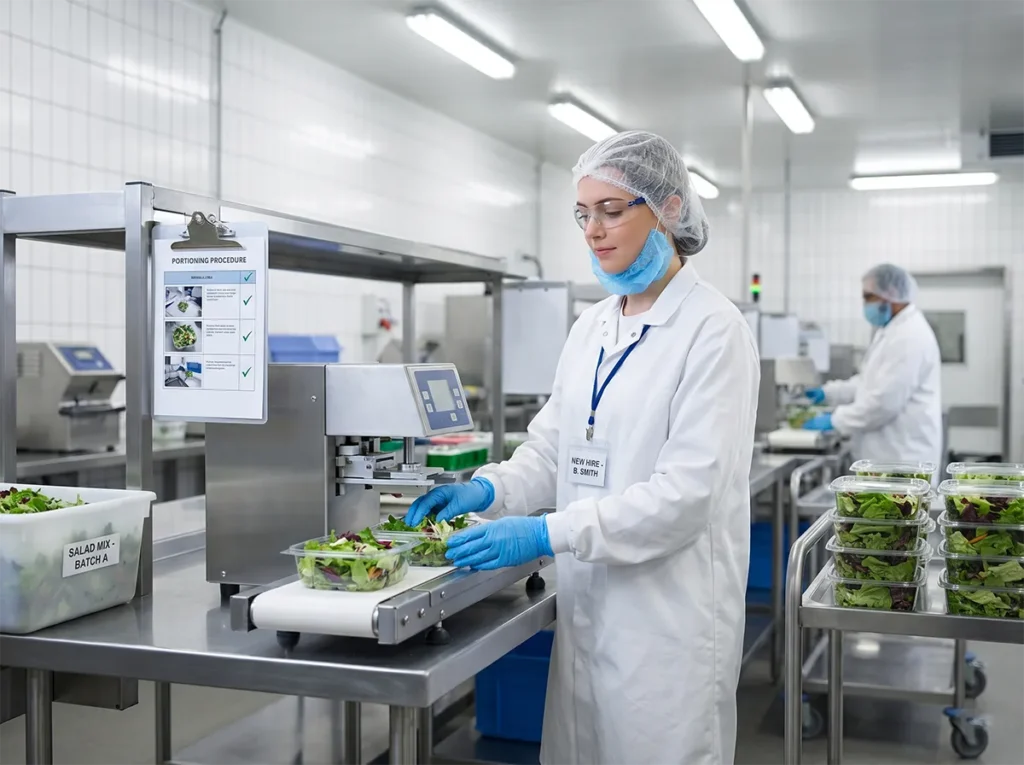
When a new worker is being brought into food production well, the site usually feels:
- structured
- calm
- readable
- and difficult to misunderstand
In practice, that often means:
- entry is controlled
- PPE is explained clearly
- the real site risks are shown, not just listed
- multilingual communication is handled more carefully
- supervision is visible
- and the worker understands that food production discipline starts before active work begins
It should not feel like:
- the worker is being rushed into production while still unsure
- previous industrial experience is being treated as enough by itself
- or the site is only noticing confusion after the first mistakes occur
Good day-one readiness does not remove every risk.
But it usually removes much of the unnecessary uncertainty that creates early problems.
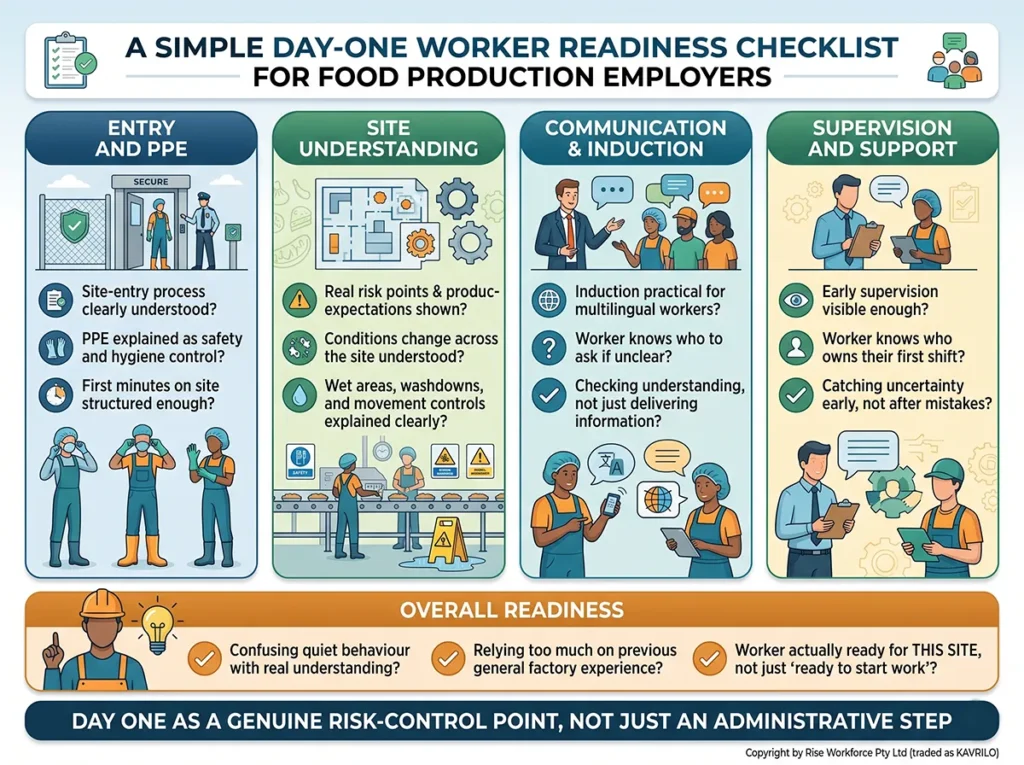
A Simple Day-One Worker Readiness Checklist for Food Production Employers
Here is a practical checklist employers can use when bringing new workers into food production.
Entry and PPE
- Does the worker understand the site-entry process clearly?
- Is PPE being explained as both a safety and hygiene control?
- Are the first few minutes on site structured enough?
Site Understanding
- Has the worker been shown the real risk points and production expectations?
- Do they understand where conditions change across the site?
- Are wet areas, washdowns, and movement controls being explained clearly?
Communication and Induction
- Is the induction practical enough for multilingual workers?
- Does the worker know who to ask if something is unclear?
- Are we checking understanding or just delivering information quickly?
Supervision and Support
- Is early supervision visible enough?
- Does the worker know who owns their first shift?
- Are we catching uncertainty early rather than after mistakes appear?
Overall Readiness
- Are we confusing quiet behaviour with real understanding?
- Have we relied too much on previous general factory experience?
- Is the worker actually ready for this site, not just ready to start work somewhere?
This kind of checklist helps employers treat day one as a genuine risk-control point, not just an administrative step.
Final Word
Bringing new workers into food production safely matters because day-one uncertainty can affect both worker safety and food safety very quickly.
For employers in Victoria’s food manufacturing sector, stronger day-one outcomes usually come from:
- structured entry
- clearer PPE explanation
- practical site-specific induction
- stronger multilingual communication
- visible supervision
- and more honest review of what the worker actually understands before active work begins
That is what helps reduce:
- preventable hygiene mistakes
- weak first-shift behaviour
- early slip or movement risk
- silent confusion
- and the operational strain that comes from onboarding workers too loosely in a tightly controlled environment
Because in food production, day one is not just the start of work.
It is the start of whether the worker can operate safely and hygienically inside the site’s real standards.
Need Practical Labour Hire Support for Warehousing and Manufacturing in Melbourne’s South-East?
KAVRILO is building its approach around safety-aware workforce support, stronger local responsiveness, and clearer operational discipline for warehouse and industrial environments, including food production settings where hygiene discipline and day-one worker readiness matter.
Whether your site needs better shift coverage, stronger day-one worker readiness, or more dependable labour coordination in hygiene-sensitive environments, KAVRILO is focused on practical workforce support that fits controlled production sites.
Need warehouse and factory labour hire support with stronger day-one readiness and more dependable workforce support for controlled production environments? Talk to KAVRILO about practical labour support across Melbourne’s South-East.
Article Disclaimer
This article is provided for general information only and does not constitute legal, workplace relations, safety, taxation, payroll or other professional advice. Please seek advice specific to your circumstances before acting on this information.
Please read our Website Disclaimer for more information.