
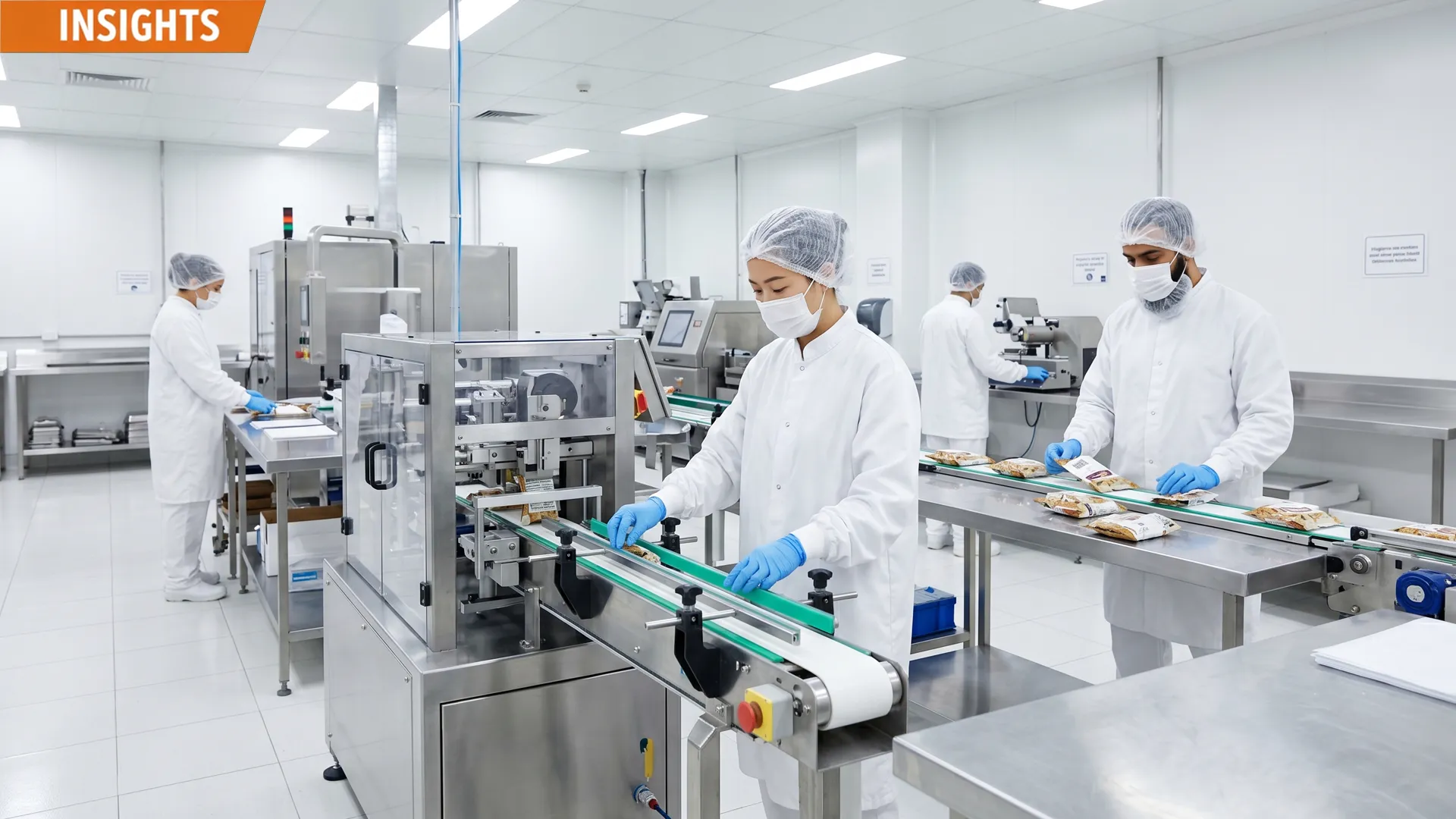
In many industrial settings, PPE is mainly understood as something that protects the worker.
That is true in food production too — but it is only part of the picture.
In food production, PPE often also helps protect:
- the product
- the production environment
- hygiene standards
- and the site’s overall discipline around contamination-sensitive work
That is what makes PPE in food production different.
Across Victoria, food manufacturers often rely on a combination of:
- hair coverings
- clean protective clothing
- gloves where appropriate
- footwear controls
- and site-specific entry requirements
These are not only there for appearance or routine.
They are part of the system that helps reduce:
- worker exposure
- contamination risk
- poor hygiene behaviour
- and inconsistency in how production areas are controlled from shift start onward
That means PPE in food production should not be explained to workers as just:
“what you have to wear.”
It should also be explained as:
- why it matters
- what it protects
- how it must be worn
- when it needs changing
- and how weak PPE discipline can create risk for both people and product
This is especially important for:
- new starters
- temporary workers
- casual labour
- and workers moving in from general warehouse or factory environments where PPE may not carry the same hygiene meaning
That is why good employers treat PPE as part of both:
- workplace safety
- and food safety control
For the broader hub article, see our Food Production Safety in Victoria pillar guide on hygiene, PPE, wet-floor risk, repetitive work, fatigue, and safer worker onboarding in fast-paced sites.
Why PPE Has a Bigger Role in Food Production
PPE matters in every workplace.
But in food production, it sits inside a more sensitive operating system.
That means protective clothing is often doing more than one job at once.
It may help:
- protect the worker from exposure
- support cleaner handling practices
- reduce contamination-sensitive behaviour
- reinforce hygiene boundaries
- and make site discipline more visible from the beginning of the shift
That is why employers should not treat PPE as a background requirement.
In food production, it is part of how the site controls:
- worker readiness
- site entry
- movement between areas
- and daily behaviour around product-facing environments
A worker who misunderstands PPE in food production may also misunderstand:
- hygiene discipline
- contamination-sensitive conduct
- site-entry standards
- and what the production environment expects from them overall
That is why PPE explanation matters so much.
What Makes PPE Different in Food Production Compared with General Industry
In a general warehouse or factory, PPE is often linked mainly to:
- injury prevention
- visibility
- foot protection
- manual work
- and site compliance
In food production, PPE may still support those things, but it often also carries:
- hygiene meaning
- contamination control value
- product protection relevance
- and stricter behavioural expectations
That means employers need workers to understand not just:
- what to wear
but also:
- how to wear it correctly
- what must stay clean
- what must not be carried between areas
- when items must be replaced
- and what behaviour weakens the control PPE is meant to provide
This is why PPE in food production should be taught more carefully than in many general industrial settings.
It is not only a clothing issue.
It is a site-control issue.
Our article on why food production safety is different from general warehouse safety explains why protective clothing, hygiene discipline, and worker behaviour carry tighter meaning in food production than in many standard warehouse environments.
10 Practical Reasons PPE Protects Both Worker Safety and Food Safety
1. PPE Helps Set the Hygiene Standard Before Work Begins
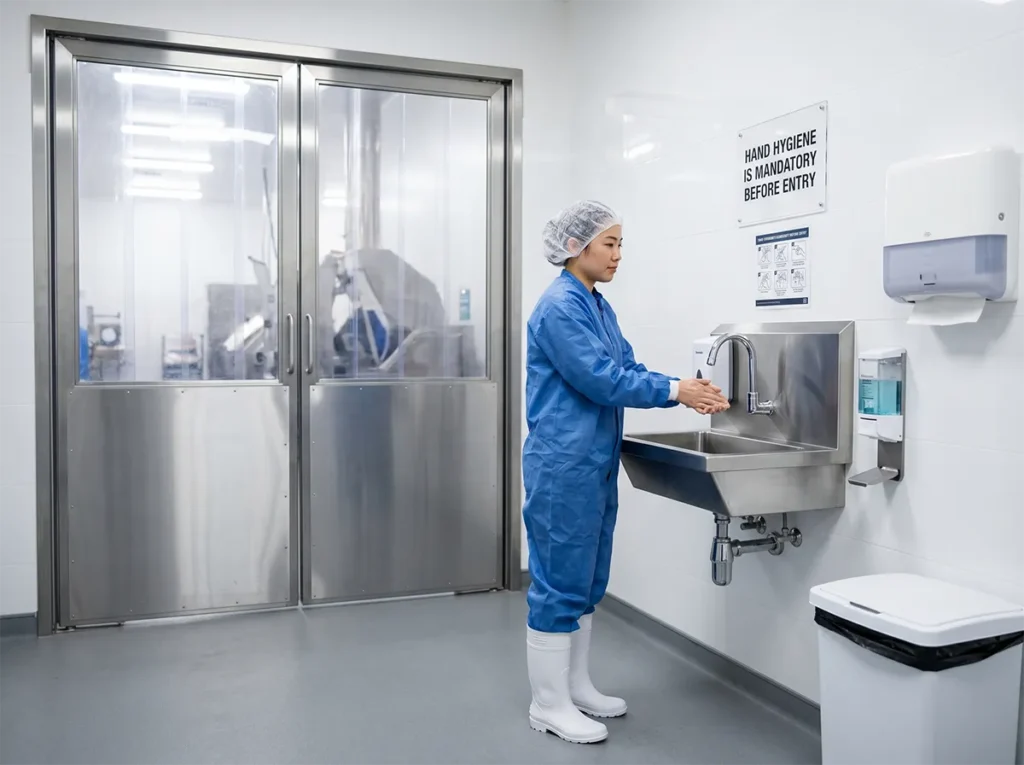
The moment a worker puts on the correct PPE properly, the site is already setting a standard.
That standard says:
- this environment is controlled
- entry matters
- hygiene matters
- and worker behaviour matters before any production task begins
This is important because PPE is often one of the first visible signs that food production operates differently from a general workplace.
A weak start here often signals weaker control elsewhere.
2. Protective Clothing Helps Reduce Product-Contact Risk
In food production, protective clothing often helps reduce the chance that everyday worker presence will affect:
- product-facing areas
- clean production zones
- surfaces
- or handling conditions that need tighter hygiene discipline
That is why clothing is not only about personal protection.
It is also about limiting the risk that normal work activity creates unnecessary product-side exposure.
This is one of the clearest reasons PPE matters on both sides of the safety equation.
3. Correct PPE Supports Cleaner Worker Behaviour
PPE can also influence behaviour.
When used properly, it reinforces that the worker is inside a controlled environment where:
- food-safe conduct matters
- movement matters
- clothing discipline matters
- and shortcuts should not be treated casually
This matters because food production safety often relies on:
- routines
- consistency
- and visible discipline
PPE helps support that discipline when the site explains it properly and reinforces it clearly.
4. Hair Coverings and Clean Clothing Help Support Contamination Control
Food production sites often require specific clothing and head coverings for a reason.
These controls help support cleaner operation by reducing unnecessary exposure from:
- loose hair
- unsuitable clothing
- and weak personal presentation in production areas
This matters because workers sometimes see these requirements as minor or cosmetic if they are not explained properly.
They are not cosmetic.
They are part of how the site protects hygiene-sensitive conditions during normal work.
5. Footwear Requirements Also Affect Floor Safety
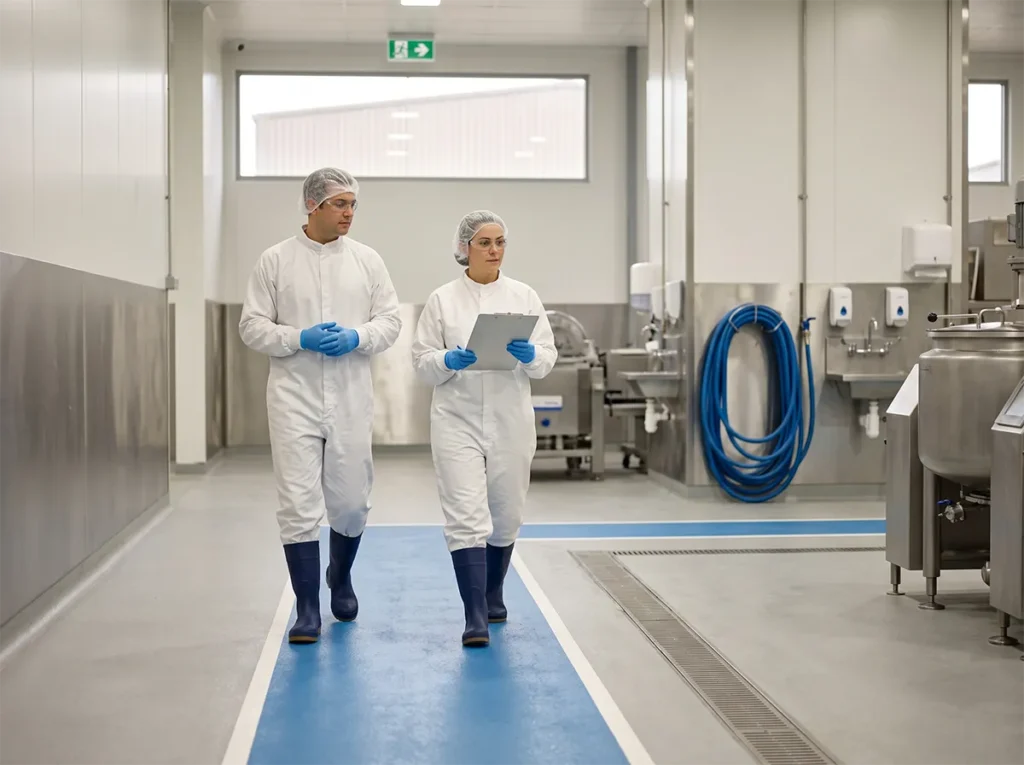
PPE in food production is not only about upper-body protective clothing.
Footwear matters too.
This is especially important where sites face:
- wet floors
- washdowns
- drainage areas
- smooth internal surfaces
- and shifting floor conditions across the day
That means footwear requirements often support both:
- slip prevention for workers
- and stronger movement control in production areas
A worker who misunderstands footwear expectations may be weaker on both:
- personal safety
- and site discipline
Our article on wet floors, washdowns and drain areas: what food production sites should review early looks more closely at why floor conditions and movement controls need stronger review in food manufacturing environments.
6. PPE Discipline Helps New Workers Understand the Site Faster
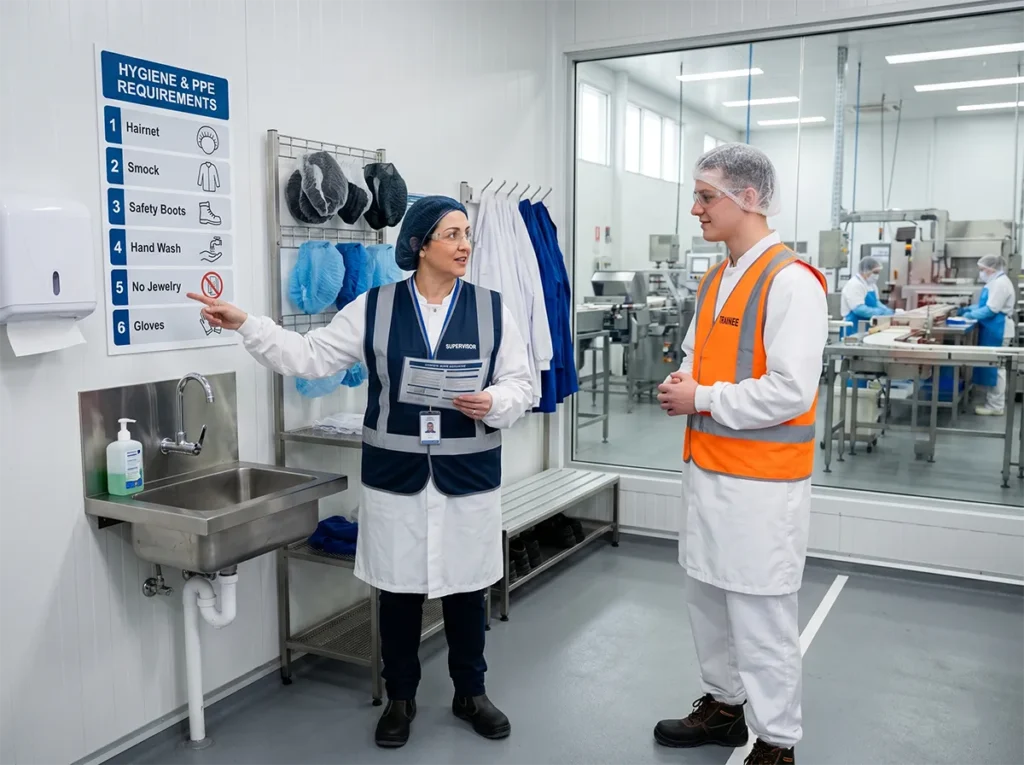
For new and temporary workers, PPE often acts as an early signal that:
- this site is structured
- entry matters
- behaviour matters
- and casual habits from other workplaces may not transfer well here
That is valuable.
Because day-one readiness in food production often depends on making the environment easy to understand clearly from the beginning.
Correct PPE use helps reinforce that this is a site where:
- rules are meaningful
- hygiene is active
- and production discipline starts before the task begins
Our article on bringing new workers into food production: how to reduce hygiene and safety risk on day one explains why day-one worker readiness depends heavily on stronger entry, clothing, and hygiene control from the start.
7. Weak PPE Use Often Signals Wider Discipline Problems
A PPE issue is not always just a PPE issue.
Sometimes it also points to:
- weak induction
- unclear worker understanding
- poor supervision
- weaker hygiene culture
- or a site that has become too casual around important controls
This matters because in food production, small visible discipline failures often reflect bigger hidden ones.
If a site is not holding the line on visible PPE standards, it may also be weaker in:
- entry control
- zone discipline
- and contamination-sensitive behaviour
That is why employers should treat repeated PPE problems as useful warning signs.
8. Gloves and Similar Controls Need Clear Explanation, Not Assumption
Where gloves or other specific protective items are used, workers need more than a rule.
They need understanding.
That includes:
- when the item is required
- when it should be changed
- how it should be used properly
- and what mistakes weaken the protection it is supposed to provide
This matters because workers sometimes assume PPE is protective in any form of use.
In reality, poor use can still create risk.
That is why explanation matters just as much as issuing the item itself.
9. PPE Expectations Need to Work for Multilingual Workforces
Many food production sites rely on multilingual teams.
That makes PPE communication especially important.
A worker may nod through an induction and still not fully understand:
- what item is required
- why it matters
- where it applies
- or when it must be changed or corrected
That is why employers should make sure PPE expectations are:
- visible
- simple
- reinforced practically
- and not dependent on one fast verbal explanation alone
Our article on how to run safer food production inductions for non-English speaking workers explains how employers can make hygiene and PPE rules much clearer on multilingual sites.
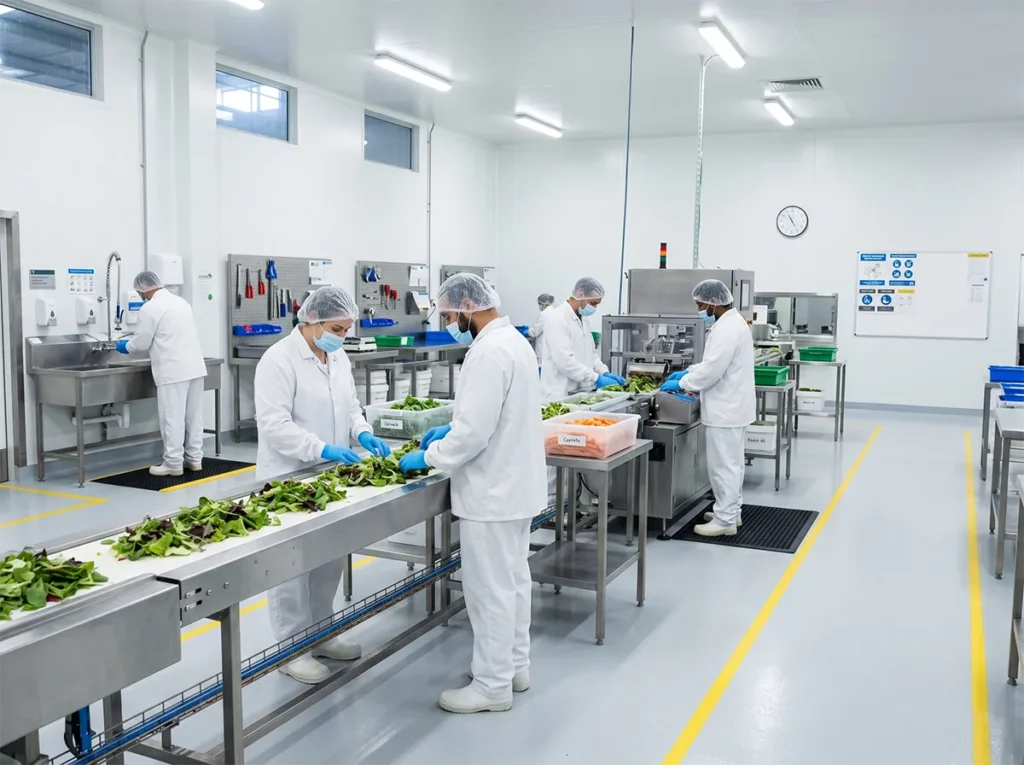
10. Good PPE Discipline Protects Production Confidence Overall
This may be the biggest point.
When PPE discipline is strong, it supports confidence in the wider system.
Supervisors can feel more confident that:
- site entry is being controlled
- workers understand the environment
- hygiene behaviour is more consistent
- and the site is operating inside the standards it depends on
When PPE discipline is weak, confidence weakens too.
That affects:
- supervision
- workforce trust
- production consistency
- and the site’s belief that its hygiene and safety controls are truly holding together during fast-paced work
That is why PPE is not just personal equipment.
It is part of production confidence.
What Employers Should Be Careful Not to Assume
A worker wearing PPE is not automatically using it properly.
A worker who has done factory work before is not automatically clear on what PPE means in food production.
And a site that has PPE rules written down is not automatically enforcing them well enough.
That is why employers should avoid assuming:
- the worker already understands food-production PPE discipline
- visible compliance means real understanding
- protective clothing is only about worker protection
- or new and temporary workers will interpret hygiene clothing correctly without stronger explanation
These assumptions often create the exact kind of risk the site is trying to avoid.
What Better PPE Control Usually Looks Like in Practice
When PPE is being managed well in food production, the site usually feels:
- clean
- structured
- consistent
- and easy to read from the worker’s point of view
In practice, that often means:
- entry expectations are clear
- workers know what to wear and why
- clothing is being used correctly and consistently
- supervisors reinforce standards early
- multilingual teams can still understand key controls
- and new workers are not left guessing what matters in the environment
It should not feel like:
- PPE is being worn loosely or inconsistently
- hygiene expectations are only being enforced after mistakes occur
- or workers are carrying general industrial habits into a more sensitive production setting without enough correction
Good PPE discipline helps the whole site feel more controlled.
A Simple PPE Checklist for Food Production Employers
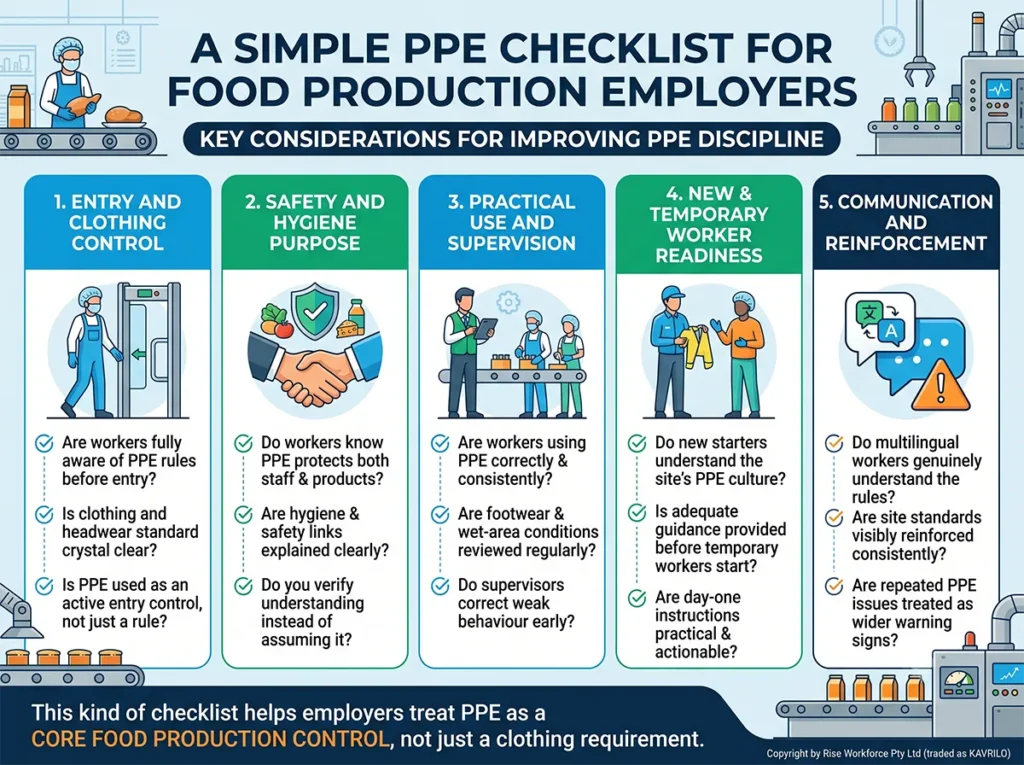
Here is a practical checklist employers can use when reviewing PPE discipline in food production.
Entry and Clothing Control
- Do workers understand what PPE is required before entering production areas?
- Are clothing and head-covering standards clear enough?
- Is PPE being used as an active entry control, not just a dress rule?
Safety and Hygiene Purpose
- Do workers understand that PPE protects both themselves and the product environment?
- Are hygiene and safety explanations being linked clearly enough?
- Are we assuming understanding instead of checking it?
Practical Use and Supervision
- Are workers using PPE correctly and consistently?
- Are footwear and wet-area conditions being reviewed together?
- Are supervisors correcting weak PPE behaviour early enough?
New and Temporary Worker Readiness
- Do new workers understand the role PPE plays on this site?
- Are temporary workers being brought in with enough PPE guidance before shift start?
- Are day-one instructions practical enough for the environment?
Communication and Reinforcement
- Are multilingual workers genuinely understanding PPE rules?
- Is the site reinforcing visible standards consistently?
- Are repeated PPE issues being treated as a wider warning sign?
This kind of checklist helps employers treat PPE as a core food production control, not just a clothing requirement.
Final Word
PPE in food production protects both worker safety and food safety because the environment is more sensitive than general industrial settings.
For food manufacturers in Victoria, stronger outcomes usually come from:
- clearer entry control
- better explanation of protective clothing
- stronger footwear and wet-area awareness
- better multilingual communication
- and more consistent reinforcement of why PPE matters to both people and product
That is what helps reduce:
- weak hygiene discipline
- preventable worker exposure
- contamination-sensitive behaviour failures
- unclear day-one expectations
- and the slow erosion of site standards during fast-paced production
Because in food production, PPE is not just what the worker wears.
It is part of how the site protects the whole environment.
Need Practical Labour Hire Support for Warehousing and Manufacturing in Melbourne’s South-East?
KAVRILO is building its approach around safety-aware workforce support, stronger local responsiveness, and clearer operational discipline for warehouse and industrial environments, including food production settings where hygiene discipline and day-one worker readiness matter.
Whether your site needs better shift coverage, stronger day-one worker readiness, or more dependable labour coordination in hygiene-sensitive environments, KAVRILO is focused on practical workforce support that fits controlled production sites.
Need warehouse and factory labour hire support with stronger day-one readiness and more dependable workforce support for controlled production environments? Talk to KAVRILO about practical labour support across Melbourne’s South-East.
Article Disclaimer
This article is provided for general information only and does not constitute legal, workplace relations, safety, taxation, payroll or other professional advice. Please seek advice specific to your circumstances before acting on this information.
Please read our Website Disclaimer for more information.