

Most labour hire placements do not fail because of one dramatic mistake.
They usually go wrong through a combination of smaller issues that build quickly once the worker reaches site.
That might include:
- a vague role brief
- weak day-one induction
- unclear supervision
- poor traffic explanation
- mixed messages from different managers
- rushed onboarding
- or a worker being placed into conditions that were never described properly in the first place
Across Melbourne’s South-East, many host employers use labour hire to support warehousing, logistics, food production, and manufacturing operations through busy periods, shift gaps, growth phases, and seasonal pressure. Labour hire can work very well in those environments. But only when the placement is set up properly.
When it is not, the problems often show up early:
- the worker looks lost
- supervisors spend time correcting basics
- safety expectations are unclear
- the role turns out to be different from what was described
- and avoidable risk starts growing before the first shift settles in
That is why good employers do not just ask whether labour hire is available.
They also ask whether the placement has been prepared in a way that gives the worker a fair and safe chance of succeeding on site.
Because when labour hire placements go wrong, the cause is often not the fact that labour hire was used.
It is the way the host employer set the placement up.
For a broader employer overview, see our Victorian labour hire compliance guide for practical host-employer responsibilities, site control, and workforce coordination.
Why Placements Usually Go Wrong in Practice
A weak placement usually begins with weak setup.
That can happen when:
- the role is described too vaguely
- the provider is not given enough site detail
- the worker arrives without enough context
- no one owns the induction properly
- or the host assumes a capable worker will simply “work it out”
That is where avoidable friction begins.
A worker can be good.
A provider can be responsive.
A site can be busy but well intentioned.
But if the placement enters the floor with poor clarity, the host employer often ends up dealing with:
- confusion
- extra supervision pressure
- slower settling-in
- safety exposure
- and frustration on both sides
That is why the best prevention is usually not reactive correction after the placement starts.
It is stronger preparation before it does.
What Early Placement Failure Often Looks Like
When a labour hire placement is not landing well, there are usually signs early.
These may include:
- the worker asking very basic site questions well into the shift
- supervisors realising the role was described too loosely
- confusion about who the worker reports to
- uncertainty around PPE or access rules
- the worker drifting into the wrong area
- repeated correction on movement or task basics
- visible mismatch between the worker and the pace or physical demands of the role
- or managers saying, “This isn’t really what we asked for”
These signs matter.
Because they often point to problems in:
- role briefing
- induction
- task fit
- supervision
- or communication between the host employer and labour hire provider
The earlier these issues are recognised, the easier they are to correct.
10 Common Host Employer Mistakes That Increase Risk
1. Giving a Vague Role Brief

This is one of the most common starting problems.
A host employer may request:
- a warehouse worker
- a process worker
- a picker packer
- a forklift operator
- or a production worker
But that title alone often does not say enough.
It may not explain:
- the pace
- the actual duties
- the area of the site
- the hazards present
- the physical demands
- the traffic exposure
- the PPE requirements
- or whether the role sits near active machinery, food zones, or high-pressure dispatch
When the brief is too vague, worker fit becomes weaker from the beginning.
A better role brief helps the provider understand the real placement, not just the label.
2. Assuming Prior Experience Means Site Readiness
A worker may have experience elsewhere and still be new to your environment.
That means they may not know:
- your layout
- your traffic movement
- your supervisor structure
- your restricted areas
- your emergency process
- your local shortcuts
- or the risk points that matter most on your site
A common host-employer mistake is assuming:
- “they’ve done this before”
- “they’ll pick it up quickly”
- or “the site rules are obvious”
They often are not obvious to a first-shift worker.
This is especially true in active warehouse and manufacturing settings where floor discipline depends on local knowledge.
Our article on site safety inductions for labour hire workers explains what host employers should cover on day one to reduce avoidable confusion, weak onboarding, and early-shift exposure.
3. Rushing or Weakening the Day-One Induction
Some placements go wrong because the site is already busy before the worker arrives.
That can lead to:
- a quick verbal handover instead of real induction
- traffic rules being glossed over
- PPE expectations not being shown clearly
- restricted areas not being explained
- and the worker being pushed onto the floor too early
This creates risk fast.
A good worker can still struggle if:
- they do not know where to walk
- they do not know who to ask
- they are unsure what areas are restricted
- or they are expected to begin the task while still interpreting the site around them
A rushed induction often creates problems that take much longer to fix later.
4. Giving the Worker the Wrong Supervisor or No Clear Supervisor
A labour hire worker should know:
- who they report to
- who gives task direction
- who handles questions
- and who to tell if something feels wrong
When that is unclear, workers may:
- follow the wrong person
- rely on informal instructions
- stay quiet too long
- or drift between areas without real control
This is one of the simplest mistakes to avoid, yet it still causes a lot of friction.
Good placements usually settle faster when one person clearly owns the early supervision.
5. Failing to Explain Traffic and Movement Properly
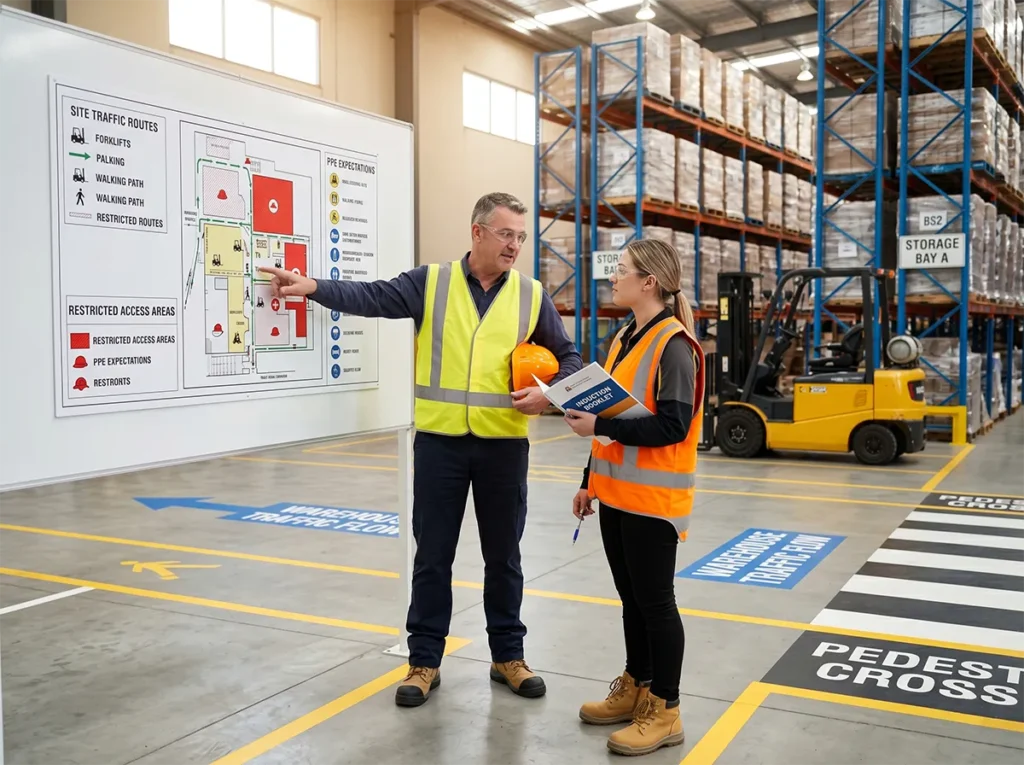
This matters especially in warehouse and logistics settings.
A worker who does not understand:
- pedestrian routes
- forklift lanes
- crossings
- dispatch pressure areas
- loading dock access
- or blind spots
can become exposed very quickly.
Some host employers assume the floor markings speak for themselves.
Often they do not.
Traffic flow should be shown clearly, not left to assumption.
Our guide to warehouse traffic management shows how stronger layout, movement rules, and supervision help reduce forklift and pedestrian risk on active sites.
6. Putting the Worker Into a Poor Task Fit
Sometimes the issue is not behaviour.
It is fit.
For example:
- the role is more physical than expected
- the pace is too fast for the placement
- the environment is more controlled than described
- the task involves repetitive strain pressure the worker was not prepared for
- or the worker is placed too close to active machinery or high-pressure movement zones too early
Good host employers review:
- whether the worker really suits the task
- whether the task matches the original brief
- and whether the site is expecting the person to adapt too fast in a difficult environment
A poor task fit often gets mistaken for a poor worker.
Sometimes the real issue is the way the placement was set up.
7. Treating Safety Reporting as an Afterthought
A labour hire worker should know from the start:
- what to report
- who to report it to
- and that speaking up early is expected
When reporting is vague, workers are more likely to:
- stay quiet about near misses
- ignore blocked walkways
- not mention awkward manual handling
- avoid reporting PPE problems
- or say nothing when they are unsure
That weakens the placement quickly.
If the site wants safer labour hire use, reporting expectations need to be clear on day one.
8. Allowing Mixed Messages Between Supervisors
Placements often become unstable when different people on site say different things.
For example:
- one supervisor enforces the walkway rule
- another tells the worker to cut through quickly
- one manager says ask before entering a zone
- another waves them through casually
- one person insists on PPE
- another treats it loosely
This creates confusion fast.
It also makes the worker look less settled than they really are, because they are trying to read inconsistent expectations.
Good host employers reduce this risk by making sure key site rules are consistent across the people directing the worker.
9. Ignoring Early Warning Signs in the First Shift

The first shift usually tells you a lot.
Good employers watch for:
- uncertainty
- repeated basic questions
- unsafe movement
- weak role understanding
- poor fit with pace or task
- awkward manual handling
- or signs that the worker was not brought onto the site clearly enough
A common mistake is seeing these issues but waiting too long to correct them.
Early intervention matters.
It is easier to fix:
- supervision
- induction gaps
- task fit
- or reporting clarity
on shift one than after several poor or unsafe shifts.
10. Blaming the Worker for a Weak Placement Setup
This is one of the most important points.
Sometimes a worker is genuinely the wrong fit.
But sometimes the worker is being blamed for problems that really came from:
- a weak role brief
- poor induction
- unclear supervision
- traffic confusion
- bad layout explanation
- inconsistent instructions
- or unrealistic site expectations
Good host employers do not ignore worker performance issues.
But they also look honestly at whether the site set the worker up properly in the first place.
That is where smarter correction begins.
What Better Placements Usually Feel Like in Practice
When a placement is set up properly, the difference is usually visible early.
It tends to feel:
- calmer
- clearer
- easier to supervise
- easier to induct into
- and less exposed to avoidable friction
In practice, that often means:
- the role is understood properly
- the worker knows where to report
- traffic and PPE rules are clear
- the supervisor is visible
- reporting is simple
- the task fit is more realistic
- and the site is not spending the whole first shift correcting preventable setup problems
That is usually the result of better host-employer preparation, not luck.
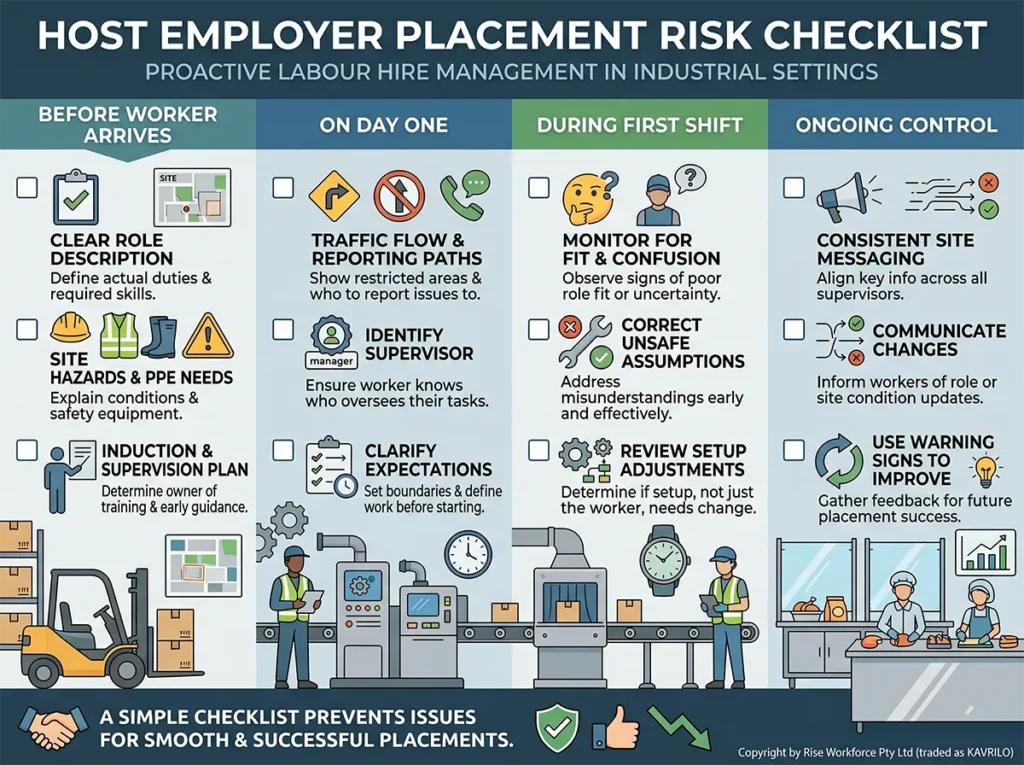
A Simple Placement Risk Checklist for Host Employers
Here is a practical checklist employers can use before and during a labour hire placement.
Before the Worker Arrives
- Have we described the actual role clearly?
- Have we explained the real site conditions, hazards, and PPE needs?
- Do we know who will own the induction and early supervision?
On Day One
- Has the worker been shown traffic flow, restricted areas, and reporting pathways?
- Do they know who supervises them?
- Have we made task expectations and boundaries clear enough before they start?
During the First Shift
- Are we seeing signs of confusion, poor fit, or repeated correction?
- Are unsafe assumptions being corrected early?
- Are we reviewing whether the setup, not just the worker, needs adjustment?
Ongoing Control
- Are key site messages consistent across supervisors?
- Are role or condition changes being communicated clearly?
- Are early warning signs being used to improve future placements?
This kind of checklist helps employers prevent many of the issues that make labour hire placements harder than they need to be.
Final Word
When labour hire placements go wrong, the cause is often not the fact that labour hire was used.
It is the way the placement was set up.
For host employers across Melbourne’s South-East, the strongest improvements usually come from:
- clearer role briefs
- better induction
- stronger supervision
- clearer traffic and PPE guidance
- aligned reporting
- and more honest review of task fit and site conditions
That is what helps reduce:
- avoidable confusion
- day-one friction
- weak onboarding
- inconsistent site control
- and preventable exposure during the first shifts of a placement
Because good labour hire support depends not only on who is sent.
It depends on how well the host employer prepares the site to receive them.
That is not just better compliance.
It is better operational discipline.
Need Practical Labour Hire Support for Warehousing and Manufacturing in Melbourne’s South-East?
KAVRILO is building its approach around safety-aware workforce support, clearer communication, and stronger operational discipline for warehouse and industrial environments.
Whether your site needs better shift coverage, stronger day-one worker readiness, or more dependable labour coordination, KAVRILO is focused on practical workforce support that fits controlled warehouse and factory environments.
Need warehouse and factory labour hire support with stronger day-one readiness and a practical safety-aware approach? Talk to KAVRILO about workforce support across Melbourne’s South-East.
Article Disclaimer
This article is provided for general information only and does not constitute legal, workplace relations, safety, taxation, payroll or other professional advice. Please seek advice specific to your circumstances before acting on this information.
Please read our Website Disclaimer for more information.