
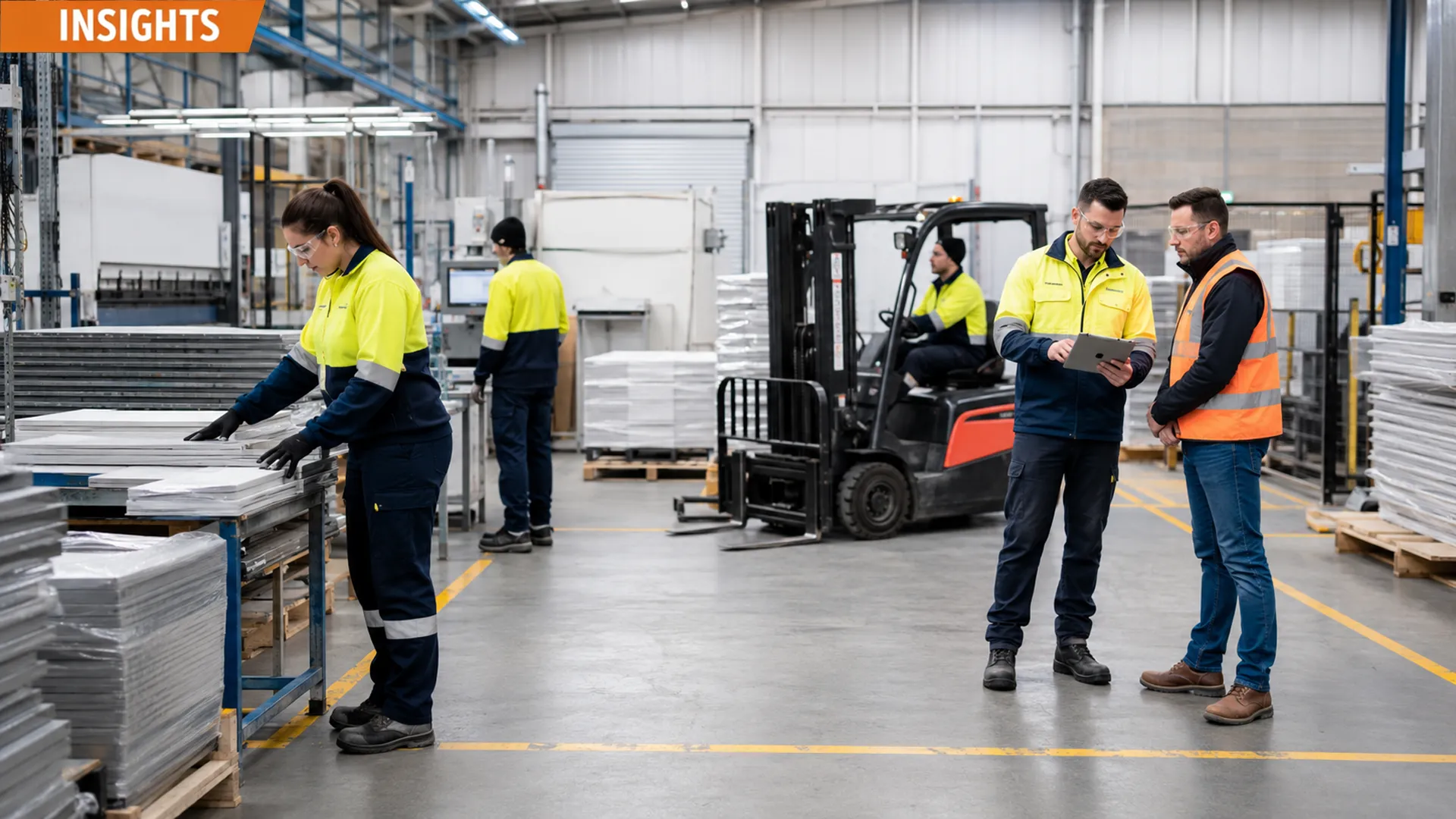
For many employers, staffing pressure first shows up as a numbers problem.
The site needs:
- more workers
- more shift coverage
- faster fill times
- and fewer gaps on the floor
That is real. But in many warehouse and factory environments, the bigger problem is not just headcount.
It is fit.
Across Dandenong and the wider South-East Melbourne corridor, employers often discover that a worker can be:
- available
- willing
- and ready to start
but still not suit:
- the pace of the site
- the physical demands
- the shift pattern
- the supervision style
- the traffic or layout conditions
- or the actual type of warehouse or factory environment they are entering
That matters because a poor-fit worker often creates more disruption than one open headcount.
A role can be technically filled and still create:
- repeated correction
- weaker output
- slower settling-in
- more supervision pressure
- earlier dropout
- and less confidence that the labour support is really helping the operation
That is why good employers do not only ask:
“How quickly can we fill the role?”
They also ask:
“Will this worker actually fit the real conditions of this site?”
That is a much stronger staffing question.
Because in active warehouse and factory environments, site fit often determines whether labour support becomes useful quickly — or becomes another problem for the floor to absorb.
For the broader local market overview, see our Staffing South-East Melbourne pillar guide for Dandenong warehouse and factory employers.
Why Headcount Alone Can Be Misleading
A site can look covered on paper and still feel under-supported in practice.
That usually happens when workers are present, but the match between worker and site is too weak.
For example:
- the pace is stronger than expected
- the task is more repetitive than the worker is used to
- the site needs more independence than the worker can give early
- the factory or warehouse environment is tighter or more controlled than described
- or the worker simply does not settle into the role in a way that reduces pressure on the operation
This matters because headcount is only useful when the people on shift can realistically support the work.
A poor fit may still count toward the roster.
But it can still create:
- slower work
- more re-explaining
- higher supervisor burden
- and a stronger chance that the placement does not last
That is why good staffing decisions go beyond numbers.
What “Site Fit” Actually Means in Practice
Site fit is not a vague concept.
In practical terms, it usually means asking whether the worker suits:
- the actual task
- the physical demands
- the environment
- the shift structure
- the supervision level
- and the operating style of the site
That may include:
- whether the worker suits a faster warehouse dispatch floor
- whether they can handle repetitive factory process work
- whether they can work safely and steadily in a more controlled food production setting
- whether they can sustain the actual start times
- and whether they can settle into the culture and rhythm of the site without creating avoidable friction
A worker can be broadly suitable for industrial work and still be the wrong fit for a specific site.
That distinction matters a lot.
10 Practical Reasons Site Fit Often Matters More Than Headcount
1. The Real Task Often Differs from the Job Title
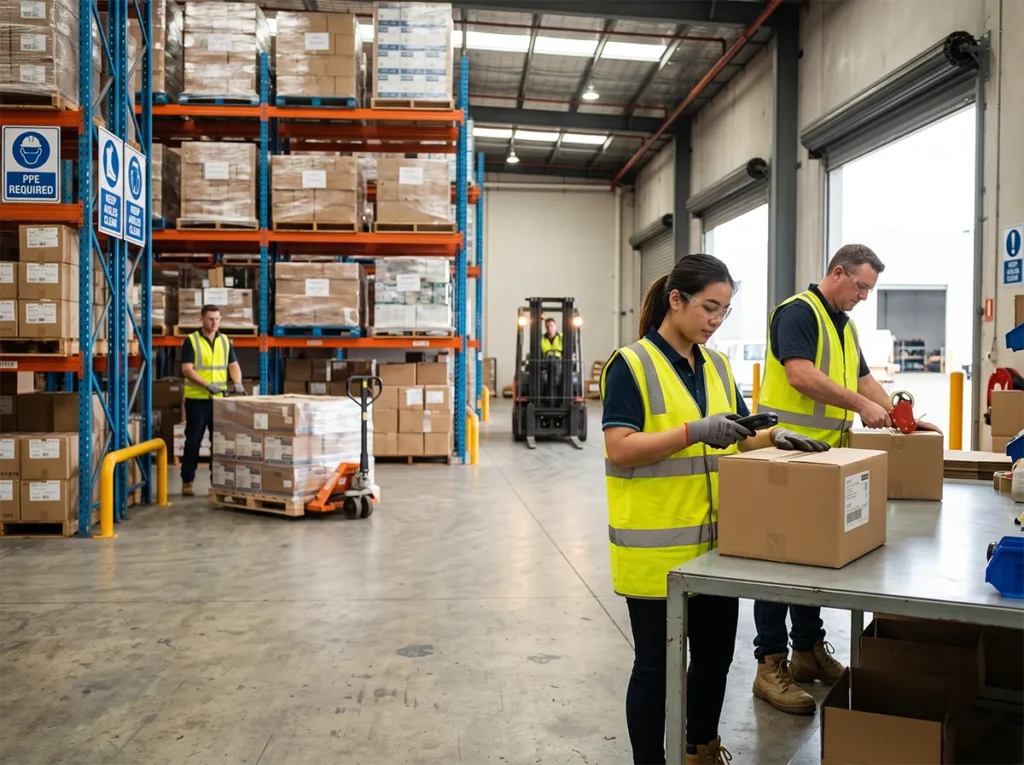
Titles such as:
- warehouse worker
- process worker
- pick packer
- production worker
- storeperson
- factory hand
can sound straightforward.
But in reality, the actual role may involve very different:
- pace
- movement
- lifting
- shift structure
- supervision expectations
- and site conditions
That is why employers should think beyond the label.
A worker may be capable in one warehouse role and still not suit another site where:
- the dispatch pressure is faster
- the walking volume is higher
- the manual handling is more repetitive
- or the environment is more tightly controlled
A good fit starts with understanding the real role, not just the title.
2. Poor Fit Creates More Supervision Pressure
When the worker is not well matched to the site, supervisors often feel it first.
That may show up through:
- repeated basic questions
- slower settling-in
- more correction than expected
- uncertainty around routine tasks
- or a worker who needs closer support for longer than the site can comfortably provide
This matters because a worker who increases supervisor strain may be reducing the site’s overall capacity rather than strengthening it.
A stronger fit usually helps the supervisor spend less time fixing and more time leading the floor.
3. Physical Suitability Matters More Than Employers Sometimes Admit
Some warehouse and factory roles are more physically demanding than they first sound.
That may include:
- repetitive lifting
- long periods on foot
- sustained picking pace
- frequent pallet movement
- process work that requires endurance
- or handling tasks in colder, faster, or more controlled environments
If the physical reality is underexplained, a worker may accept the role but struggle once the real conditions appear.
That can lead to:
- slower performance
- early dropout
- reduced attendance
- or a worker deciding quickly that the role is not sustainable
This is one reason why fit matters more than speed of fill.
4. Shift Pattern Fit Matters as Much as Task Fit
A worker may suit the work itself, but still struggle with:
- the start time
- the shift length
- rotation changes
- overtime expectations
- or the practical rhythm of the roster
This matters especially in South-East Melbourne, where travel and shift timing still shape labour reliability strongly.
A worker who fits the task but not the shift pattern often becomes:
- less punctual
- less consistent
- less willing to accept extra coverage
- or more likely to leave once the routine becomes hard to sustain
That is not always a performance problem.
It is often a fit problem.
Our article on how transport and travel time affect shift reliability in South-East Melbourne explains why commute practicality and shift structure often shape reliability more than employers first expect.
5. Environment Fit Can Be the Difference Between Settling In and Dropping Off
Not every industrial site feels the same.
A worker may suit:
- an open warehouse
but not - a tighter dispatch-heavy site
They may suit:
- general factory support
but not - a more controlled food production or process environment
This matters because environment fit affects:
- comfort
- confidence
- pace
- adjustment speed
- and whether the worker feels able to keep doing the role after the first few shifts
A worker does not need to be wrong for industrial work generally to still be wrong for one particular site.
6. Poor Fit Often Drives Second-Shift and Third-Shift Loss
Some labour mismatches do not appear immediately.
The worker may complete the first shift, then start dropping away later.
That may happen because:
- the role was more demanding than expected
- the pace was too strong
- the site layout or routine was harder to settle into
- the shift timing became less practical than it first sounded
- or the worker simply did not suit the environment well enough to continue confidently
This matters because some employers interpret later no-shows as a reliability problem alone, when the deeper cause is still weak fit.
A better fit usually improves continuity beyond the first shift.
Our guide to how to reduce no-shows and last-minute gaps in Dandenong warehouse shifts explains why repeated drop-off often points to deeper fit, travel, or expectation problems rather than isolated attendance issues alone.
7. Better Fit Usually Improves Retention
Retention is often discussed in terms of pay, conditions, or labour-market pressure.
Those factors matter.
But fit matters too.
A worker who suits:
- the site rhythm
- the physical demands
- the team style
- and the shift structure
is usually more likely to:
- stay
- perform steadily
- and become useful to the operation over time
That is why stronger fit can improve:
- casual retention
- stability in shift coverage
- and the site’s ability to build a more dependable labour pool rather than constantly refill it
8. Fast Fill Under Pressure Can Create Expensive Mismatch
When labour pressure is high, employers understandably want to fill the role quickly.
But fast fill without fit often creates:
- more correction
- lower confidence in the worker
- more labour churn
- and a higher chance that the role needs to be filled again soon
This matters because a rushed staffing decision may feel helpful on day one but cost more by day three or day five.
Good employers still ask:
- does this person suit the site?
- or are we just filling the gap because the pressure feels urgent?
That is a very important distinction.
9. Better Site Fit Often Improves Shift Reliability

A worker who suits the site is often more likely to:
- keep attending
- settle into the shift rhythm
- respond better to supervision
- and remain engaged once the role becomes routine
That is because fit supports sustainability.
A worker who feels:
- capable in the environment
- realistic about the shift
- and properly matched to the task
is usually less likely to:
- disengage
- drop off after the first few shifts
- or create ongoing attendance uncertainty
This is one reason why fit and reliability are closely connected.
10. Better Labour Support Usually Starts With Better Matching

This is where staffing support makes a big difference.
A stronger labour support approach usually looks beyond:
- availability alone
and thinks more carefully about:
- role realism
- site conditions
- shift structure
- worker suitability
- and how well the person is likely to land on the actual floor
That is especially important in Dandenong and South-East Melbourne, where industrial sites vary significantly and labour pressure can make rushed matching more tempting.
Good staffing support does not just send someone.
It tries to send someone who is more likely to work well in that real environment.
Our article on why South-East Melbourne employers need faster, more local staffing support explains why practical local knowledge often improves worker matching, response time, and labour reliability across the corridor.
What Employers Should Be Careful Not to Assume
A worker who is strong at one site is not automatically strong at every site.
A worker who is available is not automatically suitable.
And a role that sounds simple is not always simple in practice.
That is why employers should avoid assuming:
- any warehouse worker will suit any warehouse
- any casual labour support will reduce pressure automatically
- more people always means stronger staffing
- or a worker who turns up once will necessarily sustain the role over time
The better question is always:
“Does this person fit the actual site?”
That is where stronger staffing decisions begin.
What Better Site Fit Usually Looks Like in Practice
When site fit is stronger, the difference usually appears quickly.
It tends to feel:
- calmer
- more useful
- more stable
- and less exposed to avoidable friction
In practice, that often means:
- the worker settles in faster
- the shift feels more realistic
- supervisors do less repeated correction
- attendance holds more steadily
- the worker matches the actual pace and conditions better
- and the site is not left fixing mismatch that should have been reduced earlier
It should not feel like:
- the role is filled but the floor is still carrying the strain
- every new worker needs excessive re-explaining
- or labour support solves one gap by creating another type of pressure
Good site fit usually makes the operation feel more supported, not just more staffed.
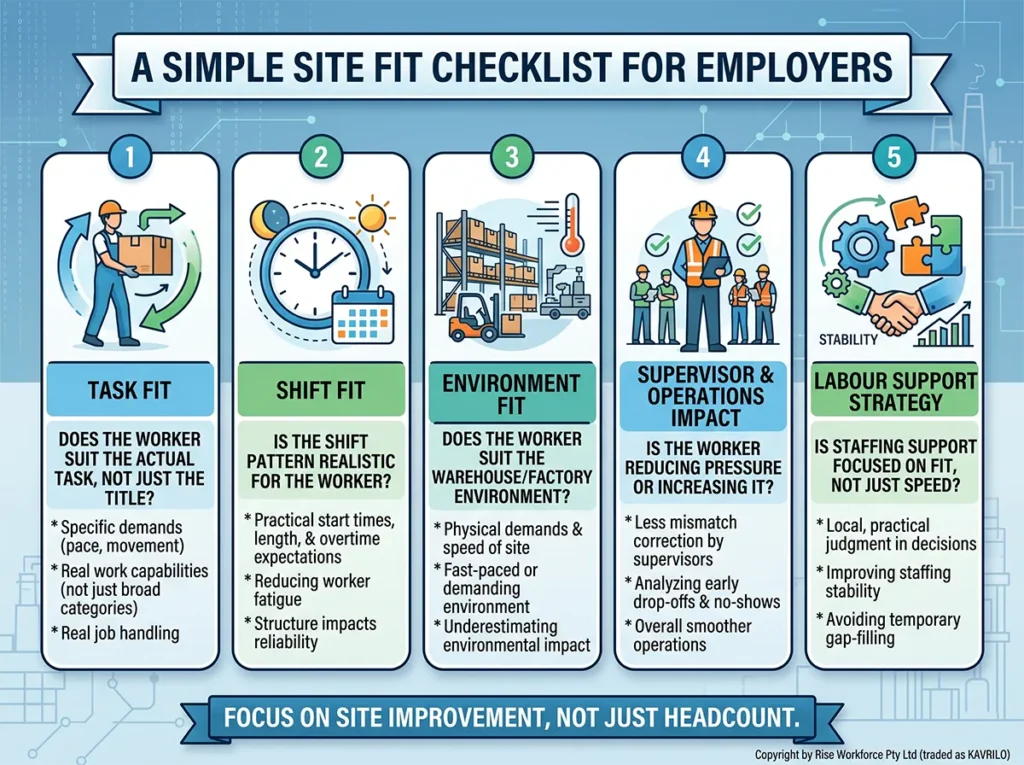
A Simple Site Fit Checklist for Employers
Here is a practical checklist employers can use when reviewing worker fit on site.
Task Fit
- Does the worker suit the actual task, not just the title?
- Have we explained the real pace, movement, and demands clearly enough?
- Is the worker likely to handle the real work, not just the broad category?
Shift Fit
- Is the shift pattern realistic for the worker?
- Are start times, length, and overtime expectations practical?
- Could shift structure be weakening reliability even if task fit looks okay?
Environment Fit
- Does the worker suit the warehouse or factory environment they are entering?
- Is the site more controlled, faster, or more physically demanding than first described?
- Are we underestimating how much the environment shapes success?
Supervisor and Operations Impact
- Is the worker reducing pressure on the floor, or increasing it?
- Are supervisors spending too much time correcting mismatch?
- Are early drop-offs or repeated no-shows pointing to a fit problem underneath?
Labour Support Strategy
- Is our staffing support focused on fit, not just speed?
- Are we using local, practical judgement in our matching decisions?
- Are we improving staffing stability or just filling gaps temporarily?
This kind of checklist helps employers move beyond headcount and focus on whether labour support is actually improving the site.
Final Word
Site fit matters more than headcount because a filled role is only useful if the worker actually suits the real conditions of the site.
For warehouse and factory employers across Dandenong and South-East Melbourne, better staffing outcomes usually come from:
- stronger role realism
- better task and shift matching
- more honest review of the environment
- and labour support that takes worker suitability seriously from the beginning
That is what helps reduce:
- weak placements
- repeated correction
- early dropout
- attendance instability
- and the false confidence that comes from seeing numbers on a roster that are not truly supporting the floor
Because in industrial staffing, the wrong worker can still count as headcount.
But the right worker is what actually helps the operation run better.
That is not just better hiring.
It is better operational control.
Need Practical Labour Hire Support for Warehousing and Manufacturing in Melbourne’s South-East?
KAVRILO is building its approach around safety-aware workforce support, stronger local responsiveness, and clearer operational discipline for warehouse and industrial environments.
Whether your site needs support during busy periods, stronger shift reliability, or more dependable labour coordination across the South-East, KAVRILO is focused on practical workforce support that fits controlled warehouse and factory environments.
Need warehouse and factory labour hire support with stronger local responsiveness and more dependable shift coverage? Talk to KAVRILO about workforce support across Melbourne’s South-East.
Article Disclaimer
This article is provided for general information only and does not constitute legal, workplace relations, safety, taxation, payroll or other professional advice. Please seek advice specific to your circumstances before acting on this information.
Please read our Website Disclaimer for more information.