
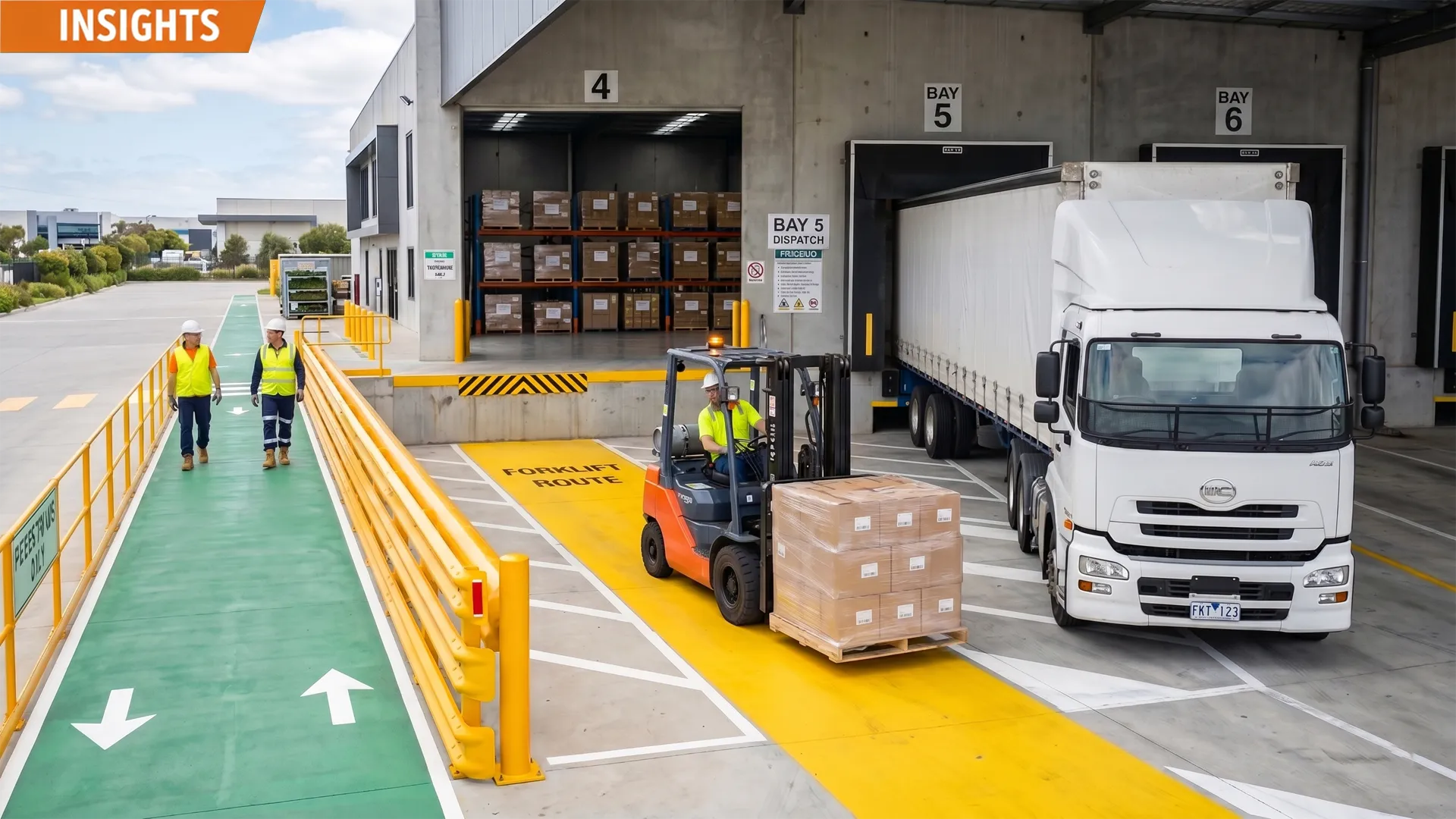
On many warehouse sites, the loading dock is where forklift risk becomes most concentrated.
It is one of the few areas where multiple kinds of movement often overlap at once:
- forklifts
- trucks or trailers
- dispatch staff
- pedestrians
- paperwork activity
- staging pressure
- and time-sensitive loading or unloading work
That combination matters.
Across Melbourne’s South-East, many warehouse and logistics sites rely on loading docks to keep stock moving through busy receiving and dispatch schedules. But because dock operations are so familiar, there is always a risk that the area becomes normalised even when the actual exposure remains high.
That is why loading dock forklift safety needs more attention than many businesses give it.
A site can have:
- licensed operators
- marked areas
- experienced supervisors
- and a functioning dispatch process
and still carry unnecessary risk if the dock area is weak in:
- visibility
- traffic separation
- pedestrian control
- turning space
- trailer interaction
- or first-shift supervision for newer operators
Good employers understand that loading dock risk is rarely just about the forklift itself.
It is also about:
- the space
- the traffic pattern
- the speed of decisions
- the pressure of the task
- and how clearly the area is being controlled in real operating conditions
That is why the loading dock deserves its own practical review.
For the broader employer overview, see our forklift safety and licence checks in Victoria pillar guide on operator fit, site induction, traffic control, and warehouse forklift risk.
Why Loading Docks Need Stronger Forklift Control
A loading dock is not just another forklift area.
It often combines:
- tighter visibility
- more directional change
- active vehicle presence
- waiting staff
- driver interaction
- staged goods
- and operational urgency
That means even a capable forklift operator can become more exposed if the dock setup is weak.
A strong dock control system should help reduce:
- awkward turns
- poor line of sight
- confusion about who can enter the area
- unpredictable pedestrian movement
- and rushed forklift behaviour during loading or unloading pressure
Good employers understand that loading dock risk rises quickly when:
- the area becomes congested
- the traffic rules become informal
- pedestrians drift too close
- or visibility is reduced by trailers, stock, or poor staging
That is why loading dock safety needs practical control, not just general warehouse awareness.
Where Loading Dock Forklift Risk Usually Builds
Dock-related forklift risk often builds in familiar ways:
- forklifts approaching trailers too quickly
- limited line of sight near dock entries
- people standing in the wrong waiting area
- staged stock narrowing the movement path
- multiple forklifts working in close sequence
- pedestrians cutting through for convenience
- operators reversing under pressure
- and dispatch urgency encouraging shorter or riskier movement decisions
Risk also tends to increase during:
- peak dispatch windows
- high-volume receiving periods
- shift changeovers
- temporary overflow staging
- first shifts for new or temporary operators
- and busy periods where the site starts relying too much on habit
That is why good employers review not just the forklift behaviour, but the whole dock system around it.
10 Practical Things Good Employers Review Early
1. Whether the Dock Approach Space Is Actually Safe Enough
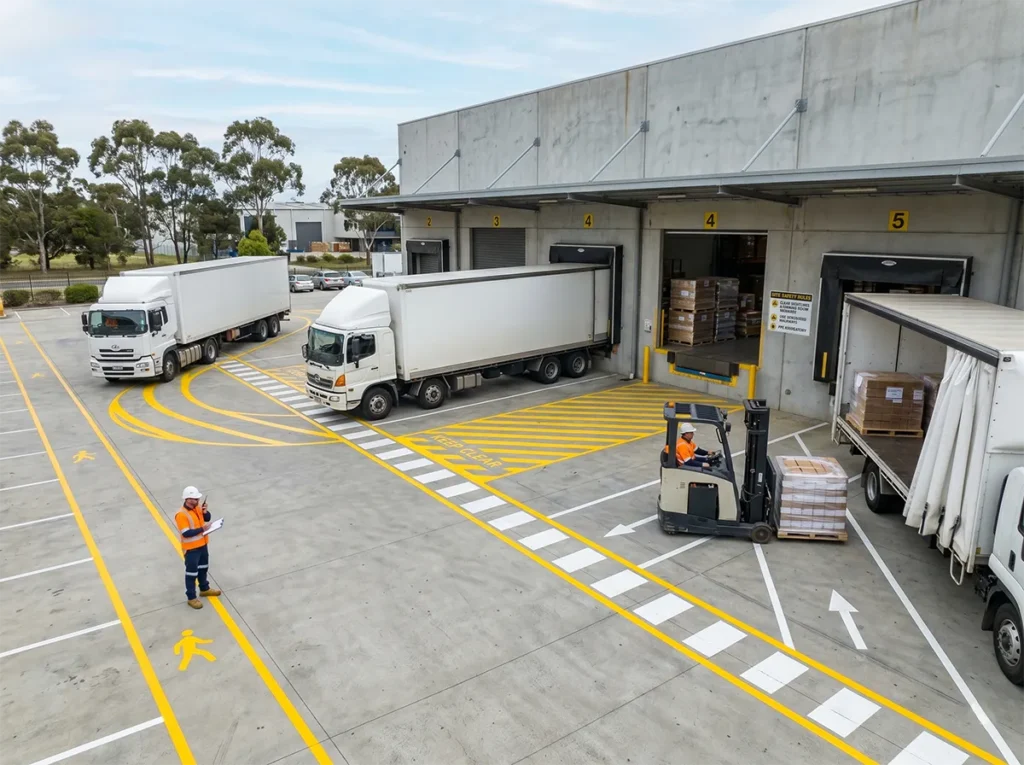
Forklift movement into and out of dock areas depends heavily on approach space.
Good employers review:
- whether the entry path is clear
- whether the forklift has enough room to line up safely
- whether turns are becoming tighter than intended
- and whether trailers, staging, or stock placement are making the approach more awkward than it should be
A route that is technically usable may still be too tight under real conditions.
That matters because tighter approach space can quickly increase:
- poor turning behaviour
- weaker visibility
- rushed correction
- and more pressure on operators when the dock is busy
2. Whether Visibility Around the Dock Is Being Reduced
Dock areas often carry visibility problems because of:
- trailer sides
- staged pallets
- dock structures
- parked vehicles
- waiting staff
- and movement happening at multiple angles
Good employers review:
- what the operator can realistically see
- where line of sight drops
- whether mirrors or other layout supports are helping
- and whether the site has simply become used to poor visibility in places that deserve stronger control
If the operator cannot read the space clearly, then safe dock movement becomes much harder to maintain under pressure.
3. Whether Pedestrian Presence Is Controlled Properly
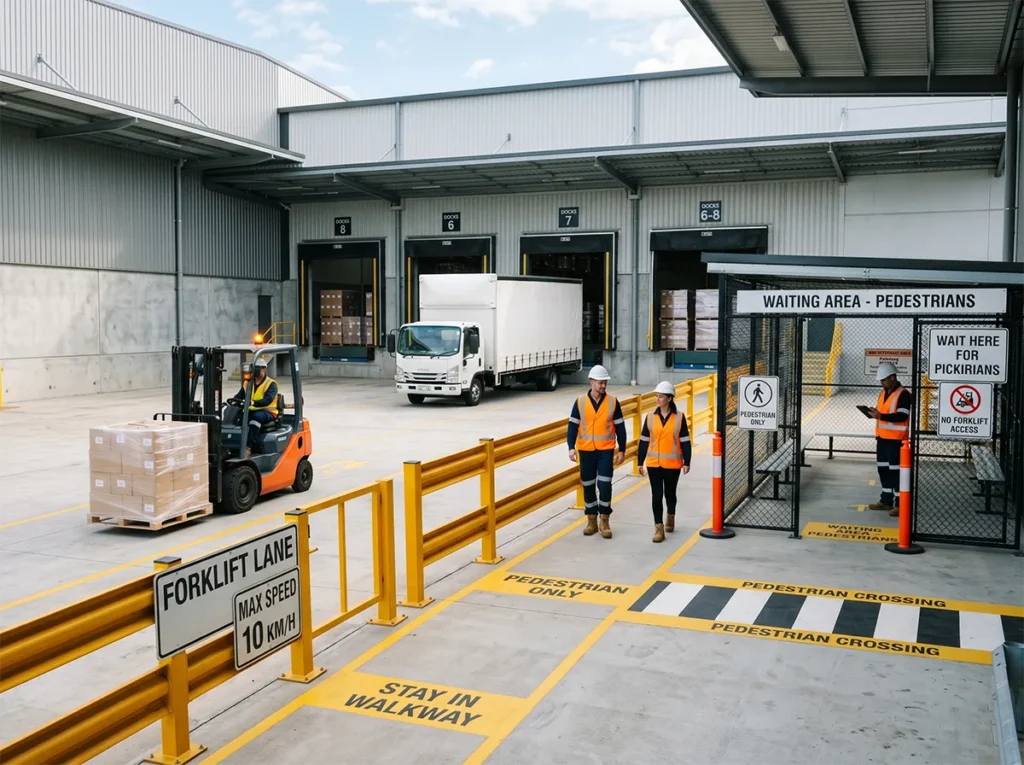
Pedestrians in dock areas create risk very quickly.
That includes:
- warehouse staff
- transport staff
- drivers
- office or dispatch staff
- and sometimes contractors or visitors moving through the wrong area
Good employers review:
- where people are expected to stand
- whether there is a clear waiting area
- whether routes are obvious
- and whether the dock zone is treated like an active forklift area, not casual shared space
A loading dock becomes much weaker when people can drift into it without clear control.
Our guide to warehouse traffic management shows how stronger pedestrian control, clearer crossings, and better movement rules help reduce forklift and people-risk in active warehouse areas.
4. Whether Forklift and Truck Movement Are Being Coordinated Clearly
A loading dock often combines forklift movement with truck or trailer presence.
That means employers need to review:
- how forklifts approach loaded or unloaded trailers
- whether truck-related movement affects visibility
- whether vehicle presence is creating pressure on turning space
- and whether the sequence of movement is clear enough for the operator
Good dock control depends on making sure the forklift is not being asked to operate around:
- unclear vehicle positioning
- awkward trailer alignment
- or changing space conditions that no one has reviewed properly
A dock may look routine, but if movement coordination is unclear, the area becomes much less predictable.
5. Whether Staging Is Quietly Increasing Dock Pressure
Dock staging often starts as a flow-control tool.
But when staging grows beyond its intended zone, it can reduce:
- turning room
- sightlines
- waiting space
- and the operator’s ability to move cleanly in or out of the dock
Good employers review whether:
- dispatch pallets are sitting too close to active movement
- overflow stock is narrowing the approach path
- staging is changing the way forklifts enter or exit the dock
- and what looked temporary has quietly become the normal condition
This matters because small staging drift can quickly become major dock risk.
6. Whether New and Temporary Operators Are Briefed Properly on Dock Rules
A forklift operator may have good general experience and still be unfamiliar with your dock conditions.
That is especially relevant for:
- temporary forklift operators
- labour hire drivers
- operators moving between sites
- and workers returning to the dock after time away from the area
Good employers make sure these operators understand:
- the dock approach
- where pedestrians may appear
- which waiting areas apply
- where visibility is poor
- and what pace or caution is expected on that site
A dock zone is not an area where operators should be left to work it out as they go.
Our article on forklift inductions for new and temporary operators explains what employers should cover on day one before a forklift operator enters high-pressure movement zones such as active loading docks.
7. Whether Operators Are Letting Pressure Change Behaviour
Loading docks are one of the first places where urgency can change forklift behaviour.
That may look like:
- tighter turns
- reduced caution near pedestrians
- inconsistent warning use
- faster approach into busy space
- or cutting corners because dispatch feels behind
Good employers review whether the operator’s standards stay controlled when the dock becomes busy.
A site’s real dock culture is rarely shown when everything is calm.
It is shown when the pressure rises and the movement still stays disciplined.
8. Whether Supervisors Are Watching the Right Things

Supervisors play a major role in dock safety.
Good employers review whether supervisors are watching:
- dock entry and exit movement
- pedestrian behaviour
- staging pressure
- trailer-related visibility
- turning space
- and whether operators are staying within the site’s actual dock rules
A supervisor who is present but focused elsewhere may still miss the pressure points where dock risk is forming.
That is why loading docks often need more deliberate supervision than general floor areas.
9. Whether Near Misses Around the Dock Are Being Taken Seriously
A near miss in a dock zone matters because the conditions are often already tight.
That might include:
- a pedestrian stepping back at the last moment
- a forklift turning more tightly than intended
- stock clipping a poor staging point
- a visibility issue around the trailer edge
- or repeated awkward movement that no one has formally reviewed
Good employers treat these events as warnings.
They ask:
- what the area is telling us
- what pattern is developing
- and what control needs to change before a more serious event occurs
Our article on forklift near misses in warehouses explains why small close calls often reveal bigger layout, supervision, and traffic-control problems before a serious incident occurs.
10. Whether Dock Conditions Are Reviewed After Change
Loading dock risk should be reviewed whenever the conditions change.
That includes:
- higher dispatch volume
- a different staging setup
- trailer flow changes
- increased forklift activity
- changed waiting areas
- new operators
- temporary labour increases
- or revised layout around the dock approach
Even small changes can reduce:
- visibility
- turning space
- route clarity
- and separation between movement types
A dock that worked safely before may become weaker very quickly when the operating conditions shift.
That is why review after change matters so much.
What Good Loading Dock Forklift Safety Usually Looks Like in Practice
A stronger dock area usually feels:
- controlled
- readable
- well separated
- and harder to misunderstand under pressure
In practice, that often means:
- forklift approach space is clear
- pedestrians know where not to stand
- waiting areas are obvious
- staging stays inside controlled zones
- operators slow properly where visibility is weaker
- and supervisors are actively watching the areas where the pressure builds fastest
It should not feel like:
- people are improvising their movement
- the dock route changes every busy day
- staging is slowly taking over the approach path
- or forklift operators are relying too heavily on habit in a space where the margin for error is already reduced
Good dock safety is visible in how calm the area stays when the work is moving quickly.
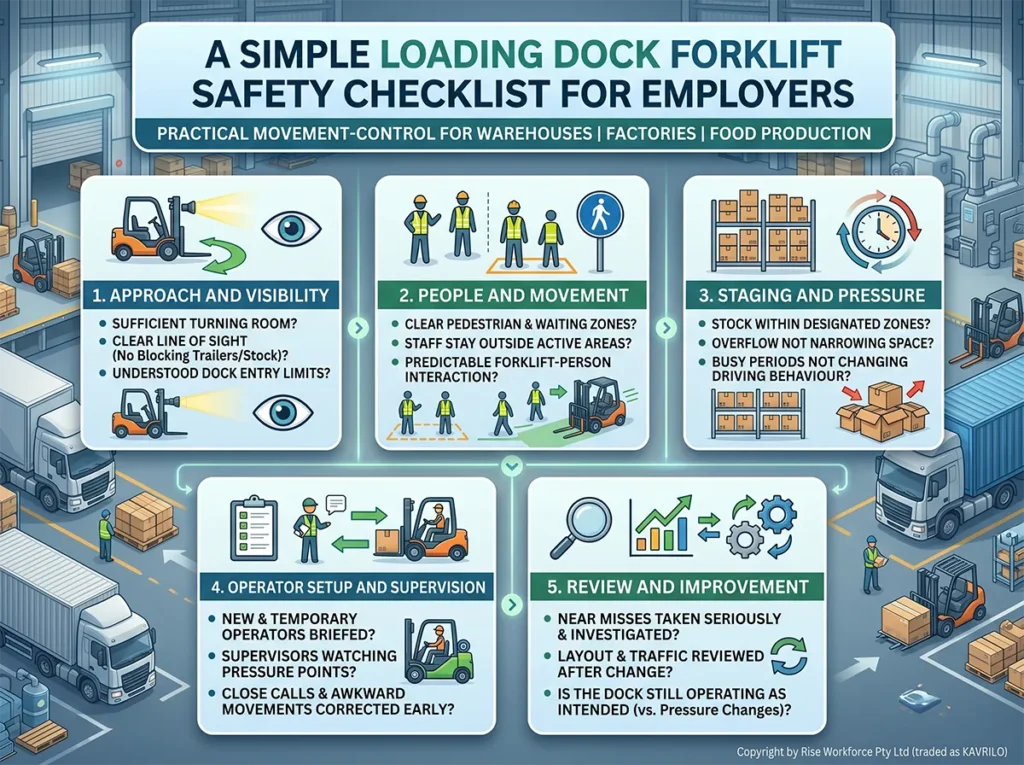
A Simple Loading Dock Forklift Safety Checklist for Employers
Here is a practical checklist employers can use when reviewing forklift safety around loading docks.
Approach and Visibility
- Does the forklift have enough room to approach and turn safely?
- Are trailers, stock, or staging reducing line of sight?
- Are the visibility limits around dock entry understood and controlled?
People and Movement
- Are pedestrian areas and waiting zones clearly controlled?
- Are transport or dispatch staff staying outside active movement space?
- Is the interaction between forklifts and people predictable enough?
Staging and Pressure
- Is dock staging still within its intended zone?
- Is overflow stock narrowing approach space or weakening visibility?
- Are busy dispatch periods changing driving behaviour or route logic?
Operator Setup and Supervision
- Are new or temporary operators briefed properly on dock rules?
- Are supervisors actively watching the pressure points?
- Are repeated close calls or awkward movement patterns being corrected early?
Review and Improvement
- Are dock near misses being taken seriously?
- Are layout and traffic conditions reviewed after change?
- Is the dock still operating the way the site intended, or has pressure quietly changed the real setup?
This kind of checklist helps employers review dock safety as a practical movement-control issue, not just a forklift issue.
Final Word
Loading dock forklift safety matters because dock zones combine movement pressure, visibility limits, people, vehicles, and staging in one concentrated space.
For warehouse employers across Melbourne’s South-East, stronger control usually comes from:
- reviewing dock approach space
- protecting visibility
- controlling pedestrian presence
- keeping staging under discipline
- supervising higher-pressure movement properly
- and treating near misses as useful warnings instead of background noise
That is what helps reduce:
- awkward turns
- dock congestion
- weak separation
- repeat close calls
- and preventable forklift exposure in one of the highest-risk parts of the warehouse
Because good dock safety is not just about whether forklifts are present.
It is about whether the dock area around them is being controlled well enough for the work actually happening there.
That is not just better dock management.
It is better warehouse control.
Need Practical Labour Hire Support for Warehousing and Manufacturing in Melbourne’s South-East?
KAVRILO is building its approach around safety-aware workforce support, clearer communication, and stronger operational discipline for warehouse and industrial environments.
Whether your site needs better shift coverage, stronger day-one worker readiness, or more dependable labour coordination for forklift-related work, KAVRILO is focused on practical workforce support that fits controlled warehouse and factory environments.
Need warehouse and factory labour hire support with stronger day-one readiness and a practical safety-aware approach? Talk to KAVRILO about workforce support across Melbourne’s South-East.
Article Disclaimer
This article is provided for general information only and does not constitute legal, workplace relations, safety, taxation, payroll or other professional advice. Please seek advice specific to your circumstances before acting on this information.
Please read our Website Disclaimer for more information.