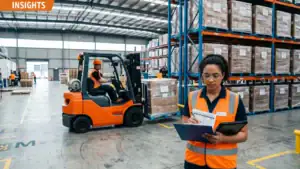

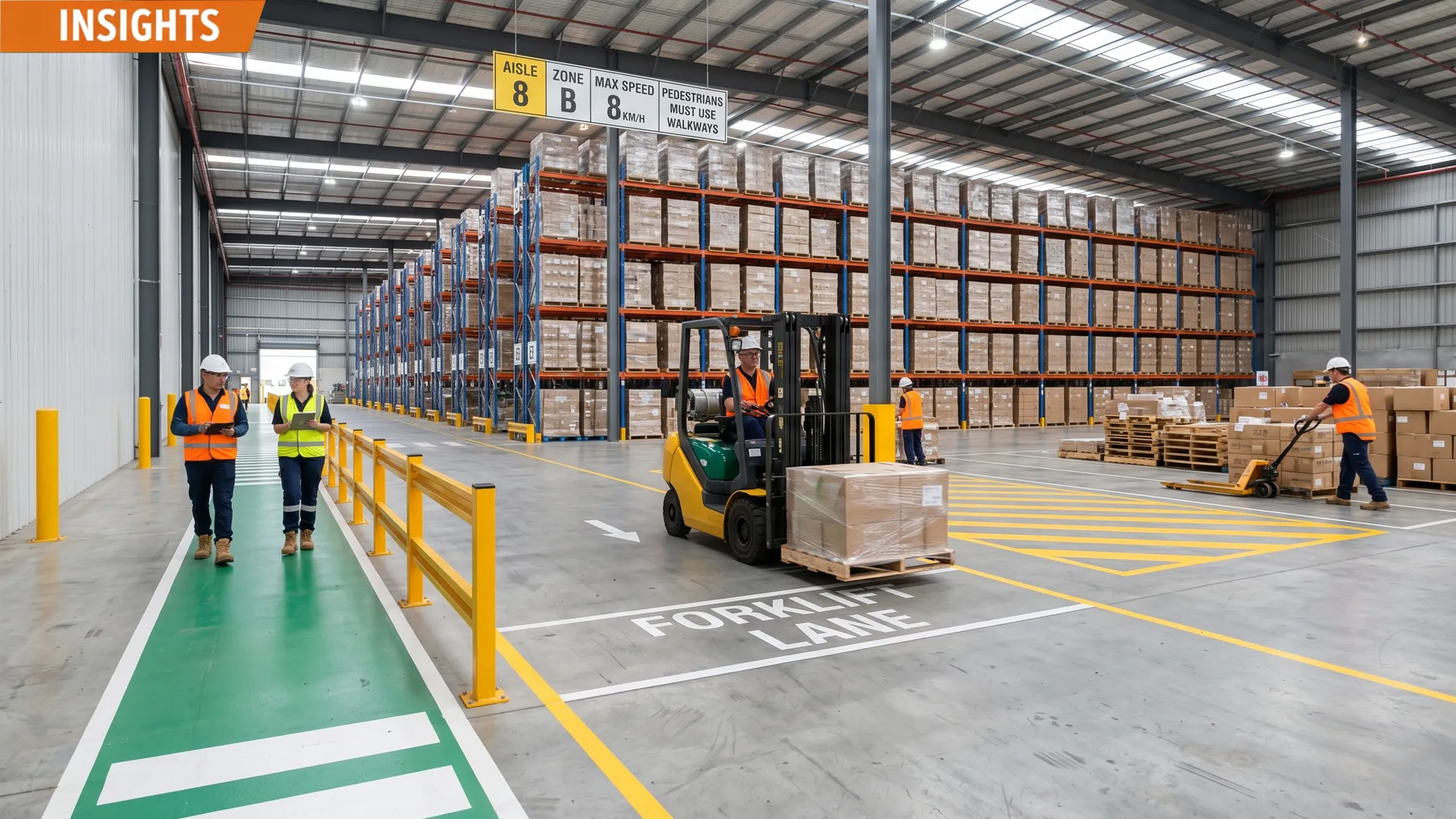
Forklift safety is often discussed as though it sits mainly with the operator.
Operator behaviour matters.
Licence checks matter.
Induction matters.
But on a live warehouse floor, layout matters just as much.
Across Melbourne’s South-East, warehouses and logistics sites rely on forklifts to support:
- replenishment
- dispatch
- receiving
- stock transfer
- dock movement
- pallet staging
- and high-volume daily traffic
In those environments, forklift risk is shaped heavily by:
- aisle width
- turning space
- crossings
- blind spots
- pedestrian routes
- dock approaches
- overflow staging
- and how clearly movement is controlled across the floor
That means a safe operator on a weak layout can still be exposed.
A forklift route that looks acceptable on paper may still become risky in practice if:
- stock reduces visibility
- walkways are squeezed
- overflow staging narrows a turn
- blind corners are poorly managed
- or pedestrians and forklifts are being pushed too close together
That is why good employers review not just who is driving the forklift, but also what kind of floor they are asking the operator to move through.
Because layout can either support safer forklift control — or quietly work against it.
For the broader employer overview, see our forklift safety and licence checks in Victoria pillar guide on licence fit, induction, supervision, and traffic control.
Why Layout Is a Forklift Safety Control
A forklift operator reacts to the environment the site creates.
If the warehouse layout is clear, visible, and well controlled, then safer movement becomes easier to maintain.
If the layout is cluttered, narrow, inconsistent, or hard to read, then the operator has less margin for error.
That is why layout should be treated as a real control measure, not just a background feature of the warehouse.
Good employers review layout because it influences:
- visibility
- stopping margin
- turning behaviour
- pedestrian interaction
- traffic predictability
- and whether normal movement stays calm or becomes pressured
A site does not need to look disorganised to be layout-weak.
Sometimes the problem is more subtle:
- crossings are technically present but poorly positioned
- aisles are just tight enough to create awkward turns
- staging areas have grown into traffic space
- or pedestrian routes work in theory but not under real shift pressure
That is why layout review matters early.
Where Layout Usually Starts Increasing Forklift Risk
Warehouse layout tends to increase forklift risk in familiar places such as:
- aisle intersections
- blind corners
- dock approaches
- dispatch staging areas
- replenishment lanes
- roller door entries
- narrow turn points
- battery charging access
- mixed pedestrian zones
- and any space where overflow stock has altered the intended route
Risk also grows when:
- traffic volume increases
- stock staging changes daily
- a temporary area becomes permanent
- new racking reduces visibility
- or the site keeps operating as though the original layout still exists even though the floor now behaves differently
That is why layout risk should always be reviewed in real operating conditions, not only against an old floor plan.
10 Practical Layout Issues Good Employers Review Early
1. Aisle Width and Turning Space
Aisles do not need to look extremely narrow to create forklift pressure.
Sometimes the problem is that the aisle gives the operator just enough room to function, but not enough room to move comfortably under real conditions.
Good employers review:
- whether turning space is genuinely adequate
- whether pallets or stock edges tighten the route
- whether replenishment activity reduces usable width
- and whether the forklift is being asked to operate in space that leaves too little margin for correction
This matters because tighter turning space can increase:
- awkward steering
- clipped corners
- reduced visibility
- and more pressure when other movement is happening nearby
A layout should support controlled movement, not just technically possible movement.
2. Blind Spots and Restricted Sightlines
Blind spots are one of the clearest layout-related forklift risks.
They often appear around:
- aisle ends
- high stock stacks
- racking corners
- roller doors
- crossing points
- and dock-adjacent turns
Good employers review:
- what the operator can realistically see
- what pedestrians can realistically see
- whether staging has reduced visibility
- and whether the blind spot is made worse during busier periods
If a forklift and a pedestrian are both entering space they cannot read properly, the layout is already increasing risk.
3. Crossing Point Design
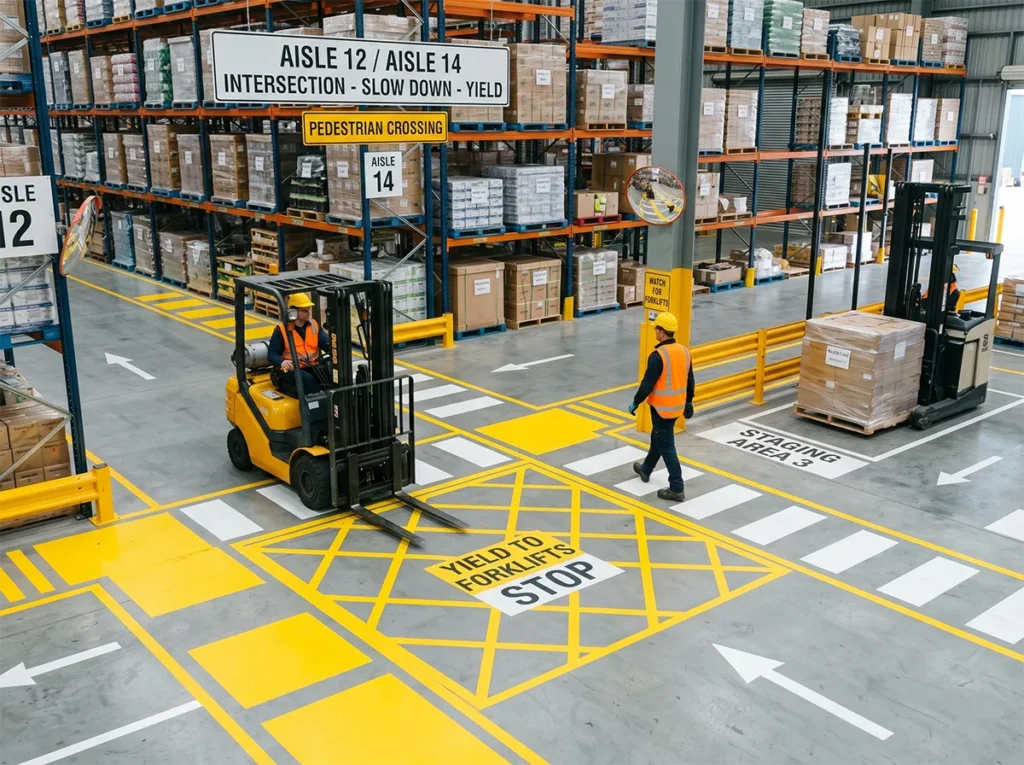
A crossing can exist and still be weak.
Good employers review whether crossings are:
- clearly visible
- positioned in the right place
- easy for pedestrians to use naturally
- and supported by the surrounding layout
Problems start when:
- pedestrians have to take awkward routes to reach the crossing
- forklift traffic approaches too fast for the visibility available
- stock staging interrupts the line of sight
- or the crossing sits too close to a turn, dock edge, or busy dispatch point
A crossing should reduce uncertainty.
If it creates more of it, the design needs review.
Our guide to warehouse traffic management shows how stronger crossings, clearer movement rules, and better separation help reduce forklift and pedestrian risk.
4. Pedestrian Route Placement
Pedestrian routes need to work in practice, not just on the painted floor plan.
Good employers review:
- whether pedestrian walkways are actually usable
- whether people are being forced into forklift space by layout pressure
- whether routes are too narrow
- whether staging or waste reduces the available path
- and whether the route still makes sense under live warehouse conditions
This matters because pedestrian behaviour often follows the path of least resistance.
If the safest path feels awkward and the easier path cuts closer to plant, layout is already encouraging the wrong behaviour.
5. Staging Areas That Spill into Traffic Space

Staging pressure is one of the most common ways a forklift layout weakens over time.
A well-planned route can become riskier when:
- pallets sit too close to a turn
- temporary staging narrows an aisle
- dispatch overflow affects a crossing
- or replenishment stock changes how a forklift enters a lane
Good employers review whether staging is:
- staying within its intended zone
- reducing sightlines
- narrowing preferred travel routes
- or increasing pressure at corners and intersections
A staging area should support flow, not compromise it.
6. Dock Layout and Approach Space
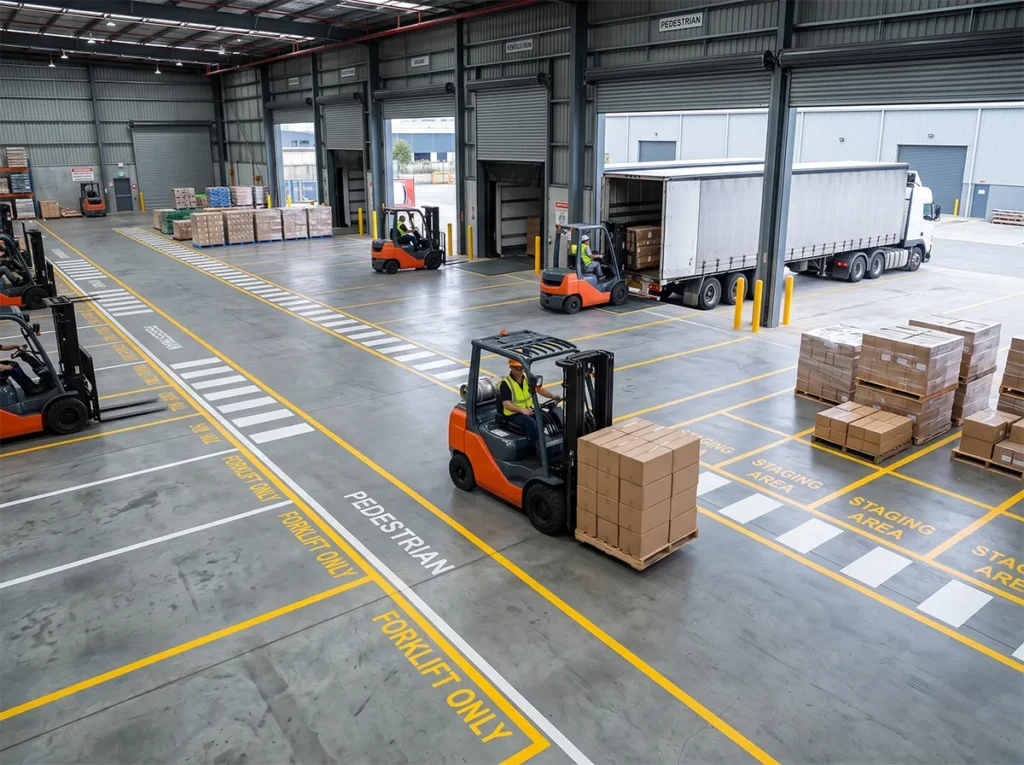
Loading docks often combine:
- forklift movement
- truck or trailer presence
- pedestrian activity
- paperwork interaction
- waiting zones
- and visibility restrictions
That makes dock layout especially important.
Good employers review:
- approach space
- turning room
- sightlines near dock entry
- where pedestrians stand
- and whether vehicles or trailers are changing how safely forklifts can move in and out
Dock areas often become high-risk not because of one dramatic issue, but because the layout allows too many movement types to compete in the same space.
Our article on forklift near misses in warehouses explains why close calls around docks, crossings, and blind movement points often reveal bigger layout and control problems underneath.
7. Overflow Stock and Temporary Layout Drift
One of the biggest layout problems is that the site no longer operates the way it was originally designed.
That often happens through:
- temporary overflow stock
- seasonal volume increases
- pallets parked “just for now”
- extra dispatch pressure
- or ad hoc use of spaces that were not meant to hold active product
This creates layout drift.
Good employers review whether the real floor is still matching the intended layout or whether temporary pressures have quietly created:
- new blind spots
- tighter turns
- altered crossings
- and more overlap between pedestrians and plant
A site can still look functional while becoming steadily less safe.
8. Clutter and Housekeeping Around Active Routes
Layout is not only about fixed design.
It is also about what sits on top of it every day.
Loose wrapping, damaged pallets, waste bins, returns, and misplaced stock can all reduce how safely a forklift route performs.
Good employers review:
- whether walkways are being squeezed
- whether startup areas are clear
- whether clutter affects sightlines
- and whether general housekeeping is changing the behaviour of both operators and pedestrians
If the layout works only when the floor is perfectly clean, but the site usually operates with clutter pressure, then the layout needs a more realistic review.
Our guide to warehouse housekeeping standards explains how clutter, blocked access, and weak floor discipline can quickly increase forklift risk even when the layout itself looks acceptable on paper.
9. Whether the Layout Supports New and Temporary Operators
A strong layout should be readable even for someone who is new to the site.
Good employers review:
- whether the routes are obvious
- whether crossings are easy to identify
- whether blind spots are managed visibly
- and whether a temporary operator can understand the traffic logic without too much guesswork
This matters because a layout that works only for people who already know it well is weaker than it should be.
A safer layout reduces reliance on memory and familiarity.
10. Whether the Site Reviews Layout After Change
Warehouse layout should not be treated as fixed forever.
Good employers review it whenever:
- racking changes
- product flow changes
- dispatch volume rises
- temporary labour increases
- staging areas shift
- pedestrian routes are altered
- or new equipment changes the way space is used
Even small changes can create:
- tighter turns
- weaker visibility
- more crossing pressure
- and reduced separation between plant and people
That is why layout review should happen after change, not only after an incident.
What Good Forklift Layout Usually Looks Like in Practice
A stronger layout usually feels:
- readable
- spacious enough for the task
- visually clear
- and harder to misunderstand under pressure
In practice, that often means:
- forklift routes make sense
- crossings are visible and usable
- pedestrians are not being squeezed into awkward paths
- staging stays inside controlled zones
- blind spots are managed visibly
- and operators are not constantly improvising movement around clutter or overflow stock
It should not feel like:
- every busy shift changes the route logic
- corners are tighter than they need to be
- crossings are hard to trust
- or operators and pedestrians are working around a layout that is no longer holding up in real conditions
Good layout reduces guesswork.
That is one of the strongest forklift controls a warehouse can have.
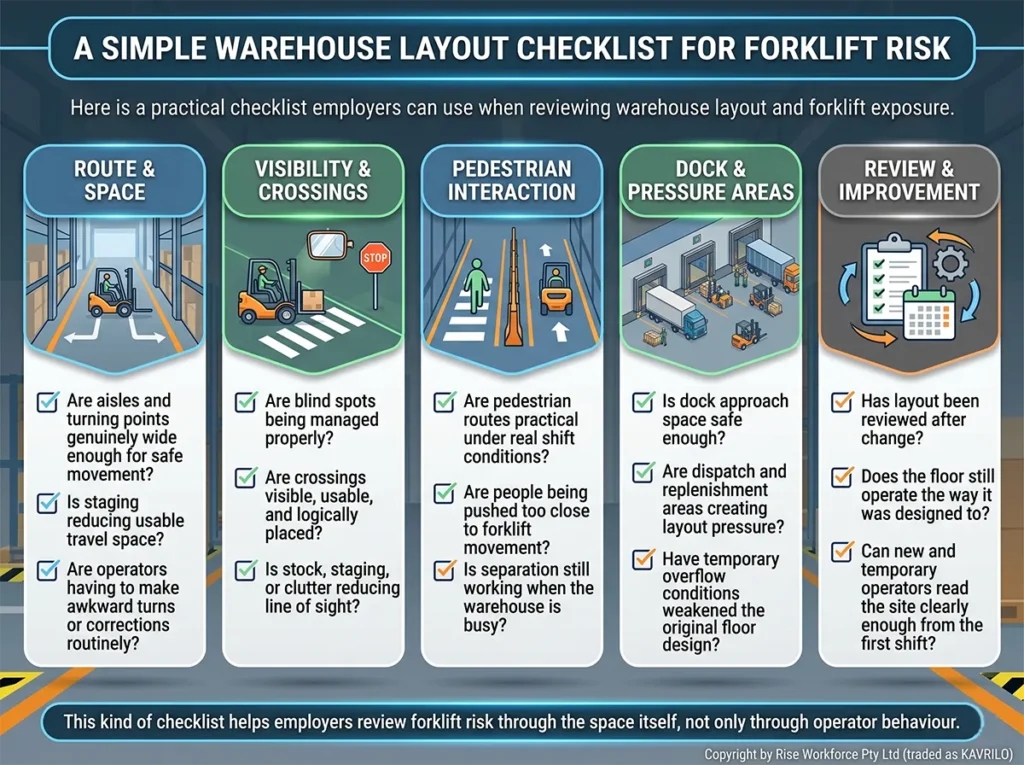
A Simple Warehouse Layout Checklist for Forklift Risk
Here is a practical checklist employers can use when reviewing warehouse layout and forklift exposure.
Route and Space
- Are aisles and turning points genuinely wide enough for safe movement?
- Is staging reducing usable travel space?
- Are operators having to make awkward turns or corrections routinely?
Visibility and Crossings
- Are blind spots being managed properly?
- Are crossings visible, usable, and logically placed?
- Is stock, staging, or clutter reducing line of sight?
Pedestrian Interaction
- Are pedestrian routes practical under real shift conditions?
- Are people being pushed too close to forklift movement?
- Is separation still working when the warehouse is busy?
Dock and Pressure Areas
- Is dock approach space safe enough?
- Are dispatch and replenishment areas creating layout pressure?
- Have temporary overflow conditions weakened the original floor design?
Review and Improvement
- Has layout been reviewed after change?
- Does the floor still operate the way it was designed to?
- Can new and temporary operators read the site clearly enough from the first shift?
This kind of checklist helps employers review forklift risk through the space itself, not only through operator behaviour.
Final Word
Warehouse layout increases or reduces forklift risk because the floor shapes how safely operators and pedestrians can move together.
For employers across Melbourne’s South-East, stronger layout control usually comes from:
- reviewing aisle width and turning space
- protecting visibility
- designing stronger crossings
- keeping staging under control
- maintaining clearer pedestrian routes
- and reviewing the floor honestly whenever conditions change
That is what helps reduce:
- awkward movement
- blind corner pressure
- weak separation
- repeat near misses
- and preventable forklift exposure in active warehouse environments
Because good forklift safety depends not just on who is driving.
It also depends on what kind of floor the site is asking them to drive through.
That is not just better layout.
It is better warehouse control.
Need Practical Labour Hire Support for Warehousing and Manufacturing in Melbourne’s South-East?
KAVRILO is building its approach around safety-aware workforce support, clearer communication, and stronger operational discipline for warehouse and industrial environments.
Whether your site needs better shift coverage, stronger day-one worker readiness, or more dependable labour coordination for forklift-related work, KAVRILO is focused on practical workforce support that fits controlled warehouse and factory environments.
Need warehouse and factory labour hire support with stronger day-one readiness and a practical safety-aware approach? Talk to KAVRILO about workforce support across Melbourne’s South-East.
Article Disclaimer
This article is provided for general information only and does not constitute legal, workplace relations, safety, taxation, payroll or other professional advice. Please seek advice specific to your circumstances before acting on this information.
Please read our Website Disclaimer for more information.