
In warehouses and factories, safety problems do not always begin with major hazards.
Sometimes they begin with things that look small:
- a pallet left in the wrong place
- wrapping on the floor
- bins narrowing a walkway
- damaged cartons sitting in an aisle
- overflow stock blocking visibility
- or a dispatch area slowly becoming harder to move through safely
That is why housekeeping matters more than many people realise.
Across Melbourne’s South-East, busy warehouse, logistics, food production, and manufacturing sites often run under pressure. Goods move constantly. Deadlines matter. Space gets tight. Temporary staging becomes semi-permanent. Small floor problems become normal. And once that happens, the site can begin carrying more risk than it appears to on paper.
Good housekeeping is not just about tidiness.
It supports:
- safer traffic flow
- clearer pedestrian access
- better manual handling
- cleaner sightlines
- easier supervision
- fewer trip hazards
- and stronger control over the way the floor actually operates
That is why good employers review housekeeping early.
Because what looks like a small floor issue can quickly become a bigger operational and safety problem if nobody addresses it.
For a broader employer overview, see our WorkSafe Victoria compliance in manufacturing and warehousing guide for practical hazard control, floor discipline, and stronger day-to-day site safety.
Why Housekeeping Is a Real Safety Control
Housekeeping is sometimes treated as secondary to “real” safety issues such as forklifts, machinery, manual handling, or plant hazards.
In practice, it connects to all of them.
Poor housekeeping can affect:
- whether pedestrians can move safely
- whether forklift routes remain clear
- whether manual handling becomes more awkward
- whether emergency access stays usable
- whether visibility is maintained
- and whether supervisors can see and control the floor properly
This is why housekeeping should not be reduced to a cleanliness issue.
It is a control issue.
When a site loses grip on housekeeping, it often also loses grip on:
- traffic discipline
- layout discipline
- staging discipline
- and the clear visual order that helps workers move safely
That is why strong sites do not just “clean up when things look bad”.
They build housekeeping into how the floor is managed every shift.
Where Housekeeping Problems Usually Start
On most warehouse and factory floors, housekeeping issues do not arrive all at once.
They usually build gradually through:
- overflow stock
- rushed dispatch
- temporary staging
- damaged pallets
- wrapping and strap waste
- poor waste removal timing
- awkward returns or rejects handling
- tools or equipment left in walkways
- and supervisors becoming used to conditions that are not actually well controlled
These issues often show up first in:
- dispatch zones
- aisle ends
- near packing stations
- pallet wrapping areas
- loading docks
- line-side storage points
- waste collection spots
- and shared access areas between warehouse and production
That is why good housekeeping review starts with asking:
Where is the floor starting to lose control?
Not:
Does the site look neat from the office?
10 Practical Things Good Employers Review Early
1. Whether Walkways Are Actually Kept Clear

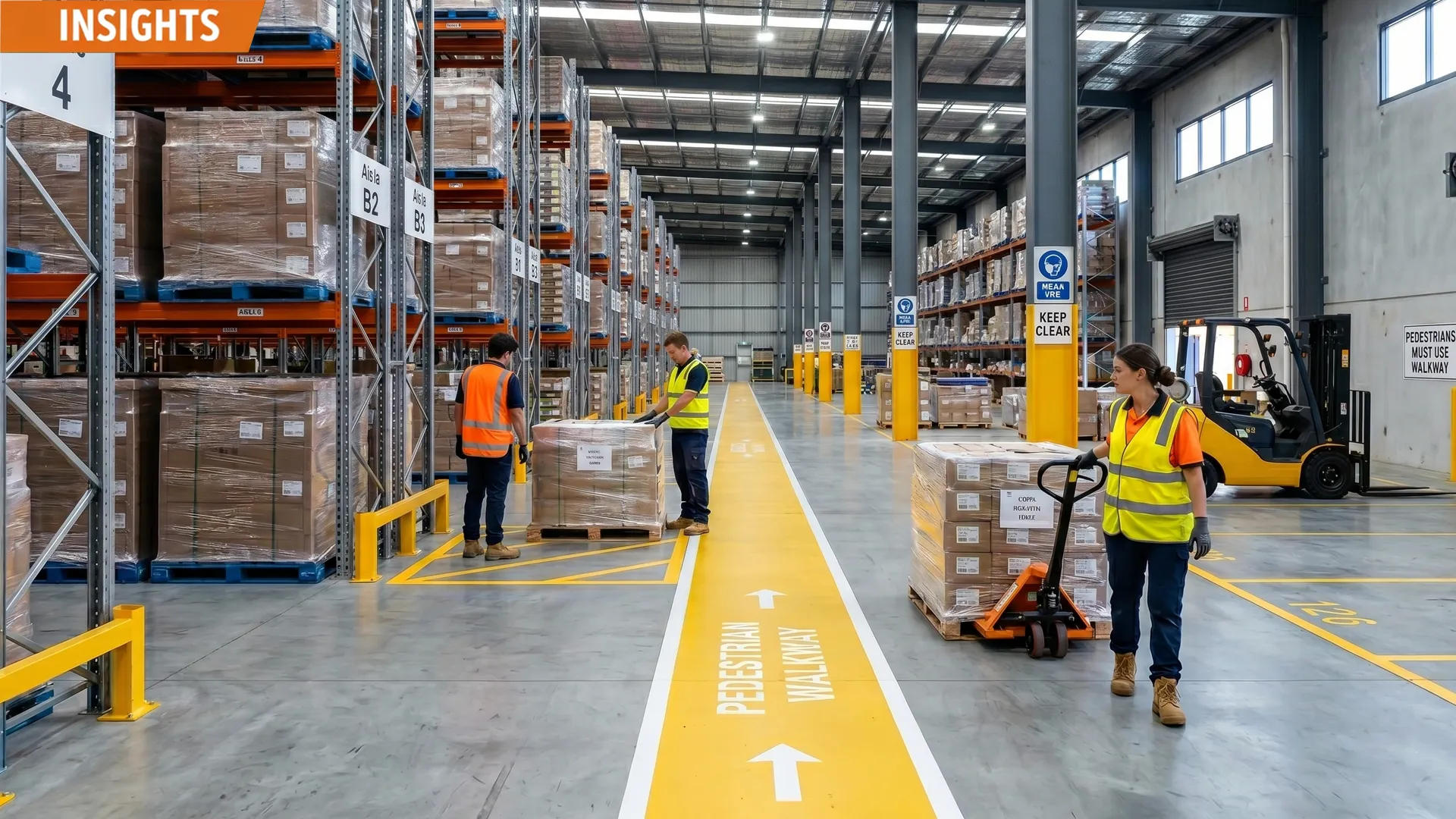
A marked walkway is only useful if people can still use it properly.
Good employers review:
- whether pallets are creeping into pedestrian routes
- whether wrapping, waste, cages, or bins are narrowing access
- whether temporary stock is blocking crossings
- and whether workers are being pushed into active traffic areas because the intended path is no longer practical
Walkways should be:
- visible
- clear
- usable
- and respected under real operating conditions
If a pedestrian route is technically marked but constantly obstructed, the site does not really have a safe walkway.
2. Whether Overflow Stock Is Quietly Creating Risk
Overflow stock is one of the most common ways floor control weakens.
It often starts with:
- a temporary pallet in a corner
- extra cartons near dispatch
- over-height stacking
- or returned goods placed where there was “just enough room for now”
Then that “temporary” condition becomes normal.
Good employers review whether overflow stock is:
- narrowing access
- blocking vision
- changing traffic flow
- creating awkward handling
- reducing turning space for plant
- or increasing instability risk
A site under pressure often treats overflow as a storage problem.
In practice, it is often a safety problem too.
3. Whether Waste and Packaging Material Are Being Removed Fast Enough
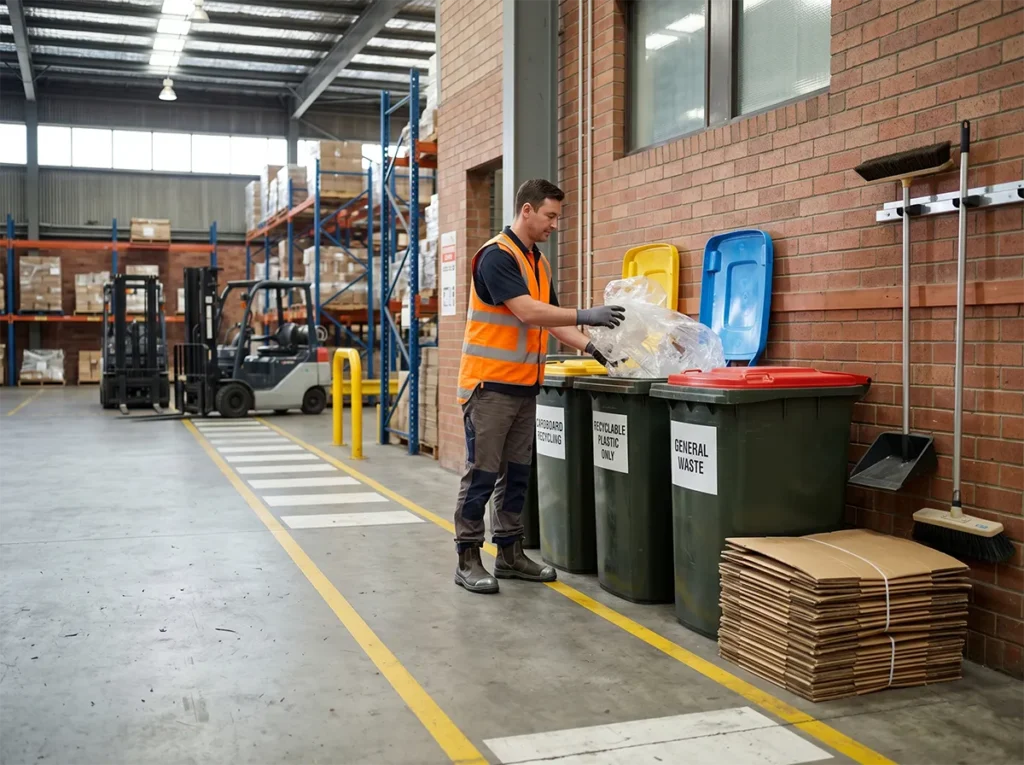
Loose wrapping, straps, cardboard, damaged cartons, plastic, and general packaging waste can quickly turn into:
- slip hazards
- trip hazards
- blocked movement
- visual clutter
- and reduced floor discipline
Good employers review:
- how often waste is cleared
- whether bins are located properly
- whether waste removal timing suits the pace of the operation
- and whether workers are leaving waste in place because it feels quicker in the moment
A floor does not need to be filthy to be unsafe.
Even small loose material in the wrong place can create unnecessary exposure.
4. Whether Housekeeping Is Affecting Traffic Management
Poor housekeeping often weakens traffic control before anyone formally notices.
For example:
- a pallet blocks part of a crossing
- staged stock reduces line of sight
- waste narrows a pedestrian path
- or bins change how forklifts turn into an aisle
That is why housekeeping should be reviewed alongside:
- forklift movement
- pedestrian flow
- blind spots
- and dispatch pressure
If the floor becomes cluttered, the traffic system is rarely as strong as it looks on paper.
Our article on warehouse traffic management shows how congestion, blocked access, and weak floor discipline can quickly increase forklift and pedestrian risk.
5. Whether Housekeeping Is Increasing Manual Handling Strain
A cluttered floor often forces workers into worse manual handling.
That can happen when:
- stock is staged awkwardly
- access to the load is reduced
- workers reach around obstacles
- pallets are placed too close together
- or the intended handling zone is partly blocked
Good employers review whether poor housekeeping is making tasks:
- more awkward
- more repetitive
- more rushed
- or harder to perform with stable posture and movement
This matters because a messy floor can quietly increase strain risk, even when the task itself has not changed.
Our guide to manual handling risks in warehouses and factories explains how layout, reach distance, and floor control often shape strain exposure more than many employers expect.
6. Whether Staging Zones Are Still Serving Their Purpose
Staging areas can help a site run smoothly — but only if they stay controlled.
Good employers review whether staging zones are:
- clearly defined
- used for the purpose intended
- not spilling into walkways
- not being used as overflow dumping areas
- and not creating confusion between active stock, rejected stock, waste, or dispatch-ready product
If staging zones become vague, the floor becomes harder to read and harder to move through safely.
That affects:
- workers
- supervisors
- forklift operators
- and visitors or temporary labour trying to understand the site quickly
7. Whether New and Temporary Workers Are Being Inducted Into Floor Standards Properly
Housekeeping standards should not be assumed.
A new or labour hire worker may not know:
- where waste goes
- where pallets can be left
- what areas must stay clear
- which staging zones are controlled
- and what “acceptable floor condition” looks like on that site
Good employers make this visible from day one.
That includes:
- showing where materials go
- explaining what must stay clear
- identifying zones that cannot be used for casual storage
- and correcting poor floor habits early
Without that clarity, a worker may create clutter simply because the site never explained the standard properly.
Our article on site safety inductions for labour hire workers explains what host employers should cover on day one so new workers understand movement, staging, reporting, and site discipline early.
8. Whether Supervisors Are Correcting Small Floor Problems Early
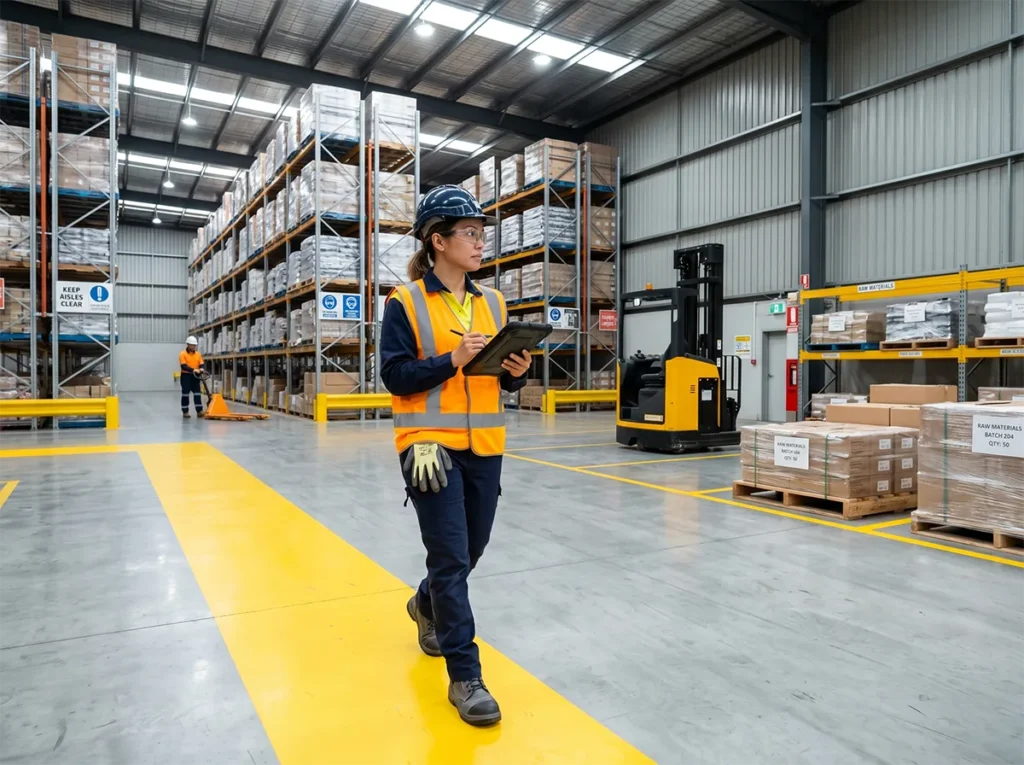
Housekeeping weakens quickly when:
- minor obstructions are ignored
- wrapping is left in place
- pallets sit where they should not
- bins drift into access zones
- and everyone assumes someone else will sort it later
Good employers review whether supervisors are:
- noticing early clutter build-up
- correcting it before it spreads
- reinforcing floor standards consistently
- and treating “small” access issues as real control problems, not background noise
The longer a floor issue is tolerated, the more normal it becomes.
That is usually when bigger risk begins.
9. Whether Housekeeping Is Affecting Emergency Access or Visibility
Some housekeeping problems matter even more because they affect:
- emergency exits
- fire equipment access
- first aid access
- machine e-stops
- plant approach zones
- or general visibility across the floor
Good employers review whether:
- exits are actually clear
- emergency access points stay unobstructed
- stacked goods are reducing sightlines
- and clutter is weakening the site’s ability to respond quickly if something goes wrong
This is one reason housekeeping should never be reviewed in isolation from the rest of site safety.
10. Whether the Site Reviews Housekeeping After Busy Periods or Layout Change
A site can feel under control one month and much weaker the next.
Review is especially important when:
- volume increases
- dispatch pressure spikes
- extra labour is brought in
- stock profiles change
- temporary staging is introduced
- layouts are shifted
- or seasonal storage pressure builds
Good employers review housekeeping standards after change, not just after an incident.
That is often when:
- clutter starts building
- overflow becomes normal
- and small access problems begin multiplying across the floor
What Poor Housekeeping Usually Looks Like Before a Bigger Problem Happens
Most sites get warning signs first.
Those signs may include:
- workers stepping around obstacles routinely
- wrapping building up near active areas
- pedestrians using odd routes because the correct one is blocked
- forklifts making awkward turns around staged goods
- stock left in “temporary” locations every day
- reduced visibility at crossings
- damaged pallets sitting in aisles
- or supervisors saying “we’ll sort that later” too often
These signs matter.
Because poor housekeeping rarely stays isolated.
It usually feeds into:
- traffic risk
- manual handling strain
- trip hazards
- slower supervision
- and weaker control over how the floor is actually functioning
Good employers notice that before a larger incident forces attention back onto it.
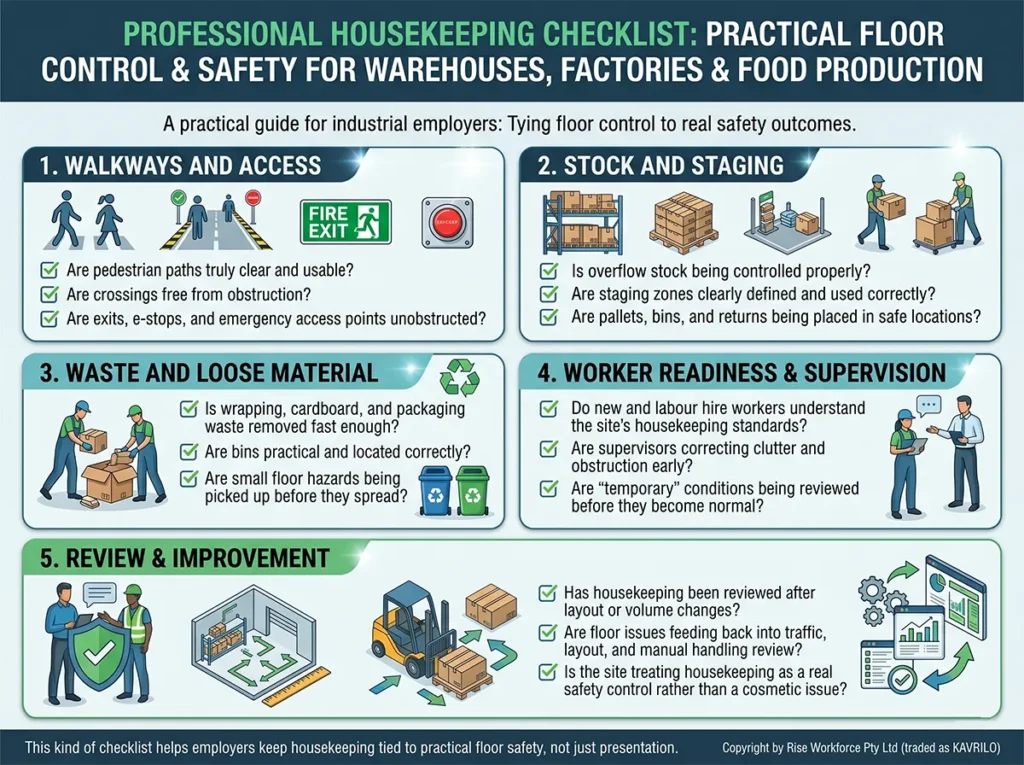
A Simple Housekeeping Checklist for Employers
Here is a practical checklist employers can use to review floor control and housekeeping standards.
Walkways and Access
- Are pedestrian paths truly clear and usable?
- Are crossings free from obstruction?
- Are exits, e-stops, and emergency access points unobstructed?
Stock and Staging
- Is overflow stock being controlled properly?
- Are staging zones clearly defined and used correctly?
- Are pallets, bins, and returns being placed in safe locations?
Waste and Loose Material
- Is wrapping, cardboard, and packaging waste removed fast enough?
- Are bins practical and located correctly?
- Are small floor hazards being picked up before they spread?
Worker Readiness and Supervision
- Do new and labour hire workers understand the site’s housekeeping standards?
- Are supervisors correcting clutter and obstruction early?
- Are “temporary” conditions being reviewed before they become normal?
Review and Improvement
- Has housekeeping been reviewed after layout or volume changes?
- Are floor issues feeding back into traffic, layout, and manual handling review?
- Is the site treating housekeeping as a real safety control rather than a cosmetic issue?
This kind of checklist helps employers keep housekeeping tied to practical floor safety, not just presentation.
Final Word
Warehouse and factory housekeeping standards matter because small floor problems rarely stay small for long.
For employers across Melbourne’s South-East, stronger housekeeping usually supports:
- safer traffic flow
- clearer walkways
- better manual handling
- improved visibility
- easier supervision
- and fewer avoidable floor-level hazards
That is why good employers review housekeeping early.
Not because they want the site to look perfect.
But because they understand that a cleaner, clearer, better-controlled floor is usually a safer one too.
That is not just tidiness.
It is better operational discipline.
Need Practical Labour Hire Support for Warehousing and Manufacturing in Melbourne’s South-East?
KAVRILO is building its approach around safety-aware workforce support, clearer site coordination, and stronger operational discipline for warehouse and industrial environments.
Whether your site needs better shift coverage, stronger day-one worker readiness, or more dependable labour coordination in active operations, KAVRILO is focused on practical workforce support that fits controlled warehouse and factory environments.
Need warehouse and factory labour hire support with stronger day-one readiness and a practical safety-aware approach? Talk to KAVRILO about workforce support across Melbourne’s South-East.
Article Disclaimer
This article is provided for general information only and does not constitute legal, workplace relations, safety, taxation, payroll or other professional advice. Please seek advice specific to your circumstances before acting on this information.
Please read our Website Disclaimer for more information.