
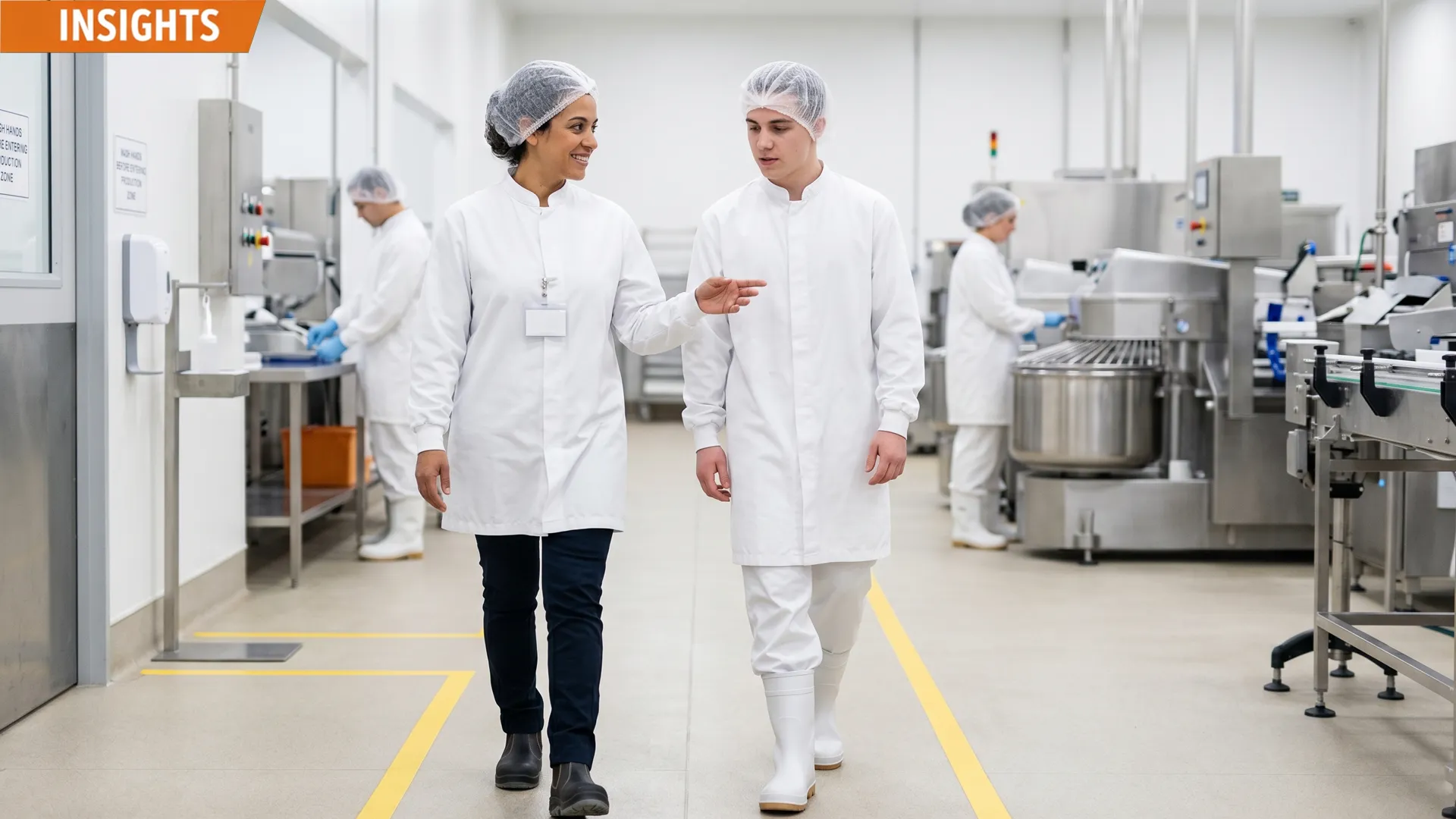
Temporary labour can be a practical solution in food production.
It helps businesses respond to demand spikes, cover absences, support changeovers, and keep production moving when permanent staffing alone is not enough. Across Melbourne’s South-East, many food manufacturers in ready meals, dairy, bakery, meat, chilled packing, and cleanroom-like environments rely on labour flexibility at some point.
But bringing in new workers also creates a very real challenge:
how do you maintain hygiene standards when the person stepping onto the floor is new to your site?
That is where many hygiene risks begin.
Not because temporary workers are automatically unsafe. And not because labour hire itself lowers standards. The real problem usually starts when onboarding is rushed, site expectations are assumed instead of explained, or the wrong worker is placed into the wrong environment without enough control.
In food production, hygiene risk does not usually come from one dramatic failure. It often comes from small misunderstandings, rushed entry, unclear boundaries, or avoidable habits on day one.
That is why reducing hygiene risk with temporary labour is not about rejecting flexibility. It is about managing it properly.
You can learn more about our approach to food production labour hire support across Melbourne’s South-East.
Why New Workers Create a Different Kind of Risk
Even a capable worker can create risk on a new site.
That is because food production environments often depend on details that are highly specific to that facility, such as:
- hygiene entry sequence
- handwashing points
- PPE expectations
- allergen controls
- zone restrictions
- line-specific handling rules
- break and re-entry procedures
- changeover discipline
- reporting pathways
A worker may have experience in food production generally, but still not know:
- how your site separates allergen risk
- which PPE rules change between areas
- what “clean enough” means in your operation
- how you want rejects, waste, or damaged product handled
- which shortcuts are absolutely not acceptable
That is why new-worker risk is often site-specific risk, not just skill risk.
The goal is not to expect instant perfection. The goal is to create a system where temporary workers can settle in safely, clearly, and without creating avoidable hygiene problems.
Where Hygiene Risks Usually Come From
When temporary labour does not work well on food sites, the cause is often one of these:
- unclear induction
- rushed start-of-shift entry
- poor worker-to-site fit
- vague PPE expectations
- weak explanation of hygiene zones
- poor communication around allergens
- assumptions that “they probably know”
- lack of follow-up during the first part of shift
In other words, the risk usually comes less from the idea of temporary labour itself, and more from how the worker is introduced to the site.
That is good news, because it means many of the risks are manageable.
10 Practical Ways to Reduce Hygiene Risks When Bringing in New Workers
1. Start with the Right Worker, Not Just an Available Worker
The first control point is not the floor. It is the placement decision.
If a site is hygiene-sensitive, allergen-sensitive, chilled, high-care, or process-heavy, the worker should be suitable for that environment.
That means thinking beyond “Can they fill the shift?” and asking:
- Have they worked in food production before?
- Do they understand basic GMP expectations?
- Can they follow instruction calmly?
- Are they likely to cope with the pace and discipline of this environment?
- Are they suitable for chilled work, repetitive line work, or controlled-zone movement?
Temporary labour works best when the worker fits the environment, not just the roster gap.
2. Do Not Rush Induction Just Because the Shift Is Busy
One of the most common mistakes is compressing induction because production is already under pressure.
That can lead to workers missing critical details around:
- handwashing
- PPE
- allergen rules
- restricted areas
- line handling
- break procedures
- who to report issues to
On busy sites, this can feel tempting. But rushed induction often creates more lost time later through correction, confusion, rework, or supervisor intervention.
A short induction is not always the problem. An unclear induction is.
Good sites focus on the points that matter most for worker behaviour in that environment.
3. Make Hygiene Entry Rules Impossible to Misunderstand
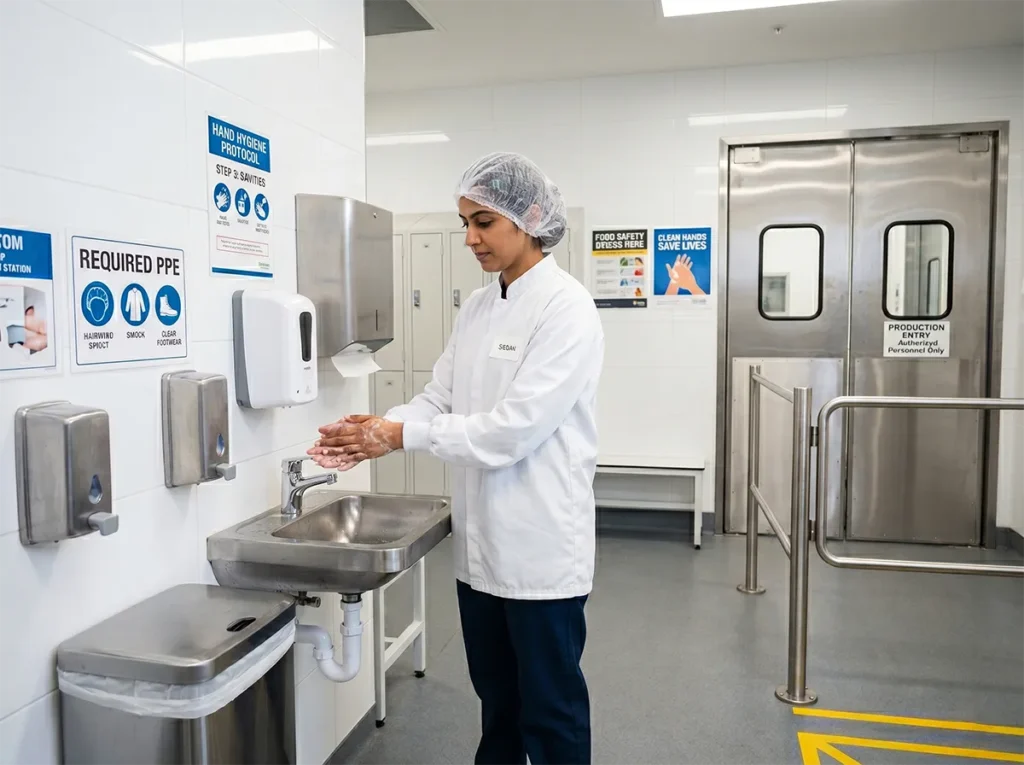
Food production entry controls should be very clear for new workers.
Do not rely on vague assumptions like “they’ll follow everyone else”.
Entry expectations should be obvious around:
- handwashing
- sanitising
- gowning order
- hairnet and beard cover use
- glove requirements
- footwear rules
- personal item restrictions
The more visual and structured this process is, the easier it is for a new worker to follow it properly on day one.
When entry is unclear, the first hygiene risk often happens before the worker reaches the line.
Our article on food factory inductions explains what good workers pay attention to on day one in hygiene-sensitive environments.
4. Be Specific About PPE — Especially Between Areas
Temporary workers should never be left guessing on PPE.
Food sites should explain:
- what must be worn
- how it must be worn
- when it must be changed
- what differs between rooms or zones
- what must not move from one area to another
- what happens on break return or task change
This matters even more in sites with:
- chilled areas
- high-care zones
- allergen-sensitive lines
- raw and cooked separation
- mixed packing and dispatch environments
Clear PPE instruction is one of the fastest ways to reduce avoidable hygiene mistakes.
5. Explain Zone Boundaries Properly
A worker who does not understand your site’s movement logic is more likely to cause problems without meaning to.
Temporary workers should be shown clearly:
- where they can and cannot go
- what areas are hygiene-sensitive
- which zones are allergen-controlled
- how movement between areas works
- whether PPE or hand hygiene changes are required at boundaries
Many cross-contamination and hygiene issues begin with a worker stepping somewhere they assumed was fine.
Good sites remove that guesswork early.
You can also read our guide to food production PPE to understand how proper protective equipment supports food safety and site readiness.
6. Treat Allergen Rules as a Core Part of New-Worker Onboarding
If allergen control matters on the site, it needs to be explained like it matters.
Do not treat it as a side note.
Temporary workers should understand:
- what allergens are on site
- whether certain rooms or lines are restricted
- what colour coding means
- what tools belong where
- what product or packaging must never be mixed
- when glove changes or line clearance matter
- who to tell if something looks wrong
This is especially important in bakery, ready meals, dairy, snack, and mixed-product facilities, where allergen risk can be managed differently from one site to another.
Our article on allergen and cross-contamination rules shows how simple worker mistakes can create bigger food safety problems very quickly.
7. Watch the First Part of the Shift Closely
The first 15 to 30 minutes often tell you whether the worker has understood the key controls.
This is when sites should look for:
- correct PPE use
- calm entry into workflow
- basic hygiene discipline
- respect for movement rules
- sensible product handling
- willingness to ask questions
- whether the worker looks controlled or uncertain
This does not mean hovering aggressively. It means being intentional about early observation.
Small errors are often easiest to correct early before they become patterns.
8. Make Reporting Simple and Immediate
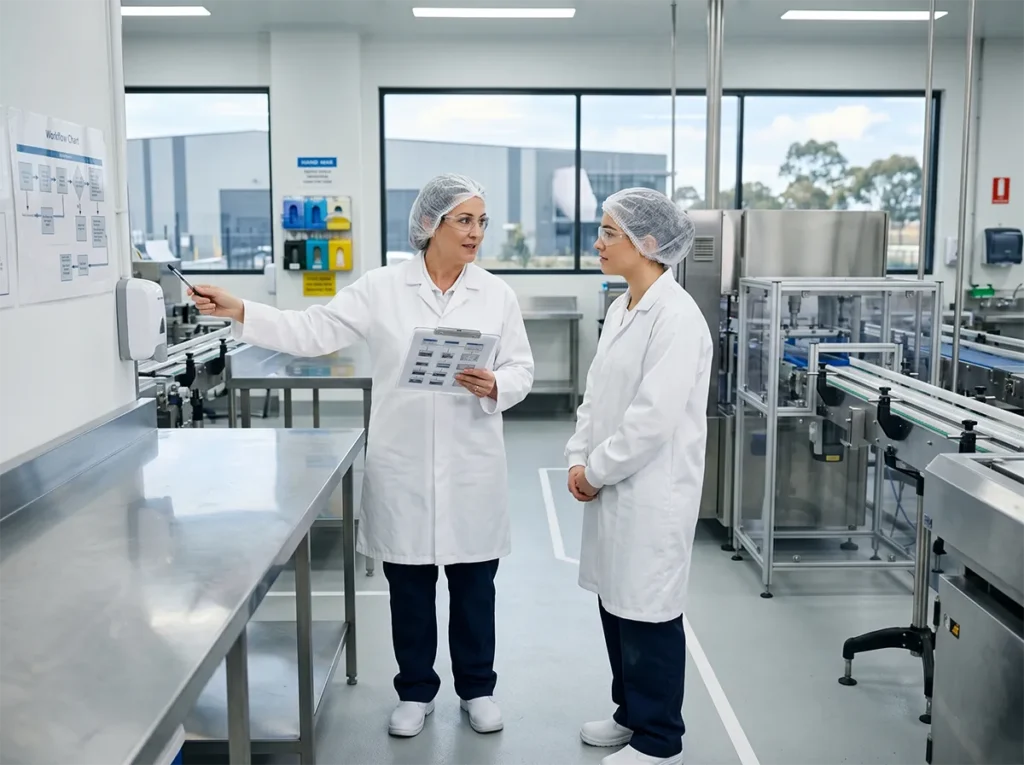
New workers need to know what to do if something looks wrong.
That includes:
- damaged packaging
- contamination concerns
- allergen questions
- incorrect labels
- product-handling uncertainty
- PPE problems
- illness symptoms
- hygiene breaches
The reporting expectation should be very clear:
- what to report
- who to report it to
- when to escalate
- that speaking up early is expected, not criticised
Workers who are unsure whether to speak often stay quiet too long.
That is a preventable risk.
9. Do Not Assume Previous Food Experience Means Site Readiness
This is an easy trap.
A worker may have previous food production experience and still need very clear guidance in your facility.
That is because:
- every site structures risk differently
- every site has its own movement logic
- every site may vary on PPE, allergens, changeovers, or handling detail
- every site has its own “normal” around cleanliness and control
Experience is useful. But experience does not replace clear onboarding.
The best approach is to value prior experience while still making site-specific expectations explicit.
10. Build a Repeatable System, Not a One-Off Fix
The best way to reduce hygiene risk with temporary labour is not through heroic supervision every time a new person arrives.
It is through a repeatable onboarding system.
That system should make it easier for any suitable new worker to understand:
- how to enter the site
- how to wear PPE
- where to move
- what to touch
- what to report
- what food safety risks matter most
If the system works only when one particular supervisor is present, it is too fragile.
Good food manufacturers reduce hygiene risk by making the right behaviour easier to follow consistently.
You can also read our guide to food safety labour hire workers to see what food manufacturers should reasonably expect from labour hire support on food sites.
What Good Temporary Labour Support Should Look Like
When temporary labour is working well on a food site, it usually looks like this:
- the worker arrives prepared
- induction is clear and focused
- hygiene entry runs smoothly
- PPE is correct early
- the worker settles into the line without chaos
- questions are raised early where needed
- supervisors are not constantly correcting obvious basics
- the site feels more supported, not more exposed
That is the standard food manufacturers should aim for.
Temporary labour should bring flexibility — not avoidable hygiene friction.
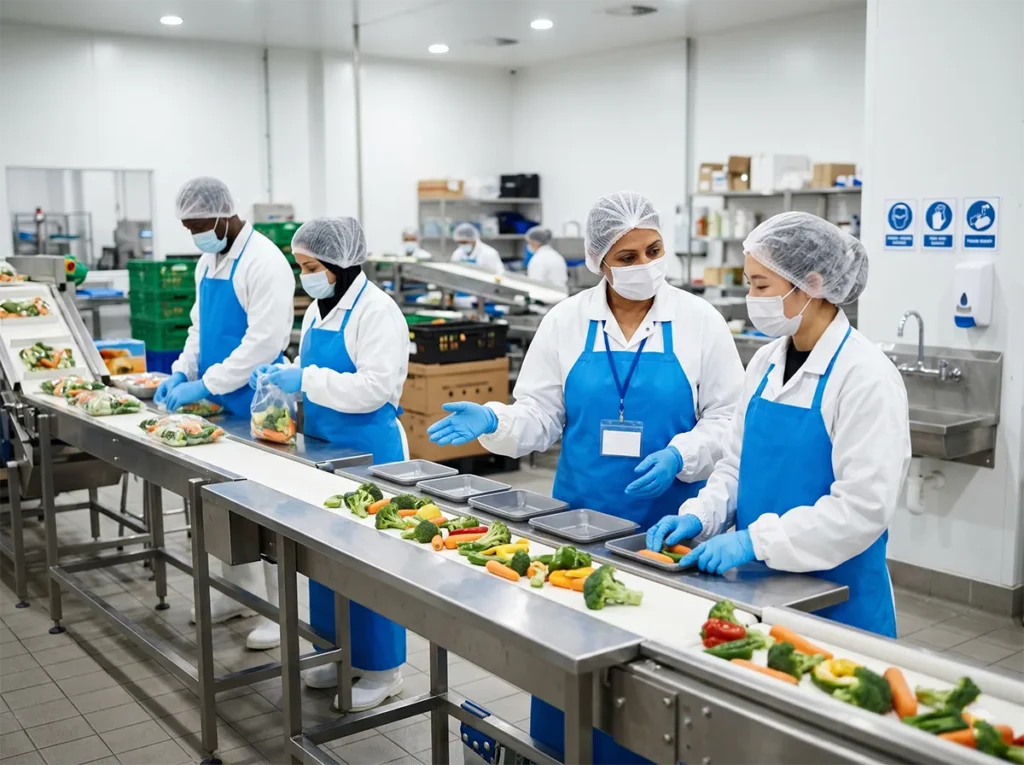
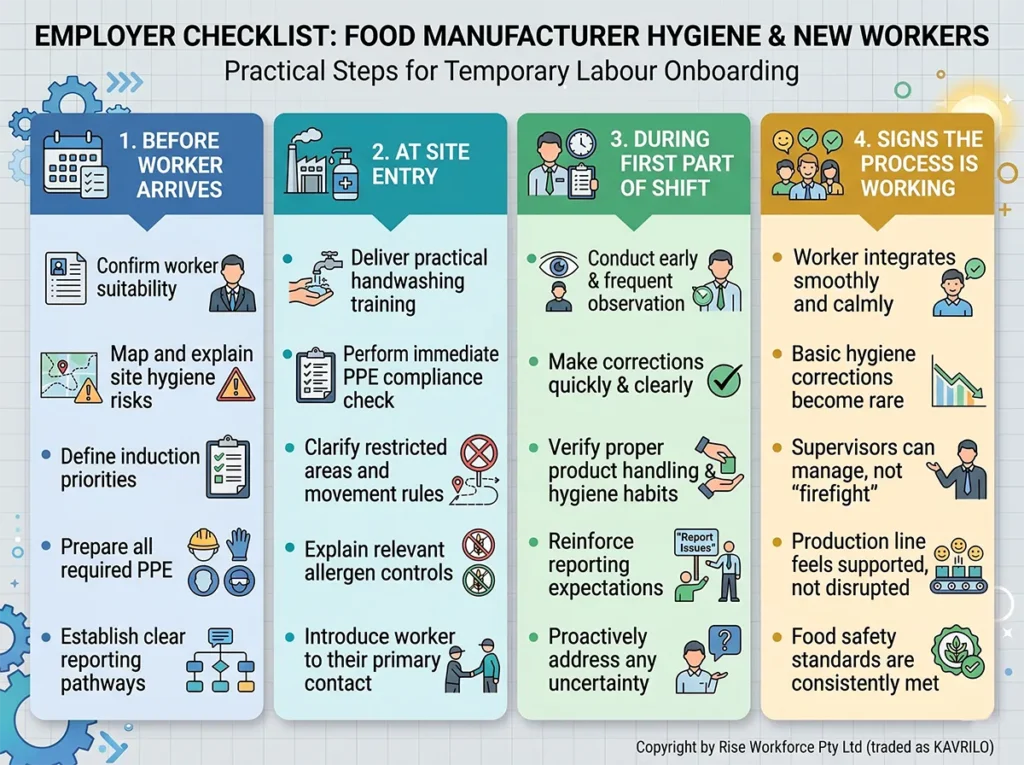
A Simple Employer Checklist: Reducing Hygiene Risk with New Workers
Here is a practical checklist food manufacturers can use when bringing in temporary labour.
Before the Worker Arrives
- the worker is suitable for the environment
- the site’s key hygiene risks are clear internally
- induction priorities are known
- PPE requirements are ready and clear
- reporting pathways are easy to explain
At Site Entry
- handwashing and hygiene entry are explained properly
- PPE is checked early
- restricted areas and movement rules are clear
- allergen controls are explained where relevant
- the worker understands who to go to with questions
During the First Part of Shift
- the worker is observed early
- corrections are made quickly and clearly
- product handling and hygiene habits are checked
- reporting expectations are reinforced
- uncertainty is addressed before it becomes risk
Signs the Process Is Working
- the worker settles in calmly
- fewer basic hygiene corrections are needed
- supervisors are not firefighting avoidable issues
- the line feels supported, not disrupted
- food safety standards remain controlled during coverage changes
This kind of checklist helps turn “temporary labour” into a more stable, manageable part of site operations.
Final Word
Temporary labour in food production does not need to mean higher hygiene risk.
The real issue is usually not that the worker is temporary. It is whether the site has made the critical expectations clear enough, early enough, and practically enough for that worker to succeed.
Food manufacturers who do this well usually focus on:
worker suitability, clear induction, visible hygiene entry, strong PPE discipline, allergen clarity, early observation, and simple reporting.
That is what helps reduce avoidable problems.
That is what protects standards while still allowing labour flexibility.
And that is what makes temporary support more valuable in food production environments.
Looking for practical labour hire support in food production across Melbourne’s South-East?
KAVRILO is building its focus in food production labour hire with a practical, safety-aware approach that values hygiene discipline, site fit, and dependable workforce support across different production environments.
Talk to KAVRILO about hygiene-aware workforce support for controlled food manufacturing environments.
Article Disclaimer
This article is provided for general information only and does not constitute legal, workplace relations, safety, taxation, payroll or other professional advice. Please seek advice specific to your circumstances before acting on this information.
Please read our Website Disclaimer for more information.