

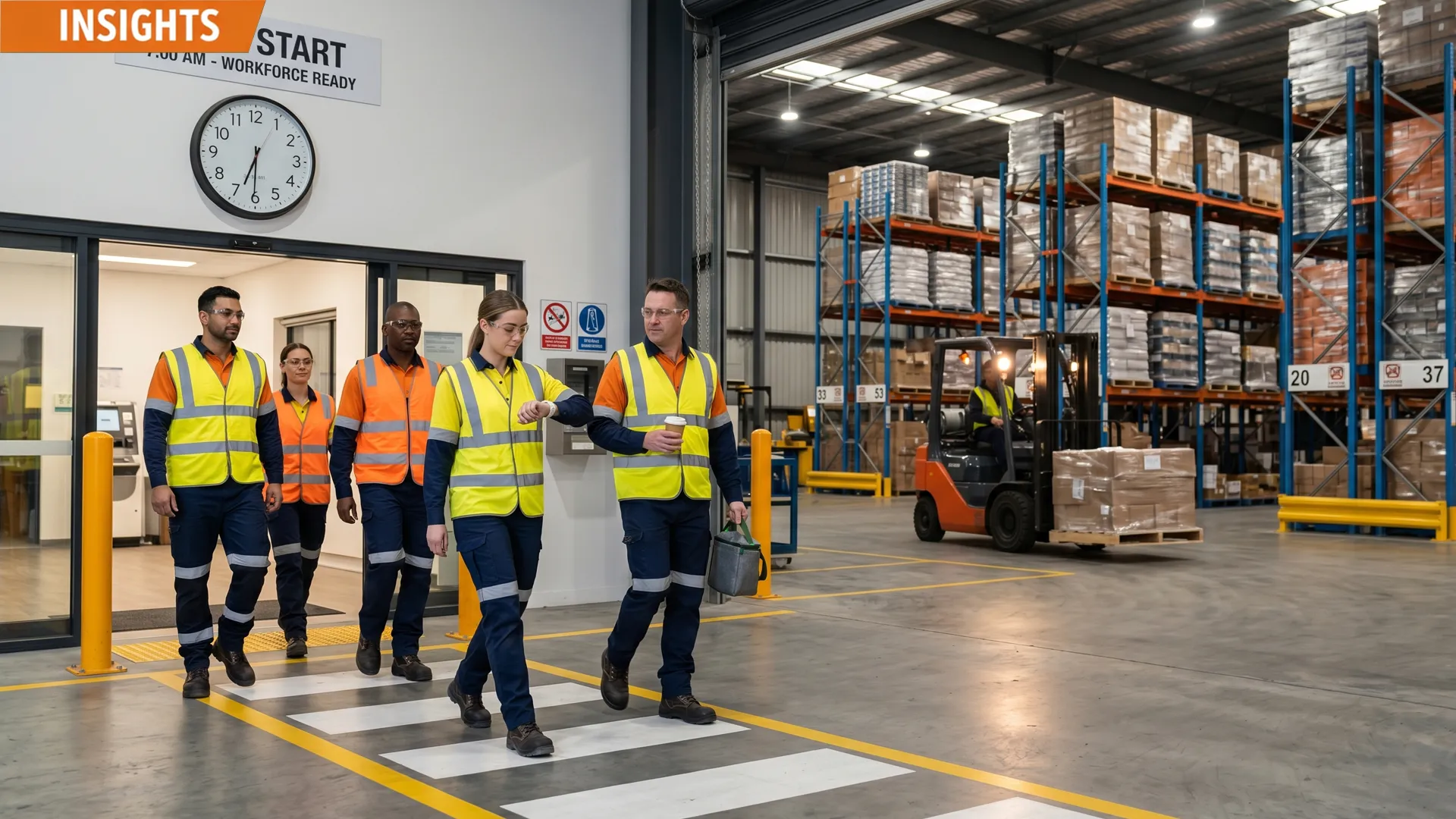
For warehouse and factory employers, labour reliability is rarely just about whether someone accepted the shift.
It is also about whether they can:
- get to site consistently
- sustain the shift pattern
- arrive on time
- and keep turning up once the routine becomes real
That is where local workers often make a difference.
Across Dandenong and the broader South-East Melbourne corridor, employers often operate in industrial areas where:
- shift starts can be early
- public transport access can be limited
- travel routes can be inconsistent
- and warehouse or factory work needs dependable attendance, not just short-term availability
In these conditions, local worker access matters.
A worker who lives closer to the site often has a practical advantage when it comes to:
- punctuality
- attendance consistency
- lower travel fatigue
- better shift sustainability
- and reduced risk of dropping off because the commute becomes too hard over time
That does not mean every local worker is automatically strong, or that non-local workers cannot perform well.
It does mean that for many industrial employers, local access often improves the odds of:
- steadier coverage
- lower turnover
- and less avoidable disruption once the shifts are underway
That is why local labour still matters so much in the South-East.
For the broader local market overview, see our Staffing South-East Melbourne pillar guide for Dandenong warehouse and factory employers.
Why Punctuality and Turnover Matter So Much on Industrial Sites
On a warehouse or factory floor, punctuality is not a minor issue.
It can affect:
- shift handover
- machine or line readiness
- dispatch timing
- team allocation
- supervisor workload
- and how calmly the site starts the day
Turnover matters just as much.
When workers leave too quickly, the site often absorbs extra cost through:
- repeated onboarding
- lower team consistency
- more supervision time
- loss of site familiarity
- and continued instability in shift coverage
That is why employers in South-East Melbourne often care less about whether labour is theoretically available and more about whether it is:
- dependable
- reachable
- sustainable
- and likely to stay long enough to become useful to the site
This is where local workforce access can become a real practical advantage.
Why Local Access Still Shapes Staffing Outcomes
In industrial staffing, travel practicality still affects outcomes more than many people admit.
A worker may be willing to take the role, but still struggle later if:
- the travel distance is long
- the route is unreliable
- the start time is too early for practical transport
- the shift pattern changes
- or the commute becomes harder to sustain than expected
This can lead to:
- lateness
- missed shifts
- fatigue
- reduced willingness to accept extra coverage
- and earlier dropout than the employer originally expected
Local workers are not immune to reliability issues.
But in many cases, they begin with fewer practical barriers around:
- getting to site
- adjusting to shift timing
- and maintaining regular attendance over time
That is why local access often improves workforce stability.
Our article on how transport and travel time affect shift reliability in South-East Melbourne looks more closely at why commute practicality still shapes attendance and punctuality across warehouse and factory sites.
10 Practical Reasons Local Workers Often Perform More Reliably
1. Shorter Travel Time Often Supports Better Punctuality
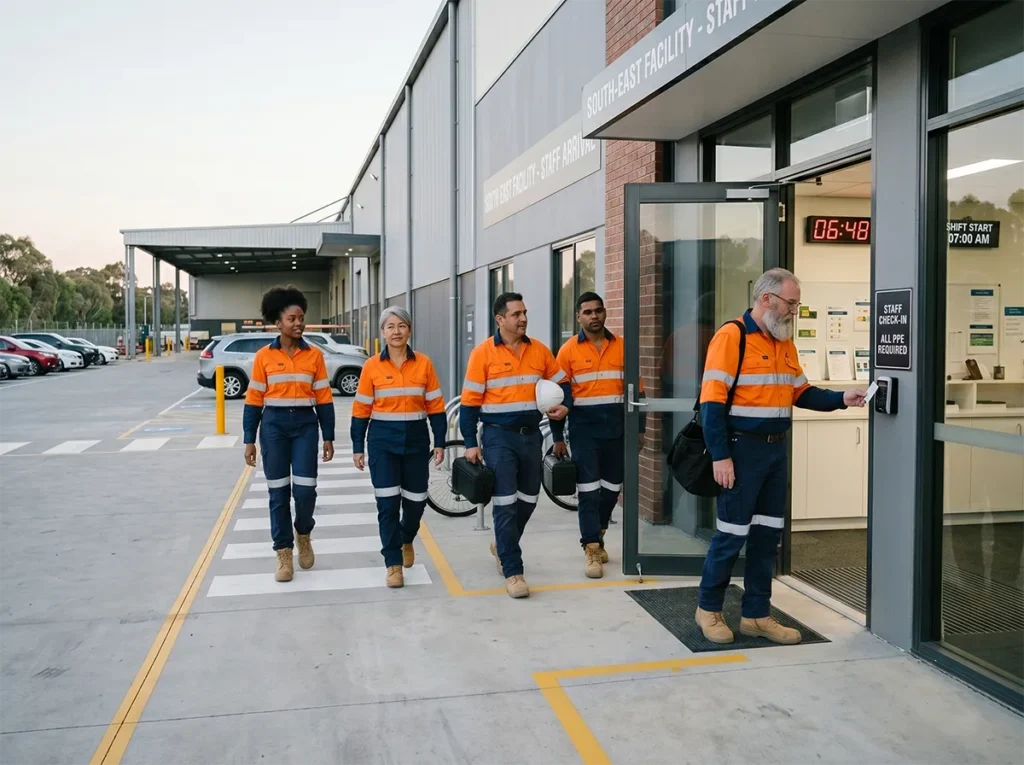
A shorter trip to work usually gives the worker:
- more margin for delay
- less dependence on long multi-step travel
- less exposure to cross-city disruption
- and a better chance of recovering from normal transport issues without missing the start time
This matters especially for:
- early morning starts
- changing shifts
- short-notice coverage
- and industrial sites where clock-on timing affects the wider team
The shorter and more practical the trip, the easier it often becomes to maintain punctuality consistently.
2. Early Starts Are Easier to Sustain When the Worker Is Nearby
Many warehouse and factory sites operate with:
- early starts
- rotating shifts
- morning dispatch pressure
- and production timing that depends on workers being ready from the start
These shifts can be much harder to sustain when the worker is travelling a long distance.
A local worker often has a practical advantage because the shift begins to feel:
- more manageable
- more repeatable
- and less physically draining before the work has even started
That can reduce:
- late arrival risk
- fatigue-related dropout
- and the chance that the worker decides the role is not sustainable after only a short period
3. Travel Fatigue Often Affects Retention More Than Employers Expect
A long or awkward commute may not stop a worker taking the role.
But it can still affect whether they stay.
Over time, difficult travel can increase:
- physical fatigue
- frustration around shift timing
- reluctance to accept certain rosters
- and the likelihood that the worker leaves when something closer becomes available
This is one reason turnover can sometimes look like a performance issue when the deeper cause is really practicality.
Local workers often face less of that pressure.
That can help improve retention over time.
4. Local Workers May Adapt Faster to the Site Routine
A worker who already lives within or near the industrial corridor may find it easier to adapt to:
- the travel timing
- the local work rhythm
- the industrial-area access
- and the pace of the shift pattern
That does not guarantee stronger performance.
But it can reduce friction around the basic practical side of getting to work and staying on schedule.
For employers, that can make the early weeks of a placement feel:
- steadier
- easier to manage
- and less exposed to attendance surprises
5. Short-Notice Shift Coverage Is Often Easier With a Local Labour Pool
One of the biggest operational challenges is same-day or short-notice coverage.
Local workers often help here because they may be:
- closer to site
- able to respond more quickly
- more realistic for urgent starts
- and better placed to support last-minute gaps without the same travel barrier
This matters for:
- absentee replacement
- unexpected volume changes
- urgent warehouse coverage
- and factory shifts that still need to run even when the roster changes suddenly
That is one reason local workforce support often feels more responsive in practice.
6. Long Travel Routes Can Increase Drop-Off After the First Few Weeks
Some roles look manageable at the start because the worker is motivated to begin.
The real test comes later.
If the daily travel is too long or too awkward, the worker may begin to:
- arrive under more stress
- lose enthusiasm for the shift pattern
- reconsider the role when another option appears closer
- or quietly disengage before leaving altogether
This is especially relevant in casual or labour hire roles, where the worker may still be comparing the job against other available options.
A local worker often has fewer practical reasons to step away early.
That can reduce turnover pressure.
7. Better Local Access Can Improve Attendance Consistency
Attendance is often shaped by simple practicality.
A worker who lives closer to the site may be:
- less affected by long commute disruptions
- more able to adjust to shift changes
- less exposed to transport fatigue
- and more likely to maintain routine attendance once the role becomes familiar
For employers, this matters because attendance consistency supports:
- smoother rosters
- stronger team trust
- lower supervisor pressure
- and fewer same-day surprises
That makes local staffing more than a convenience issue.
It becomes a stability issue too.
8. Local Workers Often Make Better Long-Term Casuals

Some of the best casual workers are not only capable.
They are sustainable.
That often means they can:
- keep turning up
- stay practical across changing rosters
- take on extra shifts when needed
- and remain useful to the site over time without frequent attendance problems
Local access can support that kind of stability.
A worker who is closer to the site may be more likely to become:
- a dependable casual
- a repeat go-to worker
- or someone worth considering for longer-term retention
Our article on when good casual workers become permanent explains what employers should think about when a strong casual worker begins standing out as a longer-term option.
9. Local Staffing Often Reduces Avoidable First-Shift Friction
A worker who lives closer to the area may still need:
- site induction
- role explanation
- safety guidance
- and supervisor support
But they may still face less practical friction around:
- finding the site
- planning the commute
- adjusting to the industrial area
- and sustaining attendance after the first few shifts
This can make onboarding feel:
- calmer
- more stable
- and less exposed to avoidable disruption that is really travel-related rather than work-related
That matters for busy sites where early stability makes a real difference.
10. Local Labour Support Often Strengthens Overall Workforce Quality

For employers, local staffing is not just about geography.
It can also improve:
- response time
- workforce matching
- attendance realism
- and how well labour support reflects the actual conditions of the South-East corridor
This is one reason local labour hire support often performs better in practice.
A provider with stronger local reach is often better placed to support:
- punctuality
- dependable shift coverage
- and more sustainable placements across Dandenong and surrounding areas
That is where local staffing becomes a real operational advantage.
Our article on why South-East Melbourne employers need faster, more local staffing support explains why local responsiveness and practical site understanding often improve labour outcomes for industrial employers in the corridor.
What Employers Should Be Careful Not to Assume
A local worker is not automatically the best worker.
Employers should still think carefully about:
- reliability
- role fit
- attitude
- site readiness
- and whether the worker suits the actual conditions of the warehouse or factory
The point is not that local access replaces proper screening or practical judgement.
The point is that local access often improves the chances of:
- stronger punctuality
- more sustainable attendance
- and lower turnover once the work routine becomes real
So local should be treated as:
- a meaningful advantage
not - a complete decision by itself
That is a more balanced way to use location as part of workforce planning.
What Better Local Staffing Usually Looks Like in Practice
When local staffing is working well, it usually feels:
- steadier
- more dependable
- easier to manage
- and less exposed to attendance disruption
In practice, that often means:
- workers reach site more consistently
- shift starts feel calmer
- no-shows happen less often
- turnover pressure reduces
- and supervisors spend less time solving basic coverage problems
It should not feel like:
- every roster depends on long-distance travel working perfectly
- workers drop off once the commute becomes real
- or the site is constantly filling shifts without improving stability
Good local staffing usually improves both:
- workforce reliability
- and operational confidence
A Simple Local Staffing Checklist for Employers
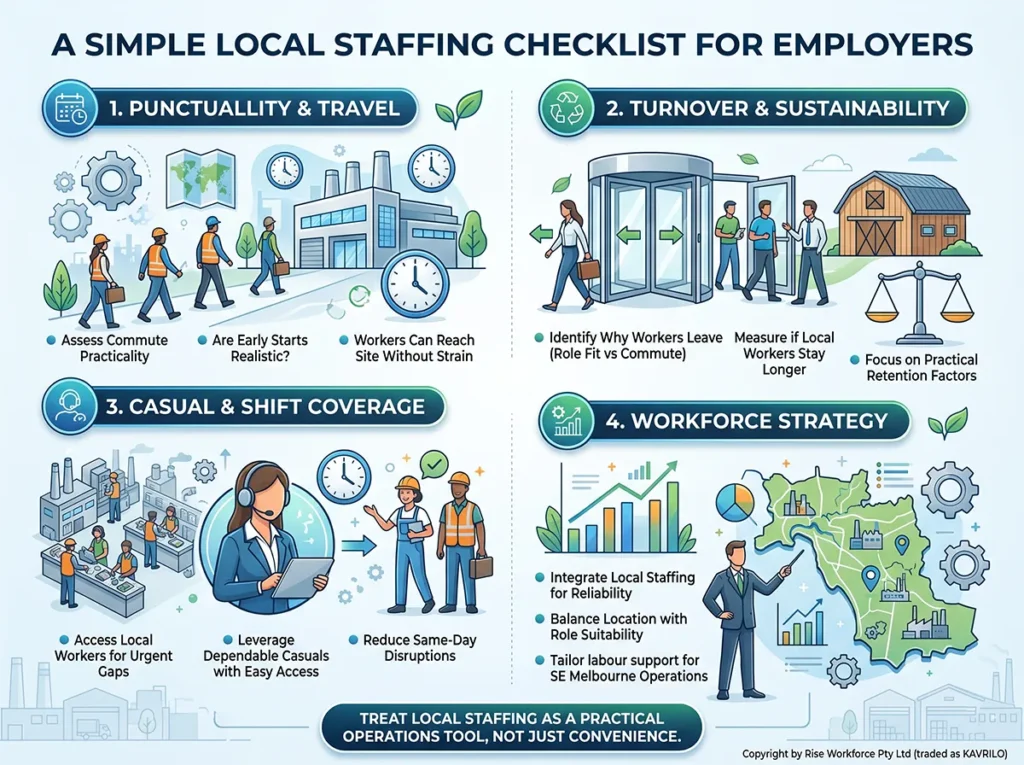
Here is a practical checklist employers can use when thinking about local staffing, punctuality, and turnover.
Punctuality and Travel
- Are our attendance issues partly being driven by commute practicality?
- Are early starts realistic for the workers we are using?
- Are workers able to reach the site consistently without excessive travel strain?
Turnover and Sustainability
- Are workers leaving because the role is unsuitable, or because the commute is too hard to sustain?
- Are stronger local workers staying longer than those travelling further?
- Are we paying enough attention to practical retention factors?
Casual and Shift Coverage
- Do we have access to local workers who can support short-notice or urgent gaps?
- Are our most dependable casuals also those with more practical access to site?
- Is local coverage helping reduce same-day disruption?
Workforce Strategy
- Are we using local staffing as part of a smarter reliability strategy?
- Are we balancing location with proper role-fit judgement?
- Does our labour support reflect how South-East Melbourne industrial sites actually operate?
This kind of checklist helps employers treat local staffing as a practical operations tool, not just a convenience factor.
Final Word
Local workers often improve punctuality and reduce turnover because practicality matters in industrial staffing.
For warehouse and factory employers across Dandenong and South-East Melbourne, stronger labour reliability often comes from:
- shorter travel time
- more sustainable shift access
- lower commute fatigue
- better attendance consistency
- and a workforce strategy that reflects how the local corridor actually works
That is what helps reduce:
- avoidable lateness
- attendance gaps
- weak shift stability
- and turnover driven by travel pressure rather than job performance
Because in industrial staffing, a worker’s ability to reach the site reliably and sustain the commute over time often matters more than employers expect.
That is not just a location issue.
It is an operations issue.
Need Practical Labour Hire Support for Warehousing and Manufacturing in Melbourne’s South-East?
KAVRILO is building its approach around safety-aware workforce support, stronger local responsiveness, and clearer operational discipline for warehouse and industrial environments.
Whether your site needs support during busy periods, stronger shift reliability, or more dependable labour coordination across the South-East, KAVRILO is focused on practical workforce support that fits controlled warehouse and factory environments.
Need warehouse and factory labour hire support with stronger local responsiveness and more dependable shift coverage? Talk to KAVRILO about workforce support across Melbourne’s South-East.
Article Disclaimer
This article is provided for general information only and does not constitute legal, workplace relations, safety, taxation, payroll or other professional advice. Please seek advice specific to your circumstances before acting on this information.
Please read our Website Disclaimer for more information.