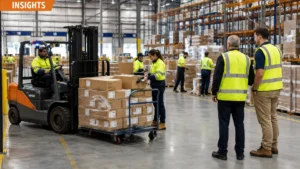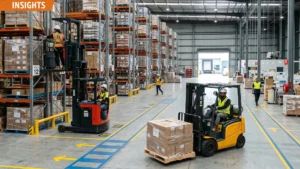

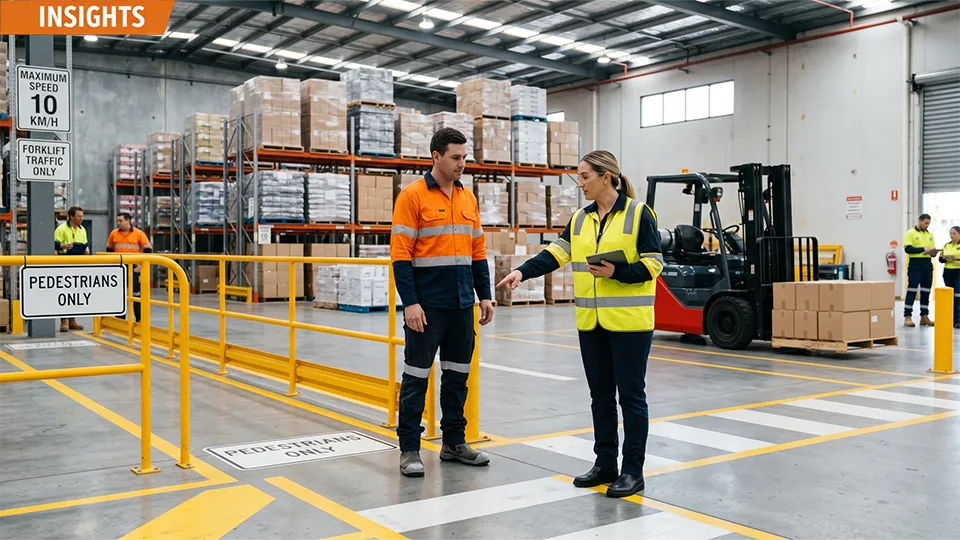
A forklift stops just in time.
A pedestrian steps back at the last moment.
An operator clears a blind corner more tightly than expected.
A crossing is blocked, so movement becomes awkward but no one is injured.
These moments are easy to dismiss because nothing serious happened in the end.
But that is exactly why they matter.
Across Melbourne’s South-East, forklifts are part of daily warehouse movement in dispatch, replenishment, staging, receiving, and stock transfer. In these environments, a near miss is often one of the clearest warnings a site will get before a more serious incident occurs.
Good employers do not treat a forklift near miss as:
- bad luck
- a passing moment
- or a minor issue that can be forgotten because no one was hurt
They treat it as useful information.
Because a forklift near miss often reveals that something on the floor is already under pressure:
- traffic flow
- visibility
- crossings
- pedestrian behaviour
- operator habits
- supervision
- or the layout itself
That is why near misses matter so much.
They show where the system came close to failing before injury, damage, or escalation forced the site to pay more attention.
For the broader employer overview, see our forklift safety and licence checks in Victoria pillar guide on traffic control, induction, supervision, and practical forklift risk reduction.
Why Forklift Near Misses Should Never Be Treated Casually
A near miss is not evidence that the system worked.
It is evidence that the system came close to not working.
That distinction matters.
A forklift near miss may point to:
- weak crossing control
- poor sightlines
- clutter affecting movement
- rushed operator behaviour
- poor pedestrian awareness
- or a floor layout that looks acceptable on paper but is weaker in real conditions
The injury may not have happened this time.
But the exposure was real enough that it could have.
That is why good employers use forklift near misses to ask:
- What made that possible?
- Was this truly random, or is there a pattern?
- What on the floor is encouraging this kind of close call?
- What do we need to tighten before a more serious event occurs?
That is a stronger safety mindset than:
“Nothing happened, so we can move on.”
Where Forklift Near Misses Usually Show Up
Forklift near misses tend to appear in familiar pressure zones such as:
- aisle intersections
- blind corners
- dock approaches
- dispatch lanes
- crossings
- mixed pedestrian areas
- replenishment zones
- roller door entries
- and areas affected by temporary staging or overflow stock
They also become more common when:
- volume rises
- dispatch pressure builds
- new or temporary operators are on site
- floor discipline weakens
- clutter affects visibility
- or supervisors become stretched across too much movement
That is why near misses should always be reviewed in the context of:
- the floor layout
- the shift conditions
- the traffic design
- and the real behaviour happening around the forklift
not just the single moment itself.
What Good Employers Review Early
1. Whether the Same Type of Near Miss Keeps Happening
A single near miss matters.
But repeated near misses in similar locations matter even more.
Good employers look for patterns such as:
- repeated close calls at the same crossing
- the same blind corner causing awkward movement
- repeated pedestrian confusion in one area
- the same dock entry creating visibility pressure
- or recurring issues where overflow stock changes the route
Patterns usually tell you the problem is not random.
It is probably sitting in:
- layout
- traffic design
- floor discipline
- or routine site behaviour
That is why repeated near misses should always trigger a closer look.
2. Whether the Traffic Layout Still Works Under Real Conditions
A traffic plan can look fine on paper and still perform poorly on a busy shift.
Good employers review:
- whether crossings are still usable
- whether walkways remain clear
- whether staging has reduced sightlines
- whether pedestrian routes are being respected
- and whether forklift lanes are still functioning the way the site intended
A near miss often shows that the traffic design is weaker in practice than it looks on a map.
That is especially true when:
- temporary stock overflow changes the space
- walkways are partly blocked
- dock pressure increases
- or operators start using routes that were not meant to carry the same level of movement
Our guide to warehouse traffic management shows how stronger layout, clearer crossings, and better movement control help reduce forklift and pedestrian risk before near misses build into something worse.
3. Whether Visibility Is Being Reduced by Layout, Stock, or Clutter

Many forklift near misses are really visibility problems.
That can include:
- pallets stacked too high near intersections
- overflow staging at aisle ends
- poor sightlines near dock entries
- blind corners not being managed strongly enough
- or clutter narrowing the operator’s view of pedestrian movement
Good employers review what the operator could and could not realistically see at the time.
That matters because a driver cannot respond properly to what the floor is hiding from them.
A near miss caused by poor visibility is often a floor-control issue, not just an operator issue.
4. Whether Operator Habits Are Contributing to the Risk
Not every near miss is caused by layout alone.
Sometimes operator behaviour plays a role through habits such as:
- taking corners too fast
- driving too fast for the actual conditions
- using warnings inconsistently
- cutting too close to pedestrian space
- becoming casual in familiar areas
- or relying on habit instead of active awareness
Good employers do not jump straight to blame.
But they do review honestly whether the operator’s behaviour added to the exposure.
That is how weaker habits get corrected before they settle in.
Our article on common forklift driving habits that increase risk explains the small behaviour patterns supervisors should notice early before they become normal on the warehouse floor.
5. Whether Pedestrian Behaviour Is Also Part of the Problem
Forklift near misses are not always only about the driver.
Pedestrians may also be:
- cutting through active lanes
- misusing crossings
- stepping into staging zones
- assuming the operator can see them
- or treating familiar warehouse areas too casually
That is why good employers review both sides of the interaction.
If pedestrians are regularly moving unpredictably, the site may have a:
- walkway problem
- behavioural problem
- signage problem
- or supervision problem
A stronger near miss review looks at the whole movement system, not just the forklift.
6. Whether New or Temporary Operators Were Set Up Clearly Enough
A temporary or new forklift operator may still be unfamiliar with:
- the local crossings
- the dock pressure
- the blind spots
- the shift pace
- the route expectations
- and the way pedestrians usually move on that site
A near miss involving a newer operator should prompt employers to ask:
- Was the induction strong enough?
- Were the movement rules clear enough?
- Did we show the risk points properly?
- Was supervision visible enough in the first shifts?
This matters because a licensed operator can still be underprepared for your specific warehouse.
Our article on forklift inductions for new and temporary operators explains what employers should cover on day one before a licensed operator enters live warehouse traffic.
7. Whether the Floor Conditions Changed Without Enough Review
Sometimes the near miss is not about a long-standing problem.
It is about a recent change that was not reviewed properly.
For example:
- temporary overflow stock changed the line of sight
- a new racking layout narrowed the turn
- dock activity increased unexpectedly
- dispatch pressure altered the normal route
- or a different staging setup pushed pedestrians closer to active forklift travel
Good employers review whether the near miss reflects a condition that changed recently and weakened control without being noticed soon enough.
That is where many avoidable issues begin.
8. Whether the Site Responds Quickly Enough After a Near Miss
A near miss only helps if the site learns from it.
Good employers review:
- how quickly the issue is checked
- whether interim controls are put in place
- whether layout, access, or supervision changes are needed
- and whether the warning actually leads to practical adjustment on the floor
If nothing changes after a near miss, then the site teaches workers and operators that reporting achieves very little.
That weakens both reporting culture and risk control.
9. Whether Supervisors Are Seeing the Real Pressure Points

Supervisors play a major role here.
A near miss often shows where supervision may need to become:
- more visible
- more specific
- or more focused on the pressure areas of the floor
Good employers review whether supervisors are actually watching:
- the crossings
- the congested lanes
- the dock approaches
- the blind intersections
- and the movement patterns where risk is most likely to build
A site can have supervisors on shift and still miss the places where the real exposure is forming.
10. Whether Near Misses Are Feeding Back Into Future Control
A strong site does not let a near miss disappear after the moment passes.
The information should feed back into:
- induction
- toolbox talks
- supervisor briefings
- movement reviews
- layout control
- and future operator support
That is one of the clearest signs of a stronger warehouse safety culture.
The site uses early warnings to tighten control before something more serious occurs.
That is what good employers review early.
What Good Forklift Near Miss Review Usually Looks Like in Practice
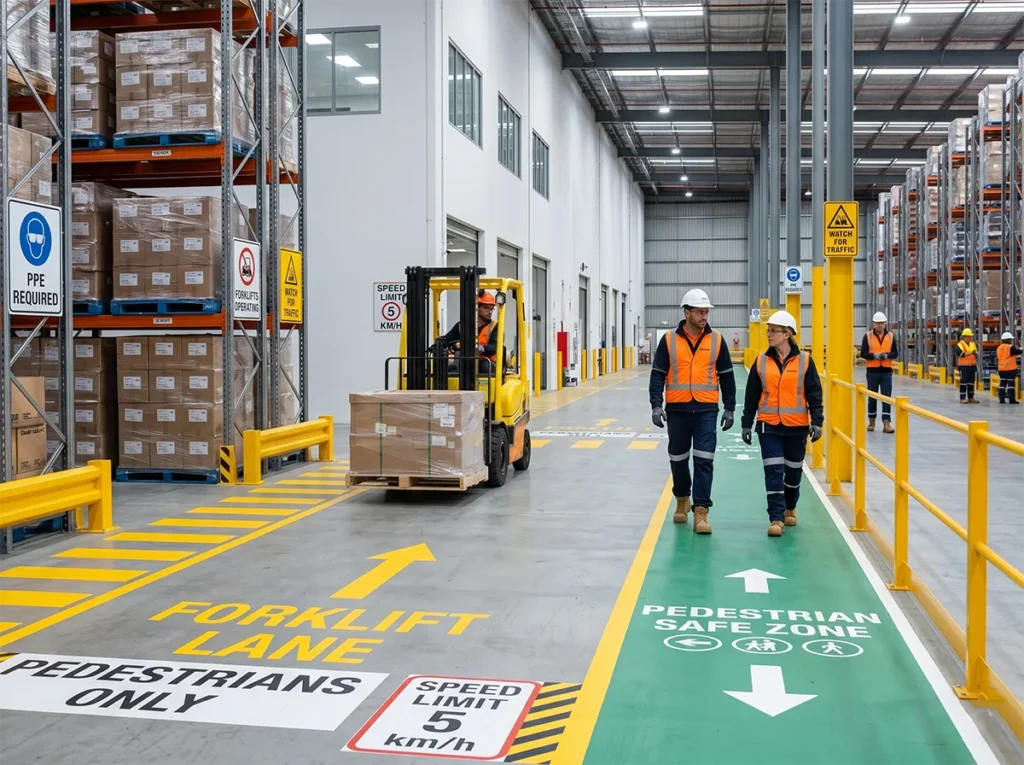
A strong near miss review usually feels:
- calm
- practical
- non-defensive
- and focused on improvement
It usually looks at:
- the exact location
- the visibility conditions
- the traffic pressure
- the behaviour of both operator and pedestrian
- the floor setup
- and what needs to change so the same close call is less likely again
It should not feel like:
- blame without learning
- paperwork without follow-up
- or a quick conversation that ends because no one was hurt
The best review asks:
“What was this near miss trying to tell us about the floor?”
That is the question that strengthens control.
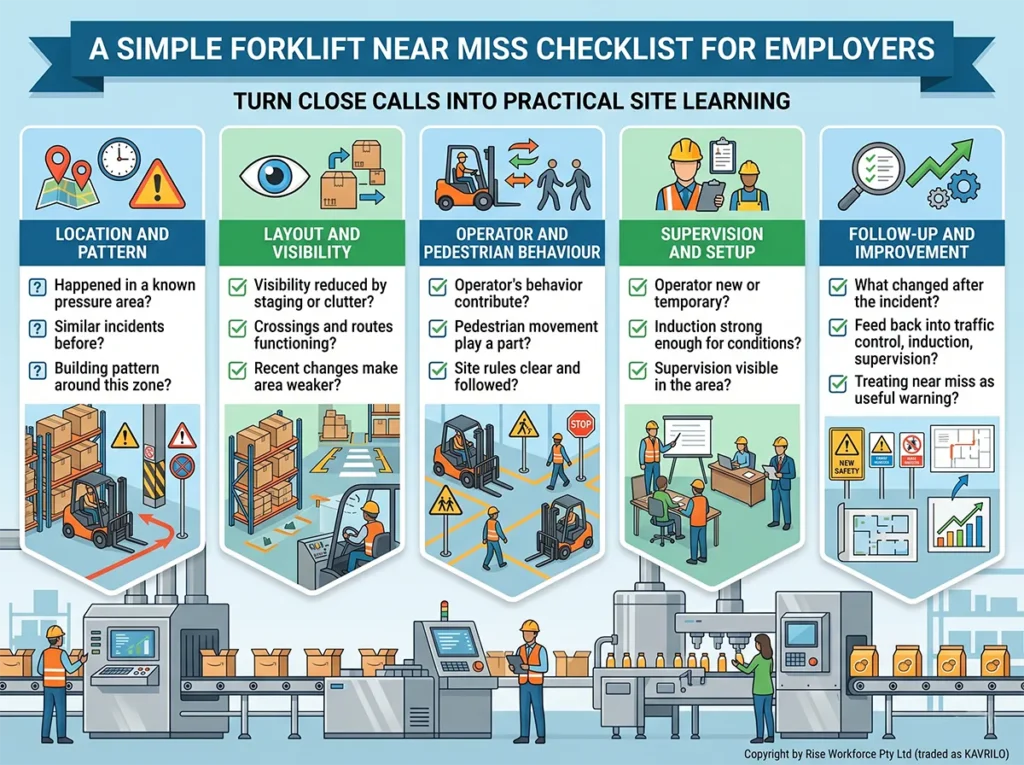
A Simple Forklift Near Miss Checklist for Employers
Here is a practical checklist employers can use after a forklift near miss.
Location and Pattern
- Did the near miss happen in a known pressure area?
- Has something similar happened there before?
- Is there a pattern building around this zone?
Layout and Visibility
- Was visibility reduced by staging, clutter, or the floor layout?
- Were crossings and routes still functioning the way they should?
- Has a recent change made the area weaker than before?
Operator and Pedestrian Behaviour
- Did the operator’s behaviour contribute to the close call?
- Did pedestrian movement also play a part?
- Were site rules clear and being followed properly?
Supervision and Setup
- Was the operator new or temporary?
- Was induction strong enough for the site conditions?
- Was supervision visible enough in the area where the near miss happened?
Follow-Up and Improvement
- What changed after the near miss?
- Did the issue feed back into traffic control, induction, or supervision?
- Is the site treating the near miss as useful warning information rather than background noise?
This kind of checklist helps employers turn near misses into practical site learning before a more serious forklift incident occurs.
Final Word
Forklift near misses matter because they show where the site came close to harm before an injury forced attention back onto the floor.
For warehouse employers across Melbourne’s South-East, stronger near miss review usually comes from:
- looking for patterns
- checking layout and visibility honestly
- reviewing both operator and pedestrian behaviour
- tightening induction and supervision
- and making sure the warning leads to practical action
That is what helps reduce:
- repeat close calls
- weak traffic control
- hidden floor pressure
- and preventable forklift exposure in active warehouse environments
Because a near miss is not just a lucky escape.
It is one of the clearest early warnings a warehouse can get.
That is not just better reporting.
It is better warehouse control.
Need Practical Labour Hire Support for Warehousing and Manufacturing in Melbourne’s South-East?
KAVRILO is building its approach around safety-aware workforce support, clearer communication, and stronger operational discipline for warehouse and industrial environments.
Whether your site needs better shift coverage, stronger day-one worker readiness, or more dependable labour coordination for forklift-related work, KAVRILO is focused on practical workforce support that fits controlled warehouse and factory environments.
Need warehouse and factory labour hire support with stronger day-one readiness and a practical safety-aware approach? Talk to KAVRILO about workforce support across Melbourne’s South-East.
Article Disclaimer
This article is provided for general information only and does not constitute legal, workplace relations, safety, taxation, payroll or other professional advice. Please seek advice specific to your circumstances before acting on this information.
Please read our Website Disclaimer for more information.