
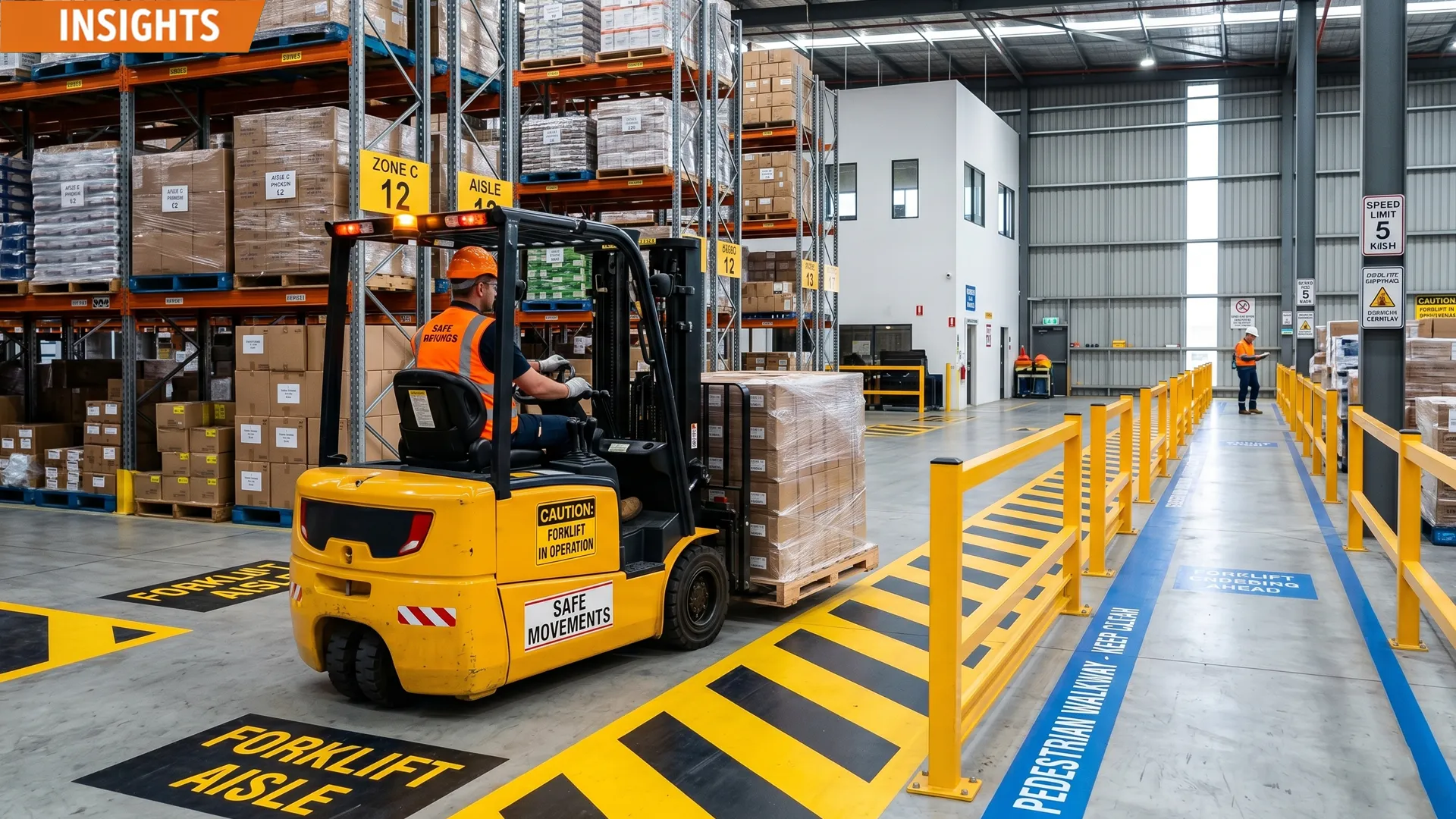
Most forklift incidents do not start with one dramatic decision.
More often, they build through smaller habits that settle into everyday behaviour on the warehouse floor.
That might look like:
- rounding corners a bit too quickly
- relying on memory instead of visibility
- cutting too close to pedestrian areas
- becoming casual in familiar zones
- skipping warnings because “nothing usually happens there”
- or treating busy traffic pressure as normal enough to work around
Across Melbourne’s South-East, forklifts are part of daily operations in warehousing, logistics, dispatch, replenishment, and industrial floor movement. Because they are so familiar, there is always a risk that unsafe behaviour starts to feel routine instead of risky.
That is why good employers do not only focus on:
- licences
- pre-start checks
- and basic induction
They also pay close attention to driving behaviour once the shift is underway.
Because on an active warehouse floor, even small habits matter.
A forklift operator may be licensed, experienced, and technically capable. But if poor habits start becoming normal, the site can still become exposed very quickly through:
- weaker traffic control
- more near misses
- poorer pedestrian interaction
- and reduced supervisor confidence in how the floor is being managed
Good supervisors notice these patterns early.
That is one of the biggest differences between a site that stays in control and a site that slowly becomes too casual around forklift risk.
For the broader employer overview, see our forklift safety and licence checks in Victoria pillar guide on licence fit, induction, traffic control, and first-shift supervision.
Why Small Driving Habits Matter So Much
Unsafe forklift behaviour does not always look dramatic.
Sometimes it looks like:
- shaving a corner slightly
- travelling a little faster than conditions allow
- getting comfortable in blind areas
- delaying warning use
- or assuming other people on the floor will move out of the way
That is what makes these habits dangerous.
They often begin as:
- convenience
- confidence
- familiarity
- or pressure to keep movement flowing
But when repeated often enough, they can weaken:
- operator judgement
- pedestrian trust
- traffic discipline
- and the site’s margin for error
Good employers understand that a forklift incident is often preceded by:
- repeated small shortcuts
- repeated close calls
- or repeated behaviour that was visible but never corrected properly
That is why the goal is not just to respond after a serious event.
It is to recognise the habits that increase risk before they become part of the floor culture.
Where These Habits Usually Show Up
Poor forklift driving habits tend to become more visible in pressure areas such as:
- aisle intersections
- dock approaches
- dispatch lanes
- replenishment zones
- pallet staging areas
- blind corners
- roller door entries
- and mixed traffic spaces where pedestrians still move nearby
They also tend to increase during:
- busy dispatch periods
- shift changeovers
- late afternoon fatigue
- stock overflow periods
- rushed replenishment windows
- and times when supervisors are stretched across too much floor activity
That is why forklift behaviour should always be reviewed in real operating conditions, not just in theory.
A driver who looks controlled in a quiet part of the warehouse may behave very differently in a congested or pressured zone.
10 Common Forklift Driving Habits That Increase Risk
1. Taking Corners Too Fast

This is one of the most common risk habits on warehouse floors.
It often develops because:
- the operator knows the route well
- the corner feels routine
- the shift is moving quickly
- or nothing bad has happened there before
But corners matter because they often reduce:
- visibility
- reaction time
- and stopping margin
That is especially important around:
- aisle ends
- crossings
- blind intersections
- and areas where pedestrians may still appear unexpectedly
A forklift that rounds corners too quickly reduces the site’s ability to avoid a close call before it becomes something worse.
2. Relying on Familiarity Instead of Active Awareness
A familiar floor can make operators less cautious than they realise.
They may begin assuming:
- this crossing is usually clear
- no one is normally in that lane
- that dock area is usually quiet
- or the replenishment aisle behaves predictably
That kind of thinking can reduce active awareness.
Good forklift operation depends on reading what is happening now, not what usually happens.
When familiarity replaces attention, the risk of near misses rises quickly.
3. Cutting Too Close to Pedestrian Areas
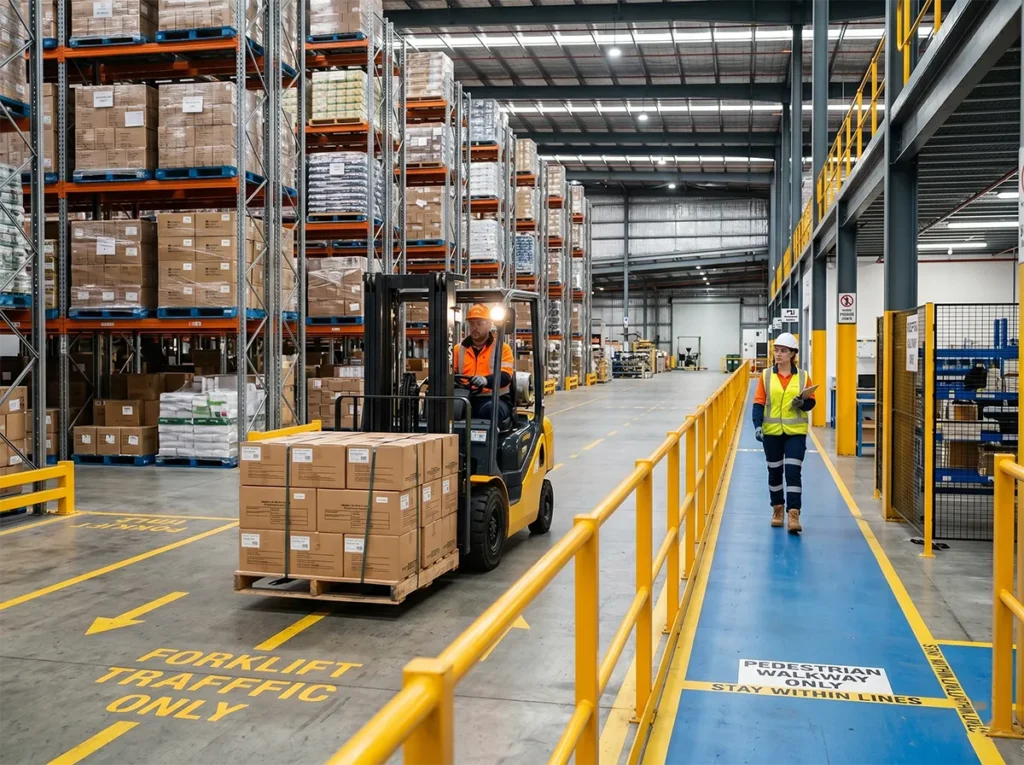
Even when there is no contact, a forklift moving too close to pedestrian space weakens traffic safety.
This may look like:
- passing too close to a walkway
- clipping the edge of a crossing line
- entering a mixed zone too aggressively
- or assuming pedestrians will hold their position and wait
This creates risk because pedestrians may:
- misread the operator’s path
- feel pressured into awkward movement
- or be forced into a narrower safe space than intended
Good employers treat this as a real behavioural issue, not just a minor style problem.
Our guide to warehouse traffic management shows how stronger layout, crossings, supervision, and site movement rules help reduce forklift and pedestrian risk.
4. Becoming Casual with Horn Use or Warnings
Warning devices matter most where visibility drops.
A common bad habit is inconsistent horn use:
- not sounding when approaching blind corners
- skipping it in familiar zones
- or using it too casually in some places and not at all in others
This weakens predictability on the floor.
Pedestrians and other operators are safer when warning behaviour is:
- consistent
- expected
- and tied clearly to the site’s higher-risk movement points
Casual warning use often signals that the operator has become too comfortable with local movement patterns.
5. Driving Too Fast for the Actual Conditions
A forklift does not need to be travelling wildly to be moving too fast.
Sometimes the real issue is that the speed is wrong for:
- the visibility
- the congestion
- the dock approach
- the stock staging
- the crossing point
- or the floor pressure at that moment
Operators sometimes judge speed based on what the machine can do rather than what the space safely allows.
Good employers review driving behaviour in context.
The question is not:
“Is this technically fast?”
It is:
“Is this speed appropriate for these conditions?”
6. Taking Shortcuts Through Non-Preferred Routes
When a site is busy, operators may start using routes that feel quicker but were not really intended for forklift travel.
This can include:
- tighter cut-throughs
- awkward turns around staged stock
- routes closer to pedestrian movement
- or crossing through areas that are only clear some of the time
This usually begins as a convenience habit.
But it can quickly create:
- poorer visibility
- weaker control
- tighter turning
- and more unpredictable interaction with people and stock
Good supervisors do not ignore shortcut routing just because it seems to save time.
7. Poor Reversing Awareness
Reversing is a point where control and awareness matter a lot.
Risk tends to increase when operators:
- assume the path behind them is clear
- begin reversing before checking properly
- rely too much on routine
- or reverse through pressure areas too casually
This is especially important in:
- congested aisles
- dock zones
- staging areas
- and mixed movement spaces
A weak reversing habit may look minor for a long time — until the one moment when visibility, timing, and pedestrian behaviour do not line up.
8. Letting Pressure Change Driving Standards
Busy periods often reveal the real driving culture on a site.
When dispatch pressure rises or replenishment is behind, some operators may:
- rush corners
- reduce caution at crossings
- take tighter turns
- delay proper warning use
- or treat safe spacing as less important than pace
This is where employers need to be careful.
A site’s forklift standard is not measured when everything is calm.
It is measured when the floor is busy and the operator still stays controlled.
If pressure changes behaviour too easily, the site is more exposed than it may appear.
9. Treating Near Misses as “Nothing Happened”
Near misses are often one of the clearest signs that a driving habit has become unsafe.
For example:
- a pedestrian steps back at the last second
- the forklift clears a corner more tightly than it should
- the operator brakes harder than expected near a crossing
- or visibility issues create repeated close calls without actual contact
If these events are treated as normal or ignored because no injury occurred, the operator and the site both lose a valuable warning.
Good employers use near misses to identify habits that need correction before something more serious forces the issue.
Our article on near miss reporting in warehousing and manufacturing explains why small incidents often reveal bigger control gaps before a serious injury occurs.
10. Becoming Less Disciplined in Familiar Areas of the Site
Some operators become most casual in the parts of the warehouse they know best.
That may include:
- regular replenishment lanes
- familiar staging zones
- the same dock approach every day
- or traffic areas they have moved through hundreds of times
This is risky because those areas often feel low-pressure right up until:
- another worker changes route
- stock blocks a sightline
- overflow staging appears
- or the shift behaves differently than usual
Good forklift safety depends on consistency.
A familiar area should not become the place where discipline drops.
What Good Employers and Supervisors Usually Watch For
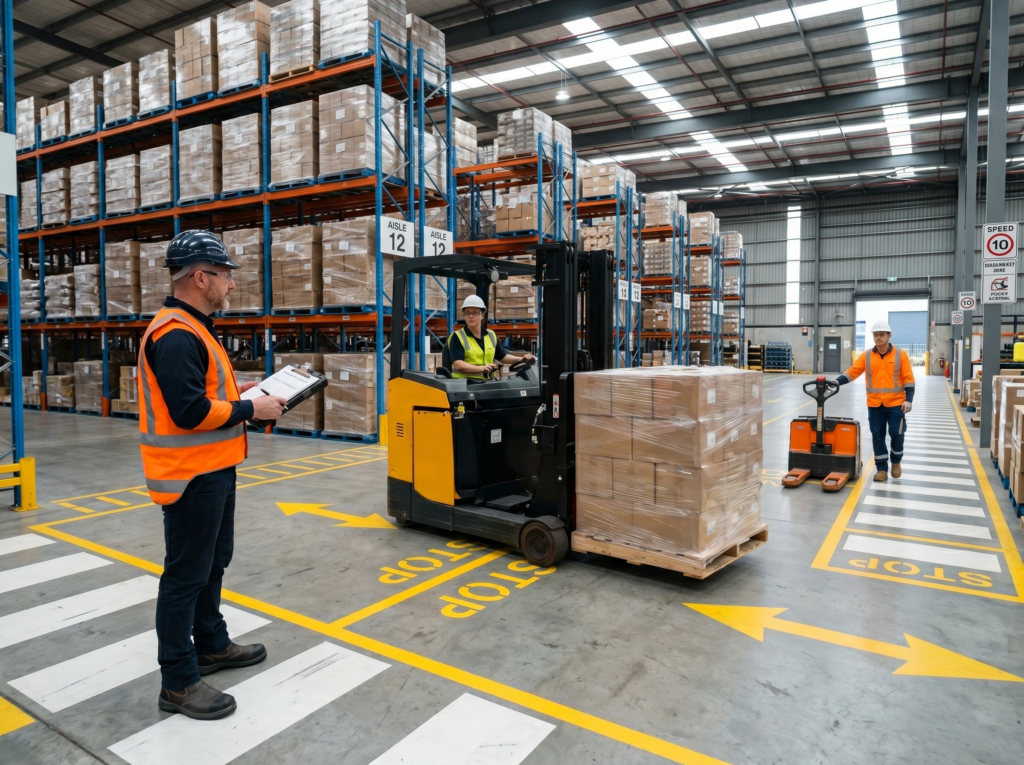
Good employers do not try to correct forklift risk only through general reminders.
They watch for specific behaviours.
That usually includes:
- how operators take corners
- how they approach crossings
- how they behave near pedestrians
- how they move during busy periods
- how consistently warnings are used
- whether they improvise routes
- and whether familiarity is making them too casual in routine areas
This is one of the reasons visible supervision matters so much.
Unsafe habits usually appear before incidents do.
A site that notices them early has a much better chance of staying in control.
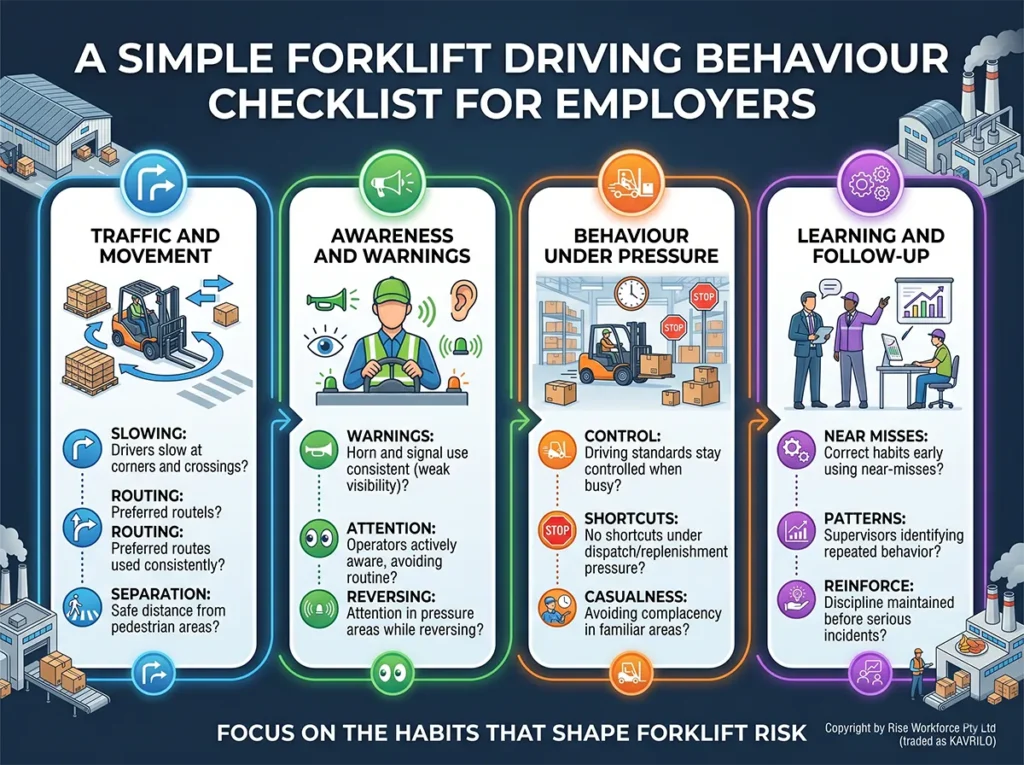
A Simple Forklift Driving Behaviour Checklist for Employers
Here is a practical checklist employers can use when reviewing forklift driving behaviour on site.
Traffic and Movement
- Are operators slowing properly at corners and crossings?
- Are they using preferred routes consistently?
- Are they keeping safer distance from pedestrian areas?
Awareness and Warnings
- Is horn use or warning behaviour consistent where visibility is weaker?
- Are operators staying actively aware rather than relying on routine?
- Is reversing being done with enough attention in pressure areas?
Behaviour Under Pressure
- Do driving standards stay controlled during busy periods?
- Are shortcuts appearing when dispatch or replenishment pressure rises?
- Are familiar areas causing operators to become too casual?
Learning and Follow-Up
- Are near misses being used to correct habits early?
- Are supervisors identifying repeated behaviour patterns?
- Is the site reinforcing driving discipline before something serious occurs?
This kind of checklist helps employers focus on the habits that actually shape forklift risk on the warehouse floor.
Final Word
Common forklift driving habits matter because serious risk often builds through repeated small behaviour, not one dramatic error.
For warehouse employers across Melbourne’s South-East, stronger control usually comes from:
- identifying poor habits early
- keeping supervision visible
- correcting routine shortcuts
- reinforcing traffic standards
- and not allowing familiarity to weaken awareness
That is what helps reduce:
- avoidable near misses
- weaker pedestrian interaction
- rushed movement
- and gradual loss of control on active warehouse floors
Because good forklift safety is not just about whether the operator can drive.
It is also about how they drive when the site is busy, familiar, and under pressure.
That is not just better supervision.
It is better warehouse discipline.
Need Practical Labour Hire Support for Warehousing and Manufacturing in Melbourne’s South-East?
KAVRILO is building its approach around safety-aware workforce support, clearer communication, and stronger operational discipline for warehouse and industrial environments.
Whether your site needs better shift coverage, stronger day-one worker readiness, or more dependable labour coordination for forklift-related work, KAVRILO is focused on practical workforce support that fits controlled warehouse and factory environments.
Need warehouse and factory labour hire support with stronger day-one readiness and a practical safety-aware approach? Talk to KAVRILO about workforce support across Melbourne’s South-East.
Article Disclaimer
This article is provided for general information only and does not constitute legal, workplace relations, safety, taxation, payroll or other professional advice. Please seek advice specific to your circumstances before acting on this information.
Please read our Website Disclaimer for more information.