
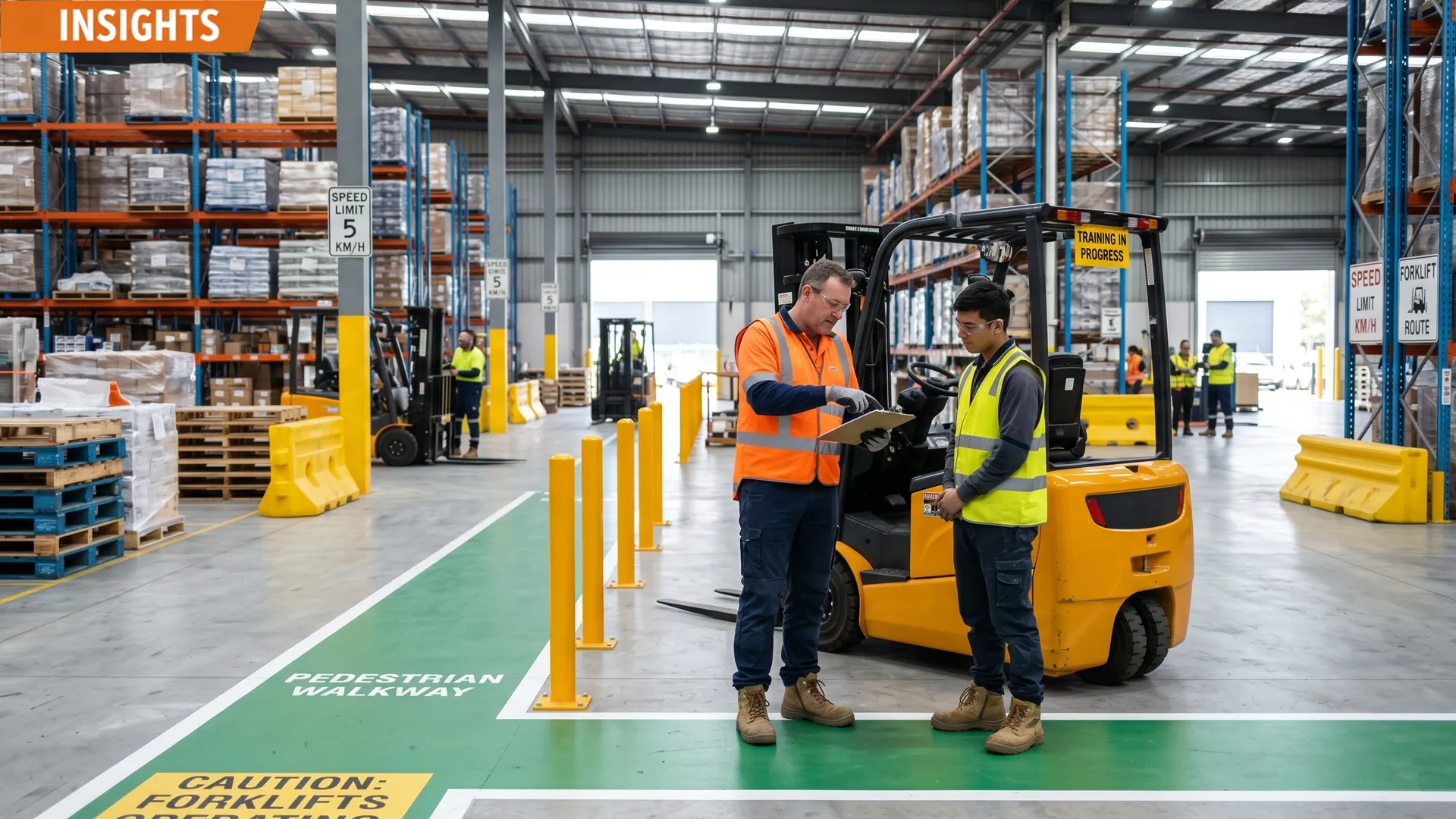
A temporary forklift operator can be licensed, experienced, and ready to work — and still be unfamiliar with your site in the ways that matter most.
That is why integration matters.
Across Melbourne’s South-East, many warehouse and logistics sites use temporary forklift operators to help with:
- demand spikes
- shift gaps
- seasonal pressure
- absenteeism
- project work
- and fast-moving operational changes
That flexibility can support the business well. But it also creates one clear safety challenge:
how do you bring a temporary operator into an active warehouse without asking them to guess how your floor works?
Because they may not yet know:
- your traffic logic
- your busiest crossings
- your local blind spots
- your dock pressure
- your site habits
- your supervisor structure
- or the standards your regular team already understands without thinking
This is where safety culture becomes practical.
A strong site culture is not just something permanent staff “already know”.
It is something that needs to be shown clearly to the people entering the site now.
That includes temporary forklift operators.
Good employers do not leave this to chance.
They make safety culture visible through:
- induction
- supervision
- movement control
- reporting clarity
- and consistent expectations from the first shift
That is how temporary support becomes safer, more settled, and easier to manage under pressure.
For the broader employer overview, see our forklift safety and licence checks in Victoria pillar guide on licence fit, day-one readiness, traffic control, and first-shift supervision.
Why Temporary Operators Need Stronger Site Integration
A temporary forklift operator may know how to operate the machine.
That does not mean they know how your warehouse operates.
This is where some sites get caught out.
They assume that because the operator is:
- licensed
- experienced
- and confident
they will settle in safely with minimal site-specific support.
Sometimes that works.
Often it creates avoidable exposure.
That is because forklift safety depends partly on:
- the operator
but also heavily on: - the floor
- the traffic design
- the local pressure points
- the supervisor response
- and the site’s ability to make its own expectations clear
A temporary operator enters that environment without the background knowledge your regular staff already have.
That is why the safest sites do not simply “allow them to start”.
They integrate them properly.
What Safety Culture Means in Practical Warehouse Terms
Safety culture can sound abstract.
On an active warehouse floor, it is not.
In practical terms, it usually shows up through:
- how traffic rules are followed
- how crossings are respected
- how warnings are used
- how supervisors respond to unsafe habits
- how near misses are reported
- how clutter or blocked walkways are handled
- and whether site expectations stay consistent when the floor is under pressure
A temporary operator will notice this quickly.
If the site says one thing in induction but regular staff do another, the temporary operator receives a mixed message.
That is where integration weakens.
A stronger safety culture is one that:
- makes the rules visible
- reinforces them consistently
- and helps a new operator understand how this site actually works before movement begins
That is what temporary operators need to enter the floor with more control and less uncertainty.
10 Practical Ways to Integrate Temporary Forklift Operators More Safely
1. Start With the Actual Role, Not Just “Forklift Driver”
A temporary placement becomes weaker when the role is described too broadly.
A stronger setup starts with clarity about:
- what forklift task the operator will perform
- what area of the site they will work in
- how busy the traffic conditions are
- whether the role involves dock work, replenishment, or mixed movement
- and what level of pace or pressure the shift carries
This matters because “forklift driver” can mean very different things depending on:
- the warehouse layout
- the stock profile
- the aisle access
- the dock exposure
- and whether pedestrians and plant overlap frequently
Good integration starts before the operator arrives.
It begins with a clearer role picture.
2. Treat Site Induction as Part of Safety Culture, Not Just Compliance
A temporary forklift operator should not be expected to:
- read the floor by instinct
- copy others safely
- or work out your traffic culture while already moving
That is why induction matters.
A strong induction should show:
- traffic routes
- one-way systems
- crossings
- blind spots
- loading dock rules
- PPE expectations
- reporting pathways
- and who the operator goes to if something feels unclear
This is not just about passing on information.
It is how the site shows:
“This is how safety works here.”
Our article on forklift inductions for new and temporary operators explains what employers should cover on day one before an operator enters active traffic and warehouse movement.
3. Make Traffic Logic Easy to Understand on the First Shift

A temporary operator should not have to guess:
- which route is preferred
- where pedestrians appear most often
- what crossing carries the most pressure
- where visibility drops
- or which turns need more caution than they seem to at first glance
Good employers help by making traffic logic:
- visible
- practical
- site-specific
- and easy to follow under live shift conditions
This matters because traffic culture is one of the biggest parts of forklift safety culture.
If the operator cannot read the floor quickly, then the site is asking too much from memory and too little from control.
Our guide to warehouse traffic management shows how stronger movement rules, clearer layout, and better floor discipline reduce forklift and pedestrian risk.
4. Show What “Good” Looks Like on This Site
A temporary operator should be shown more than rules.
They should also be shown standards.
That means helping them understand what good operator behaviour looks like here, such as:
- slowing properly at corners
- using warnings consistently
- maintaining clear pedestrian separation
- reporting blocked crossings early
- not improvising routes
- and asking before entering unfamiliar or tighter movement zones
This helps the operator settle faster because they are not trying to interpret the site culture through observation alone.
It also reduces the risk of the operator bringing habits from another site into the wrong environment here.
5. Make Supervision More Visible Early
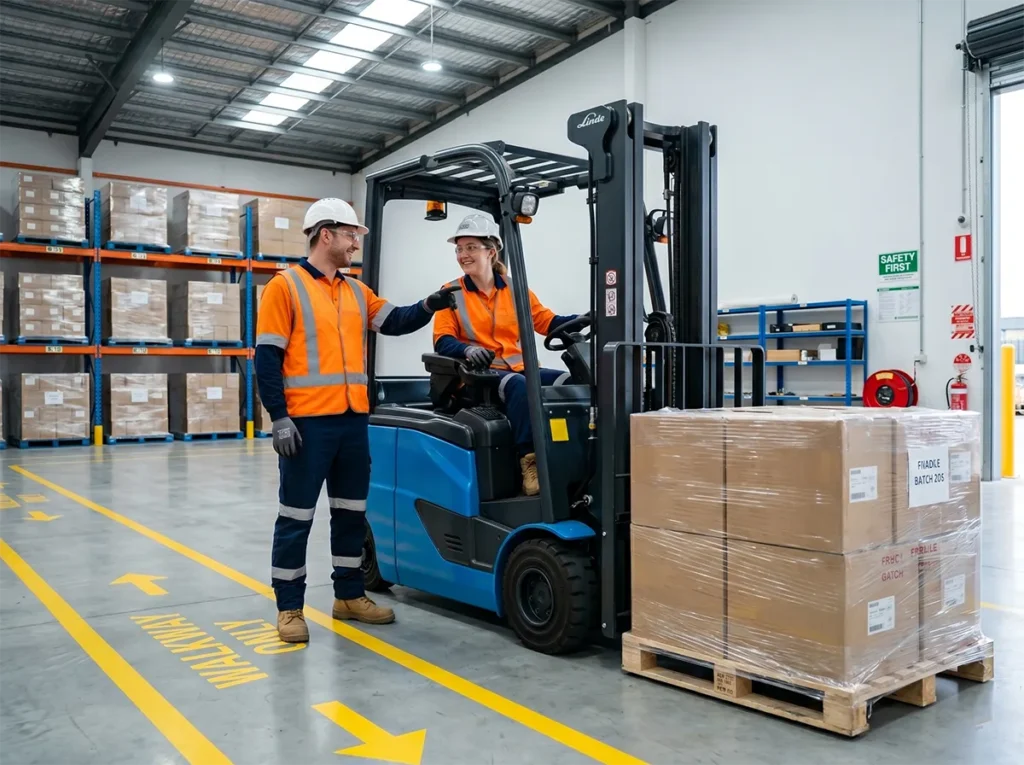
A temporary forklift operator does not need to be left alone to prove competence.
In fact, the opposite is usually safer.
Good employers make sure:
- the operator knows who supervises them
- the supervisor is visible during the early shifts
- local questions can be raised quickly
- and poor assumptions are corrected before they become routine
This is especially important in:
- busy dispatch periods
- tight aisle environments
- higher pedestrian overlap areas
- and any site where the floor is harder to read under pressure
Visible early supervision is one of the strongest practical integration controls you have.
6. Keep Regular Staff and Temporary Operators Under the Same Standards

One of the easiest ways to weaken integration is to create two different rule systems:
- one for regular staff
- and one looser or vaguer system for temporary operators
That creates confusion quickly.
A stronger site reinforces the same standards for:
- traffic movement
- warning use
- PPE
- reporting
- crossings
- speed control
- and supervisor expectations
A temporary operator integrates better when they can see that the site’s standards are:
- real
- consistent
- and applied across the floor
That builds trust faster than a site where formal rules exist but everyday behaviour tells a different story.
7. Encourage Reporting Early, Not After a Problem Escalates
A temporary operator should know:
- what to report
- who to tell
- and that speaking up early is expected, not awkward
That includes:
- near misses
- visibility issues
- blocked routes
- equipment concerns
- poor pedestrian behaviour
- and any area where the operator feels the movement pattern is less safe than it should be
This matters because temporary operators often see things fresh.
They may notice:
- confusion points
- weak sightlines
- poor crossings
- or unsafe floor habits
that long-term staff have become used to.
A good site uses that information, not silence.
Our guide to near miss reporting in warehousing and manufacturing explains why small warnings often reveal bigger control gaps before a more serious incident occurs.
8. Do Not Assume Confidence Means Full Site Readiness
Some temporary operators arrive looking highly confident.
That can be a strength.
It can also hide risk if the site assumes confidence equals full site adaptation.
An operator can appear comfortable and still be:
- unclear on local traffic pressure
- unfamiliar with your dock routine
- too casual in a blind corner they have not yet learned properly
- or unsure who to tell when something does not look right
Good employers do not confuse confidence with full site integration.
They still make:
- induction visible
- supervision accessible
- and standards explicit from the beginning
9. Review How the Placement Is Actually Settling In
Integration should not stop once the first briefing is over.
Good employers review early:
- whether the operator is following preferred routes
- whether crossing behaviour is consistent
- whether warning use is aligned with the site standard
- whether the operator understands the local pace
- and whether supervisors are having to correct the same basics repeatedly
This helps the site identify:
- whether the placement is settling well
- whether the induction was strong enough
- or whether something in the setup needs tightening
That is how culture becomes operational, not just verbal.
10. Use Temporary Operators to Strengthen, Not Dilute, Site Discipline
A busy site can sometimes become more casual because the operator is temporary.
That may look like:
- weaker briefing
- looser supervision
- relaxed route control
- or tolerance of behaviour that would normally be corrected
That is a mistake.
Temporary forklift operators should not lower the site standard.
They should be brought into it clearly.
Good employers use temporary placements as a reason to strengthen:
- clarity
- visibility
- consistency
- and floor discipline
That is what protects both the operator and the site.
What Good Integration Usually Looks Like in Practice
A temporary operator who is being integrated well usually experiences:
- a clear start
- a practical induction
- visible traffic logic
- stronger early supervision
- simple reporting expectations
- and a site that behaves consistently with what it says
From the employer side, good integration usually feels:
- calmer
- easier to supervise
- easier to correct early
- and less exposed to awkward first-shift uncertainty
It should not feel like:
- the operator is figuring out the floor alone
- different supervisors are saying different things
- or the site is only noticing the gaps after a near miss or repeated correction
A strong safety culture is easier to recognise when a temporary operator can read it quickly and work inside it without confusion.
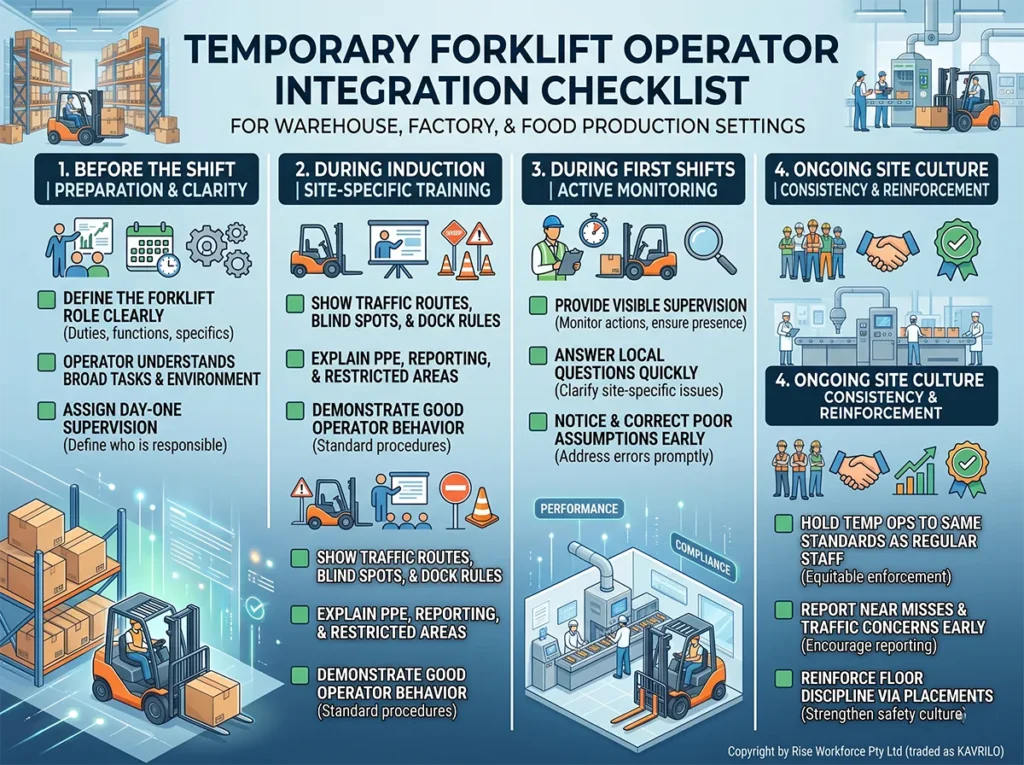
A Simple Temporary Forklift Operator Integration Checklist
Here is a practical checklist employers can use when bringing temporary forklift operators onto site.
Before the Shift
- Have we defined the actual forklift role clearly?
- Does the operator understand the broad task and environment?
- Do we know who owns day-one supervision?
During Induction
- Have traffic routes, crossings, dock rules, and blind spots been shown clearly?
- Are PPE, reporting, and restricted areas explained properly?
- Have we shown what good operator behaviour looks like on this site?
During the First Shifts
- Is supervision visible enough?
- Are local questions being answered quickly?
- Are poor assumptions or repeated corrections being noticed early?
Ongoing Site Culture
- Are temporary operators being held to the same standards as regular staff?
- Are near misses or traffic concerns being reported early?
- Is the site using temporary placements to reinforce, not weaken, floor discipline?
This kind of checklist helps employers make temporary forklift integration safer, clearer, and more controlled under real operating conditions.
Final Word
Integrating temporary forklift operators into your existing safety culture matters because site familiarity is one of the biggest parts of forklift safety.
For warehouse employers across Melbourne’s South-East, stronger integration usually comes from:
- clearer role setup
- better induction
- visible traffic logic
- stronger early supervision
- more consistent floor standards
- and simpler reporting from the first shift onward
That is what helps reduce:
- weak onboarding
- awkward movement decisions
- mixed messages
- avoidable near misses
- and preventable first-shift exposure in active warehouse environments
Because a temporary operator can be capable and still be new to your floor.
That is exactly why your safety culture needs to be visible enough for them to step into it safely from the beginning.
That is not just better onboarding.
It is better warehouse control.
Need Practical Labour Hire Support for Warehousing and Manufacturing in Melbourne’s South-East?
KAVRILO is building its approach around safety-aware workforce support, clearer communication, and stronger operational discipline for warehouse and industrial environments.
Whether your site needs better shift coverage, stronger day-one worker readiness, or more dependable labour coordination for forklift-related work, KAVRILO is focused on practical workforce support that fits controlled warehouse and factory environments.
Need warehouse and factory labour hire support with stronger day-one readiness and a practical safety-aware approach? Talk to KAVRILO about workforce support across Melbourne’s South-East.
Article Disclaimer
This article is provided for general information only and does not constitute legal, workplace relations, safety, taxation, payroll or other professional advice. Please seek advice specific to your circumstances before acting on this information.
Please read our Website Disclaimer for more information.