
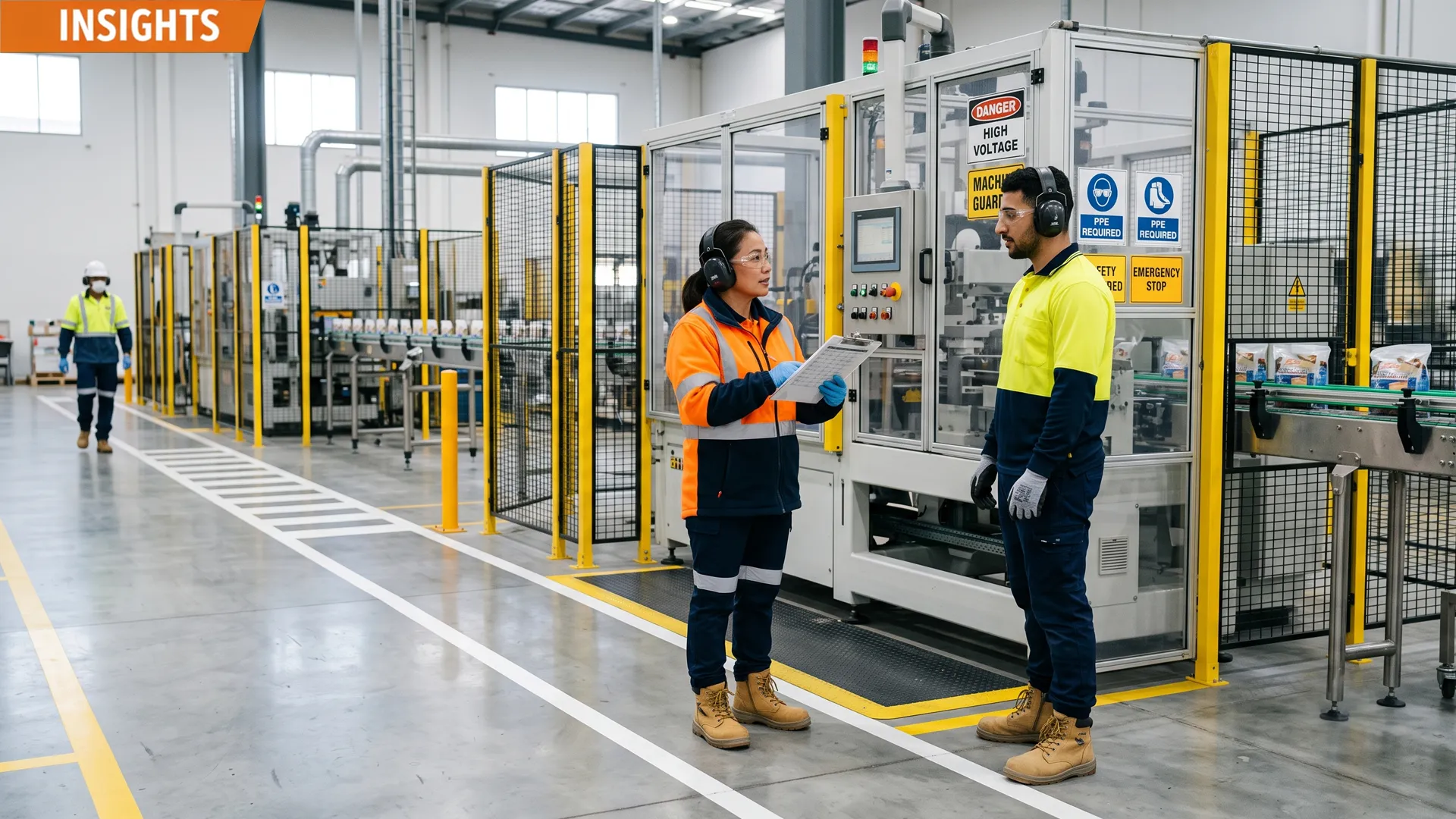
When hiring a machine operator, it is natural for employers to ask:
“Does this worker have experience?”
That is a useful question.
But it is not the only question.
A worker may have years of machine operator experience and still need further instruction, familiarisation or supervision before operating your specific machinery safely.
This is because machine operator competency is not only about time spent in factories.
It depends on whether the worker can safely perform the actual task, on the actual equipment, in the actual workplace, under the actual site procedures.
That distinction matters.
A worker may have experience with:
- packaging machines
- filling lines
- labelling equipment
- food production machinery
- cutting or forming equipment
- processing machines
- semi-automated production lines
- warehouse equipment
- general factory machinery
But that does not automatically mean they are competent on your machine.
Different workplaces can have different:
- controls
- guards
- emergency stops
- product flow
- operating speeds
- cleaning requirements
- changeover processes
- quality checks
- fault-reporting procedures
- manual handling demands
- supervision levels
- site rules
Experience is valuable, but experience alone can create dangerous assumptions.
A stronger approach is to ask:
“Can this worker perform this role safely, with the right instruction, controls and supervision for this workplace?”
That is where proper competency thinking begins.
For a broader employer overview, read our guide to machine operator labour hire in Melbourne, which explains role matching, site induction and shared safety responsibilities in labour hire placements.
Why Experience Alone Can Be Misleading
Experience is often used as a shortcut.
Employers may assume that if someone has worked as a machine operator before, they can quickly move into another machine operator role.
Sometimes that may be true.
But not always.
Experience can be misleading when the employer does not know:
- what machine the worker operated
- how similar the previous machine was
- whether the worker operated independently
- whether they performed setup or only basic monitoring
- whether they were allowed to adjust settings
- whether they completed changeovers
- whether they handled faults or only reported them
- whether they worked under close supervision
- whether the previous site had strong safety procedures
- how long ago the experience occurred
A worker may honestly say:
“I have machine operator experience.”
But that phrase may mean very different things.
It might mean they were a fully authorised operator on one specific machine.
It might mean they assisted another operator.
It might mean they worked near machinery but did not control it.
It might mean they operated only under supervision.
It might mean they completed production checks but not machine setup.
This is why employers should go deeper than job titles.
The real question is not whether the worker has machine experience.
The real question is whether the worker’s experience matches the machinery, duties, risks and expectations of the role being offered.
What Machine Operator Competency Usually Involves
Machine operator competency is practical.
It is not just a certificate, a resume line or a number of years.
Depending on the role, competency may involve:
- understanding the machine’s purpose
- knowing the normal operating process
- following site-specific instructions
- recognising common faults or abnormal conditions
- understanding guards and safety controls
- knowing emergency stop locations
- knowing what tasks are authorised
- knowing what tasks are not authorised
- using PPE correctly
- following manual handling requirements
- reporting hazards and defects
- completing quality checks
- communicating with supervisors
- stopping work when something is unsafe or unclear
A competent worker should know the limits of their role.
That is important because machine operation can involve tasks that look simple but carry higher risk.
For example:
- clearing jams
- adjusting settings
- cleaning machine parts
- changing products
- removing guards
- assisting maintenance
- restarting after faults
- loading awkward materials
- working near moving parts
A worker may be competent to monitor a machine but not competent to clear a fault.
A worker may be competent to operate under supervision but not independently.
A worker may be competent on one machine but not another.
Good employers recognise these differences before the placement begins.
1. Check the Actual Machine, Not Just the Job Title
The first competency check is the machine itself.
Do not rely only on the title “machine operator”.
Ask:
- What machine will the worker use?
- What does the machine do?
- What products or materials are involved?
- Is the machine manual, semi-automatic or automatic?
- Does the worker load or unload the machine?
- Is the worker expected to adjust settings?
- Are changeovers required?
- Is cleaning required?
- Are quality checks part of the role?
- Is the machine connected to a production line?
- Are there high-speed, cutting, crushing, heat, pressure or entanglement risks?
- Are food safety or hygiene controls involved?
These details matter because experience does not transfer equally across machines.
A worker who operated packaging machinery may not be competent to operate cutting equipment.
A worker who monitored a line may not be competent to perform setup.
A worker who worked with one product may not understand the risks created by another material.
The more specific the machinery information, the better the competency discussion.
Our article on what to check before hiring a machine operator explains the practical role, machinery and site-readiness questions employers should ask before engaging workers.

2. Check What Duties the Worker Is Expected to Perform
Machine operator roles can vary significantly.
Before deciding whether a worker is competent, employers should separate the duties clearly.
The role may involve:
- basic monitoring
- normal operation
- loading materials
- unloading finished products
- checking product quality
- recording production information
- cleaning work areas
- reporting machine faults
- changing product batches
- adjusting speed or settings
- clearing minor jams
- performing setup
- completing changeovers
- assisting maintenance
These duties are not equal.
A worker may be competent for some tasks but not others.
For example:
- A worker may safely monitor a machine but not adjust settings.
- A worker may load materials but not perform changeovers.
- A worker may identify defects but not troubleshoot equipment.
- A worker may clean the surrounding work area but not clean internal machine parts.
- A worker may report a jam but not clear it.
This is why the role should be described accurately.
If the job brief says “basic machine operation” but the real job includes setup, changeovers, fault clearing and cleaning, the worker may be placed into tasks they were not selected or prepared for.
Good competency checking starts with honest duty description.
3. Check Whether Previous Experience Is Similar Enough
Relevant experience is useful only if it is similar enough to the current role.
Employers should consider whether the worker’s experience matches:
- machinery type
- product type
- speed of production
- workplace environment
- hygiene requirements
- level of automation
- manual handling demand
- level of supervision
- fault-reporting process
- quality-control requirements
- shift conditions
- operating procedures
A worker may have strong experience in a slower, lower-risk environment but need support in a faster or more controlled production site.
A worker may have food production experience but not machine setup experience.
A worker may have operated one brand or type of machine but need familiarisation on a different model.
A worker may have been competent at a previous workplace because they knew that site’s procedures well, but still be new to your procedures.
The question is not whether their experience is “good” or “bad”.
The question is whether it is relevant to the actual work you need performed.
4. Check Whether Competency Is Current
Experience can become outdated.
A worker may have used a certain machine years ago but not recently.
Since then, the worker may have forgotten details, or the machinery may have changed.
Competency may need review where:
- the worker has not operated similar machinery recently
- the machine type is different
- the production process has changed
- new safety controls are in place
- the worker has been away from factory work
- the site uses different procedures
- the role involves higher production speed
- the worker is returning after injury or extended absence
- the work now includes new duties
This does not mean the worker is unsuitable.
It means employers should be careful before assuming past experience is enough.
A short familiarisation or supervised start may be enough in some cases.
In other cases, more structured training or assessment may be needed.
5. Check Training, Familiarisation and Site Instructions
Competency usually depends on instruction.
A worker needs to understand how the work is done at your site.
This may include:
- site induction
- machine-specific familiarisation
- supervised demonstration
- safe operating procedure review
- PPE instruction
- emergency stop location
- guarding expectations
- fault-reporting process
- authorised task boundaries
- manual handling requirements
- cleaning rules
- quality requirements
- production documentation
- escalation process
Do not assume that a worker will know these things because they have operated machinery somewhere else.
A previous employer may have had different procedures.
A previous machine may have had different guards.
A previous supervisor may have allowed tasks that your site does not allow.
A previous workplace may have had weaker safety controls.
Site-specific instruction helps remove assumptions.
6. Check Whether the Worker Knows What They Are Not Allowed to Do
One of the most important parts of competency is knowing role boundaries.
A worker should understand not only what they can do, but also what they must not do.
This is especially important around machinery.
Employers should make clear whether the worker is authorised to:
- start the machine
- stop the machine
- adjust settings
- clear jams
- remove product from restricted areas
- open guards
- perform cleaning
- complete changeovers
- handle chemicals
- assist maintenance
- restart after a fault
- isolate equipment
- work alone
If the worker is not authorised to perform a task, that must be clear.
A worker who does not know the boundary may try to be helpful and create risk.
For example, a worker may attempt to clear a jam, adjust a guard or restart a machine because they want to keep production moving.
That is not a competency strength.
It can be a warning sign.
A competent worker respects limits and asks before acting outside instruction.

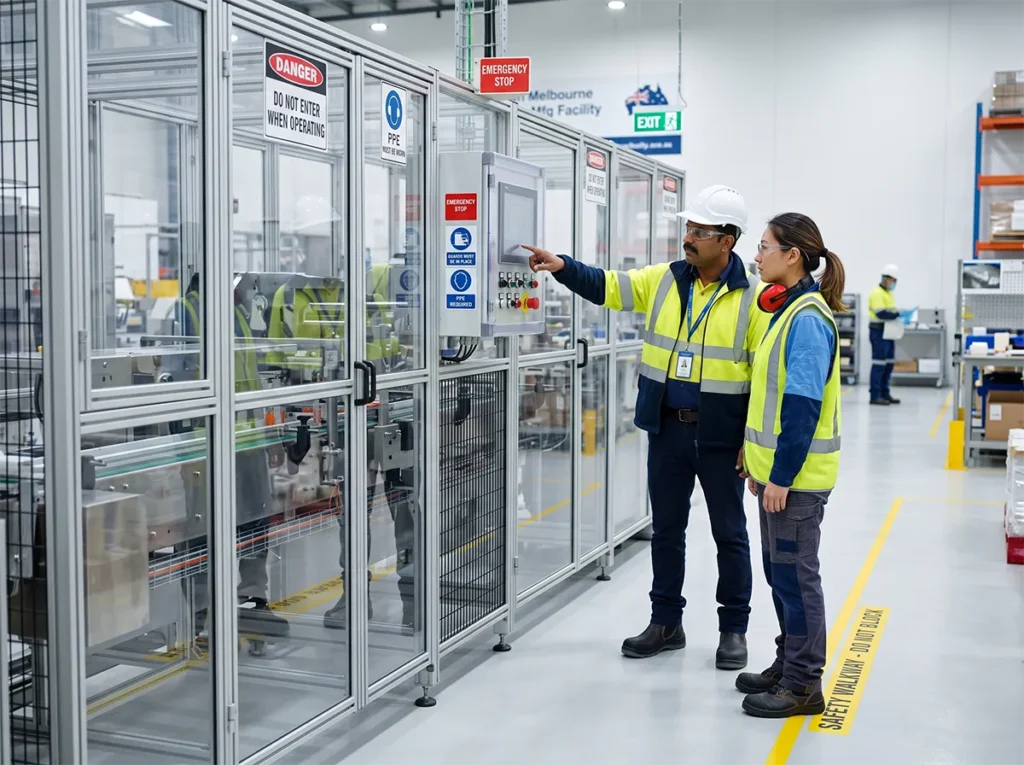
7. Check Understanding of Guards, Emergency Stops and Safety Controls
Machine operator competency must include safety controls.
A worker should understand the importance of:
- guards
- interlocks
- emergency stops
- exclusion zones
- warning signs
- safe access points
- lockout or isolation rules where relevant
- defect reporting
- safe distance from moving parts
Employers should make sure workers understand that guards and safety devices are not optional.
A worker should not be asked or permitted to:
- bypass guards
- defeat interlocks
- reach into moving machinery
- operate damaged equipment
- keep working with missing safety controls
- use unsafe shortcuts to maintain output
- clear faults outside their training or authority
Competency is not only about operating the machine when everything works normally.
It also includes knowing how to respond when something is abnormal.
A worker who keeps going despite a defect may not be competent for the task, even if they have years of experience.
8. Check Fault, Jam and Defect Reporting
Machine operation often becomes riskier when something goes wrong.
A worker may be competent during normal production but uncertain during faults.
Before work begins, clarify:
- what counts as a fault
- what counts as a defect
- when the machine should be stopped
- who the worker reports to
- whether the worker can clear minor issues
- what the worker must never clear
- whether maintenance must be called
- how defects are recorded
- whether damaged guards or emergency stops must be reported immediately
- what should happen if product quality changes
This is important because workers may feel pressure to keep the line moving.
A worker may try to solve a problem quickly, especially if they think reporting will slow production.
That pressure should be managed before it appears.
A safe reporting process protects the worker, the machine, the product and the employer.
9. Check Whether Supervision Matches the Risk
A worker may be competent with support but not yet competent to work independently.
This is normal.
Employers should think about the level of supervision required.
Consider:
- Is this the worker’s first shift?
- Is the machine new to them?
- Is the production process unfamiliar?
- Are changeovers involved?
- Are there significant moving-part risks?
- Is the line fast-paced?
- Is the worker from a different industry?
- Are language or communication issues possible?
- Is the role safety-critical?
- Is the worker being asked to work alone?
Supervision should match the risk and the worker’s familiarity.
The first shift is especially important.
A supervisor should be available to answer questions, observe early performance and correct misunderstandings.
Competency should not be assumed because the worker appears confident.
Confidence and competency are not the same.

10. Check Language, Communication and Instruction Quality
A worker may have experience but still misunderstand instructions if communication is unclear.
This can happen in any workforce.
It is especially important where workers:
- speak English as a second language
- are new to Australian workplaces
- are unfamiliar with site terminology
- are processing many instructions at once
- feel nervous asking questions
- are trying to impress the supervisor
- are working in noisy environments
Good communication may require:
- simple instructions
- demonstration
- checking understanding
- visual signs
- translated or multilingual support where appropriate
- repetition of critical safety points
- supervisor confirmation
- opportunity to ask questions
Do not rely only on a signed form.
A signature does not always prove understanding.
Employers should check whether the worker can explain the key points back in practical terms.
For machine work, misunderstanding can quickly become a safety or quality problem.
11. Check Whether Productivity Pressure Is Affecting Competency
Competency can be weakened by pressure.
A worker may understand the right procedure but take shortcuts when production speed increases.
Employers should watch for signs such as:
- rushing around moving equipment
- ignoring PPE
- skipping checks
- reaching into risky areas
- failing to report faults
- continuing despite unusual machine behaviour
- becoming fatigued
- missing quality problems
- copying unsafe shortcuts from others
A competent worker should know how to maintain safe behaviour under normal production pressure.
But employers also need to manage the pressure itself.
If the line speed, workload or supervision system encourages shortcuts, even experienced workers may be exposed to unnecessary risk.
Competency should be supported by realistic work design, not tested by unsafe expectations.
12. Check Whether Duties Change During the Placement
Competency should be reviewed when duties change.
A worker selected for one role may not be competent for another.
Review the placement if the worker is moved to:
- another machine
- another production line
- a different product
- a different process
- a different shift
- cleaning or washdown work
- setup or changeover tasks
- more complex quality checks
- work involving new hazards
- work with less supervision
This is a common issue in busy production environments.
A supervisor may think:
“They are already here; we can move them to another machine.”
But the worker may not have been screened, inducted or trained for that machine.
If duties change materially, the labour hire provider should be notified and the placement should be reviewed.
13. Check Documentation and Practical Evidence
Competency should not rely only on memory or assumption.
Depending on the role, useful records may include:
- resume details
- interview notes
- licence or ticket records where relevant
- training records
- induction records
- site familiarisation records
- supervisor observations
- practical assessment notes
- authorisation records
- task-specific sign-offs
- incident or performance notes
- refresher training records
Documentation does not need to be excessive, but it should be useful.
A practical question is:
“If a problem occurs later, can we show what information was provided, what was checked and what the worker was authorised to do?”
Good records help employers, workers and labour hire providers understand the placement more clearly.
They also reduce disputes about what was expected.
14. Check the Labour Hire Provider’s Role in Competency
If the worker is supplied through labour hire, both the host employer and labour hire provider need clear communication.
The host knows the machinery, site layout, hazards and operating requirements.
The labour hire provider may support worker screening, onboarding, communication and employment administration.
Before placement, the host should give the provider enough information to assess suitability.
This may include:
- machine type
- role duties
- required experience
- site hazards
- PPE
- manual handling
- induction requirements
- supervision arrangements
- shift details
- any required licences or tickets
- whether changeovers or fault clearing are involved
The provider should not be expected to guess what the role involves.
Likewise, the host should not assume the provider has verified machine-specific competency unless that process has been clearly discussed.
Good competency decisions come from shared information.
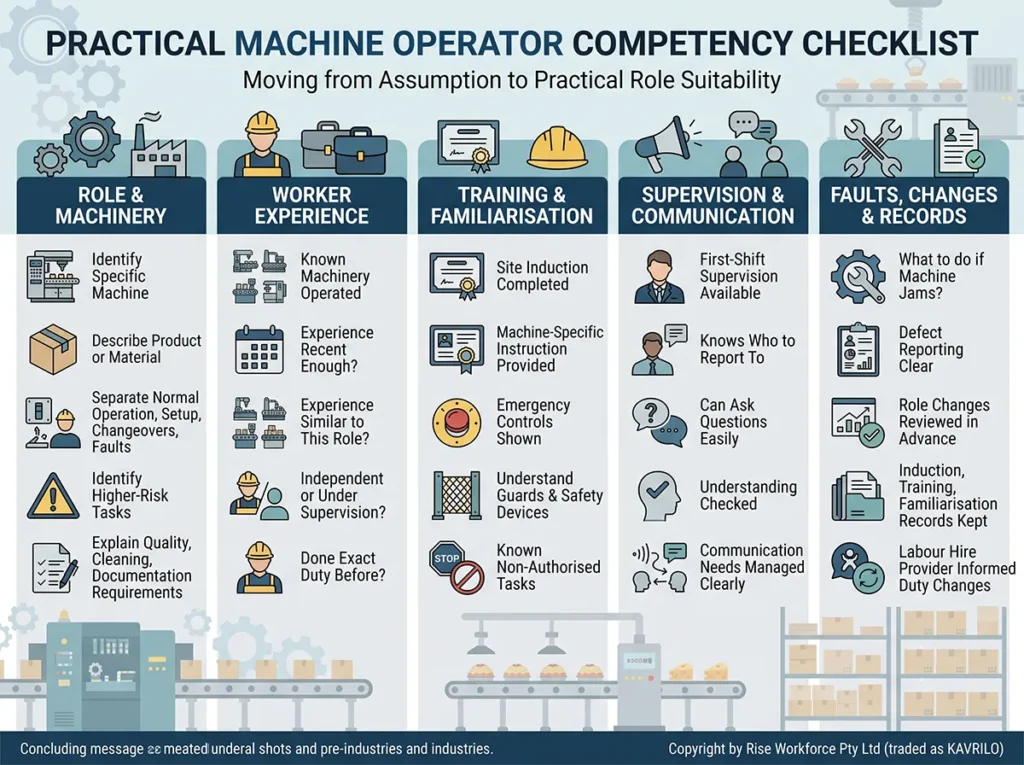
A Practical Machine Operator Competency Checklist for Employers
Use this checklist before allowing a worker to operate machinery.
Role and Machinery
- Have we identified the specific machine?
- Have we described the product or material?
- Have we separated normal operation from setup, changeovers and fault clearing?
- Have we identified any higher-risk tasks?
- Have we explained quality, cleaning or documentation requirements?
Worker Experience
- Do we know what machinery the worker has actually operated?
- Is the experience recent enough?
- Is the experience similar enough to this role?
- Did the worker operate independently or under supervision?
- Has the worker done this exact duty before?
Training and Familiarisation
- Has the worker completed site induction?
- Has machine-specific instruction been provided?
- Has the worker been shown emergency controls?
- Does the worker understand guards and safety devices?
- Has the worker been told what they are not authorised to do?
Supervision and Communication
- Is first-shift supervision available?
- Does the worker know who to report to?
- Can the worker ask questions easily?
- Has understanding been checked?
- Are communication needs being managed clearly?
Faults, Changes and Records
- Does the worker know what to do if the machine jams?
- Is defect reporting clear?
- Are role changes reviewed before they happen?
- Are induction, training or familiarisation records kept?
- Has the labour hire provider been told if duties change?
This checklist helps employers move from assumption to practical role suitability.
Final Word
Machine operator experience is useful, but it is not enough by itself.
A worker may have factory experience, production experience or previous machine experience and still need further training, familiarisation or supervision before safely operating your machinery.
Employers should check:
- what machinery is involved
- what duties are expected
- what the worker has actually done before
- whether the experience is current and relevant
- what training or familiarisation is needed
- what tasks the worker is authorised to perform
- what supervision is required
- how faults and hazards will be reported
- whether duties change during the placement
Machine operator competency should be treated as practical, task-specific and site-specific.
The best outcomes usually come from clear role information, honest experience checks, proper induction, realistic supervision and open communication between the host employer, worker and labour hire provider.
That is how employers reduce assumptions before they become safety, quality or production problems.
Need Machine Operators With Clearer Role Matching?
KAVRILO is building its approach around practical labour hire support for warehouse, factory, logistics and production environments.
If you need machine operators, it helps to provide clear information about the machinery, duties, shift conditions, experience requirements, PPE, supervision and site-specific risks.
The more accurate the role information is, the better the discussion around worker suitability and safe placement.
KAVRILO is preparing to operate in accordance with Victorian labour hire licensing requirements. Labour hire services will only be supplied where permitted under applicable law.
Need machine operator labour hire support with clearer competency expectations and stronger day-one readiness? Talk to KAVRILO about practical workforce support for Melbourne warehouse, factory and production environments.
Article Disclaimer
This article is provided for general information only and does not constitute legal, workplace relations, safety, taxation, payroll or other professional advice. Please seek advice specific to your circumstances before acting on this information. Please read KAVRILO’s Website Disclaimer for more information.