

Machine operator jobs can be a strong opportunity for job seekers who want practical work in manufacturing, packaging, food production, warehousing, logistics or general factory environments.
But employers usually look for more than someone who says:
“I have machine experience.”
That statement is too broad.
A machine operator may work around:
- moving parts
- guards and emergency stops
- production lines
- quality checks
- manual handling
- repetitive tasks
- packaging materials
- food hygiene rules
- cleaning procedures
- forklifts and pedestrian areas
- shift pressure
- site-specific safety instructions
Because of this, employers usually want workers who are not only experienced, but also careful, reliable and honest about what they can safely do.
A good machine operator is not someone who pretends to know every machine.
A good machine operator is someone who:
- understands their own experience
- listens carefully
- follows instructions
- asks questions when unsure
- reports faults early
- respects guards and safety controls
- works steadily without unsafe shortcuts
- communicates clearly with supervisors
This article explains what employers commonly look for when hiring machine operators and how job seekers can present themselves more professionally.
If you are looking for a broader overview, read our guide to machine operator jobs in Melbourne, which explains how job seekers can prepare for machine operator, factory and production work.
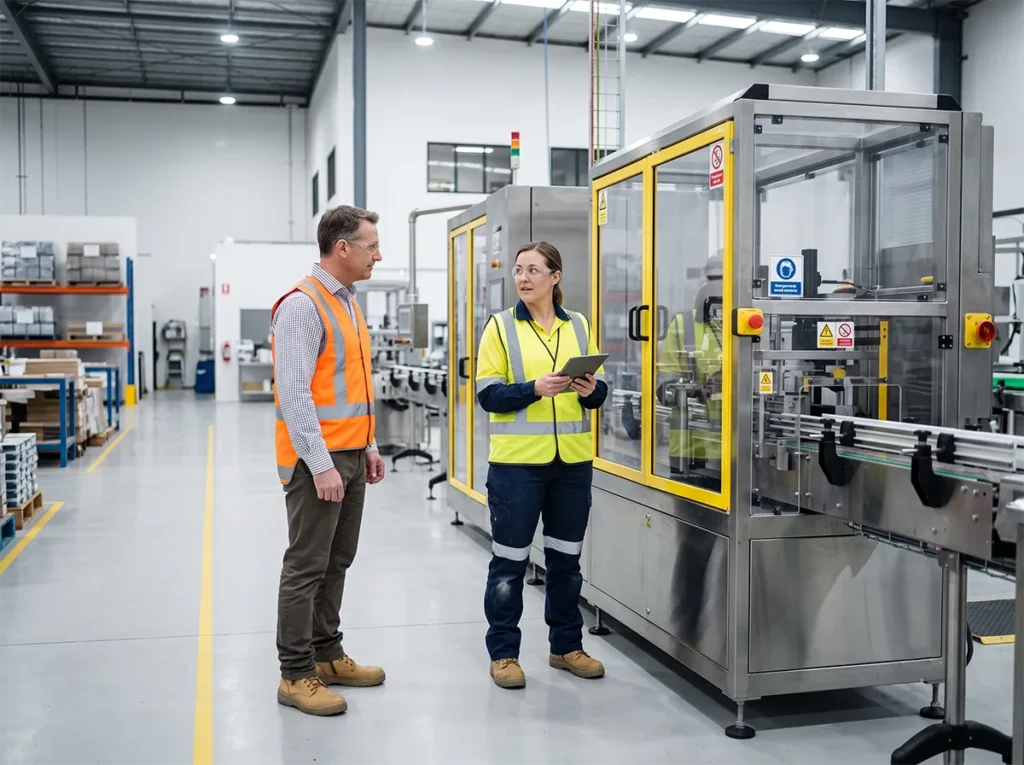
1. Relevant Machine or Production Experience
The first thing many employers look for is relevant experience.
But “experience” does not always mean the same thing.
Some job seekers have operated machinery independently. Others have assisted an operator, packed products near a machine, loaded materials, performed quality checks or worked on a production line without controlling the machine itself.
All of those experiences can be useful, but they should be described accurately.
Employers may want to know:
- what machine or equipment you used
- what product or material was involved
- whether you operated independently or under supervision
- whether you started or stopped the machine
- whether you loaded or unloaded materials
- whether you adjusted settings
- whether you performed changeovers
- whether you reported faults
- whether you completed quality checks
- whether you followed cleaning or hygiene procedures
A job seeker who explains experience clearly is easier to trust than someone who uses vague or exaggerated wording.
For example, instead of saying:
“I can operate all machines.”
A stronger statement would be:
“I have operated packaging machinery in a food production environment under site procedures, including product monitoring, basic quality checks and fault reporting to the supervisor.”
That gives the employer useful information.
2. Honest and Accurate Resume Information
Employers value honesty.
This is especially important for machine operator roles because overstating experience can create safety, quality and production problems.
Avoid vague resume lines such as:
- machine operator
- factory worker
- production experience
- worked with machines
- all-rounder
- can operate any machine
These may not tell the employer enough.
Better resume wording explains:
- the type of machine
- the industry
- the product or material
- your actual duties
- your level of supervision
- safety or quality responsibilities
For example:
- Operated packaging and labelling equipment in a fast-paced production environment
- Assisted with filling line operation under supervisor instruction
- Monitored product flow and reported jams or quality issues
- Followed PPE, hygiene and site safety procedures
- Completed basic quality checks and production paperwork
- Worked day and afternoon shifts in a manufacturing environment
This kind of wording shows maturity.
It also helps employers match you to the right role.
If you have not operated a particular machine, it is better to say so and show willingness to learn safely.
Employers usually prefer honest workers over workers who overclaim and then struggle on site.
3. Safety Awareness Around Machinery
Safety awareness is one of the most important qualities employers look for in a machine operator.
Machine operators may work near equipment that can create risk if instructions are ignored or shortcuts are taken.
Employers want workers who understand basic safety expectations such as:
- following site induction instructions
- wearing required PPE
- staying clear of moving parts
- respecting guards and safety devices
- reporting defects or unusual machine behaviour
- not clearing jams unless trained and authorised
- not bypassing safety controls
- keeping the work area tidy
- asking questions if unsure
- stopping and reporting unsafe conditions
A safety-aware worker does not treat safety as something separate from the job.
They understand that safety protects:
- themselves
- nearby workers
- production quality
- equipment
- the employer’s operations
- future work opportunities
One of the strongest signs of a good machine operator is the ability to stop and ask before doing something unsafe.
A worker who says, “I am not trained on this machine yet; can you show me the correct procedure?” is usually more valuable than a worker who guesses.

4. Ability to Follow Site-Specific Instructions
Every workplace is different.
Even if two factories use similar equipment, they may have different:
- machine controls
- emergency procedures
- PPE rules
- supervisor instructions
- reporting processes
- cleaning requirements
- product standards
- production speeds
- quality checks
- site access rules
Employers look for machine operators who can adapt to the site they are working in.
This means listening carefully during induction and not assuming that the new site works exactly like a previous workplace.
Good workers ask questions such as:
- Who do I report machine faults to?
- What am I authorised to do if the machine jams?
- Where are the emergency stops?
- What PPE is required in this area?
- Am I allowed to adjust settings?
- Who approves product changeovers?
- What should I do if I notice a quality issue?
- Who should I contact if I am unsure?
Asking questions early prevents confusion later.
Employers usually value workers who take instructions seriously and follow the site’s procedures instead of relying only on old habits.
5. Reliability and Attendance
Reliability is one of the biggest factors in labour hire and factory work.
Machine operator roles often form part of a production schedule. If a worker arrives late, misses a shift or leaves without proper notice, the impact can affect:
- production flow
- team workload
- supervisor planning
- output targets
- other workers
- client confidence
- future shift opportunities
Employers look for workers who:
- arrive on time
- confirm shifts properly
- bring required PPE
- understand the location before the shift
- communicate early if delayed
- avoid repeated last-minute cancellations
- follow attendance procedures
- stay professional across the whole shift
Good attendance builds trust.
For job seekers, this is important because one reliable placement can lead to more opportunities.
A worker who is punctual, steady and easy to communicate with is often remembered by supervisors.
6. Attention to Detail
Machine operator work often requires attention to small details.
A small mistake can affect:
- product quality
- packaging accuracy
- labels
- batch numbers
- measurements
- machine settings
- material flow
- hygiene standards
- customer requirements
- production records
Employers may look for workers who can notice:
- damaged packaging
- incorrect labels
- product defects
- unusual machine noise
- blocked material flow
- repeated jams
- missing PPE
- hygiene concerns
- wrong product or batch information
- unsafe movement around the work area
Attention to detail is especially important in food production, packaging, labelling and quality-sensitive manufacturing environments.
A good machine operator does not simply keep the machine moving.
They also pay attention to whether the work is being done correctly.
7. Communication With Supervisors and Team Members
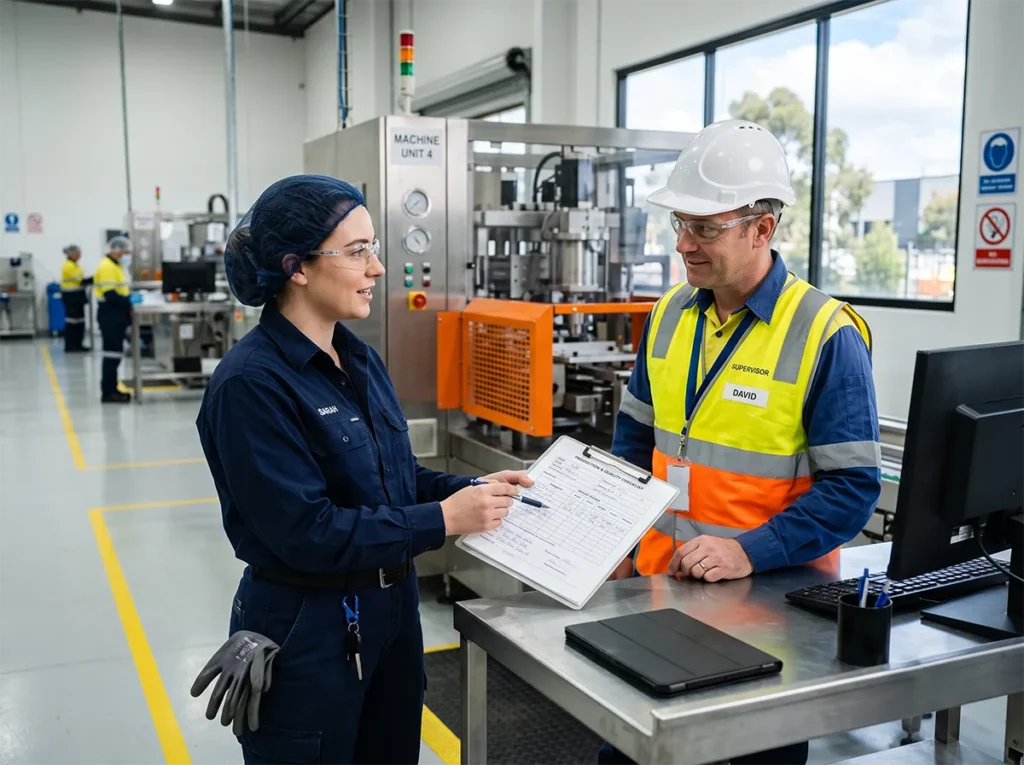
Employers look for machine operators who communicate clearly.
This does not mean being loud or talking constantly.
It means knowing when to speak up.
A good machine operator communicates when:
- they do not understand an instruction
- the machine behaves differently
- a fault or jam occurs
- product quality looks wrong
- PPE is missing or damaged
- a task appears unsafe
- they feel unwell or fatigued
- they are asked to do something outside their experience
- they are unsure who to report to
Poor communication can create bigger problems.
For example, a worker may notice a small issue but stay silent because they do not want to interrupt production. Later, the issue may become a safety incident, quality defect or equipment problem.
Employers usually prefer early reporting.
Clear communication shows responsibility.
It also helps supervisors solve issues before they become serious.
8. Willingness to Learn Safely
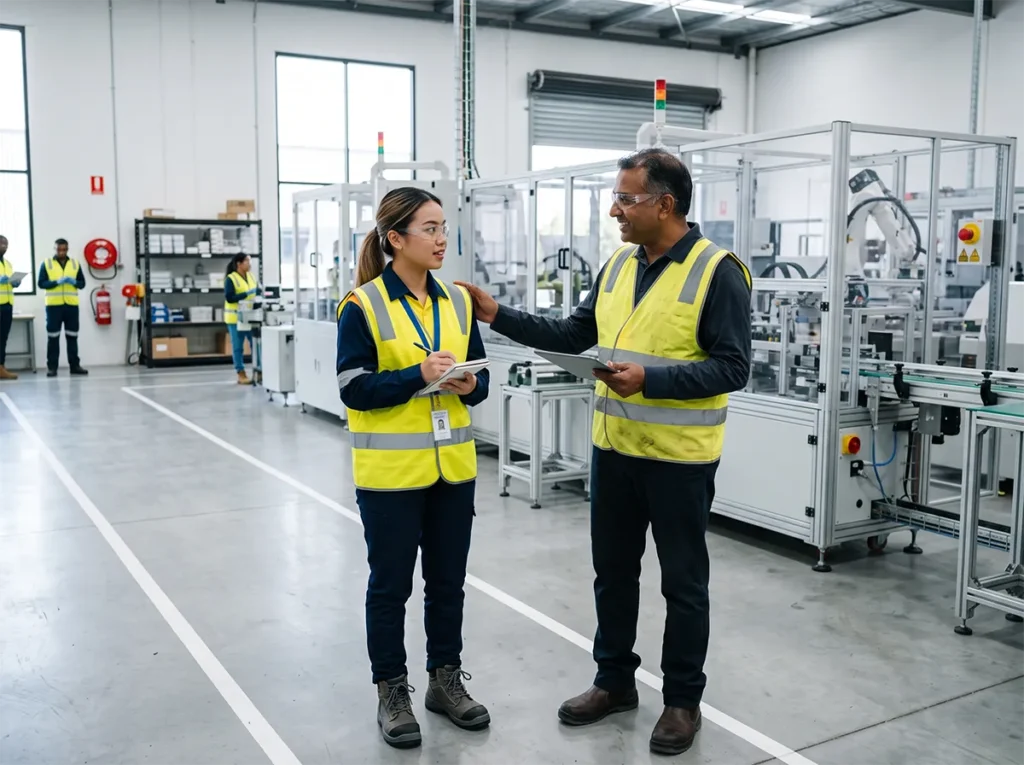
Many machine operator opportunities involve learning new site procedures.
Even experienced operators may need familiarisation when moving to a new workplace.
Employers look for workers who are open to learning but still careful about safety.
Good signs include:
- listening during induction
- asking practical questions
- accepting correction professionally
- not pretending to understand
- watching demonstrations carefully
- following supervisor instructions
- learning the site’s reporting process
- staying within authorised tasks
- taking feedback calmly
A worker who is willing to learn safely can be valuable even if they are not yet experienced on every machine.
The important point is attitude.
Employers want workers who can grow into a role without taking unsafe shortcuts.
9. Understanding of PPE and Workplace Presentation
PPE and presentation matter in machine operator work.
Depending on the site, required PPE may include:
- safety boots
- high-visibility clothing
- hearing protection
- eye protection
- gloves where suitable
- hair nets
- beard covers
- food production clothing
- cold-room clothing
- dust or respiratory protection
- other task-specific equipment
Employers look for workers who take PPE seriously.
This includes:
- wearing PPE correctly
- replacing damaged PPE
- following area-specific rules
- keeping clothing suitable for the work
- tying back long hair where required
- avoiding loose clothing or jewellery near machinery
- understanding that some PPE can be unsafe for certain machines if used incorrectly
In food production, PPE may also protect the product and production environment, not only the worker.
A worker who arrives prepared gives a better first impression.
10. Ability to Work at a Steady and Safe Pace
Machine operator roles often involve pace.
Employers want workers who can keep up with production without becoming careless.
A good pace means:
- working steadily
- following instructions
- maintaining quality
- avoiding panic
- staying aware of surroundings
- not rushing through safety steps
- reporting issues instead of hiding them
- keeping the work area controlled
Speed alone is not enough.
A worker who moves quickly but makes mistakes may create more problems than they solve.
Employers value workers who can balance:
- output
- safety
- quality
- teamwork
- communication
- reliability
In production environments, consistency is often more important than short bursts of speed.
11. Basic Problem Recognition
Employers do not expect every machine operator to be a mechanic or technician.
But they do want workers who can recognise when something is not right.
This may include noticing:
- unusual noise
- vibration
- product misalignment
- repeated jams
- leaking material
- damaged guards
- inconsistent product size
- incorrect packaging
- missing labels
- unsafe movement
- warning lights
- unexpected machine behaviour
The worker does not always need to fix the problem.
In many cases, the correct action is to stop, report and wait for instruction.
That is why problem recognition matters.
A machine operator who notices issues early helps protect safety, product quality and machine condition.
12. Respect for Role Boundaries
A good machine operator understands what they are authorised to do and what they are not authorised to do.
This is important because some tasks may require additional training, supervision or specialist personnel.
A worker should know whether they are allowed to:
- start the machine
- stop the machine
- adjust settings
- clear jams
- clean parts of the machine
- perform changeovers
- remove guards
- isolate equipment
- assist maintenance
- restart after a fault
- handle chemicals or cleaning products
Employers value workers who respect boundaries.
A worker who refuses to guess is not being difficult.
They are protecting themselves, the site and the employer.
If the role changes, the worker should ask for instruction and, where relevant, notify the labour hire provider.
13. Good Workplace Attitude
Attitude matters.
Employers often look for machine operators who are:
- respectful
- calm under pressure
- willing to listen
- reliable
- team-focused
- practical
- patient during training
- honest about mistakes
- careful with equipment
- consistent across the shift
- willing to follow reasonable instructions
A poor attitude can damage an otherwise good placement.
Examples of poor workplace attitude include:
- ignoring supervisors
- arguing about safety rules
- refusing PPE
- using a phone in active work areas
- blaming others immediately
- hiding mistakes
- rushing unsafely
- acting overconfident around unfamiliar machinery
A good attitude does not mean saying yes to unsafe work.
It means being professional, respectful and willing to communicate properly.
14. Readiness for Shift Work
Machine operator jobs in Melbourne may involve different shift patterns.
These can include:
- morning shift
- day shift
- afternoon shift
- night shift
- rotating rosters
- weekend work
- overtime
- short-notice shifts
- peak-season shifts
Employers look for workers who understand their real availability.
Before applying, job seekers should consider:
- transport
- sleep routine
- family commitments
- travel distance
- start time
- finish time
- fatigue
- whether they can attend consistently
- whether they can work the full shift
It is better to be honest about availability than to accept shifts that are not realistic.
Reliable shift availability is one of the easiest ways to build trust.
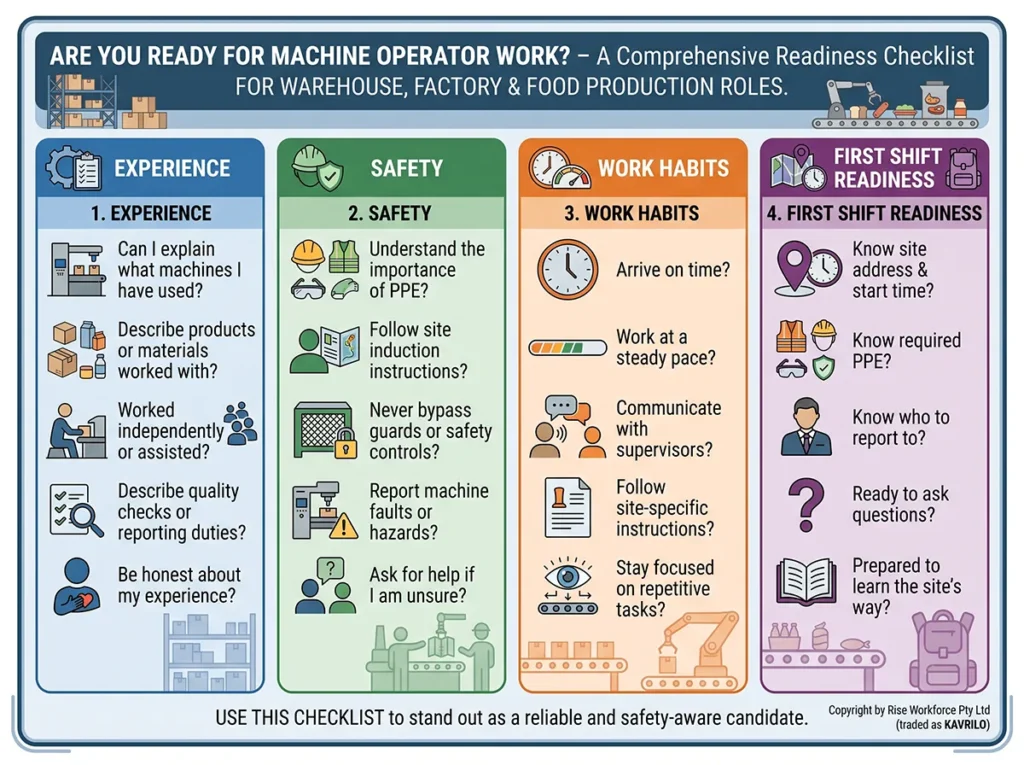
A Simple Checklist: Are You Ready for Machine Operator Work?
Use this checklist before applying for machine operator jobs.
Experience
- Can I clearly explain what machines I have used?
- Can I describe what products or materials I worked with?
- Can I explain whether I operated independently or assisted?
- Can I describe any quality checks or reporting duties?
- Am I being honest about my experience?
Safety
- Do I understand the importance of PPE?
- Will I follow site induction instructions?
- Will I avoid bypassing guards or safety controls?
- Will I report machine faults or hazards?
- Will I ask for help if I am unsure?
Work Habits
- Can I arrive on time?
- Can I work at a steady pace?
- Can I communicate with supervisors?
- Can I follow site-specific instructions?
- Can I stay focused during repetitive tasks?
First Shift Readiness
- Do I know the site address and start time?
- Do I know what PPE is required?
- Do I know who to report to?
- Am I ready to ask questions?
- Am I prepared to learn the site’s way of working?
This checklist can help you present yourself as a more reliable and safety-aware candidate.
What Makes a Machine Operator Stand Out?
A strong machine operator candidate usually stands out because they combine practical experience with responsible work habits.
They do not just say they are experienced.
They can explain:
- what they have done
- what machines they have used
- what safety rules they followed
- how they reported problems
- what work environments they understand
- what shifts they can reliably attend
- what they still need training or instruction for
This kind of honesty is powerful.
It helps employers trust the worker.
It also helps the worker avoid being placed into a role that is not suitable.
The best machine operators are not only fast or confident.
They are careful, consistent, reliable and willing to follow the site’s safety and production system.
Looking for Machine Operator Work in Melbourne?
KAVRILO is building its approach around practical workforce support for warehouse, factory, logistics and production environments.
If you are interested in machine operator work, it helps to provide accurate information about:
- the machines you have used
- the products or industries you worked with
- your duties and responsibilities
- your licences or tickets
- your shift availability
- your preferred work locations
- your transport situation
- your safety and production experience
The more accurate your information is, the easier it is to understand what roles may be suitable.
Submitting your details does not guarantee work, shifts or placement. Work opportunities depend on role availability, client requirements, worker suitability, work rights, onboarding checks, safety requirements and applicable laws.
KAVRILO is preparing to operate in accordance with Victorian labour hire licensing requirements. Labour hire services will only be supplied where permitted under applicable law.
Final Word
Employers look for more than machine operation experience.
They look for workers who can be trusted around production equipment, follow site instructions, communicate early, respect safety controls and work reliably across the shift.
For job seekers, the best approach is simple:
- be honest about your experience
- explain what machines you have used
- describe your duties clearly
- follow induction instructions
- ask questions when unsure
- report faults and hazards early
- respect guards and PPE
- arrive prepared and on time
A good machine operator does not need to know every machine.
But they do need to know how to work safely, communicate clearly and learn the site’s procedures before taking on unfamiliar tasks.
That is what many employers value most.
Want to Register for Machine Operator, Factory or Production Work?
If you have machine operation, factory, packaging, production or food manufacturing experience, KAVRILO can receive your expression of interest and review your details for possible future labour hire opportunities.
Looking for machine operator jobs or factory work in Melbourne? Register your interest with KAVRILO and provide accurate details about your experience, availability and preferred work locations.
Article Disclaimer
This article is provided for general information only and does not constitute legal, workplace relations, safety, taxation, payroll or other professional advice. Please seek advice specific to your circumstances before acting on this information. Please read KAVRILO’s Website Disclaimer for more information.