
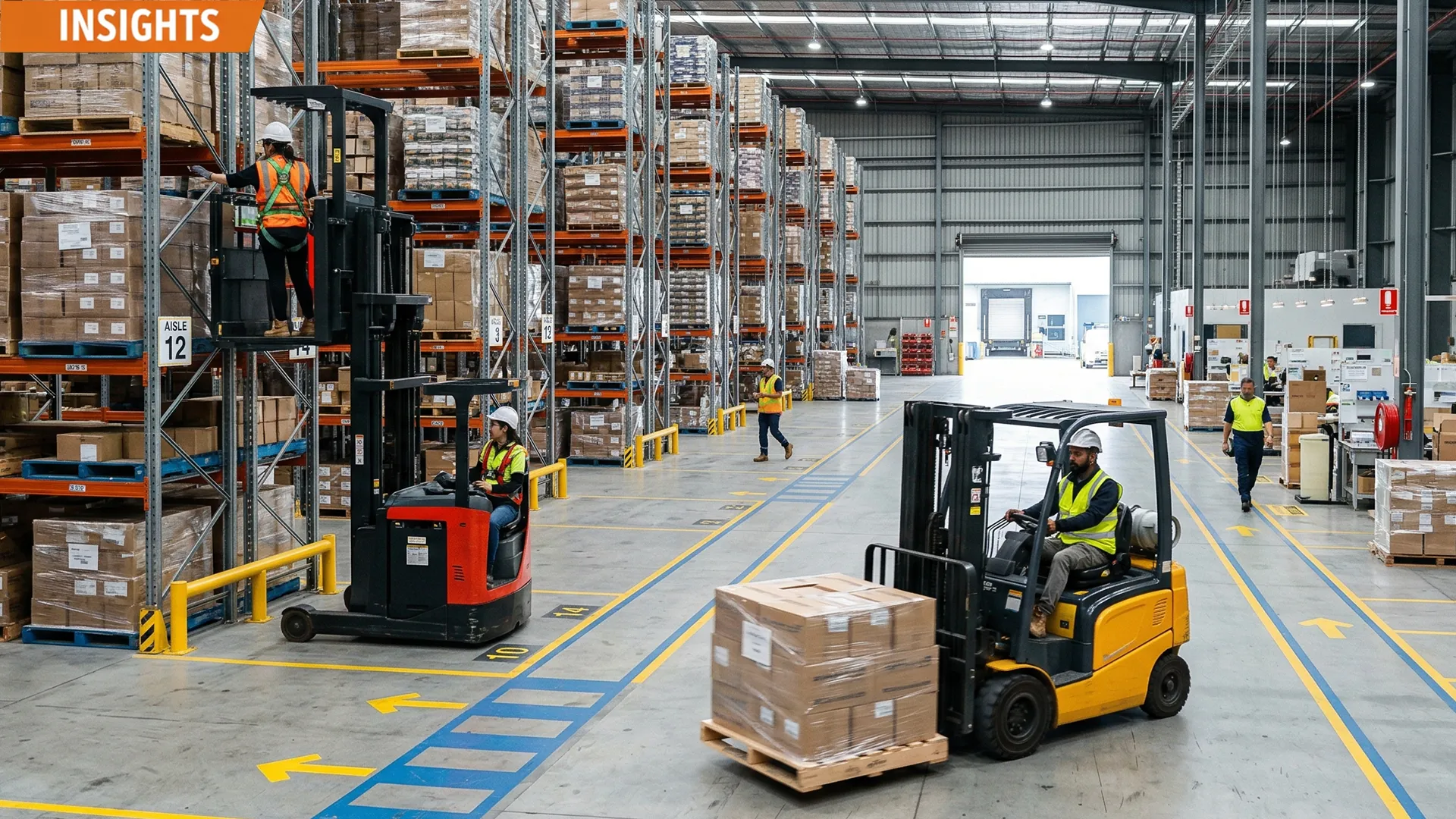
If you’re looking for forklift work in South-East Melbourne (Dandenong South, Hallam, Keysborough, Braeside and nearby industrial areas), getting the right licence can make a real difference to how quickly you get booked.
But the answer isn’t always “get the higher one.” Some sites want LF operators every day. Other sites run on LO order pickers and won’t place you without that ticket. Most workers get more shifts when they understand what each licence covers and build experience that matches the local warehouse demand.
This guide breaks it down clearly so you can choose the best path for more consistent forklift shifts.
1) What LF and LO actually mean (simple)
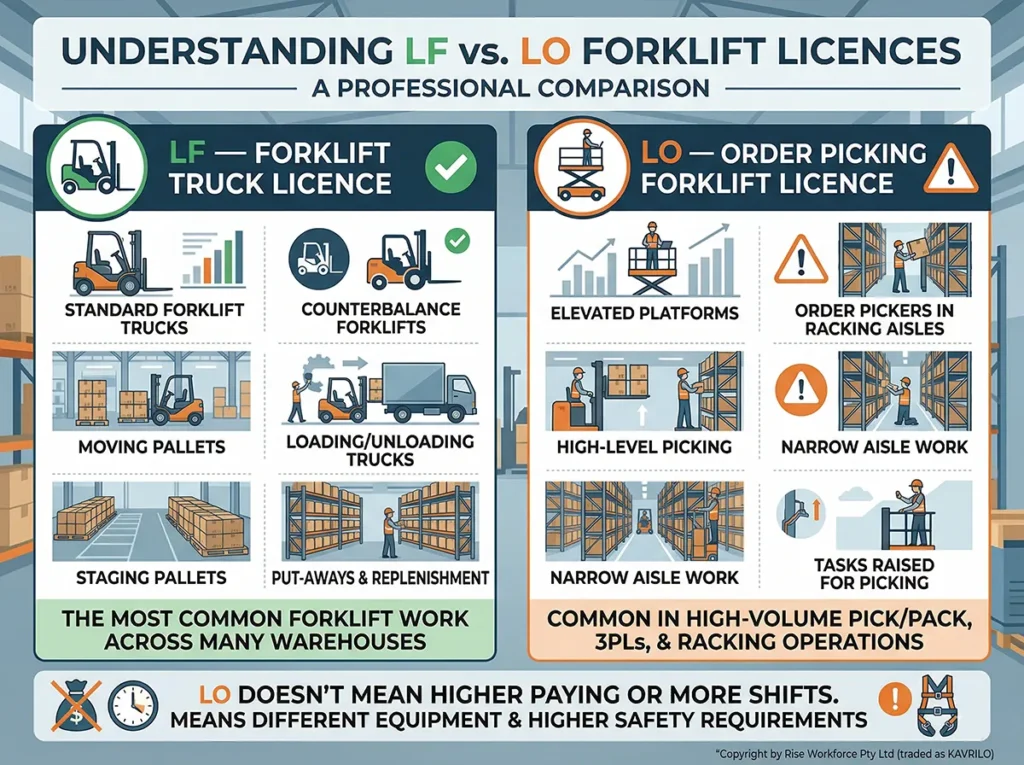
LF — Forklift Truck Licence
LF covers the standard forklift truck you see everywhere:
- counterbalance forklifts
- moving pallets in wide bays
- loading/unloading trucks
- staging pallets for dispatch
- put-aways and replenishment (on standard forklifts)
This is the most common forklift work across many warehouses.
LO — Order Picking Forklift Licence
LO covers order-picking forklifts (often elevated platforms):
- order pickers used in racking aisles
- high-level picking and replenishment
- narrow aisle work (depending on site)
- tasks where you’re raised up to pick cartons
LO work is common in high-volume pick/pack operations, certain 3PLs, and facilities with heavy racking-based picking.
Important: LO doesn’t automatically mean “higher paying” or “more shifts.” It means “different equipment and higher fall/safety requirements.”
2) Which one gets more shifts in South-East Melbourne?
In practice, LF tends to generate more total shift opportunities because LF forklifts exist in almost every warehouse and factory with a dock.
However, LO can be a strong advantage if you’re targeting:
- e-commerce pick/pack operations
- racking-heavy 3PL environments
- sites with high-level order picking as a daily task
The short answer
- Most shift availability overall: LF
- More specialised access: LO
- Best position for more consistent work: LF + LO, with real experience on both
If you only have one ticket, LF is usually the best starting point for more shifts across more sites.
3) Why LO can be harder to get shifts at first (even with the ticket)
Many workers get an LO licence and then wonder why shifts don’t come quickly.
Common reasons:
- LO roles often require recent experience (sites don’t want first-timers at height)
- sites want confidence around harness/fall controls where applicable
- LO work often sits in narrow aisles with higher collision risk
- pick accuracy matters more than speed at height
If you have LO but no experience, your fastest pathway is:
- start in general warehouse work or LF roles
- ask to be trained up on LO at a site once you’re proven reliable and safe
4) What employers actually look for (beyond the ticket)
A forklift ticket is a minimum requirement. What gets you rebooked is behaviour.
Supervisors look for:
- safe speed (not rushing)
- clean turning and corner discipline
- respecting pedestrian zones
- stable loads (no wobble, no risky lifts)
- calm communication
- not using a phone on the floor
- reporting damaged pallets and hazards
In South-East Melbourne, a forklift operator who turns up on time and works safely will get booked again. A risky operator will be removed fast, no matter how “fast” they are.
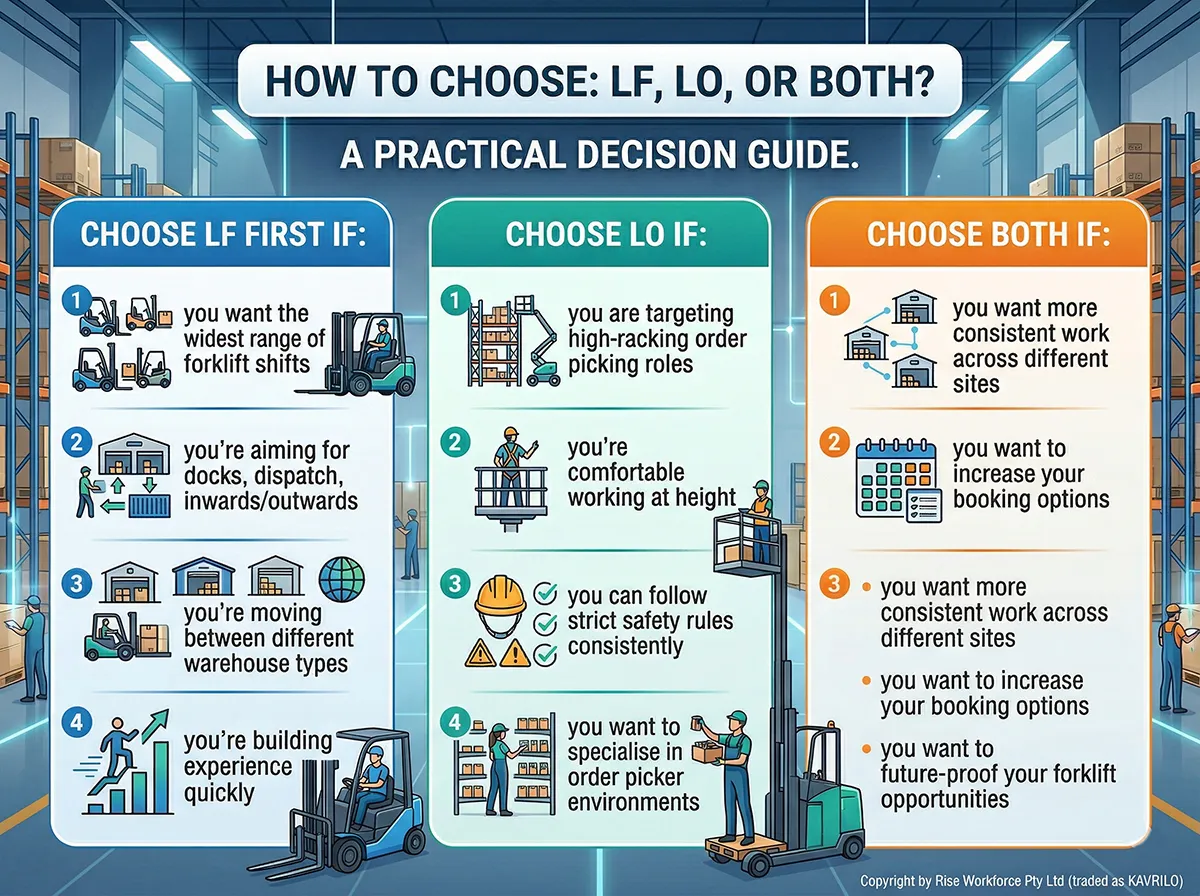
5) How to choose: LF, LO, or both?
Here’s a practical decision guide.
Choose LF first if:
- you want the widest range of forklift shifts
- you’re aiming for docks, dispatch, inwards/outwards
- you’re moving between different warehouse types
- you’re building experience quickly
Choose LO if:
- you are targeting high-racking order picking roles
- you’re comfortable working at height
- you can follow strict safety rules consistently
- you want to specialise in order picker environments
Choose both if:
- you want more consistent work across different sites
- you want to increase your booking options
- you want to future-proof your forklift opportunities
6) How to get more forklift shifts (practical steps)
If you want more bookings, focus on these:
Step 1: Be clear about your experience
When asked, be specific:
- “LF, last shift 1 week ago, loading docks + put-aways”
- “LO, 6 months experience in pick aisles, replenishment, at-height picking”
Honesty builds trust. Overstating experience gets you removed quickly.
Step 2: Stay local and punctual
Sites in Dandenong South / Hallam often start early. Local workers who can arrive reliably get booked more.
Step 3: Keep your PPE ready
Steel caps, hi-vis, and any site-specific gear. Arriving unprepared costs you shifts.
Step 4: Get good at site induction
Every site differs:
- speed limits
- horn points
- pedestrian rules
- dock procedures
- racking rules
Operators who follow site rules get rebooked.
Step 5: Build a “rebookable” reputation
Your first shift is your audition:
- steady work
- safe behaviour
- no attitude issues
- clear communication
That’s how you become “the forklift operator they call first.”
7) Pay and shift reality (keep expectations grounded)
Pay rates depend on:
- award classification and site agreement
- shift type (day/afternoon/night)
- penalties and allowances
- role complexity (loading, picking, cold storage)
LO doesn’t automatically equal higher pay. Some LF dock roles pay very well due to shift loadings and environment.
Focus on getting steady work first. Consistency often beats chasing one-off higher-rate shifts.
Quick checklist: which licence gets you more shifts?
- Want broad forklift shift availability? → LF
- Want order picker and at-height picking roles? → LO
- Want the most opportunities long-term? → LF + LO + real experience
- Want more bookings fast? → Be reliable, safe, and local

Final takeaway
If you’re choosing based on “more shifts,” LF is usually the fastest path because it’s used across almost every warehouse and factory site.
LO is valuable — but it works best when paired with real experience and strong safety habits.
If you’re based in South-East Melbourne and want consistent forklift work, aim to build a track record of safe, reliable shifts. That’s what keeps you booked.
Looking for LF/LO forklift shifts in South-East Melbourne? Join the KAVRILO roster and we’ll match you to suitable sites based on your licence, experience, and availability.
Article Disclaimer
This article is provided for general information only and does not constitute legal, workplace relations, safety, taxation, payroll or other professional advice. Please seek advice specific to your circumstances before acting on this information.
Please read our Website Disclaimer for more information.