

Hiring a machine operator should never be treated as a simple labour gap.
A machine operator may be working around moving parts, production pressure, guards, emergency stops, manual handling, quality requirements, cleaning procedures, changeovers, repetitive tasks, forklifts, food hygiene rules or other site-specific risks.
That means employers need to look beyond the question:
“Has this person operated machines before?”
A better question is:
“Has this person operated the right kind of machinery, in a similar environment, with the right level of instruction, safety awareness and supervision for this role?”
This distinction matters because “machine operator” is a broad title.
It can describe workers in:
- food production
- packaging
- manufacturing
- warehousing
- processing
- printing
- metal or plastics production
- filling and sealing lines
- labelling operations
- automated production lines
- semi-automated equipment areas
A worker may have solid experience in one type of machine-operating role but still need training, familiarisation or close supervision on another site.
Before hiring or requesting a machine operator through labour hire, employers should check the role, the machinery, the worker’s experience and the site’s readiness.
This guide explains what to review before putting a machine operator into your workplace.
For a broader employer overview, read our guide to machine operator labour hire in Melbourne, which explains role matching, competency, site induction and shared safety responsibilities in more detail.
Why Machine Operator Hiring Needs More Care Than General Labour Hire
General labour hire often focuses on availability, reliability, physical capacity and site fit.
Machine operator labour hire requires those things too, but it also needs a deeper review of machine-related risk.
A machine operator may need to understand:
- machine controls
- operating limits
- guards and interlocks
- emergency stops
- safe loading and unloading
- jam reporting
- fault escalation
- product changeovers
- cleaning boundaries
- quality checks
- PPE requirements
- manual handling around the machine
- site-specific procedures
A poor placement can create problems quickly.
The wrong worker may:
- misunderstand the machine
- operate outside their experience
- fail to report defects
- continue production when something is wrong
- ignore warning signs
- place hands or clothing near moving parts
- bypass normal reporting channels
- damage product or equipment
- increase supervision pressure
- create safety risk for themselves or others
This does not mean employers should avoid labour hire machine operators.
It means the request needs to be specific.
The better the job brief, the easier it is to identify whether a worker is likely to be suitable.
1. Check the Exact Machine and Production Environment
The first thing to check is the machinery itself.
Do not only say:
“We need a machine operator.”
Instead, identify:
- what type of machine is involved
- what the machine does
- what product or material is being processed
- whether the machine is manual, semi-automatic or automatic
- whether the worker will load or unload materials
- whether the worker will monitor the process only
- whether the worker will adjust settings
- whether changeovers are required
- whether cleaning is part of the role
- whether the machine is part of a fast production line
- whether food, hygiene or contamination controls apply
This information helps separate general production experience from directly relevant machine experience.
For example, experience on a packaging line may not automatically transfer to cutting, forming, filling, sealing, labelling, printing or CNC-related equipment.
Even similar machines can differ between workplaces.
Controls, speeds, guards, products, materials, layout and reporting procedures can all change.
The more clearly you describe the equipment, the better the hiring decision will be.
Our article on [how to write a clear machine operator job brief] explains how employers can describe machinery, duties and site conditions more accurately before requesting labour hire support.

2. Check What the Worker Has Actually Done Before
Experience should be checked in practical detail.
A resume that says “machine operator” does not tell you enough.
Ask questions such as:
- What machines have you operated?
- What products or materials did you work with?
- Did you operate independently or under supervision?
- Did you start and stop the machine?
- Did you load materials into the machine?
- Did you perform setup or changeovers?
- Did you adjust settings?
- Did you perform quality checks?
- Did you report faults or clear jams?
- Did you follow food safety or hygiene requirements?
- Did you complete pre-start checks?
- Did you work around forklifts or other mobile plant?
These questions help reveal the difference between:
- a true machine operator
- a machine assistant
- a production worker
- a packer working near machinery
- a worker who has only observed machine operation
- a worker who can operate only under close supervision
There is nothing wrong with a worker being less experienced.
The risk comes from misunderstanding what they can safely and confidently do.
3. Check Whether Experience Matches This Role
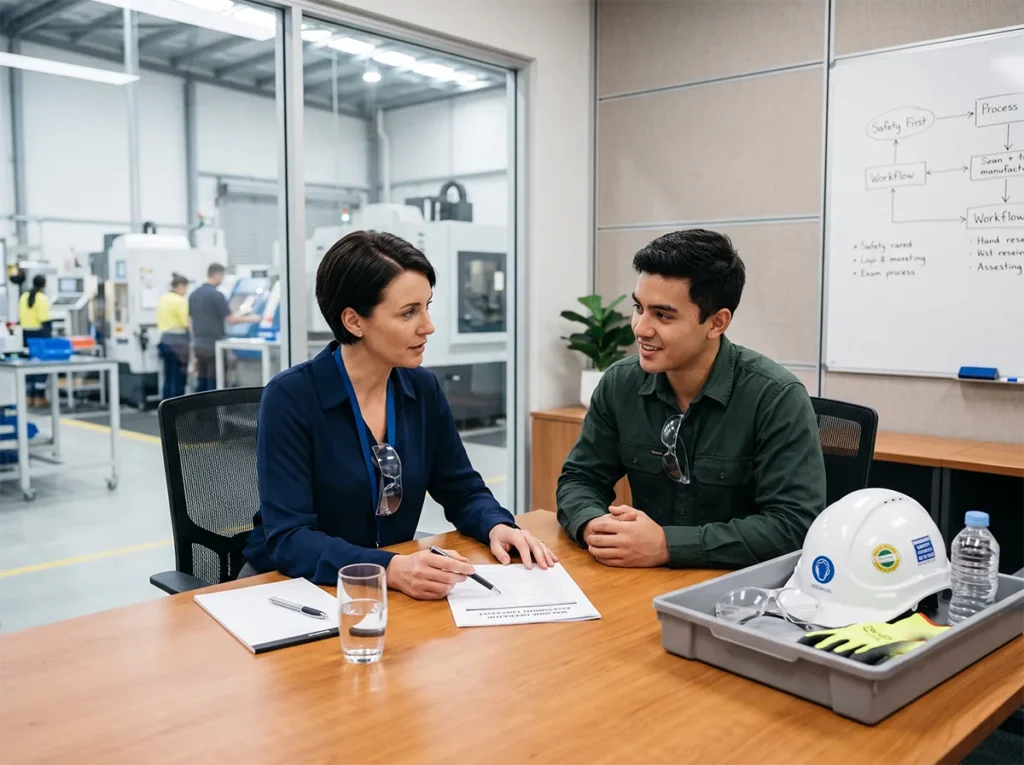
The next step is to compare the worker’s experience with your actual role.
A worker may be experienced, but not in the way your site needs.
Consider whether the experience matches:
- machinery type
- product type
- speed of line
- level of automation
- physical demands
- quality standards
- hygiene requirements
- shift conditions
- level of supervision
- fault-reporting process
- changeover expectations
- cleaning responsibilities
For example, a worker may be suitable for monitoring a packaging line but not suitable for independent setup, adjustment or troubleshooting.
Another worker may be reliable in general production but not ready for a role involving high-speed moving parts, frequent changeovers or strict food hygiene controls.
The safest approach is to match the worker to the real role, not to the title.
4. Check Whether the Role Requires Training, Familiarisation or Competency Verification
Experience alone may not be enough.
Before a worker starts, consider whether they need:
- site-specific induction
- machine familiarisation
- supervised operation
- practical assessment
- specific authorisation
- written or verbal instruction
- manufacturer or site procedure review
- refresher training
- translated or simplified instructions
- additional supervision during the first shift
This is especially important where the worker is new to the site or the machinery differs from what they used previously.
A worker may understand general machine operation but still need to learn:
- where emergency stops are located
- how defects are reported
- what the site considers an unsafe condition
- what they are allowed to adjust
- what they must not touch
- who authorises changeovers
- how cleaning and isolation boundaries work
- when to stop and call a supervisor
The goal is not to make the process complicated.
The goal is to prevent assumptions.
5. Check Site-Specific Induction Requirements
- Check Site-Specific Induction Requirements
Every new machine operator should receive a suitable site induction.
Even an experienced worker needs to understand the specific workplace.
A strong induction may include:
- site entry and sign-in process
- emergency procedures
- first aid arrangements
- incident and hazard reporting
- PPE requirements
- restricted areas
- pedestrian and forklift routes
- machine guarding expectations
- emergency stop locations
- normal operating boundaries
- supervisor contact details
- break areas and amenities
- food hygiene or contamination controls where relevant
- quality standards
- cleaning or washdown rules
- what to do if a fault occurs
Do not rely only on a quick verbal instruction or a signature on a form.
A worker should understand the key risks before active work begins.
If the worker is from a multilingual background, use clear language and check understanding rather than assuming the message has landed.
6. Check PPE and Clothing Requirements
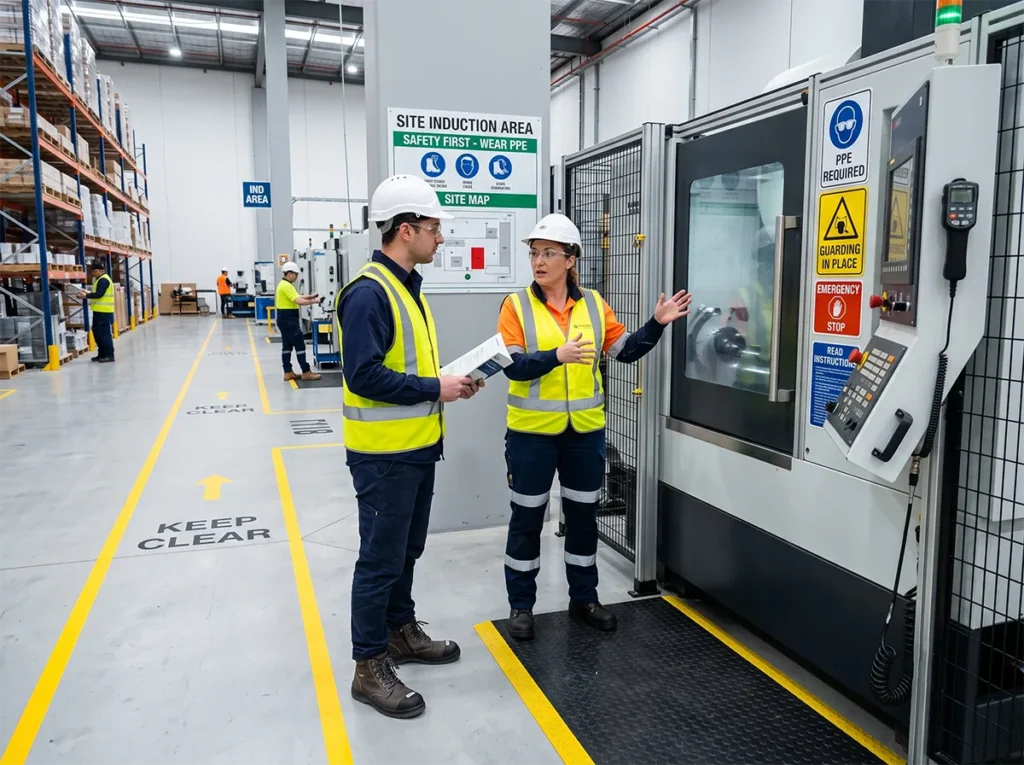
Machine operator PPE should be clear before the worker arrives.
Depending on the site, PPE may include:
- high-visibility clothing
- safety boots
- gloves where appropriate
- hearing protection
- eye protection
- hair nets
- beard covers
- food production clothing
- cut-resistant protection
- dust or respiratory protection
- task-specific protective equipment
Employers should also consider clothing risks around machinery.
Loose clothing, jewellery, loose hair or inappropriate gloves can create serious entanglement or safety risks depending on the machine and task.
Before the shift begins, clarify:
- what PPE is required
- who provides each item
- where PPE must be worn
- whether PPE changes between areas
- what should happen if PPE is damaged or missing
- whether any PPE creates machine-specific risk
PPE should not be left unclear until the worker arrives at the production floor.
7. Check the Manual Handling and Physical Demands
- Check the Manual Handling and Physical Demands
Machine operator work can involve significant physical demands.
Even where the machine performs most of the production function, the worker may still need to:
- lift materials
- load product
- remove finished goods
- stack boxes
- stand for long periods
- repeat the same movement
- bend, reach or twist
- push or pull trolleys
- handle pallets
- work at a fast pace
- perform cleaning tasks
Employers should provide realistic information about the physical requirements.
Do not describe a role as “light machine operation” if it involves constant lifting, repetitive handling or fast-paced output.
This matters for worker suitability, injury prevention and honest recruitment.
Physical demands can also change across the shift.
A role that feels manageable for 20 minutes may become much harder after several hours of repetition.
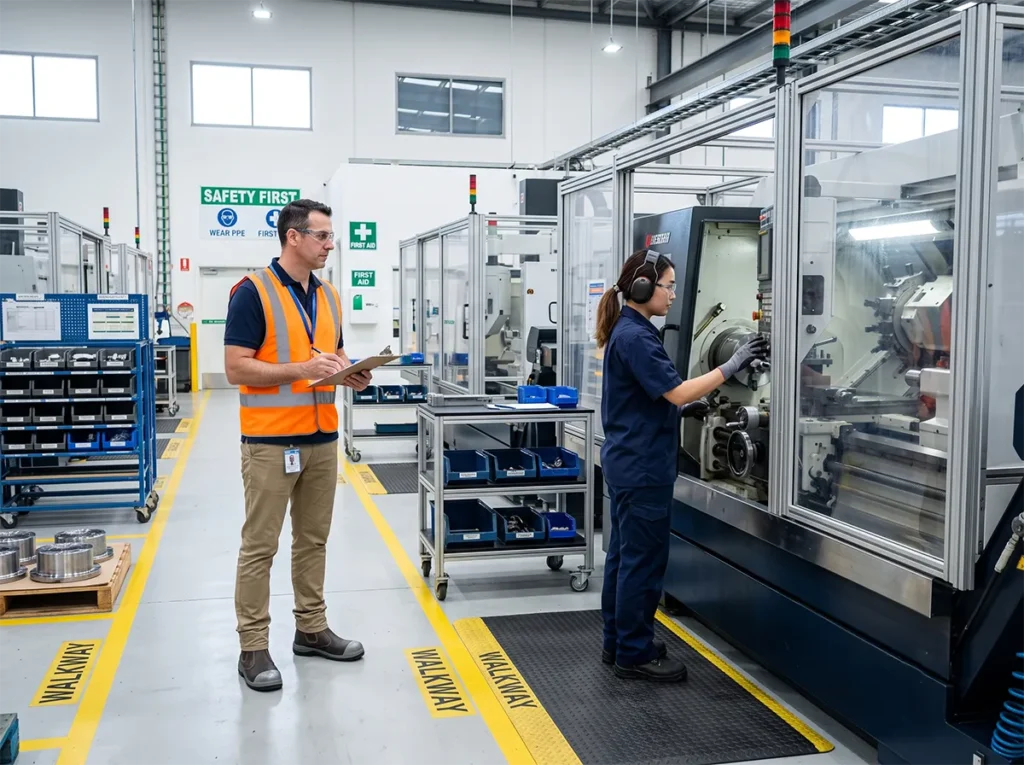
8. Check Supervision on the First Shift
First-shift supervision is one of the most important checks.
A new machine operator should know:
- who their supervisor is
- who gives instructions
- who approves changes
- who to call if the machine stops
- who to report defects to
- what tasks they are authorised to perform
- what tasks they must not perform
- what to do if they are unsure
Even experienced workers need support in a new environment.
The first shift is where assumptions often appear.
For example:
- the worker assumes a control works like a previous machine
- the supervisor assumes the worker understands the line
- the team assumes the worker knows site shortcuts
- the worker does not know who to ask
- the worker tries to keep up rather than stop and clarify
Good supervision does not mean standing over the worker all day.
It means making sure the worker starts with clear direction, visible support and a safe way to ask questions.
9. Check What Happens When the Machine Jams or Faults
A machine operator should know what to do when something goes wrong.
Before the worker starts, clarify:
- what counts as a fault
- when the machine should be stopped
- who must be notified
- whether the worker can clear minor issues
- what the worker is not authorised to do
- what lockout, isolation or maintenance rules apply
- whether maintenance staff must be called
- how defects are recorded
- how product quality issues are escalated
This is critical.
Many serious machine risks arise when people try to clear jams, remove product, reach into moving areas or solve problems outside their training.
A worker should never feel pressured to “just fix it” if the task is outside their instruction or authority.
The safer expectation is simple:
Stop, report and wait for the correct instruction.
10. Check Guards, Emergency Stops and Safety Controls
Before placing a machine operator, employers should ensure machinery safety controls are understood and functioning.
This may include reviewing:
- fixed guards
- interlocked guards
- emergency stops
- light curtains where applicable
- warning signs
- safe access areas
- exclusion zones
- operating panels
- isolation points
- defect reporting procedures
The worker should know that guards and safety devices are not optional.
They should not be asked to:
- remove guards
- bypass interlocks
- defeat safety controls
- reach into moving machinery
- use unsafe shortcuts to maintain output
- operate visibly damaged or defective equipment
- perform maintenance tasks without authorisation
Productivity pressure should never be allowed to normalise unsafe operation.
If a machine cannot be operated safely, the issue needs to be escalated.
11. Check Whether the Job Brief Matches the Real Work
One of the most common labour hire problems is role drift.
This happens when the actual work is different from what was originally requested.
For example, the job brief may say:
- machine monitoring only
But the actual work may include:
- setup
- adjustment
- changeovers
- cleaning
- fault clearing
- lifting
- forklift interaction
- quality documentation
- working on a different machine
This creates risk because the worker may not have been selected for the changed duties.
Before hiring, employers should check that the job brief is honest and complete.
During the placement, employers should contact the labour hire provider if the work changes materially.
A machine operator placement should be reviewed if:
- machinery changes
- duties change
- shift conditions change
- hazards change
- supervision changes
- PPE requirements change
- the worker is moved to another line
- the worker is asked to perform higher-risk tasks
12. Check Labour Hire Provider Communication
- Check Labour Hire Provider Communication
If you are engaging a machine operator through labour hire, communication with the provider is important.
Before the placement, provide:
- clear job brief
- machine details
- shift details
- required experience
- site hazards
- PPE requirements
- induction process
- supervision arrangements
- expected duration
- location and access instructions
- any food safety or hygiene requirements
During the placement, notify the provider if:
- the worker is unsuitable
- the role changes
- a safety issue occurs
- there is an incident or near miss
- the worker raises a concern
- attendance or performance issues appear
- the site requires extra workers
- the assignment is ending or extending
Good communication helps avoid misunderstanding.
It also supports safer decision-making when the work changes.
13. Check Labour Hire Licence Status in Victoria
- Check Labour Hire Licence Status in Victoria
If you are using labour hire in Victoria, licence status matters.
Before engaging a labour hire provider, employers should check whether the provider is permitted to supply labour hire services.
Do not rely only on a claim, logo, email or paper document.
Check the relevant public register and keep records of the check.
For KAVRILO’s own public wording, we state clearly that KAVRILO is preparing to operate in accordance with Victorian labour hire licensing requirements and that labour hire services will only be supplied where permitted under applicable law.
Employers should be cautious with any provider that:
- cannot explain its licence status
- provides inconsistent company information
- uses unclear business names
- avoids written agreements
- cannot explain payroll and compliance processes
- gives unrealistic claims about immediate supply
- appears to be supplying workers at unusually low rates
- refuses to provide basic compliance information
A reliable labour hire arrangement should feel transparent, not vague.
14. Check the Commercial Terms and Replacement Process
Before hiring a machine operator, employers should understand the commercial terms.
Clarify:
- hourly rate or charge basis
- minimum shift conditions
- overtime treatment
- public holiday treatment
- cancellation rules
- replacement process
- timesheet approval process
- incident reporting expectations
- notice requirements
- role changes
- end-of-assignment process
Replacement support should be clearly described.
Avoid assuming that every issue automatically triggers an immediate replacement. Suitability, availability, notice, safety and agreed service terms all matter.
A good provider should be clear about what happens if:
- the worker is unsuitable
- the worker does not attend
- the role was not described accurately
- the worker is moved to a different machine
- the worker raises a safety concern
- the site changes shift or duties
Clear terms reduce conflict later.
A Practical Checklist Before Hiring a Machine Operator
Use this checklist before requesting or hiring a machine operator.
Machinery and Role Details
- Have we identified the exact machine or equipment?
- Have we explained what the machine does?
- Have we described the product or material?
- Have we listed the actual duties?
- Have we separated operation from setup, changeovers and maintenance?
- Have we described cleaning or hygiene tasks?
- Have we explained quality-checking requirements?
Worker Experience and Suitability
- Have we checked the worker’s actual machine experience?
- Have we asked what machines they operated before?
- Have we checked whether the experience is recent?
- Have we confirmed whether they worked independently or under supervision?
- Have we checked whether the worker understands safety reporting?
- Have we avoided assuming that all machine experience is transferable?
Safety and Induction
- Is site induction ready?
- Are PPE requirements clear?
- Are guards and emergency controls explained?
- Are fault and jam-reporting procedures clear?
- Is supervision available on the first shift?
- Is the worker authorised only for suitable tasks?
- Are manual handling demands clearly explained?
Labour Hire and Compliance
- Have we checked the provider’s licence status where required?
- Have we provided a clear job brief to the provider?
- Have we explained site hazards and controls?
- Have we agreed on communication and incident reporting?
- Have we clarified timesheets and commercial terms?
- Have we planned what happens if duties or machinery change?
This checklist helps employers treat machine operator hiring as a safety and suitability decision, not only a staffing decision.

Final Word
Hiring a machine operator requires more care than simply finding someone available for a shift.
Employers need to check:
- what machinery is involved
- what the worker has actually done before
- whether the experience matches the role
- what induction and supervision are required
- what PPE and safety controls apply
- how faults and hazards will be reported
- whether the labour hire provider is properly authorised
- whether the job brief matches the real work
Machine operator labour hire can be highly useful when it is handled properly.
But the best outcomes usually come from clear role information, honest experience checks, site-specific induction, practical supervision and open communication between the host employer, worker and labour hire provider.
Good hiring is not just about filling a vacancy.
It is about putting the right worker into the right role with the right instructions, controls and support.
Need Machine Operators for Your Warehouse, Factory or Production Site?
KAVRILO is building its approach around practical labour hire support for warehouse, factory, logistics and production environments.
If you need machine operators, it helps to provide clear information about:
- machinery type
- duties
- shift times
- experience requirements
- PPE
- manual handling
- site induction
- supervision
- hazards and controls
- expected assignment duration
The more accurate the role information is, the better the discussion around worker suitability and safe placement.
KAVRILO is preparing to operate in accordance with Victorian labour hire licensing requirements. Labour hire services will only be supplied where permitted under applicable law.
Need machine operator labour hire support with clearer role matching and stronger day-one readiness? Talk to KAVRILO about practical workforce support for Melbourne warehouse, factory and production environments.
Article Disclaimer
This article is provided for general information only and does not constitute legal, workplace relations, safety, taxation, payroll or other professional advice. Please seek advice specific to your circumstances before acting on this information. Please read KAVRILO’s Website Disclaimer for more information.