

One of the most positive staffing problems an employer can have is this:
A casual worker turns out to be genuinely strong.
They:
- turn up reliably
- settle into the site well
- understand the pace
- work steadily with the team
- and reduce pressure on the operation instead of adding to it
In warehouse and factory environments, that matters a lot.
Across Dandenong and the broader South-East Melbourne corridor, many employers rely on casual labour to help with:
- peak demand
- shift gaps
- leave coverage
- seasonal pressure
- and changing operational needs
That flexibility is useful. But over time, some casual workers clearly stand out.
They may become:
- more dependable than expected
- easier to roster
- more useful across key areas
- and more valuable to keep than to replace
That is when the question changes.
The issue is no longer:
“Can this worker help us as a casual?”
It becomes:
“Should we think about keeping this person permanently?”
That is a good question — but it should not be answered casually.
Because moving a worker from casual to permanent is not just about rewarding good performance. It is also about:
- long-term fit
- workload stability
- attendance consistency
- site value
- and whether the role genuinely supports a more permanent workforce decision
That is why good employers think about this carefully.
For the broader local market overview, see our Staffing South-East Melbourne pillar guide for Dandenong warehouse and factory employers.
Why This Decision Matters More Than It First Seems
A strong casual worker can create real value on the floor.
They may already know:
- the site routine
- the pace of the work
- the team structure
- the practical expectations
- and how to operate with less supervision than a newer starter
That means keeping them can look like an easy decision.
Sometimes it is.
But not always.
A move to permanent should still be reviewed as a workforce planning decision, not just a positive reaction to someone doing well.
This matters because employers need to think about:
- whether the workload is stable enough
- whether the worker suits the business long term
- whether the site is solving a short-term problem or a longer-term one
- and whether the role really should become more permanent at all
Good casual-to-permanent decisions usually help improve:
- workforce stability
- labour retention
- supervisor confidence
- and shift consistency
Poorly thought-through decisions can create:
- mismatch later
- unnecessary commitment
- or a role structure that no longer suits the business once demand changes again
That is why this decision deserves more thought than many employers first give it.
Why Good Casual Workers Matter So Much in South-East Melbourne
In Dandenong and the broader South-East Melbourne industrial corridor, dependable labour is valuable because the labour market is active and competitive.
Many employers are trying to solve similar problems around:
- attendance
- role fit
- shift reliability
- and workforce continuity
That means when a good casual worker proves they can:
- sustain the shift pattern
- handle the site conditions
- work well with the team
- and keep turning up consistently
they become more than a temporary solution.
They become a potential long-term asset.
This is especially true where the worker has already shown:
- practical site fit
- lower attendance risk
- better pace than average
- or stronger adaptability than many short-term placements
That is why good casual workers often deserve closer review.
They may already be the kind of worker the site has been trying to find more permanently.
10 Practical Things Employers Should Think About Before Making the Move
1. Whether the Worker Is Truly Strong, Not Just Better Than Recent Alternatives
Sometimes a worker looks excellent because recent labour quality has been inconsistent.
That is understandable, but employers should still ask:
- is this person genuinely strong?
- or do they just look stronger because the comparison has been weak?
A better review looks at whether the worker is actually delivering:
- reliable attendance
- solid role performance
- good pace
- lower supervision pressure
- and practical value to the floor over time
A permanent decision should be based on real contribution, not just relief that the worker is better than the last few.
2. Whether the Role Is Stable Enough to Justify a Permanent Move
This is one of the biggest questions.
A worker may be strong, but that does not automatically mean the role should become permanent.
Employers should think about:
- whether the volume is ongoing
- whether the labour demand is seasonal or stable
- whether the site is solving a peak problem or a long-term need
- and whether the business can support that commitment beyond the current pressure period
If the role is only temporarily busy, a permanent move may not be the right answer yet.
The worker may be worth keeping close, but the position still needs to make sense structurally.
3. Whether the Worker Has Proved Reliable Over Time, Not Just for a Short Period

A few good shifts are encouraging.
But permanent decisions usually deserve a wider view.
Good employers often look at:
- attendance consistency over time
- punctuality
- willingness to accept realistic shift patterns
- performance across different days or pressure levels
- and whether the worker remains dependable once the first enthusiasm settles
This matters because long-term reliability is one of the strongest reasons to move a worker into a more permanent role.
Our article on why local workers often improve punctuality and reduce turnover explains why dependable attendance and practical travel access often shape long-term workforce stability more than employers first expect.
4. Whether the Worker Truly Fits the Site Culture and Workflow

A worker can be capable and still not be the right long-term fit for the business.
That is why employers should look beyond:
- output alone
and think about:
- how the worker fits the team
- how they respond to supervision
- how they handle the actual pace
- how much correction they still need
- and whether they support smoother operations over time
A permanent decision usually works better when the worker is not just usable, but genuinely aligned with:
- the site rhythm
- the standards
- and the practical working style of the operation
Our guide to why site fit matters more than headcount in warehouse and factory staffing explains why worker suitability often affects long-term success more than simply filling roles quickly.
5. Whether the Worker Reduces or Increases Supervisor Load
This is one of the clearest practical tests.
A good worker usually helps make the floor easier to run.
That may show up through:
- lower correction needs
- stronger routine understanding
- steadier output
- fewer repeated questions
- and more dependable behaviour under normal shift pressure
If the worker still creates ongoing supervision strain, that is worth noticing.
A permanent move usually makes more sense when the worker is clearly:
- reducing friction
not - just being tolerated because coverage is needed
That is a very useful distinction.
6. Whether the Shift Pattern Is Sustainable for the Worker Long Term
A worker may perform well casually and still struggle if the long-term shift structure is harder to sustain than it first appears.
Employers should think about:
- start times
- overtime patterns
- roster consistency
- transport practicality
- and whether the worker is likely to maintain the same reliability once the arrangement becomes a permanent routine
This matters because some workers cope well with casual flexibility but may find a fixed long-term pattern harder if:
- the travel is too demanding
- the shift timing changes
- or the role creates more long-term fatigue than expected
A permanent move works better when the shift structure is practical for both sides.
7. Whether Keeping This Worker Solves a Real Business Problem
A good permanent decision usually solves something meaningful.
For example:
- reducing repeat recruitment
- improving team stability
- protecting a valuable worker from drifting away
- strengthening a key area of the floor
- or reducing dependence on constant refill labour
This matters because the best casual-to-permanent moves are not just people decisions.
They are operational decisions too.
The question should be:
“What real workforce problem does keeping this person help solve?”
If the answer is strong, the decision often becomes clearer.
8. Whether the Business Is Reacting Emotionally or Planning Practically
Sometimes employers want to lock in a good worker quickly because dependable labour feels scarce.
That instinct makes sense.
But good decisions still need practical review.
Employers should think about:
- whether this is a genuine long-term fit
- whether the demand supports the role
- whether the timing is right
- and whether the worker’s value has been assessed clearly rather than emotionally
A good worker should be valued.
But permanent decisions are strongest when they are made through:
- calm judgement
- and practical planning
rather than fear of losing someone before the business has thought properly.
9. Whether the Site Has a Clear Pathway for Strong Casuals
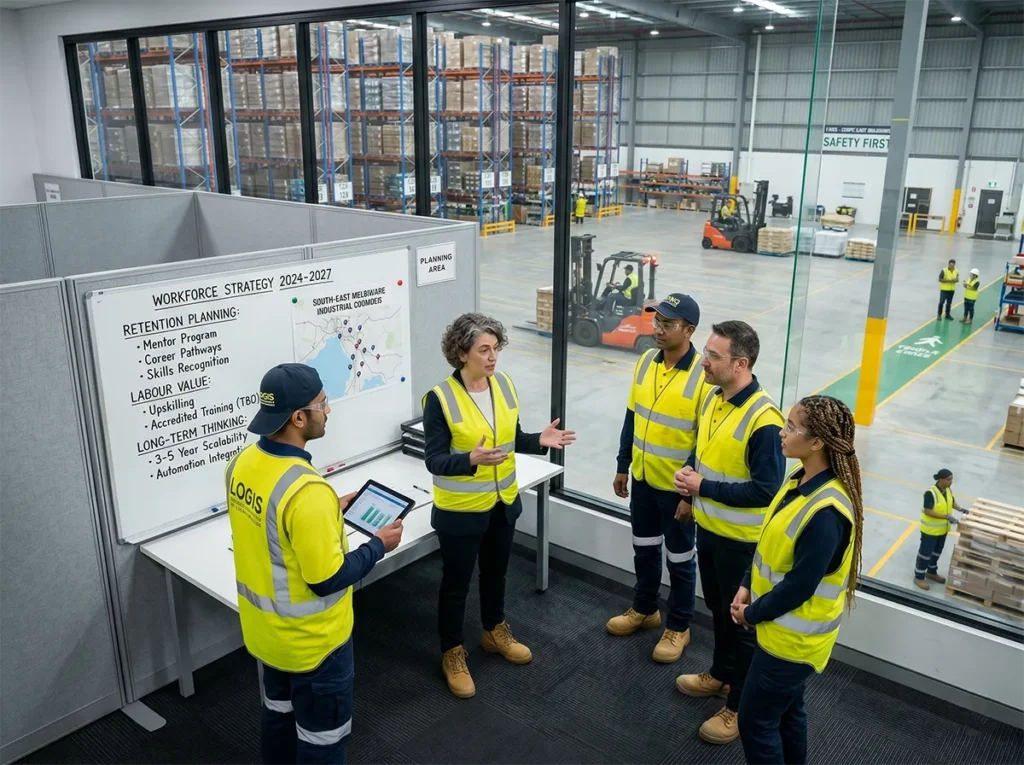
Some businesses handle this transition better than others because they already know:
- what they look for
- how they assess reliability
- when they consider longer-term options
- and how they identify stronger workers early
That clarity helps.
Without it, casual-to-permanent decisions can become inconsistent or too reactive.
Good employers often benefit from having a clearer internal view on:
- what makes a casual worker worth retaining
- what evidence matters most
- and when the business should seriously consider a more permanent offer
This makes the process more deliberate and more repeatable.
10. Whether the Labour Support Model Helps You Keep Strong Workers
This is often overlooked.
A good workforce support model should not only help fill shifts.
It should also help the employer recognise and keep stronger workers where appropriate.
That means the wider labour strategy should support:
- practical retention thinking
- good worker visibility
- better long-term matching
- and stronger decisions about which casuals are worth holding onto
In South-East Melbourne, where dependable workers can be hard to keep once they prove themselves, this matters a lot.
A strong labour model helps the business build workforce quality over time, not just survive one shift at a time.
What Better Casual-to-Permanent Decisions Usually Look Like in Practice
When employers handle this decision well, the result usually feels:
- steadier
- more intentional
- more valuable
- and less reactive
In practice, that often means:
- the worker has already proven reliability
- the role is stable enough to justify the move
- the site fit is clear
- supervisors are confident in the person
- and the business knows why keeping the worker matters
It should not feel like:
- the site is acting too quickly because labour has been hard to find
- the role is still uncertain
- or the decision is being made without enough practical review of long-term fit
Good casual-to-permanent moves usually strengthen both:
- workforce quality
- and operational confidence
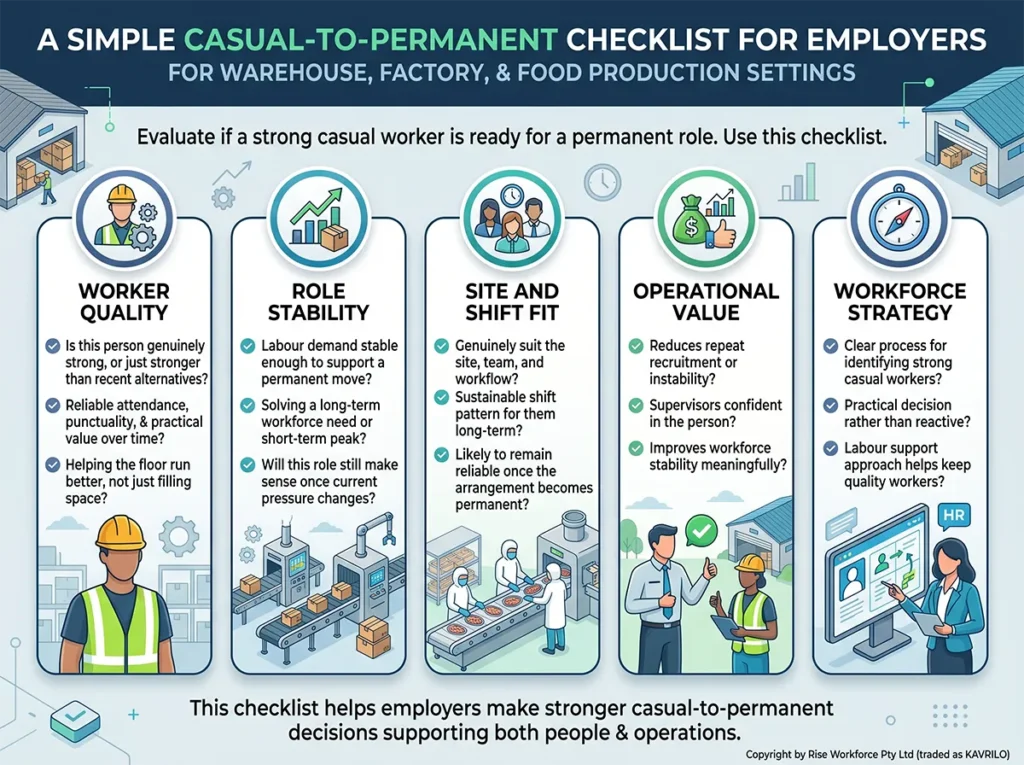
A Simple Casual-to-Permanent Checklist for Employers
Here is a practical checklist employers can use when reviewing whether a strong casual worker should move into a more permanent role.
Worker Quality
- Is this person genuinely strong, or just stronger than recent alternatives?
- Have they shown reliable attendance, punctuality, and practical value over time?
- Are they helping the floor run better, not just filling space?
Role Stability
- Is the labour demand stable enough to support a permanent move?
- Are we solving a long-term workforce need or a short-term peak?
- Will this role still make sense once current pressure changes?
Site and Shift Fit
- Does the worker genuinely suit the site, team, and workflow?
- Is the shift pattern sustainable for them long term?
- Are they likely to remain reliable once the arrangement becomes more permanent?
Operational Value
- Does keeping this worker reduce repeat recruitment or instability?
- Are supervisors confident in the person?
- Will this decision improve workforce stability in a meaningful way?
Workforce Strategy
- Do we have a clear process for identifying strong casual workers?
- Are we making this decision practically rather than reactively?
- Is our labour support approach helping us keep quality workers where appropriate?
This kind of checklist helps employers make stronger casual-to-permanent decisions that support both people and operations.
Final Word
When good casual workers become permanent, the decision should be based on more than appreciation alone.
For warehouse and factory employers across Dandenong and South-East Melbourne, the strongest decisions usually come from:
- proven reliability
- clear site fit
- sustainable shift structure
- genuine long-term workload
- and practical workforce planning that values strong people properly
That is what helps reduce:
- repeated refill pressure
- labour instability
- unnecessary turnover
- weak retention decisions
- and the loss of workers who were already making the operation easier to run
Because a strong casual worker is often more than temporary coverage.
They may already be the long-term workforce value the site has been trying to build.
That is not just better retention.
It is better workforce strategy.
Need Practical Labour Hire Support for Warehousing and Manufacturing in Melbourne’s South-East?
KAVRILO is building its approach around safety-aware workforce support, stronger local responsiveness, and clearer operational discipline for warehouse and industrial environments.
Whether your site needs support during busy periods, stronger shift reliability, or more dependable labour coordination across the South-East, KAVRILO is focused on practical workforce support that fits controlled warehouse and factory environments.
Need warehouse and factory labour hire support with stronger local responsiveness and more dependable shift coverage? Talk to KAVRILO about workforce support across Melbourne’s South-East.
Article Disclaimer
This article is provided for general information only and does not constitute legal, workplace relations, safety, taxation, payroll or other professional advice. Please seek advice specific to your circumstances before acting on this information.
Please read our Website Disclaimer for more information.