
Not every workplace injury starts with a dramatic incident.
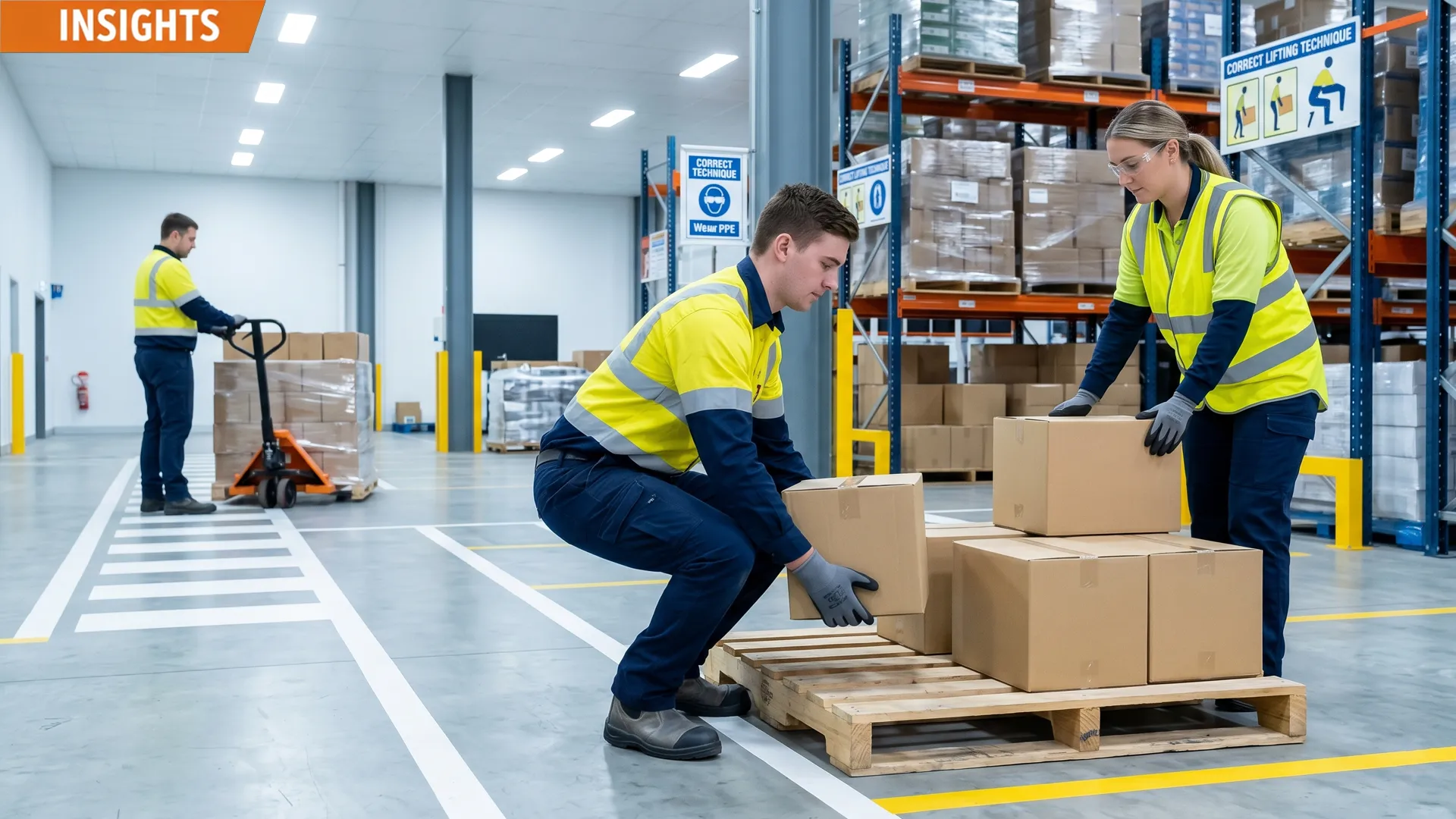
In warehouses and factories, many injuries build through repetition, awkward lifting, poor reach distances, rushed movement, unstable loads, poor workstation design, or tasks that simply ask too much from the body too often. That is why manual handling remains one of the most practical risk areas for employers to review early.
Across Melbourne’s South-East, warehouses, food production sites, manufacturing facilities, and logistics operations often depend on physical work that includes:
- lifting
- lowering
- carrying
- pushing
- pulling
- reaching
- bending
- twisting
- and repetitive movement under time pressure
When these tasks are not designed or managed properly, the result is not just worker discomfort. It can lead to:
- strains
- sprains
- shoulder injuries
- back injuries
- fatigue
- lost time
- and reduced confidence across the floor
Good employers do not wait until someone is hurt to take manual handling seriously.
They review it early — through layout, workflow, equipment, onboarding, supervision, and practical hazard control.
That is where stronger site safety often begins.
For a broader employer overview, see our WorkSafe Victoria compliance in manufacturing and warehousing guide for practical hazard control across warehouse and factory environments.
Why Manual Handling Risk Needs Early Review
Manual handling injuries are often underestimated because the task can look ordinary.
A worker lifts a carton.
Moves a tub.
Stacks a pallet.
Reaches across a bench.
Pulls a trolley.
Bends into a low pick face.
Nothing about those movements seems unusual on its own. But across a full shift, repeated under pressure or in poor conditions, they can create real strain.
That is why good employers review not only:
- how heavy something is
but also:
- how often it is handled
- how awkward the posture is
- how far the worker has to reach
- whether twisting is involved
- whether the lift starts too low or ends too high
- whether the item is stable
- whether the floor condition adds difficulty
- and whether the pace of work encourages rushing
Manual handling risk grows when the task design is poor, even if the worker is experienced.
That is why early review matters.
Where Manual Handling Risks Usually Show Up
In warehouse and factory settings, manual handling pressure often shows up in familiar places.
These include:
- pallet picking and replenishment
- carton handling
- container unloading
- packing lines
- sorting and repacking
- low-level storage zones
- shrink-wrapping areas
- dispatch staging
- raw material movement
- waste handling
- and repetitive bench work
Risk also tends to increase when:
- the shift is busy
- stock is stored awkwardly
- workers are fatigued
- the floor is congested
- mechanical aids are missing
- the task is repetitive
- or new workers are placed into the role without enough guidance
That is why a safe-looking site can still carry manual handling risk if the underlying workflow has not been reviewed properly.
What Good Employers Review Early
1. How the Task Is Actually Performed
The first question is not:
“Is lifting part of the job?”
It is:
“How is this task really being done on the floor?”
Good employers look at:
- where the item starts
- where it ends
- whether the worker twists
- how many repetitions occur
- whether the worker reaches too far
- whether the posture is awkward
- how much time pressure is involved
- and whether people are quietly improvising unsafe methods to keep up
A safe procedure on paper does not always match what happens under real shift conditions.
Early review means watching the task as it is actually performed.
2. Load Weight, Size, and Stability
Some loads are risky because they are heavy.
Others are risky because they are:
- bulky
- unstable
- hard to grip
- poorly balanced
- slippery
- awkwardly shaped
- or difficult to see around
That matters because a lighter awkward load can still create poor posture and injury risk.
Good employers review:
- whether weights are known
- whether the item can be gripped properly
- whether it shifts during handling
- and whether it is forcing workers into poor positions
If the load is unstable, unpredictable, or hard to control, the risk is already higher.
3. Start and Finish Heights
This is one of the most practical issues to review.
Many manual handling problems begin because the item is being lifted:
- from floor level
- from below knee height
- from above shoulder height
- or into awkward storage positions
Lifts that start too low or finish too high often increase:
- bending
- reaching
- twisting
- sudden force
- and fatigue across the shift
Good employers review whether:
- storage heights make sense
- heavy items are placed in better lifting zones
- repeated lifts are happening at poor heights
- and workstation levels are creating avoidable strain
Small layout changes here can make a big difference.
4. Repetition and Task Duration
Some tasks are not especially difficult once.
They become risky when performed:
- hundreds of times
- under time pressure
- without variation
- with poor recovery time
- or while the worker is already tired
This is especially relevant in:
- pick and pack
- production lines
- food processing
- sorting
- repetitive assembly
- and fast dispatch support roles
Good employers review:
- how repetitive the task is
- how long the worker stays on it
- whether task rotation is needed
- and whether the pace of work is pushing movement quality down
A role can look manageable for 20 minutes and still become a strain risk over an 8-hour shift.
5. Layout, Reach Distance, and Floor Space
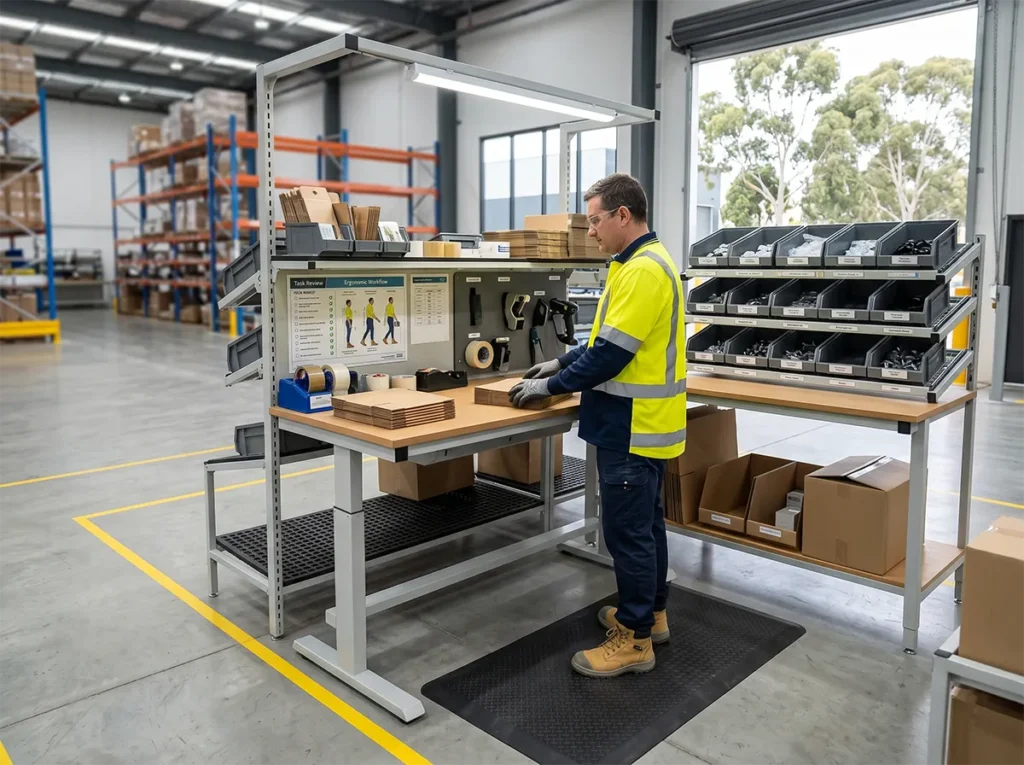
Manual handling is often made worse by poor layout rather than just poor lifting technique.
For example:
- stock is too far back on shelving
- cartons are stacked in a way that forces over-reaching
- workstations are cramped
- trolleys cannot be positioned close enough
- pallets are staged badly
- or walkways are narrowed by overflow stock
Good employers review:
- how far the worker has to reach
- whether the body stays square to the load
- whether there is enough space to move properly
- and whether clutter or poor staging is making the task harder than it needs to be
This is one reason housekeeping and layout control matter so much.
Our article on warehouse traffic management also shows how layout, congestion, and floor discipline affect broader site safety, not just vehicle movement.
6. Use of Mechanical Aids
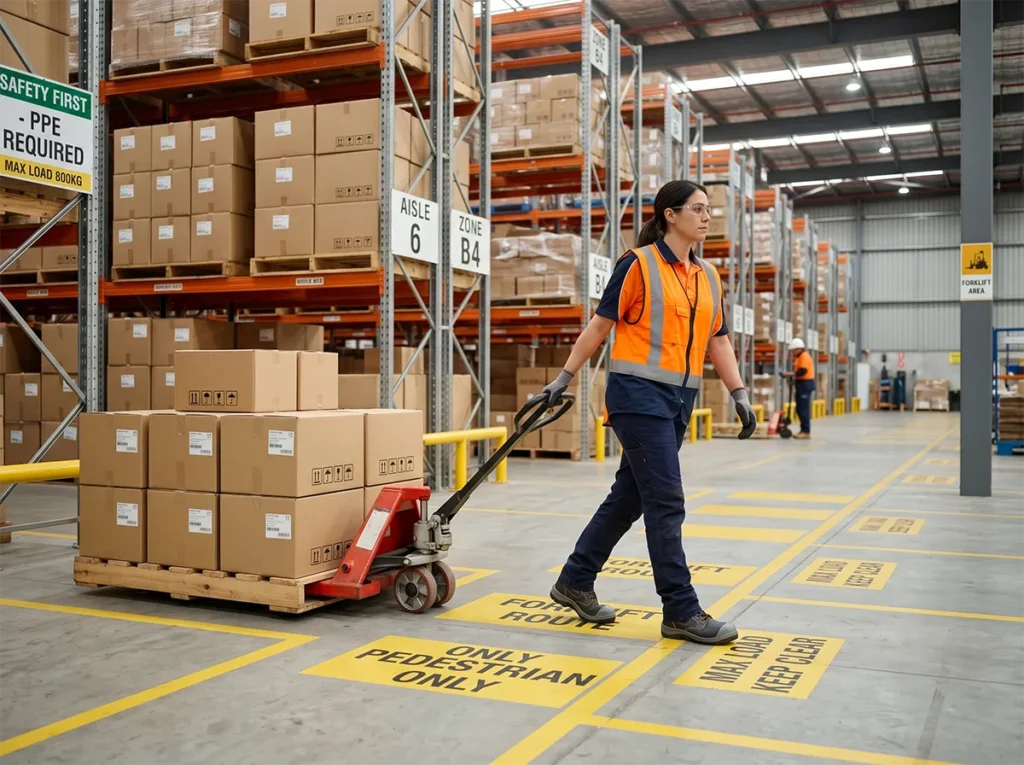
Where reasonably practicable, manual handling risk should be reduced through better tools and equipment.
That may include:
- pallet jacks
- trolleys
- lift tables
- conveyors
- turntables
- vacuum lifters
- hoists
- or improved workbench setup
The key question is not:
“Do we own a mechanical aid?”
It is:
“Is it practical, available, and actually being used in the task?”
Good employers review:
- whether aids are present
- whether they are fit for the load
- whether workers can access them easily
- and whether workflow pressure makes people ignore them
A mechanical aid only reduces risk if it is realistically part of the job.
7. Worker Fit, Capability, and Onboarding
Not every worker arrives with the same capacity, familiarity, or technique.
That is especially relevant for:
- new starters
- labour hire workers
- workers entering repetitive roles for the first time
- and workers moving into a different environment than their previous one
Good employers review:
- whether the worker understands the task
- whether safe handling expectations were shown clearly
- whether manual handling risk was explained in practical terms
- and whether the worker has been placed into a role that fits their capability and site familiarity
This matters because a good worker can still be exposed on day one if they are rushed into a repetitive or awkward task without enough guidance.
Our guide to site safety inductions for labour hire workers explains what host employers should cover on day one to reduce avoidable risk before the shift gets moving.
8. Pace, Productivity Pressure, and Unsafe Shortcuts
Manual handling risk often increases when output pressure starts driving unsafe behaviour.
That can look like:
- workers lifting faster than they should
- carrying too much at once
- skipping mechanical aids
- twisting while moving to save time
- throwing product into place
- or working through fatigue because the line is pushing hard
Good employers review whether the task is being performed safely under real production pace, not ideal pace.
If a role can only be done “safely” when the floor is quiet, the control is probably too weak.
A good review looks honestly at whether productivity pressure is pushing movement quality down.
9. Supervision and Early Correction
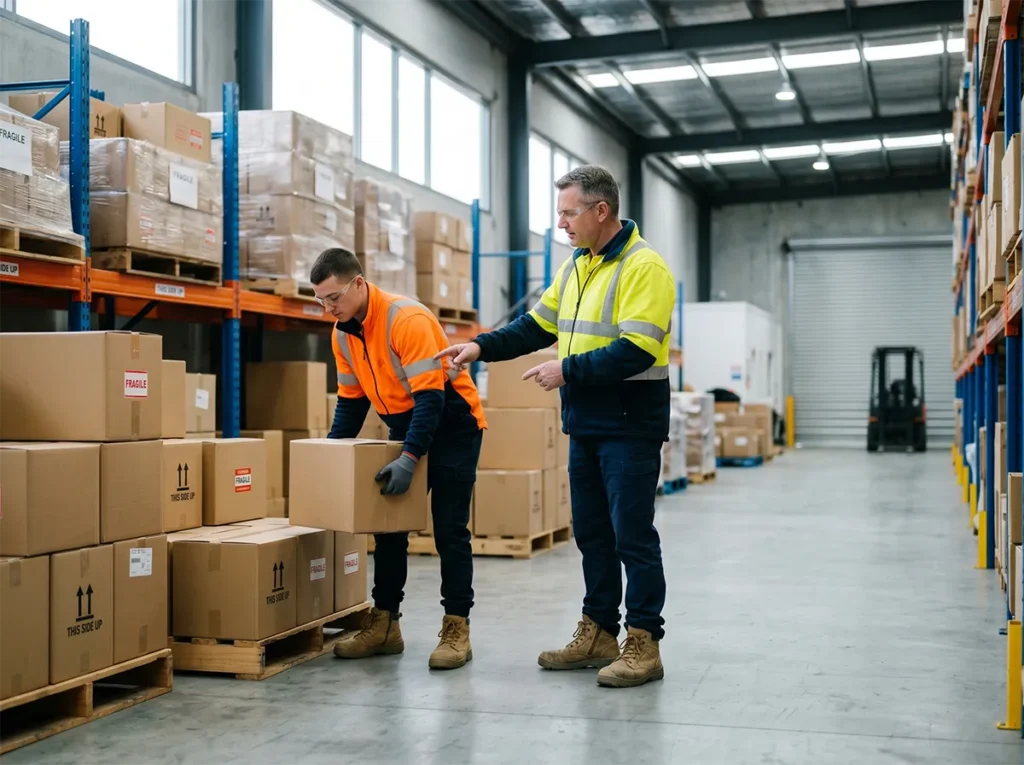
Manual handling controls are weakened when unsafe habits go uncorrected.
Workers may:
- overreach
- bend poorly
- twist while carrying
- drag unstable stock
- or improvise handling methods that look quicker but increase strain
If supervisors treat this as normal, the risk becomes embedded in the task.
Good employers make sure supervisors:
- can recognise poor handling patterns
- correct them early
- reinforce better methods practically
- and escalate layout or equipment issues when the problem is bigger than the worker’s technique
This is not about blaming the worker.
It is about recognising when the task, setup, or pace is making unsafe handling more likely.
10. Review After Change, Not Just After Injury
Manual handling risk can change quickly when the site changes.
That includes:
- new stock profiles
- heavier loads
- faster dispatch demand
- new packaging
- layout changes
- temporary overflow storage
- seasonal peaks
- or increased use of casual labour
Good employers review manual handling whenever work changes — not only when someone gets hurt.
That is a stronger and more practical way to reduce exposure early.
What Manual Handling Risk Usually Looks Like Before an Injury Happens
In many workplaces, there are signs before a manual handling injury actually occurs.
Those signs may include:
- workers stretching too far
- repeated bending into low storage
- visible fatigue late in shift
- people avoiding certain tasks when possible
- dropped items
- rushed or unstable carrying
- small complaints about soreness
- repeated use of awkward workarounds
- or supervisors quietly accepting “that’s just how the job is”
These are warnings worth noticing.
Because once those habits become normal, injuries often feel sudden — even though the risk had been building for some time.
A Simple Manual Handling Checklist for Employers
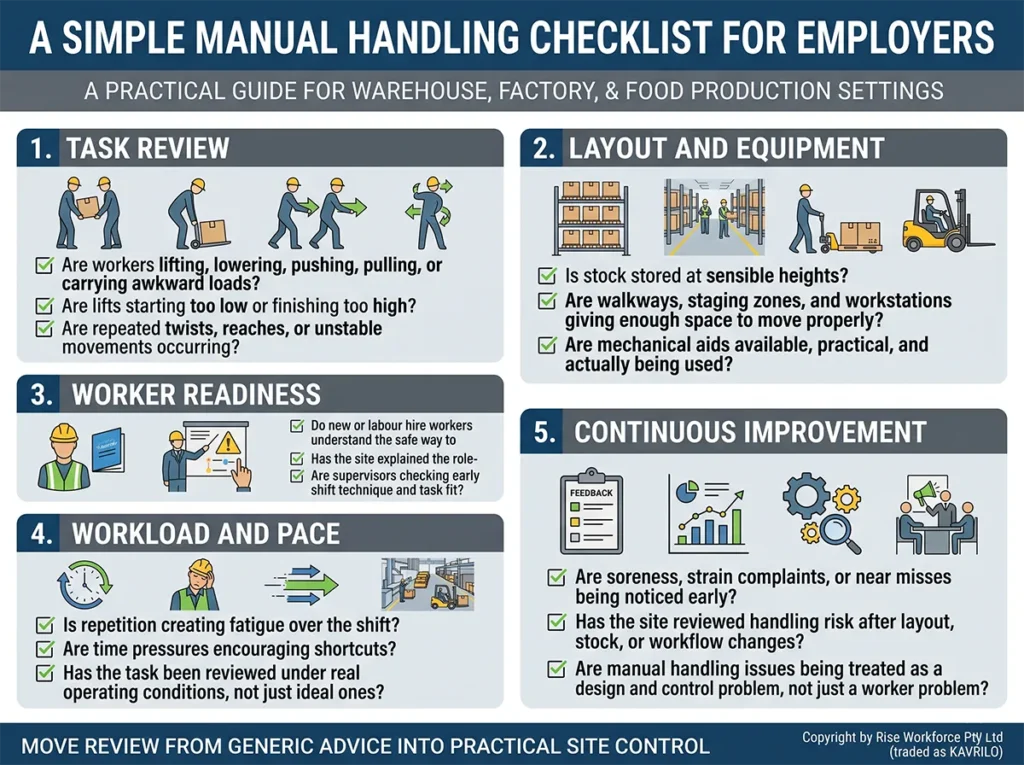
Here is a practical checklist for warehouse and factory employers reviewing manual handling exposure.
Task Review
- Are workers lifting, lowering, pushing, pulling, or carrying awkward loads?
- Are lifts starting too low or finishing too high?
- Are repeated twists, reaches, or unstable movements occurring?
Layout and Equipment
- Is stock stored at sensible heights?
- Are walkways, staging zones, and workstations giving enough space to move properly?
- Are mechanical aids available, practical, and actually being used?
Worker Readiness
- Do new or labour hire workers understand the safe way to perform the task?
- Has the site explained the role-specific handling risks clearly?
- Are supervisors checking early shift technique and task fit?
Workload and Pace
- Is repetition creating fatigue over the shift?
- Are time pressures encouraging shortcuts?
- Has the task been reviewed under real operating conditions, not just ideal ones?
Continuous Improvement
- Are soreness, strain complaints, or near misses being noticed early?
- Has the site reviewed handling risk after layout, stock, or workflow changes?
- Are manual handling issues being treated as a design and control problem, not just a worker problem?
This kind of checklist helps employers move manual handling review from generic advice into practical site control.
Final Word
Manual handling risk in warehouses and factories is not just about teaching workers to “lift properly”.
It is about reviewing the task properly.
Good employers reduce risk earlier by looking at:
- task design
- load type
- height and reach
- repetition
- layout
- equipment
- worker onboarding
- and the real pace of the job
For employers across Melbourne’s South-East, this is one of the most practical areas to strengthen if you want:
- fewer preventable injuries
- better day-one worker readiness
- stronger supervision
- and a safer, more controlled floor
Because when manual handling is reviewed early, the site usually becomes easier to manage, easier to induct into, and less exposed to avoidable strain-related injuries.
That is not just safer work.
It is better operations.
Need Practical Labour Hire Support for Warehousing and Manufacturing in Melbourne’s South-East?
KAVRILO is building its approach around safety-aware workforce support, clearer site coordination, and stronger operational discipline for warehouse and industrial environments.
Whether your site needs support during busy periods, new workflow demands, or more dependable labour coordination, KAVRILO is focused on workforce support that fits controlled warehouse and factory environments.
Need warehouse and factory labour hire support with stronger day-one readiness and a practical safety-aware approach? Talk to KAVRILO about workforce support across Melbourne’s South-East.
Article Disclaimer
This article is provided for general information only and does not constitute legal, workplace relations, safety, taxation, payroll or other professional advice. Please seek advice specific to your circumstances before acting on this information.
Please read our Website Disclaimer for more information.