
For many warehouse employers, the end of the year is not just busy.
It is the period when every weakness in staffing, planning, layout, and supervision starts showing up at once.
Across Dandenong and the wider South-East Melbourne corridor, the end-of-year rush often brings:
- higher outbound volume
- tighter dispatch timelines
- more stock movement
- greater pressure on existing teams
- more shift coverage risk
- and less room for labour problems to be solved slowly
That is why peak season preparation matters.
For warehouse employers, the challenge is rarely just volume alone. It is usually the combination of:
- labour availability
- attendance reliability
- site organisation
- training time
- traffic pressure
- and the need to keep the operation moving without letting the floor become reactive or unstable
A site can have strong people and still struggle if it prepares too late.
That is because peak pressure often exposes:
- weak shift planning
- too much dependence on last-minute fill-ins
- poor site-fit decisions
- cluttered staging
- overworked supervisors
- and a workforce that was already operating close to its limit before the rush even began
That is why the best end-of-year results usually come from earlier planning, not faster panic.
For employers in Dandenong, where warehouse activity is already competitive and industrial demand stays high, the end-of-year period needs to be approached as an operational planning task, not just a seasonal inconvenience.
For the broader local market overview, see our Staffing South-East Melbourne pillar guide for Dandenong warehouse and factory employers.
Why the End-of-Year Rush Hits Warehouses So Hard
Peak season creates a different kind of pressure from ordinary busy periods.
The issue is not just that there is more work.
It is that more work arrives while the warehouse is already managing:
- shift rosters
- attendance risk
- dispatch commitments
- space pressure
- supervision load
- and the normal unpredictability of industrial operations
That means even a small labour problem can have wider impact.
For example:
- one absence can slow dispatch
- one weak placement can increase supervision strain
- one cluttered staging area can reduce movement efficiency
- and one poorly prepared shift can place extra pressure on the rest of the team
In peak season, these problems stack faster.
That is why employers who prepare earlier usually protect themselves better against:
- last-minute labour gaps
- avoidable no-shows
- poor first-shift integration
- and rising floor pressure that makes everything harder to manage
What Peak-Season Pressure Usually Looks Like on the Floor
The end-of-year rush often feels less like one big problem and more like several smaller pressures landing together.
That may include:
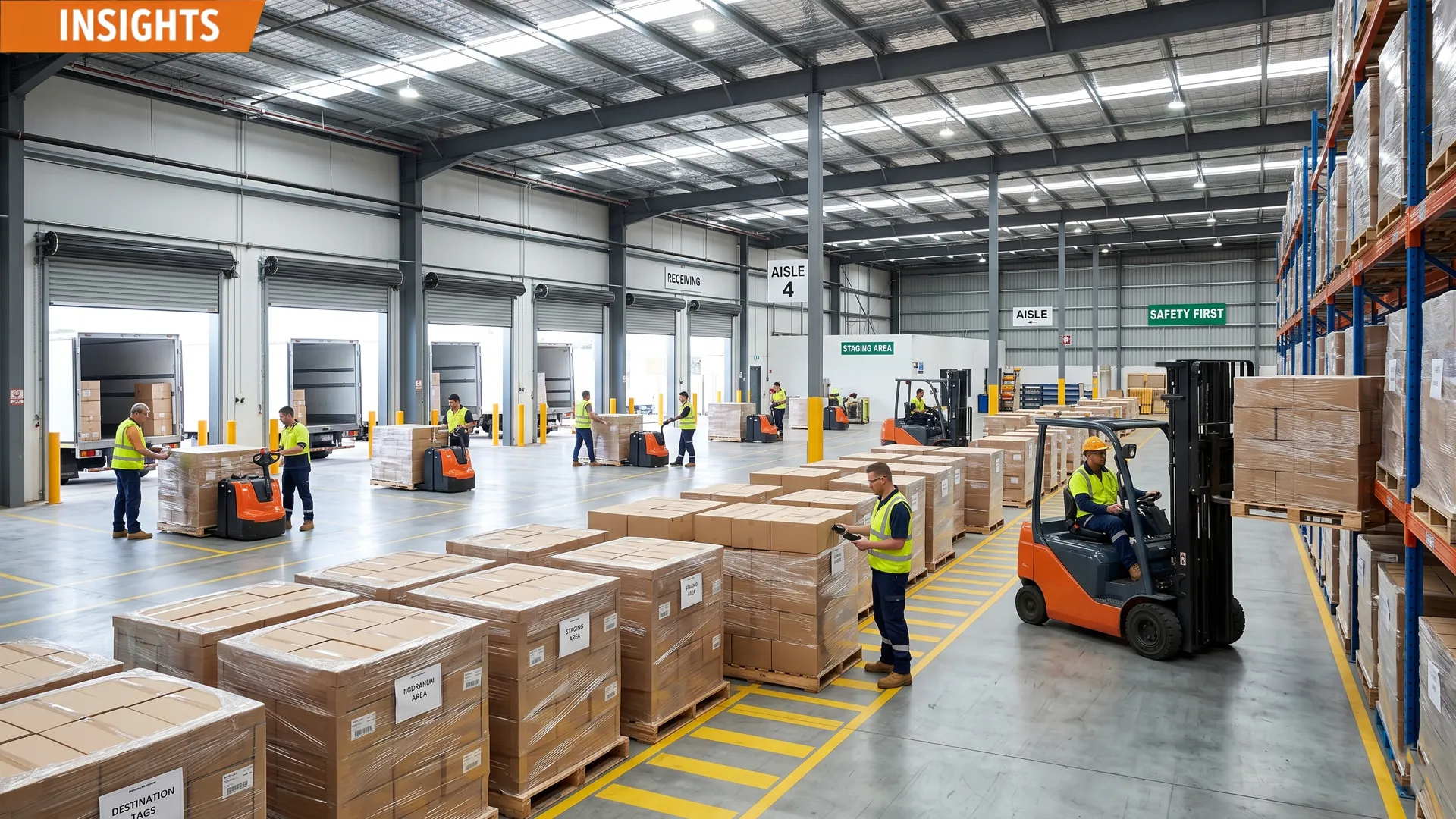
- more pallets moving through the same space
- tighter dispatch cut-offs
- more frequent load-in and load-out activity
- extra casual labour requirements
- longer or more complex shift patterns
- more supervision pressure on team leaders
- and less tolerance for lateness or weak role fit
This is where warehouses often feel the strain most clearly.
Because even if the demand increase is expected, the site can still be caught off guard if it has not prepared for:
- workforce coverage
- labour quality
- site organisation
- or how the existing team will absorb extra pace
That is why planning for peak season should include both:
- labour strategy
- and floor-readiness strategy
10 Practical Things Dandenong Employers Should Prepare Early
1. Review Labour Demand Before the Pressure Starts

One of the most common mistakes is waiting until the rush is already visible before reviewing staffing needs.
Good employers usually look early at:
- expected volume changes
- likely dispatch pressure
- leave periods
- known absentee risk
- and what extra labour coverage may realistically be needed
This matters because once the peak starts, the labour market may already feel tighter.
Earlier planning gives the business more room to:
- assess coverage gaps
- explain role requirements properly
- and avoid rushed staffing decisions that create extra friction later
2. Decide Where Casual Support Will Actually Be Needed
Not every busy area needs the same kind of staffing support.
Good employers think clearly about:
- which tasks need extra hands
- which shifts are most exposed
- which roles require stronger site fit
- and where the existing team is likely to feel the most pressure
That may include:
- pick packing
- dispatch support
- replenishment
- container or inbound handling
- pallet movement
- or general warehouse process work
The clearer the labour plan is, the easier it becomes to match support properly.
3. Tighten Shift Reliability Before Peak Volume Arrives
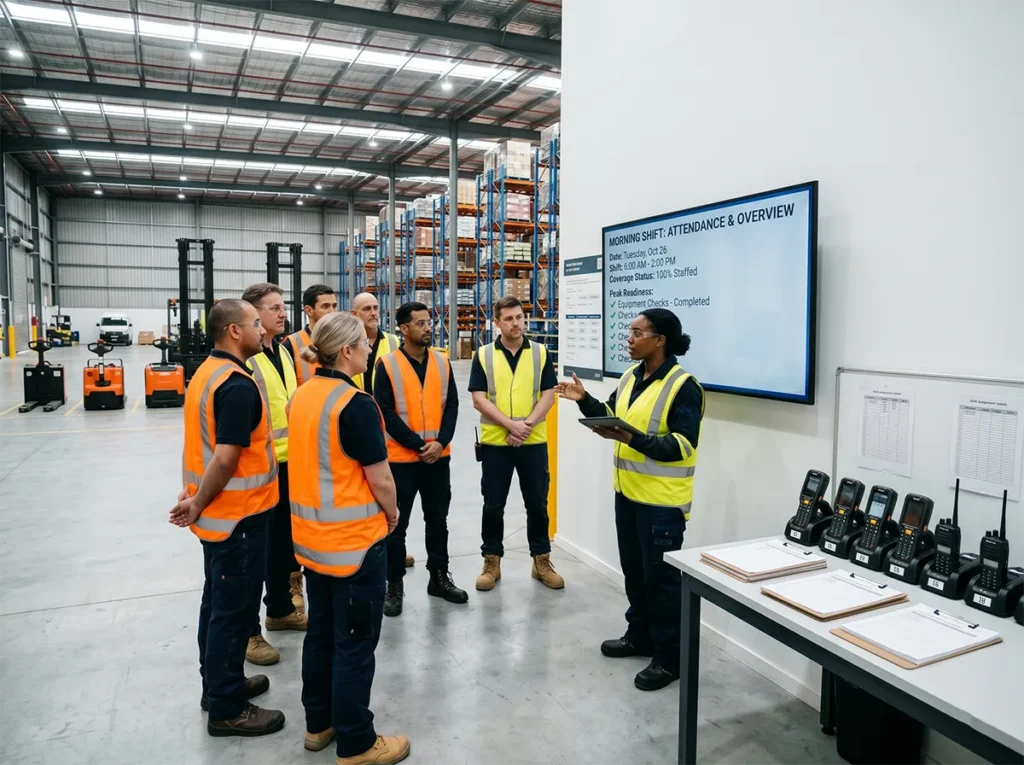
Peak season makes attendance issues more damaging.
A no-show during a quieter period is a problem.
A no-show during end-of-year pressure can affect:
- dispatch timing
- team load
- output rhythm
- and supervisor workload much more quickly
That is why good employers review:
- current attendance patterns
- where late arrivals are already happening
- what roles are most exposed to short-notice gaps
- and what can be improved before demand lifts further
Our article on how to reduce no-shows and last-minute gaps in Dandenong warehouse shifts explains practical ways employers can tighten shift reliability before those problems become more disruptive under peak demand.
4. Think Carefully About Travel and Shift Practicality
Peak coverage becomes harder when the shift pattern is difficult to sustain.
This is especially relevant where:
- shifts begin very early
- overtime extends the working day
- travel to site is already demanding
- or workers are coming from less practical locations
A worker may be available at the start of the peak and still struggle to maintain consistency once:
- fatigue rises
- transport pressure builds
- or the routine becomes harder to sustain over several weeks
Good employers review whether their peak staffing assumptions are practical from a travel and reliability point of view, not just from a roster point of view.
Our guide to how transport and travel time affect shift reliability in South-East Melbourne explains why commute practicality still matters so much for attendance and punctuality during busy industrial periods.
5. Prioritise Site Fit, Not Just Headcount
When demand increases, it becomes tempting to focus only on numbers.
That is understandable, but risky.
A poor-fit worker during peak season can create more strain than support if they:
- need excessive correction
- do not suit the pace
- struggle with the physical demands
- or take too long to settle into the workflow
That is why good employers still think about:
- role fit
- shift fit
- site pace
- and practical suitability
even when labour pressure is rising.
Peak season is exactly when poor fit becomes more expensive.
Our article on why site fit matters more than headcount in warehouse and factory staffing explains why better role matching often protects warehouse performance more effectively than simply filling numbers quickly.
6. Get the Floor Ready for Higher Throughput

Peak season preparation is not only about labour.
It is also about whether the floor can handle the extra pressure safely and efficiently.
That means reviewing:
- staging space
- dispatch flow
- access routes
- walkways
- pallet build-up risk
- and whether temporary overflow conditions are likely to create more friction than the team can absorb
If the floor becomes cluttered or harder to read, then even good labour support becomes less effective.
That is why physical organisation still matters during staffing planning.
7. Protect Supervisor Capacity Early
During busy periods, supervisors often become one of the most stretched parts of the operation.
They may be trying to handle:
- staffing questions
- shift gaps
- floor coordination
- training and onboarding
- dispatch pressure
- and ongoing production expectations at the same time
If supervisors are already overloaded before peak starts, the site can lose control faster once extra labour and higher volume arrive.
Good employers review:
- who will support first-shift onboarding
- who will manage floor questions
- and whether supervisor capacity needs protection before demand ramps up further
8. Prepare for Faster Onboarding Without Making It Weaker
Peak season often means bringing people in faster.
That can be necessary.
But faster onboarding should not become weaker onboarding.
Good employers still make sure workers understand:
- where to report
- what the shift expectations are
- who supervises them
- what areas are high-pressure
- and what “good” looks like on that site from the beginning
A rushed onboarding process often creates:
- slower settling-in
- more repeated correction
- poorer shift flow
- and extra supervisor burden during the period the site can least afford it
9. Strengthen Communication Before Small Problems Multiply
The faster the warehouse moves, the more damaging unclear communication becomes.
During peak season, employers should think early about:
- who communicates changes
- how labour issues are escalated
- how shift changes are shared
- and whether supervisors, casual staff, and permanent workers are all receiving consistent direction
This matters because small misunderstandings become larger faster when:
- volume is up
- time pressure is higher
- and the site has less spare capacity to absorb confusion
Peak periods reward clarity.
10. Work With Staffing Support That Understands the South-East Properly
Dandenong warehouse employers often benefit from support that feels:
- local
- responsive
- realistic
- and aware of how the South-East industrial corridor actually behaves during busy periods
This matters because peak-season staffing is harder to manage when the labour support is:
- too generic
- disconnected from local site conditions
- or slow to respond when the pressure changes quickly
A stronger labour partner can help reduce:
- role mismatch
- delayed fill times
- unreliable coverage
- and unnecessary first-shift friction during one of the busiest periods of the year
Our article on why South-East Melbourne employers need faster, more local staffing support explains why local responsiveness often makes workforce coverage more practical and dependable during high-pressure periods.
What Better Peak Preparation Usually Looks Like in Practice
When a warehouse is better prepared for the end-of-year rush, the difference is usually visible early.
It tends to feel:
- more organised
- more realistic
- less reactive
- and easier to support operationally
In practice, that often means:
- labour demand was reviewed early
- casual support is planned rather than improvised
- shift reliability is being protected
- supervisors are not carrying all the strain alone
- the floor is better prepared for higher throughput
- and communication is clearer under pressure
It should not feel like:
- the site is solving staffing problems shift by shift
- every extra worker creates more confusion than support
- or peak season exposes how little labour planning was done before volume increased
Good preparation does not remove the pressure.
But it usually keeps the pressure more controlled.
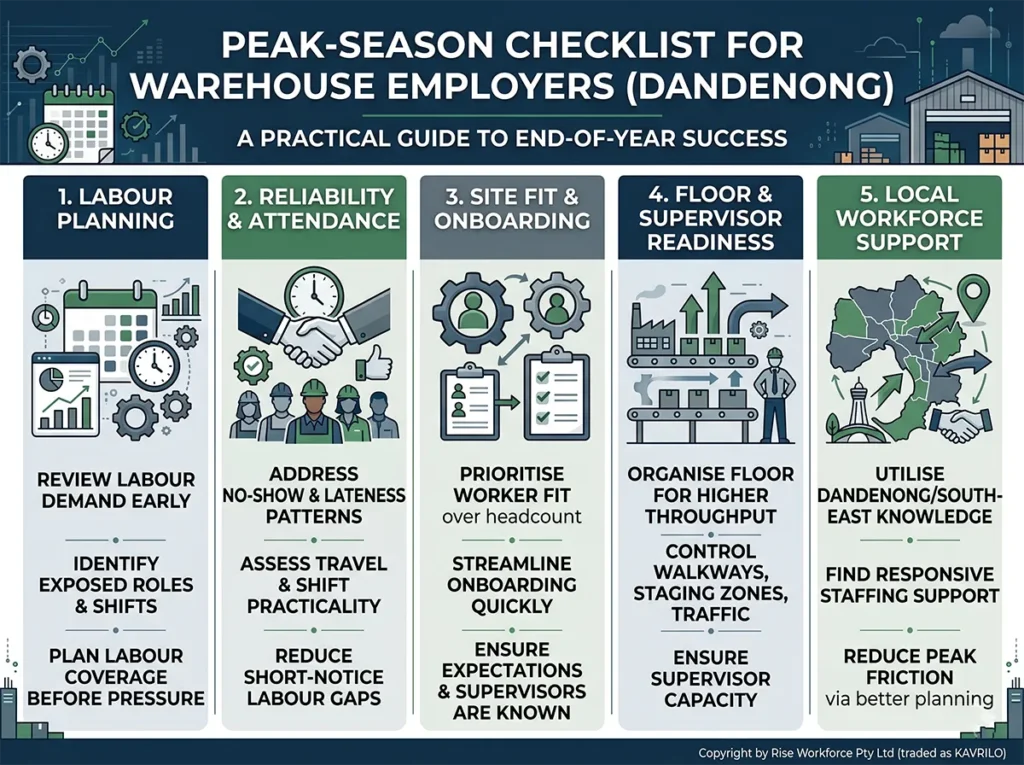
A Simple Peak-Season Checklist for Dandenong Warehouse Employers
Here is a practical checklist employers can use before the end-of-year rush begins.
Labour Planning
- Have we reviewed likely labour demand early enough?
- Do we know what roles and shifts are most exposed?
- Are we planning labour coverage before the pressure fully arrives?
Reliability and Attendance
- Are current no-show or lateness patterns already affecting the floor?
- Are travel and shift practicality being thought through realistically?
- Are we too exposed to short-notice labour gaps?
Site Fit and Onboarding
- Are we still prioritising worker fit, not just headcount?
- Can we onboard extra workers quickly without weakening the process?
- Do new workers know who supervises them and what the site expects?
Floor and Supervisor Readiness
- Is the floor organised well enough for higher throughput?
- Are walkways, staging zones, and traffic areas under control?
- Do supervisors have enough capacity to handle added pressure?
Local Workforce Support
- Are we using labour support that understands Dandenong and the South-East properly?
- Can our staffing support respond quickly when conditions change?
- Are we reducing peak friction or setting the warehouse up for more of it?
This kind of checklist helps employers treat the end-of-year rush as a planning task rather than a seasonal emergency.
Final Word
Preparing your Dandenong warehouse for the end-of-year rush matters because peak season amplifies every weakness in staffing, planning, and floor control.
For warehouse employers across Dandenong and South-East Melbourne, better peak outcomes usually come from:
- earlier labour planning
- stronger attendance thinking
- better site fit
- more controlled onboarding
- stronger supervisor protection
- and local workforce support that reflects how the corridor actually operates
That is what helps reduce:
- avoidable staffing stress
- same-day disruption
- poor worker fit under pressure
- chaotic shift coverage
- and operational strain that should have been reduced before the peak began
Because the end-of-year rush is hard enough already.
It becomes much harder when the labour plan starts too late.
That is not just better seasonal preparation.
It is better warehouse control.
Need Practical Labour Hire Support for Warehousing and Manufacturing in Melbourne’s South-East?
KAVRILO is building its approach around safety-aware workforce support, stronger local responsiveness, and clearer operational discipline for warehouse and industrial environments.
Whether your site needs support during busy periods, stronger shift reliability, or more dependable labour coordination across the South-East, KAVRILO is focused on practical workforce support that fits controlled warehouse and factory environments.
Need warehouse and factory labour hire support with stronger local responsiveness and more dependable shift coverage? Talk to KAVRILO about workforce support across Melbourne’s South-East.
Article Disclaimer
This article is provided for general information only and does not constitute legal, workplace relations, safety, taxation, payroll or other professional advice. Please seek advice specific to your circumstances before acting on this information.
Please read our Website Disclaimer for more information.