
Casual labour can be very useful in food production.
It helps sites respond to:
- peak demand
- leave coverage
- absenteeism
- short-term volume changes
- and the reality that production pressure does not always wait for a long recruitment process
But flexibility should not come at the cost of control.
Across Victoria, food manufacturers that use casual workers still need to ask a very practical question before the first shift begins:
Is this worker actually ready for this environment?
That question matters because food production is not just another factory setting.
A casual worker may have:
- general warehouse experience
- process work experience
- packing experience
- or good industrial attitude
and still be underprepared for:
- hygiene entry
- PPE discipline
- contamination-sensitive behaviour
- wet-floor movement
- line pace
- and the stricter behavioural control that food production often requires from the first shift
That means host employers should not treat “worker available” as the same thing as “worker ready”.
A food production site needs more than attendance.
It needs workers who can enter the environment without creating avoidable risk for:
- themselves
- the production area
- the product
- the team
- and the supervisors who would otherwise have to correct too much, too quickly, under real production pressure
That is why the strongest employers check readiness early.
Not as a paper exercise, but as a practical control before the worker enters active production.
For the broader hub article, see our Food Production Safety in Victoria pillar guide on hygiene, PPE, wet-floor risk, repetitive work, fatigue, and safer worker onboarding in fast-paced sites.
Why Casual Worker Readiness Matters So Much in Food Production
A casual worker can arrive willing, punctual, and cooperative — and still be a weak fit for a food production site if the readiness checks are too loose.
That is because food production often expects workers to understand from the beginning:
- site entry discipline
- correct PPE use
- hygiene behaviour
- movement boundaries
- washdown and wet-area risk
- line pace
- and who to ask when something is unclear
If those things are weak on shift one, the site may quickly experience:
- more supervision pressure
- more correction
- more uncertainty
- weaker hygiene control
- and a higher chance that the worker is trying to learn the environment by guessing rather than by clear guidance
This matters because in food production, a small misunderstanding is not always small.
It can affect:
- worker safety
- food safety
- pace
- quality
- and team confidence
That is why host employers need stronger checking before casual labour enters active production areas.
Where Employers Often Get Too Casual About Casual Workers
The biggest problems usually do not come from bad intent.
They come from assumptions such as:
- they have done factory work before, so they will be fine
- the agency has sent them, so they must already understand the site
- they look confident, so they probably understand the rules
- they have PPE on, so they must know what it means here
- or they can pick it up as they go
These assumptions are risky in food production.
A worker may still be unclear on:
- hygiene sequence
- zone control
- site-entry expectations
- wet-area behaviour
- line discipline
- or when they are supposed to stop and ask rather than continue and hope for the best
That is why host employers need to check:
- understanding
- site fit
- and first-shift support
not just presence and paperwork.
10 Practical Things Host Employers Should Check Early
1. Whether the Worker Understands This Is a Food Production Environment, Not Just General Factory Work
This sounds basic, but it matters.
A worker moving into food production should understand that the site expects:
- tighter hygiene discipline
- stronger PPE control
- more structured entry
- and more sensitive behaviour around production areas
This matters because some workers will arrive with solid industrial experience but still interpret the site through a general warehouse or factory mindset.
That can create problems early.
Good host employers make sure the worker understands:
- this environment is different
- and the rules matter differently here
Our article on why food production safety is different from general warehouse safety explains why food sites require tighter behavioural and hygiene control than many other industrial environments.
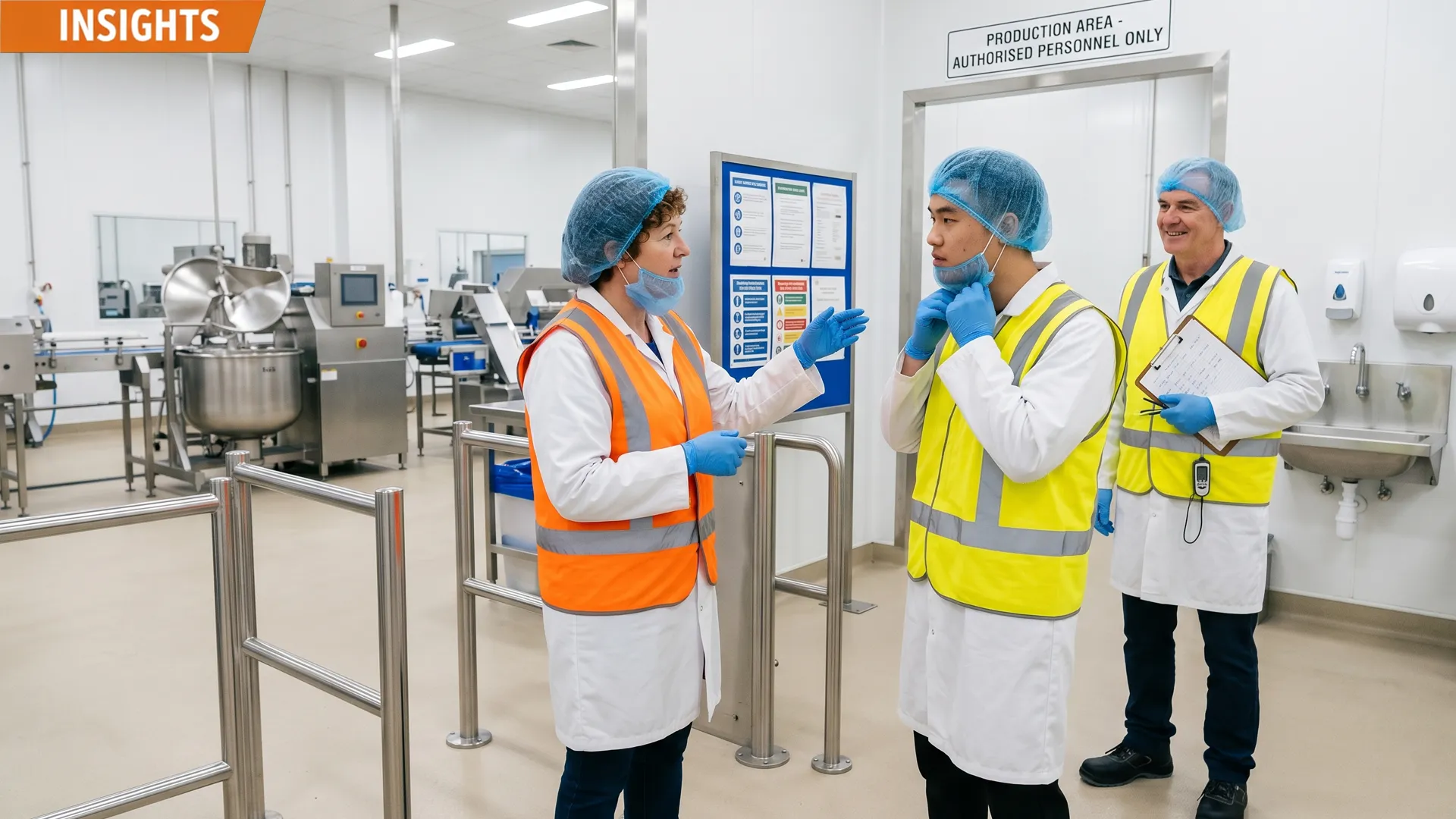
2. Whether the Worker Knows the Site Entry Steps Before Shift Start
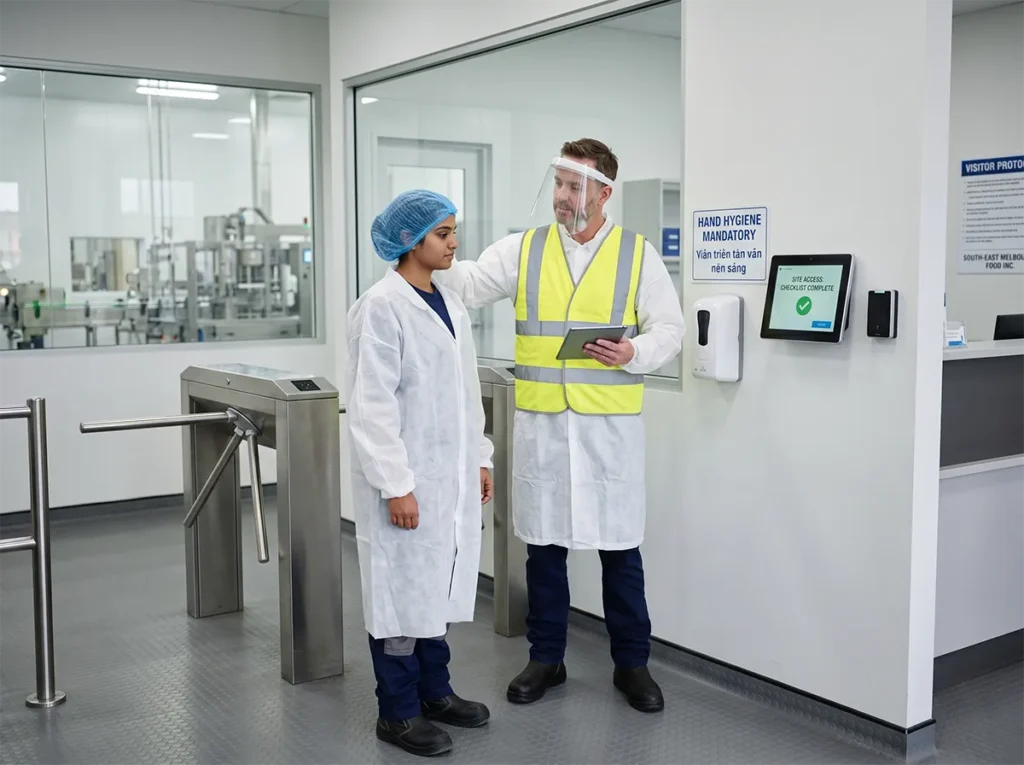
A casual worker should not be trying to work out:
- where to report
- what entry sequence applies
- what hygiene steps matter
- what PPE must be on before entry
- or where they are actually allowed to go
once the shift has already started.
This should be clear before the worker enters active areas.
A stronger host employer checks that the worker understands:
- reporting point
- entry process
- hygiene sequence
- and who is taking them through those first steps
That is one of the most practical day-one controls on the site.
Our article on food production site entry rules: what new workers need to understand before shift start looks more closely at the practical entry controls that should be made clear before the worker enters production zones.
3. Whether PPE Is Understood Properly, Not Just Worn
A worker arriving in PPE is not the same as a worker understanding PPE.
Host employers should check whether the worker understands:
- what must be worn
- how it should be worn
- what must stay covered
- when items need changing
- and why the PPE matters to both worker safety and food safety
This matters because weak PPE understanding often signals wider misunderstanding about:
- hygiene
- contamination-sensitive behaviour
- and how controlled the site really is
A stronger site does not just check for visible compliance.
It checks for practical understanding.
Our article on why PPE in food production protects both worker safety and food safety explains why protective clothing should be treated as a dual control from the first shift onward.
4. Whether the Worker Can Follow Simple Hygiene and Movement Rules Clearly
Before a casual worker enters active production, the employer should be confident they understand:
- where they can and cannot go
- what hygiene sequence applies
- how to move through the site
- what behaviour matters in controlled areas
- and what to do if they are uncertain
This matters because many day-one mistakes are not caused by defiance.
They are caused by uncertainty.
A worker who is not clear on movement and hygiene control may:
- copy others badly
- cross into the wrong area
- or carry general industrial habits into a more sensitive food production setting
That is avoidable with better checking.
5. Whether the Worker Has Been Shown the Real Risk Points on Site
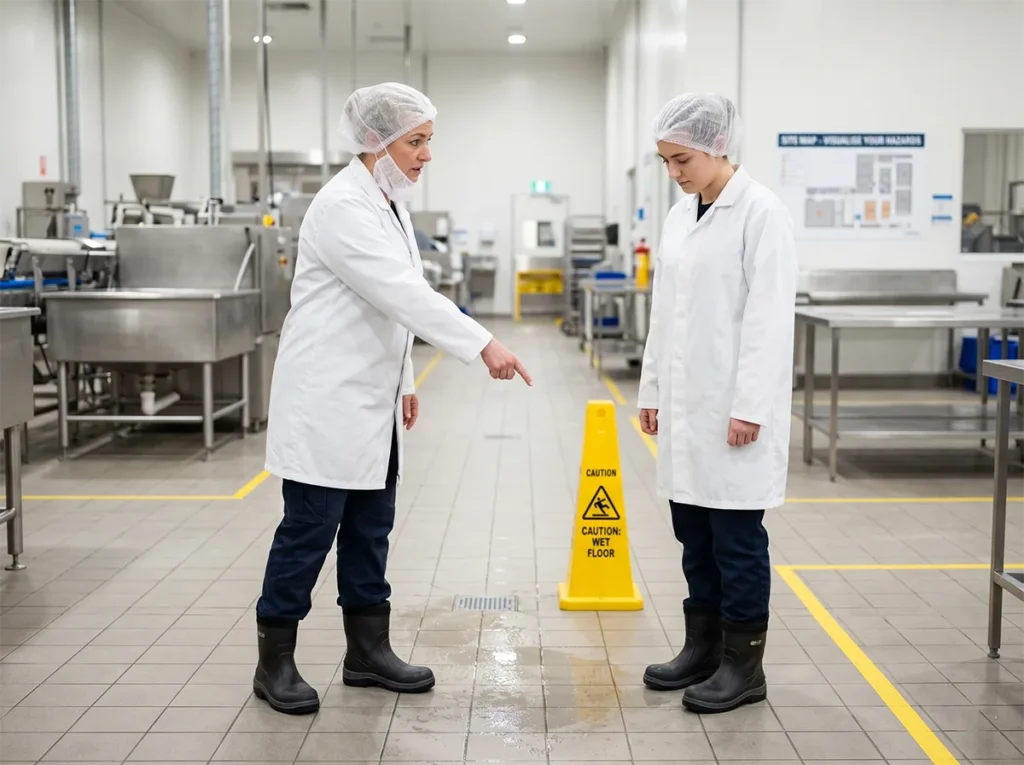
General induction is important.
But host employers should also check whether the worker has been shown the site’s actual pressure points, such as:
- wet areas
- washdown zones
- drain areas
- tighter walkways
- line pace expectations
- and any places where behaviour needs to change quickly or carefully
This matters because real site understanding is often stronger when the worker can connect:
- the rule
to - the place where it applies
A casual worker is much safer when the site is easier to read from the start.
Our article on wet floors, washdowns and drain areas: what food production sites should review early explains why workers need clearer practical guidance around routine wet-area risk before moving independently through the site.
6. Whether Language or Communication Gaps Are Being Overlooked
A worker may appear to understand and still be unclear.
This is especially important where:
- English is limited
- the worker is multilingual
- or the site has relied too heavily on fast verbal explanation
Host employers should check whether the worker can actually follow:
- the sequence
- the PPE requirements
- the hygiene steps
- the movement boundaries
- and who to ask when something is unclear
This matters because a quiet worker is not automatically a ready worker.
Good employers treat communication clarity as a real safety and hygiene control.
Our article on how to run safer food production inductions for non-English speaking workers looks at how employers can make site rules and key controls much clearer for multilingual workers.
7. Whether the Worker Can Realistically Cope With the Pace of the Role
Some casual workers may be able to do the task in theory but still struggle with:
- the speed
- the repetition
- the line rhythm
- or the physical sustainability of the work across the full shift
That is worth checking early.
A host employer should think about:
- whether the worker suits the actual pace
- whether the role is more repetitive than expected
- and whether the worker is likely to cope with the physical pattern once the first-shift energy fades
This matters because weak pace fit often becomes:
- weak movement quality
- early fatigue
- poorer handling
- or more supervision pressure later in the shift
8. Whether First-Shift Supervision Is Visible Enough
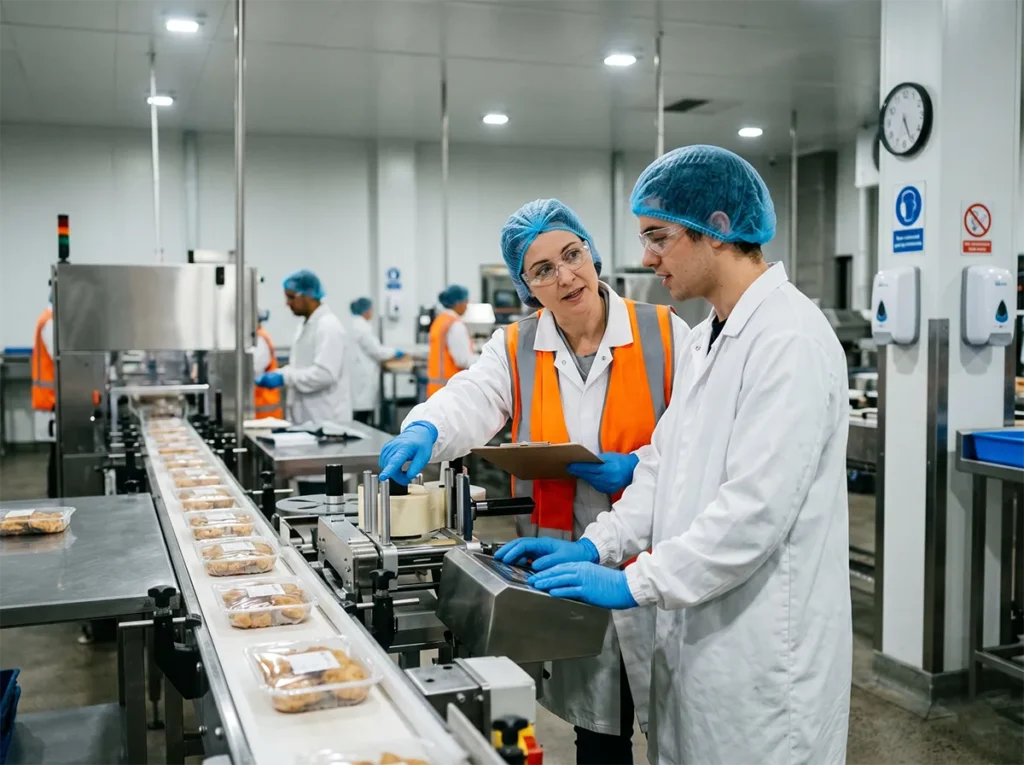
A casual worker should know:
- who owns their first shift
- who they report to
- who can answer questions
- and who is watching whether they have actually understood the environment
This matters because even a decent induction can be weakened quickly if the worker is then left to:
- copy others
- guess
- or stay silent about uncertainty
Visible supervision on shift one helps reduce:
- drift
- confusion
- and the quiet build-up of avoidable errors
A stronger site does not assume orientation ended when the briefing ended.
Our article on bringing new workers into food production: how to reduce hygiene and safety risk on day one explains why visible first-shift supervision is one of the strongest controls once the worker enters active production.
9. Whether the Worker Is Being Asked to Learn Too Much Too Fast
A casual worker may be overloaded if they are expected to absorb:
- entry sequence
- PPE rules
- hygiene expectations
- line pace
- workstation setup
- and site behaviour
all at once without enough structure.
That is especially risky on busy sites.
Host employers should check whether the worker has been given:
- the essentials first
- the real risk points clearly
- and enough practical guidance to work safely before more complex expectations are layered on top
This helps reduce the common problem where the worker remembers only fragments of what mattered most.
10. Whether the Site Is Mistaking “We Need Someone” for “This Person Is Ready”
This is the biggest question of all.
Sometimes the site urgently needs coverage.
That is real.
But urgency can tempt employers to lower their readiness threshold.
That can sound like:
- they will learn quickly
- we just need someone on the line
- we can fix it later
- or the team will show them as they go
In food production, that can create unnecessary risk.
A stronger host employer still asks:
- is this person actually ready for this site today?
- have we checked enough?
- are we controlling the first shift well enough to justify putting them into active production?
That is a much better standard than urgency alone.
What Better Casual Worker Readiness Usually Looks Like in Practice
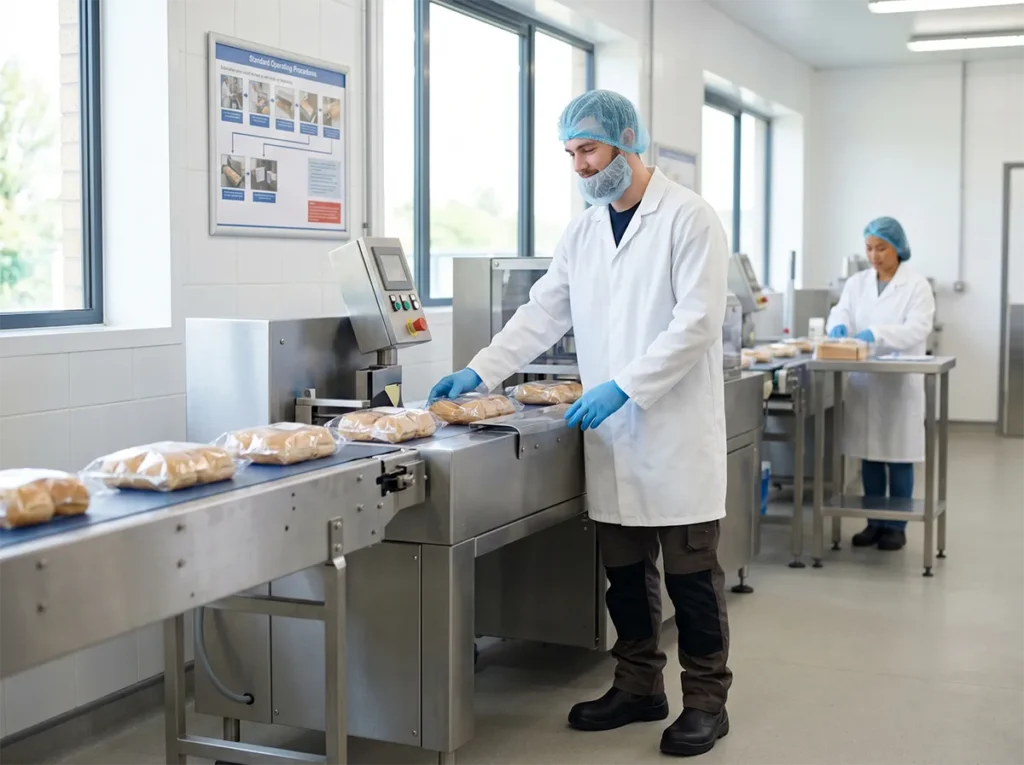
When casual worker readiness is being checked well, the site usually feels:
- more structured
- more readable
- less reactive
- and easier to support operationally
In practice, that often means:
- the worker understands this is a food production environment
- entry and PPE expectations are clear
- site risk points have been shown
- communication gaps are not being ignored
- pace fit is being considered honestly
- and supervision remains visible after the briefing finishes
It should not feel like:
- the worker is present but still guessing
- the team is filling in gaps that should have been covered earlier
- or host employers are relying too heavily on urgency to justify weak day-one control
Good readiness checking usually reduces more than risk.
It also reduces friction on the floor.
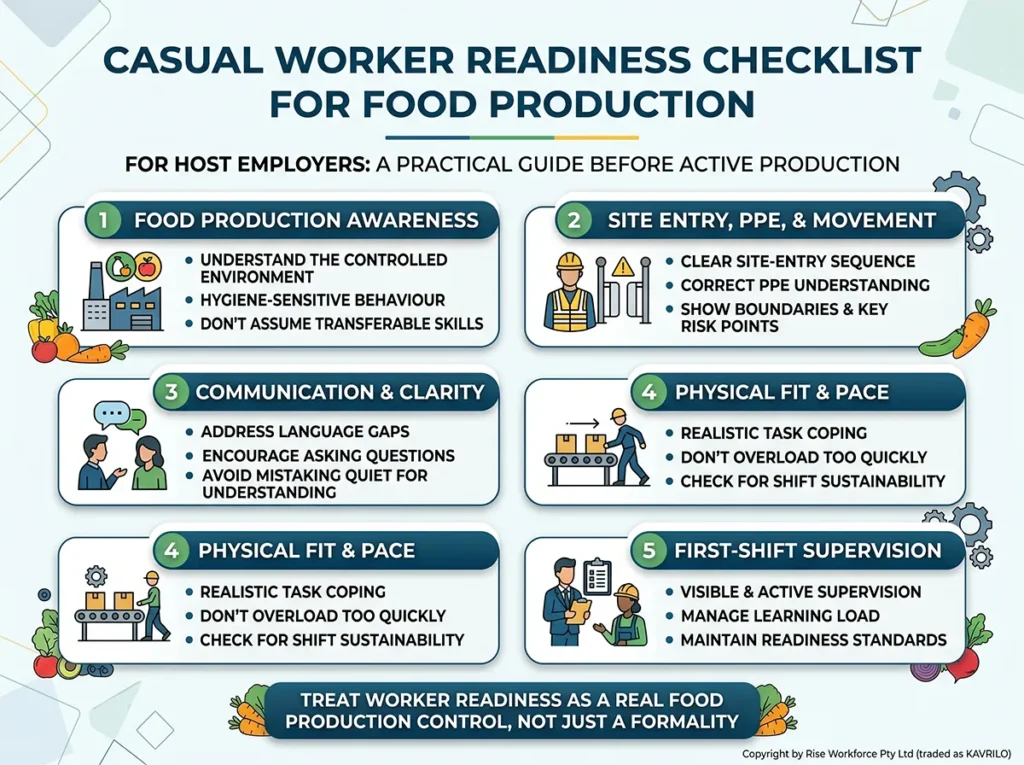
A Simple Casual Worker Readiness Checklist for Host Employers
Here is a practical checklist food manufacturers can use before putting casual workers into active production.
Food Production Readiness
- Does the worker understand this is a controlled food production environment, not just general factory work?
- Have we checked their understanding of hygiene-sensitive behaviour?
- Are we assuming too much because they have done industrial work elsewhere?
Entry, PPE, and Movement
- Does the worker know the site-entry sequence clearly?
- Do they understand PPE properly, not just visually comply with it?
- Have movement boundaries and key site risk points been shown clearly enough?
Communication and Understanding
- Are language or communication gaps affecting day-one clarity?
- Can the worker ask questions easily?
- Are we mistaking quiet behaviour for real understanding?
Pace and Physical Fit
- Can the worker realistically cope with the pace and repetition of the role?
- Are we putting them into a task that is too demanding too quickly?
- Have we checked whether the work is sustainable for them across the shift?
First-Shift Control
- Is first-shift supervision visible enough?
- Is the worker being asked to learn too much too fast?
- Are we letting urgency lower the readiness standard too far?
This kind of checklist helps host employers treat casual-worker readiness as a real food production control, not just a staffing formality.
Final Word
Host employers should check more than availability before putting casual workers into food production.
For food manufacturers in Victoria, stronger outcomes usually come from:
- checking site-specific readiness early
- making entry and PPE expectations clearer
- showing real site risk points
- taking communication gaps seriously
- considering pace and physical fit
- and keeping first-shift supervision visible enough to catch uncertainty before it becomes risk
That is what helps reduce:
- preventable hygiene mistakes
- weak day-one movement behaviour
- poor PPE understanding
- unnecessary supervision pressure
- and the false confidence that comes from having a worker on the roster who is not yet truly ready for the site
Because in food production, casual labour can be useful.
But only when the site treats readiness as part of the safety system.
Need Practical Labour Hire Support for Warehousing and Manufacturing in Melbourne’s South-East?
KAVRILO is building its approach around safety-aware workforce support, stronger local responsiveness, and clearer operational discipline for warehouse and industrial environments, including food production settings where hygiene discipline and day-one worker readiness matter.
Whether your site needs better shift coverage, stronger day-one worker readiness, or more dependable labour coordination in hygiene-sensitive environments, KAVRILO is focused on practical workforce support that fits controlled production sites.
Need warehouse and factory labour hire support with stronger day-one readiness and more dependable workforce support for controlled production environments? Talk to KAVRILO about practical labour support across Melbourne’s South-East.
Article Disclaimer
This article is provided for general information only and does not constitute legal, workplace relations, safety, taxation, payroll or other professional advice. Please seek advice specific to your circumstances before acting on this information.
Please read our Website Disclaimer for more information.