
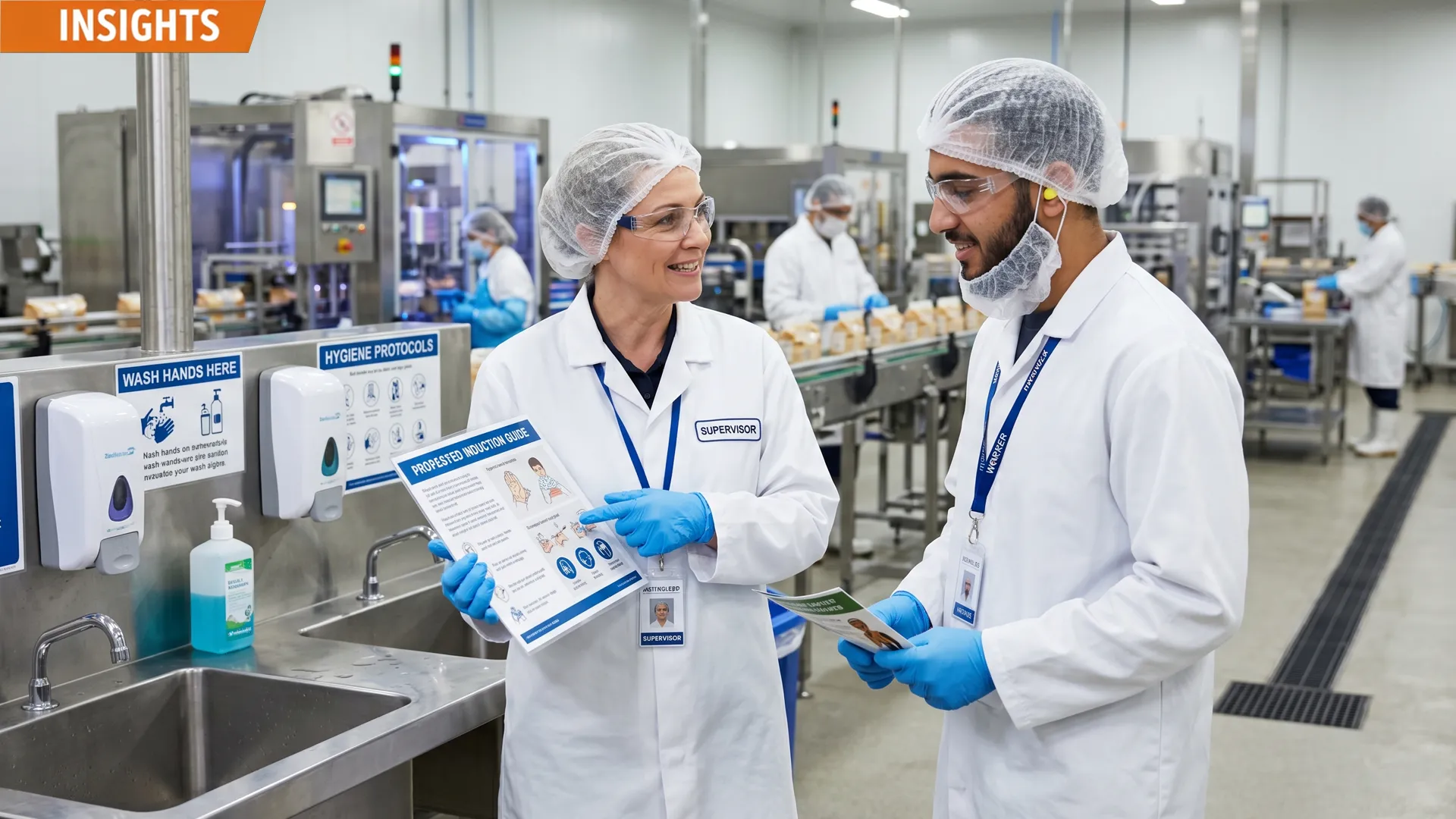
In food production, a worker can appear to understand the induction and still leave unclear on what matters most.
That is a real problem.
Across Victoria, many food manufacturers rely on multilingual workforces that include:
- non-English speaking workers
- workers with limited workplace English
- casual labour
- temporary workers
- and new starters entering controlled food environments for the first time
That is normal in modern production settings.
But it also means employers cannot treat induction as:
- a quick verbal explanation
- a set of forms to sign
- or a process that is considered complete simply because the worker nodded along
In fast-paced food production, that creates real risk.
A worker who is unclear on:
- hygiene sequence
- PPE expectations
- movement boundaries
- washdown risk
- food-safe behaviour
- or who to ask when something is unclear
may already be exposed before active work properly begins.
That affects more than worker safety.
It can also affect:
- hygiene discipline
- contamination-sensitive behaviour
- product protection
- day-one supervision pressure
- and the site’s confidence that the worker is actually ready for the environment
That is why induction quality matters so much.
A safer induction for non-English speaking workers is not about making things more complicated.
It is about making the important things:
- clearer
- more visible
- more practical
- and harder to misunderstand
That is what good food production onboarding should do from the start.
For the broader hub article, see our Food Production Safety in Victoria pillar guide on hygiene, PPE, wet-floor risk, repetitive work, fatigue, and safer worker onboarding in fast-paced sites.
Why Induction Quality Matters More in Food Production
A weak induction creates risk in any workplace.
In food production, that risk becomes more serious because the worker is entering an environment where:
- worker safety and food safety overlap
- hygiene behaviour matters from the first shift
- PPE has stricter meaning
- movement through the wrong area can matter
- and small misunderstandings may affect both people and product
That means employers need stronger induction quality, not just faster induction delivery.
A worker does not need to understand every detail immediately.
But they do need enough clarity on the key controls that the site is not asking them to guess.
This is especially important for:
- new workers
- temporary workers
- labour hire staff
- and workers moving in from general warehouse or factory environments where food-safe behaviour may not have been part of the job before
That is why food production induction should focus on what the worker must clearly understand before active work begins, not just what the business hopes was covered in theory.
What Usually Goes Wrong in Multilingual Inductions
Most induction failures for non-English speaking workers are not caused by bad intent.
They usually happen because the process relies too heavily on:
- fast verbal explanation
- too much information at once
- general wording instead of site-specific examples
- assumptions that the worker already understands key industrial concepts
- or a belief that silence means comprehension
That is where the problem starts.
A worker may:
- nod out of politeness
- avoid asking because they feel unsure or embarrassed
- copy others without understanding the reason behind the behaviour
- or remember only part of the message because too many important controls were explained in one rushed block
This matters because food production sites often depend on workers understanding:
- sequence
- timing
- clothing
- hygiene behaviour
- controlled movement
- and what to do when unsure
If those points are only half understood, the site may already be carrying more day-one risk than it realises.
10 Practical Ways to Run Safer Inductions for Non-English Speaking Workers
1. Focus on Clarity Before Speed
Many sites are busy when new workers arrive.
That is understandable.
But speed should not come at the cost of clarity.
A fast induction that is poorly understood is often slower in the long run because it creates:
- repeated correction
- weak first-shift behaviour
- supervisor strain
- and avoidable hygiene or safety mistakes
Good employers prioritise making the key expectations clear enough first.
That usually means:
- fewer assumptions
- less rushed explanation
- and stronger focus on the few things the worker must understand before active work begins
A slower clear induction is usually safer than a faster unclear one.
2. Keep the First Induction Focused on the Most Important Site Controls
A worker does not need every policy detail all at once.
They do need clear understanding of the controls that matter immediately.
In food production, that often includes:
- where to report
- site entry sequence
- correct PPE
- hygiene steps
- movement boundaries
- wet-area awareness
- food-safe behaviour
- and who to ask if something is unclear
This matters because too much information too early can blur the most important controls.
A safer induction often starts by making the essential day-one expectations unmistakably clear.
Our article on bringing new workers into food production: how to reduce hygiene and safety risk on day one] explains which controls employers should make clear before a worker begins active production work.
3. Use Simple, Direct Language
Induction language does not need to sound technical to be effective.
In many cases, it works better when it is:
- shorter
- simpler
- more direct
- and tied closely to what the worker will actually see and do
This matters because complex wording can make a worker appear confused even when the site assumes the message was delivered properly.
A clearer approach often means:
- one idea at a time
- direct instruction
- practical wording
- and less reliance on abstract safety language
The goal is not to simplify the risk.
It is to simplify the understanding.
4. Show the Real Site, Not Just the Rules on Paper
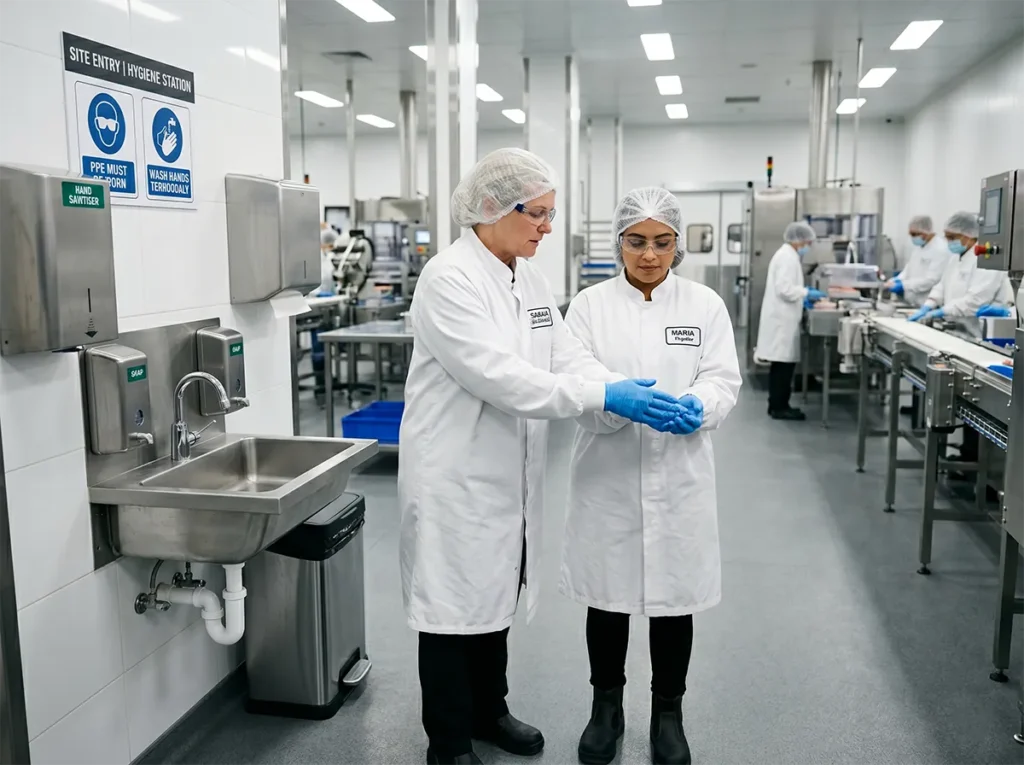
Non-English speaking workers often understand practical demonstration better than abstract instruction alone.
That is why a stronger induction usually shows:
- the entry point
- the PPE station
- the hygiene sequence
- the wet areas
- the boundaries between zones
- and the actual production environment the worker is about to enter
This matters because food production controls are easier to understand when the worker can connect:
- the rule
to - the place where it applies
A worker may not fully understand “movement control” as a phrase.
But they can often understand much more clearly when shown:
- where to walk
- where not to go
- and what good movement looks like on this site
Our article on food production site entry rules: what new workers need to understand before shift start explains why practical entry guidance is often clearer and safer than relying on general instruction alone.
5. Explain Why PPE Matters, Not Just What to Wear
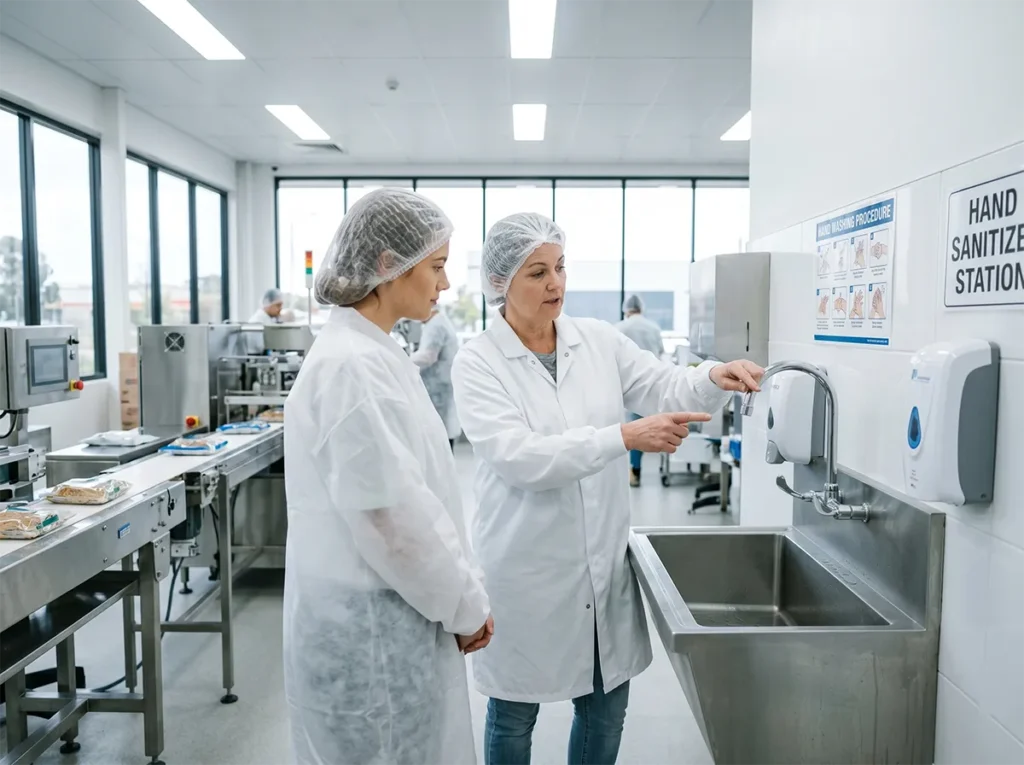
A worker may follow PPE instructions more consistently when they understand what the PPE is protecting.
That means a safer induction should explain:
- what must be worn
- how it should be worn
- when it applies
- and why it matters to both worker safety and food safety
This is important because food production PPE is not only about personal protection.
It also supports:
- hygiene discipline
- product protection
- and the site’s broader control of contamination-sensitive behaviour
When workers understand the reason, they are often better able to follow the rule properly.
Our article on why PPE in food production protects both worker safety and food safety looks more closely at how protective clothing supports both worker protection and hygiene control in fast-paced sites.
6. Treat Wet Areas and Floor Conditions as Part of Induction, Not Background Knowledge
A worker who is new to food production may not yet understand:
- that wet floors can be routine
- which areas are wetter than others
- how washdowns affect movement
- where drains or transitions make footing harder
- and why pace needs to change in some parts of the site
This should not be left to assumption.
A stronger induction makes these movement conditions part of the first-shift explanation.
That matters because wet-area misunderstanding can create:
- immediate slip risk
- awkward carrying behaviour
- and weaker confidence in the site’s overall control
Our article on wet floors, washdowns and drain areas: what food production sites should review early explains why routine wet conditions should be shown and explained clearly before new workers start moving independently through the site.
7. Make It Easy for Workers to Ask Questions Without Losing Face
Some workers will avoid asking questions because they do not want to:
- appear difficult
- look inexperienced
- or slow things down on a busy site
That means employers need to actively make questions easier.
A stronger induction does this by making it clear:
- asking is normal
- uncertainty should be raised early
- and it is safer to check than to guess
This matters because a worker staying silent is not the same as a worker understanding.
A safer site does not wait for confusion to become a mistake before recognising that the message was not fully clear.
8. Do Not Treat Signed Forms as Proof of Understanding
A signed induction record may show that the process happened.
It does not automatically prove the worker understood the site’s key controls properly.
This is especially important for non-English speaking workers.
Good employers do not rely only on paperwork.
They also look at whether the worker can:
- follow the entry sequence
- use PPE properly
- move correctly through the site
- and respond safely to the first-shift environment
This matters because real understanding is visible in behaviour, not only in forms.
Documentation matters, but it should not replace practical confirmation.
9. Keep First-Shift Supervision Visible After the Induction Ends
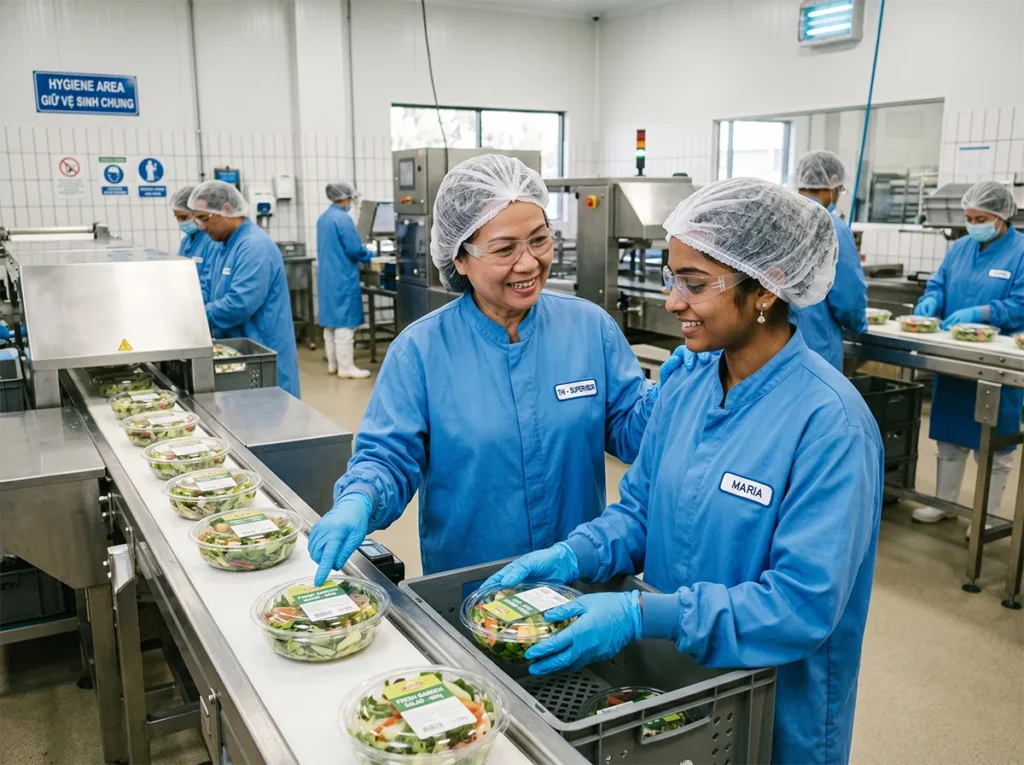
Induction does not finish the moment the briefing finishes.
For many non-English speaking workers, the first shift is where understanding is either reinforced or lost.
That is why visible early supervision matters.
A worker should know:
- who to follow
- who to ask
- who will correct them if needed
- and who is responsible for their early shift guidance
This helps reduce:
- guessing
- imitation without understanding
- and quiet uncertainty that continues after induction because no one visibly owns the support
Our article on bringing new workers into food production: how to reduce hygiene and safety risk on day one explains why visible early supervision is one of the strongest controls after induction finishes and active work begins.
10. Review the Induction by What Workers Actually Do on the Floor
One of the strongest ways to improve multilingual induction is to watch what happens after it.
Good employers review:
- where workers hesitate
- what gets repeated most often
- what PPE mistakes keep appearing
- which instructions are misunderstood
- and whether workers are copying behaviour rather than understanding it
This matters because the floor often reveals whether the induction is truly working.
If the same confusion appears repeatedly, that is usually feedback about the induction process, not just the worker.
A stronger site uses those signals to improve:
- the wording
- the demonstration
- the sequence
- and the practical clarity of the next induction
That is how safer induction gets built over time.
What Better Multilingual Induction Usually Looks Like in Practice

When induction is working well for non-English speaking workers, it usually feels:
- calmer
- clearer
- more practical
- and less dependent on guesswork
In practice, that often means:
- the worker knows where to report
- PPE and hygiene steps are shown clearly
- the real site risk points are demonstrated
- questions feel easier to ask
- supervisors remain visible after the briefing
- and the worker is not being judged ready simply because they stayed quiet
It should not feel like:
- the site delivered a lot of words quickly and hoped for the best
- forms replaced real communication
- or confusion is only discovered once the worker is already inside active production
Good multilingual induction makes the site easier to understand before the first mistake has a chance to happen.
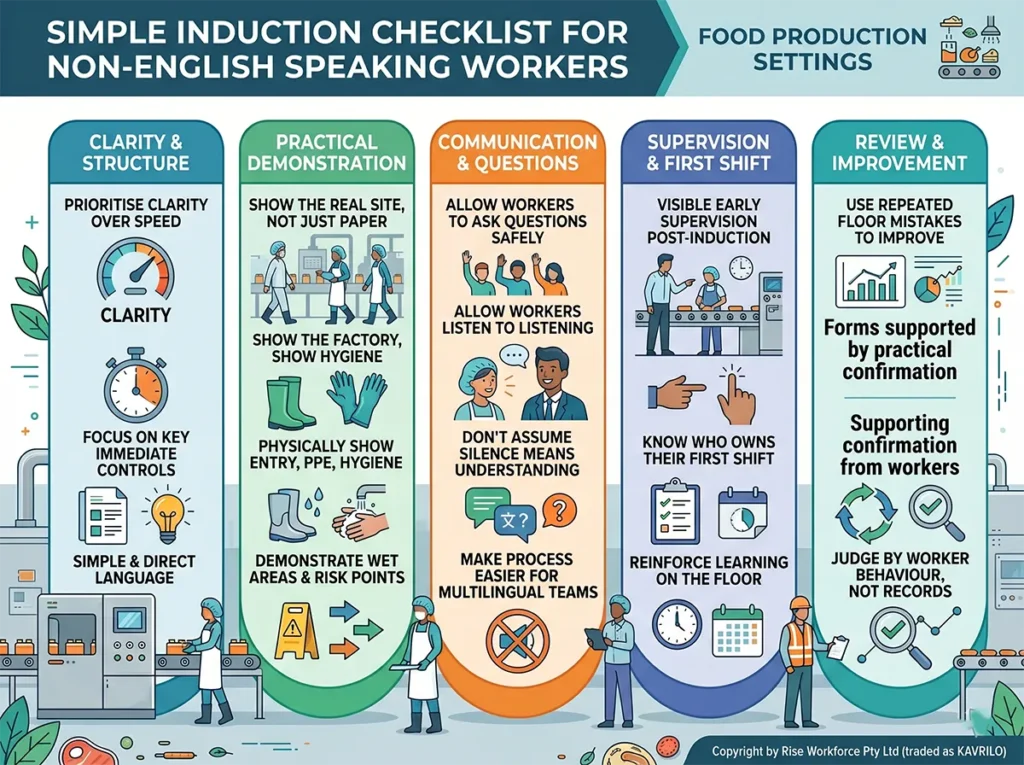
A Simple Induction Checklist for Non-English Speaking Workers
Here is a practical checklist employers can use when reviewing food production inductions for non-English speaking workers.
Clarity and Structure
- Are we prioritising clarity over speed?
- Are we focusing first on the key controls the worker needs immediately?
- Is the induction language simple and direct enough?
Practical Demonstration
- Are we showing the worker the real site, not just explaining rules on paper?
- Have we physically shown entry, PPE, hygiene steps, and movement boundaries?
- Are wet areas and real risk points being demonstrated clearly?
Communication and Questions
- Does the worker feel able to ask questions safely?
- Are we assuming silence means understanding?
- Are we making the process easier for multilingual workers to follow?
Supervision and First Shift
- Is early supervision visible after the induction ends?
- Does the worker know who owns their first shift?
- Are we reinforcing understanding on the floor, not just in the induction room?
Review and Improvement
- Are repeated floor mistakes being used to improve the induction?
- Are forms being supported by practical confirmation?
- Are we judging induction quality by worker behaviour, not only by completion records?
This kind of checklist helps employers build food production inductions that are safer, clearer, and more effective for multilingual teams.
Final Word
Safer food production inductions for non-English speaking workers matter because a worker can appear ready and still be unclear on the controls that matter most.
For food manufacturers in Victoria, stronger induction outcomes usually come from:
- clearer language
- better demonstration
- stronger entry and PPE explanation
- more visible first-shift support
- and a more practical understanding that paperwork alone does not prove readiness
That is what helps reduce:
- preventable confusion
- weak hygiene behaviour
- day-one movement risk
- silent misunderstanding
- and the hidden safety problems that start when sites explain too much too quickly and confirm too little
Because in food production, a safer induction is not about saying more.
It is about making the right things much harder to misunderstand.
Need Practical Labour Hire Support for Warehousing and Manufacturing in Melbourne’s South-East?
KAVRILO is building its approach around safety-aware workforce support, stronger local responsiveness, and clearer operational discipline for warehouse and industrial environments, including food production settings where hygiene discipline and day-one worker readiness matter.
Whether your site needs better shift coverage, stronger day-one worker readiness, or more dependable labour coordination in hygiene-sensitive environments, KAVRILO is focused on practical workforce support that fits controlled production sites.
Need warehouse and factory labour hire support with stronger day-one readiness and more dependable workforce support for controlled production environments? Talk to KAVRILO about practical labour support across Melbourne’s South-East.
Article Disclaimer
This article is provided for general information only and does not constitute legal, workplace relations, safety, taxation, payroll or other professional advice. Please seek advice specific to your circumstances before acting on this information.
Please read our Website Disclaimer for more information.