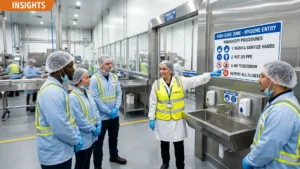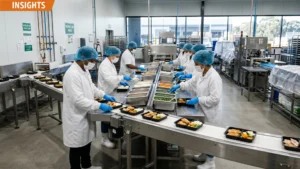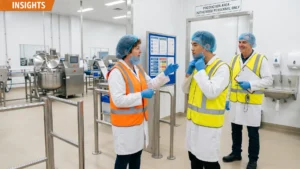

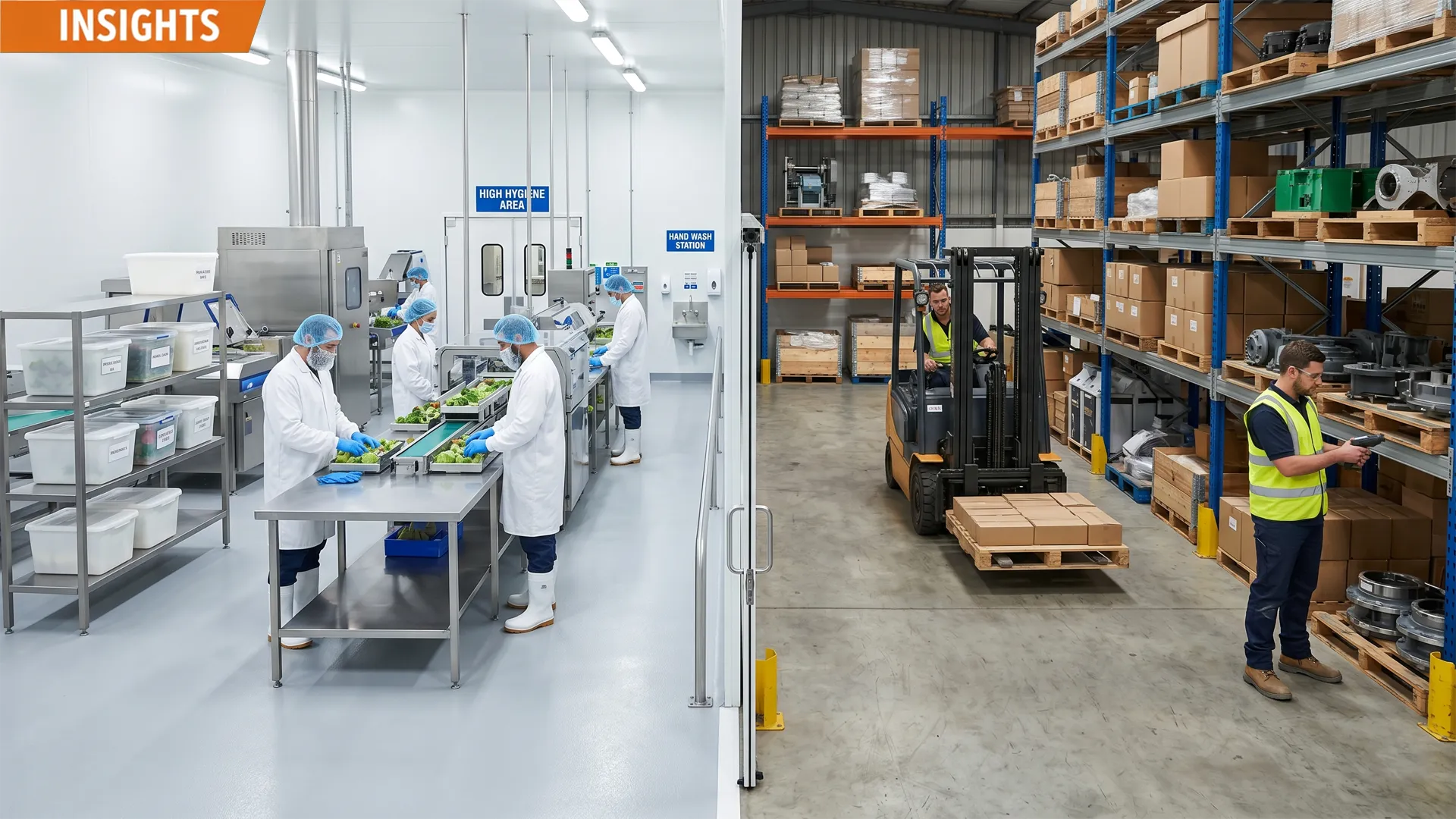
At first glance, food production and warehouse environments can appear to share many of the same risks.
Both may involve:
- manual handling
- forklifts or pallet movement nearby
- shift-based work
- repetitive tasks
- fast pace
- and pressure to keep operations moving consistently
But food production adds another layer that changes the whole safety picture:
the worker’s behaviour can affect both people and product at the same time.
That is what makes the environment different.
Across Victoria, food manufacturers often operate in settings where employers need to manage:
- hygiene entry
- contamination control
- protective clothing
- washdowns and wet floors
- repetitive line work
- fatigue
- multilingual induction challenges
- and much tighter behavioural discipline than a general warehouse may require
This means a worker entering food production is not only expected to work safely in the usual industrial sense.
They are also expected to:
- protect hygiene standards
- follow stricter site-entry rules
- understand food-safe behaviour
- and avoid creating risks that could affect production quality as well as worker safety
That is why food production safety should not be treated as just another version of warehouse safety.
It has overlapping risks, but it also has tighter controls, less margin for behavioural error, and stronger day-one expectations.
That is where many employers need to think differently.
For the broader hub article, see our Food Production Safety in Victoria pillar guide on hygiene, PPE, wet-floor risk, repetitive work, fatigue, and safer worker onboarding in fast-paced sites.
Why the Safety Standard Is Higher in Food Production
A general warehouse may still have strong safety expectations.
But food production usually asks workers to operate inside a more tightly controlled system from the moment they arrive.
That includes:
- what they wear
- how they enter
- where they can go
- how they clean or sanitise
- how they behave near product
- and how consistently they follow rules that protect both the worker and the production environment
This matters because some mistakes in food production carry a double consequence.
For example:
- weak PPE discipline may affect worker safety and hygiene control
- careless movement through the wrong area may affect site order and contamination-sensitive boundaries
- rushed behaviour may increase injury risk and weaken product protection at the same time
That is why the standard often feels stricter.
It is stricter.
Employers are not only managing workplace safety.
They are also protecting the conditions that food manufacturing depends on.
What Food Production Has That General Warehouses Often Do Not
The main difference is not that food production has completely different hazards.
It is that familiar hazards sit inside a more sensitive operating environment.
Food production often includes:
- hygiene entry procedures
- more controlled PPE use
- washdowns and wetter floor conditions
- stricter zoning and movement discipline
- product-sensitive behaviour expectations
- higher consequences for weak worker discipline
- and more need for structured induction before work begins
A general warehouse may still require:
- safety shoes
- hi-vis
- manual handling awareness
- traffic control
- and basic onboarding
But food production may also require the worker to understand:
- hygiene sequence
- contamination-aware behaviour
- clothing discipline
- site entry standards
- food-safe movement
- and why small personal habits matter much more than they would in many other industrial settings
That is why employers cannot assume general warehouse readiness automatically transfers well into food production.
10 Practical Ways Food Production Safety Differs from General Warehouse Safety
1. Hygiene Entry Matters Much More
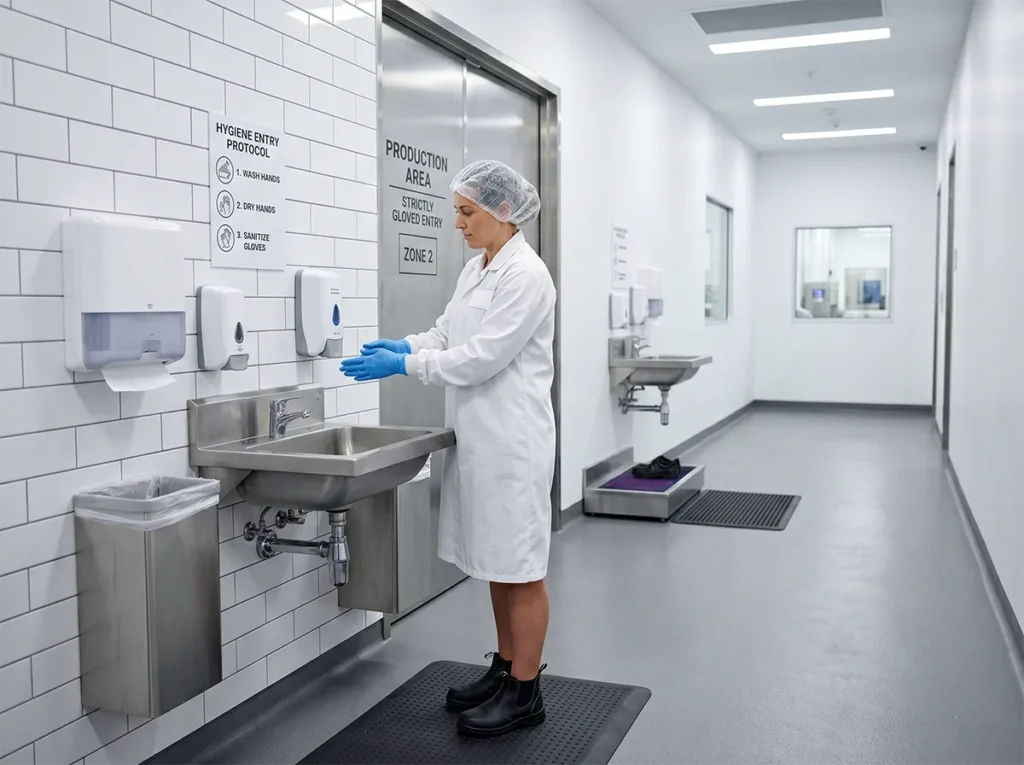
A warehouse worker may report, sign in, and begin work after a general induction and PPE check.
In food production, site entry often involves much tighter control around:
- hand hygiene
- protective clothing
- hair covering
- entry sequence
- and controlled access into production zones
This matters because the first few minutes on site are already part of food production safety.
A worker who begins incorrectly may already be outside the standard before the task even starts.
That makes entry discipline a much more important control than it often is in general warehousing.
Our article on food production site entry rules: what new workers need to understand before shift start explains why entry discipline is one of the first and most important controls in hygiene-sensitive production areas.
2. PPE Has a Dual Purpose
In a general warehouse, PPE mainly protects the worker.
In food production, PPE often helps protect:
- the worker
- the product
- the process
- and the hygiene standard of the environment
That changes how employers should explain it.
Workers need to understand not only:
- what they wear
but also - why it matters
- how it should be worn
- when it must be changed
- and what behaviour weakens the control it is meant to provide
This is one of the clearest differences between the two environments.
Our article on why PPE in food production protects both worker safety and food safety looks more closely at why protective clothing in food manufacturing has a stronger and more sensitive role than in many general warehouse settings.
3. Worker Behaviour Has More Direct Impact on Product Safety
In a warehouse, worker behaviour still matters greatly for safety and operations.
In food production, behaviour can also affect:
- hygiene integrity
- contamination-sensitive zones
- handling practices
- and the site’s ability to maintain consistent food-safe standards
That means employers need tighter control around:
- movement
- touching surfaces or product-adjacent areas
- clothing discipline
- hand hygiene
- and what workers do when something is unclear
A worker who is casual about rules may create much bigger problems in food production than in a standard warehouse role.
4. Wet Floors and Washdowns Are More Normalised — and More Dangerous
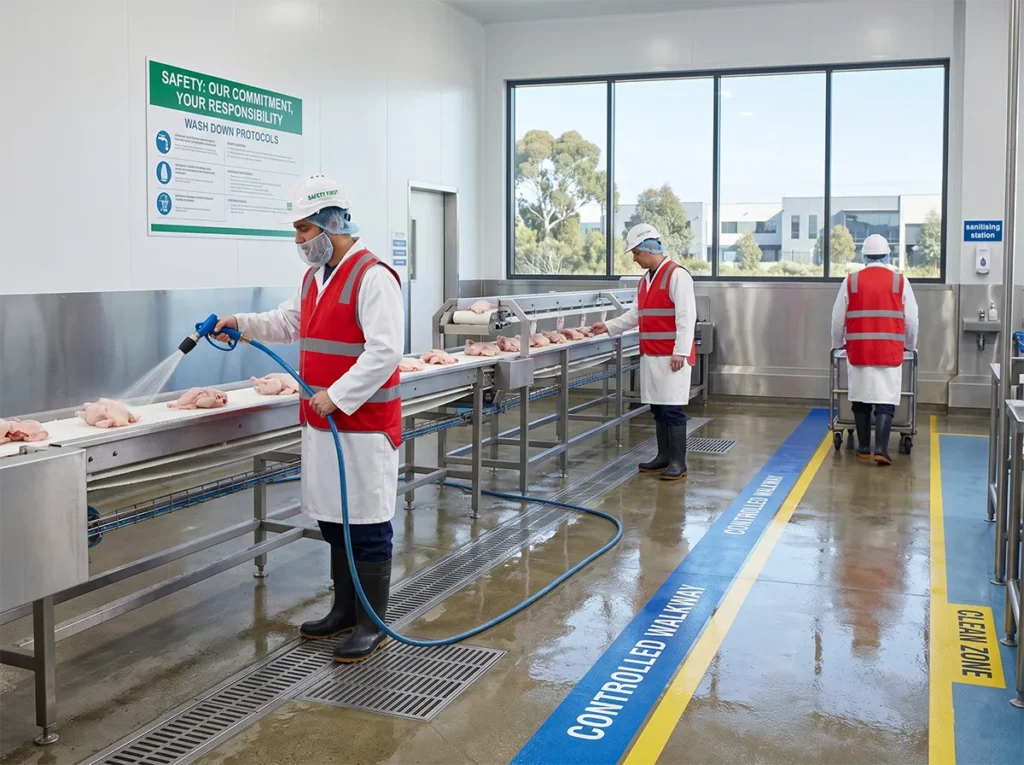
Food production often involves:
- regular washdowns
- moisture near lines
- drain areas
- rinsing processes
- and floor conditions that change throughout the shift
A warehouse may still experience spills or isolated slippery surfaces, but food production sites often deal with wet conditions as part of normal operation.
That creates a different kind of risk.
The danger is not only the wet floor itself.
It is the risk that workers and managers begin treating it as ordinary background instead of something that still needs active control.
Our guide to wet floors, washdowns and drain areas: what food production sites should review early explains why these routine conditions deserve much stronger review than many sites give them.
5. Repetitive Line Work Is Often More Intense
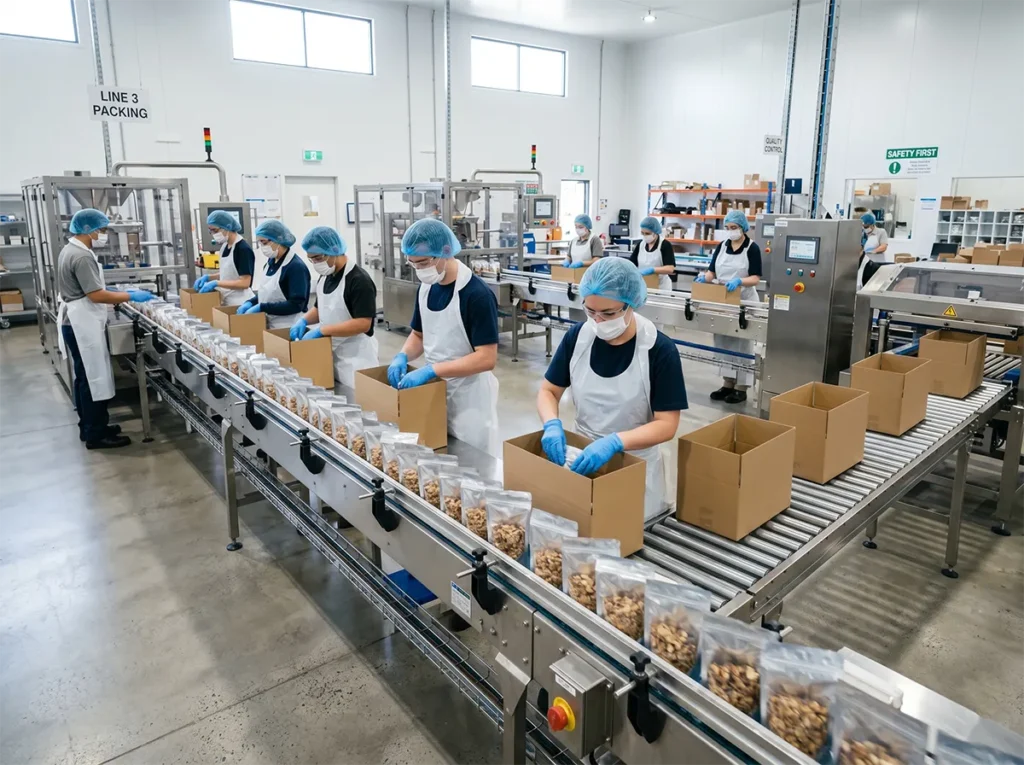
Many warehouses involve repeated movement.
But food production often adds:
- sustained line pace
- repetitive hand tasks
- repetitive reaching or packing
- controlled work rhythm
- and less task variation across longer periods
That can increase:
- fatigue
- discomfort
- repetitive strain risk
- and reduced concentration over time
This matters because food production pace can make repetitive work feel normal long before the body starts showing clearer signs of strain.
Our article on repetitive work in food manufacturing: what employers should review before injuries build explains why line-based food production tasks often need earlier ergonomic review than many sites expect.
6. Fatigue Can Affect Hygiene Discipline as Well as Safety
Fatigue matters in any industrial environment.
But in food production, fatigue can weaken:
- movement quality
- attention to process
- hygiene discipline
- manual handling
- and consistency in following the steps that protect both people and product
That means employers should think about fatigue in broader terms.
It is not only a worker wellbeing issue.
It can also affect how well the site maintains the discipline it depends on during longer or faster shifts.
Our article on managing worker fatigue during long packing and production shifts looks at how fatigue risk can start affecting both safety and food-safe behaviour when production pace stays high for too long.
7. Day-One Onboarding Needs to Be Stronger
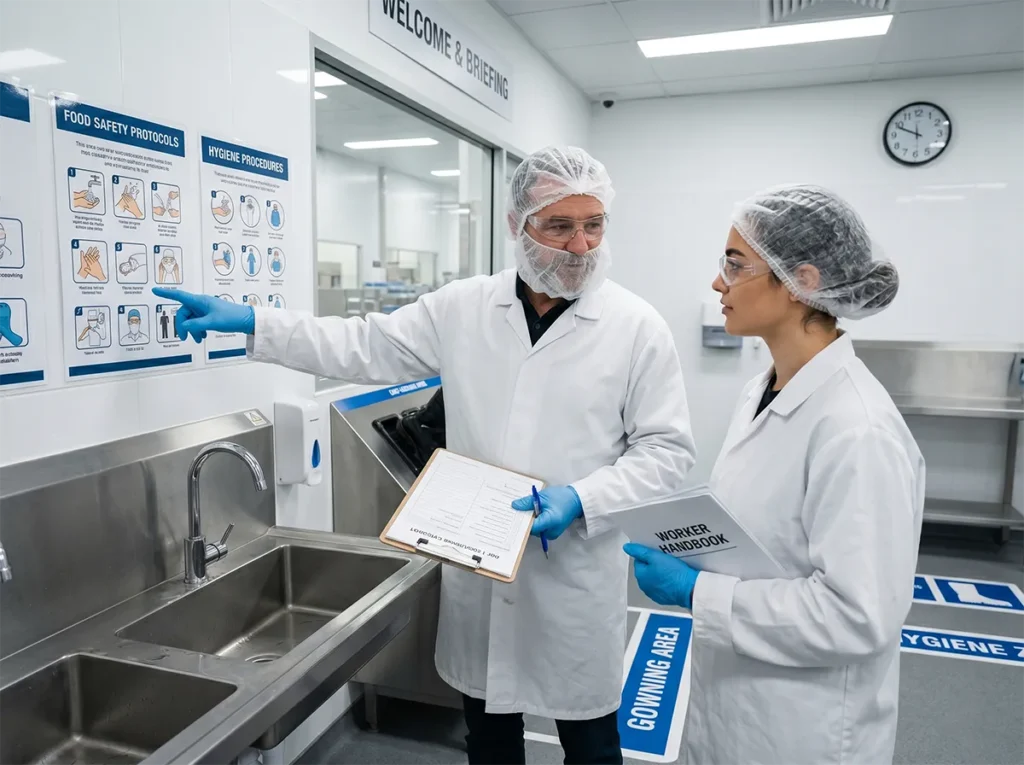
A worker entering a general warehouse may be able to settle through:
- basic route explanation
- general PPE
- and practical supervision on the floor
In food production, that is usually not enough.
A new worker often needs much stronger day-one clarity around:
- entry procedure
- hygiene rules
- clothing expectations
- where they can and cannot go
- what safe and food-safe behaviour looks like
- and who supervises them early
This matters because food production environments usually allow less room for “learning by drift”.
Our article on bringing new workers into food production: how to reduce hygiene and safety risk on day one explains what employers should cover before new or temporary workers enter active production areas.
8. Multilingual Communication Gaps Carry More Risk
Communication matters in every workplace.
But in food production, a misunderstood instruction may affect:
- hygiene
- safe movement
- contamination control
- PPE use
- and line behaviour
That is why multilingual induction and instruction quality matter more than many employers first expect.
A general warehouse may sometimes tolerate a worker taking longer to understand site rhythm.
A food production site often has much less room for misunderstanding around key controls.
Our article on how to run safer food production inductions for non-English speaking workers explains how employers can reduce misunderstanding and make key hygiene and safety expectations much clearer from the start.
9. Pace Pressure Can Affect Quality and Safety Together
In a general warehouse, faster pace may mainly affect:
- output
- movement quality
- and error rate
In food production, faster pace can also affect:
- hygiene discipline
- product handling behaviour
- worker fatigue
- repetitive strain
- and how consistently the site maintains control under pressure
That means line speed and output pressure need closer review.
Not because speed is always wrong, but because it can begin changing behaviour before managers fully realise it.
Our article on how faster line speed can increase safety and quality risk in food production looks at how pace pressure can quietly affect behaviour, consistency, and control in fast-moving food sites.
10. Temporary Worker Readiness Is a Much Bigger Risk Factor
In a general warehouse, a temporary worker may still integrate reasonably with practical supervision and routine task guidance.
In food production, the same worker may create larger risk if they are unclear on:
- hygiene
- PPE
- zoning
- food-safe behaviour
- and what standards the site expects from the first shift
This is why temporary labour in food production needs tighter onboarding and clearer readiness checks.
The worker may be capable in industrial work generally, but still not ready for the behavioural discipline food production requires.
Our article on what host employers should check before putting casual workers into food production explains why temporary worker readiness should be treated as a core food safety and workforce risk control.
What Employers Should Be Careful Not to Assume
A worker with warehouse experience is not automatically ready for food production.
A worker who has done factory work elsewhere is not automatically clear on:
- hygiene entry
- contamination-sensitive behaviour
- food-safe PPE discipline
- or the tighter standards a food site depends on
That is why employers should be careful not to assume:
- general industrial experience is enough by itself
- routine safety induction covers food production properly
- fast-paced workers will automatically adapt well to hygiene-sensitive environments
- or product protection controls will hold up if worker readiness is weak
These assumptions often create the exact kind of day-one risk that stronger onboarding was meant to prevent.
What Better Food Production Safety Usually Looks Like in Practice
When food production safety is being managed well, the site usually feels:
- structured
- disciplined
- clean
- calm under pressure
- and difficult for workers to misunderstand
In practice, that often means:
- entry expectations are clear
- PPE is consistent
- wet-area risk is being reviewed honestly
- repetitive tasks and fatigue are not being ignored
- new workers are not being rushed onto the floor without enough clarity
- and supervisors are reinforcing both safety and hygiene together
It should not feel like:
- food-safe behaviour is being left to assumption
- warehouse habits are being carried into a more sensitive environment without correction
- or faster production pace is slowly weakening the discipline the site depends on
Good food production safety usually shows up in the way the site operates every shift, not just in written policy.
A Simple Employer Checklist: Food Production vs General Warehouse Safety
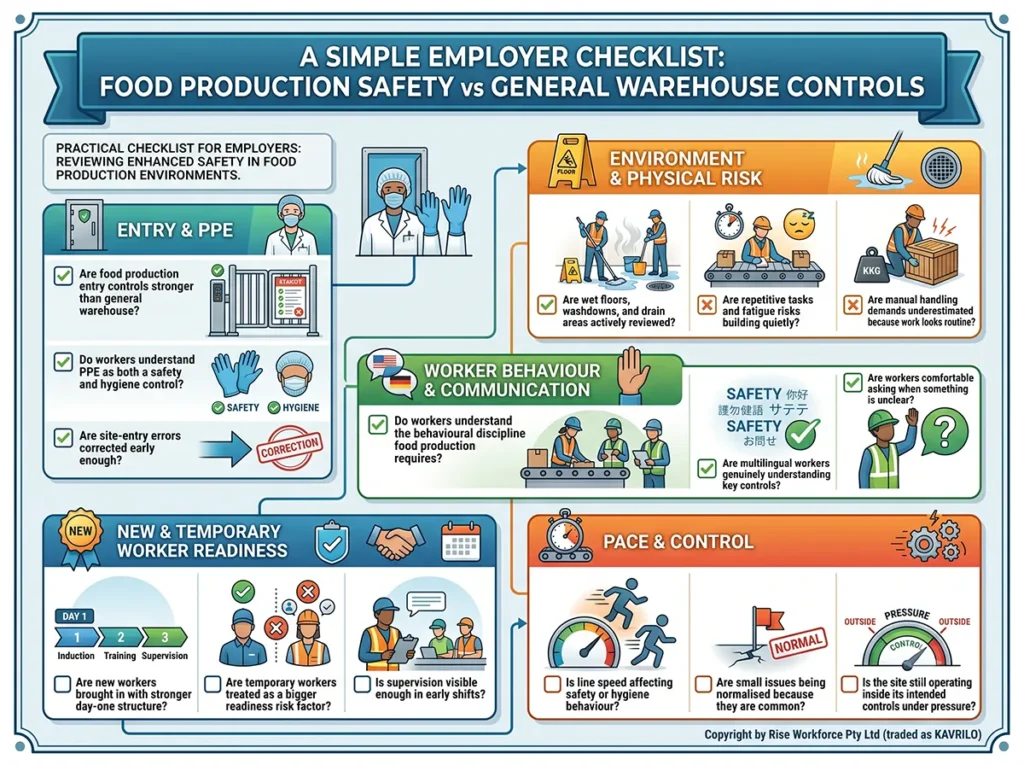
Here is a practical checklist employers can use when reviewing whether they are treating food production safety with the extra control it requires.
Entry and PPE
- Are food production entry controls stronger than general warehouse entry?
- Do workers understand PPE as both a safety and hygiene control?
- Are site-entry errors being corrected early enough?
Environment and Physical Risk
- Are wet floors, washdowns, and drain areas being actively reviewed?
- Are repetitive tasks and fatigue risks building quietly?
- Are manual handling demands being underestimated because the work looks routine?
Worker Behaviour and Communication
- Do workers understand the behavioural discipline food production requires?
- Are multilingual workers genuinely understanding key controls?
- Are workers comfortable asking when something is unclear?
New and Temporary Worker Readiness
- Are new workers being brought in with stronger day-one structure?
- Are temporary workers being treated as a bigger readiness risk factor?
- Is supervision visible enough in early shifts?
Pace and Control
- Is line speed affecting safety or hygiene behaviour?
- Are small issues being normalised because they are common?
- Is the site still operating inside its intended controls under pressure?
This kind of checklist helps employers review food production safety as a more sensitive and more tightly controlled environment than general warehouse work.
Final Word
Food production safety is different from general warehouse safety because the site is protecting more than workers alone.
For employers in Victoria’s food manufacturing sector, stronger outcomes usually come from:
- tighter hygiene entry
- better PPE discipline
- more honest wet-area review
- earlier attention to repetitive work and fatigue
- stronger day-one worker control
- and better communication in multilingual environments
That is what helps reduce:
- preventable injury risk
- contamination-sensitive behaviour failures
- weak onboarding
- repeated misunderstanding
- and operational pressure that should have been controlled earlier
Because in food production, worker safety and food safety are closely linked from the first step onto the floor.
That is not just a tighter rule set.
It is a different operating environment.
Need Practical Labour Hire Support for Warehousing and Manufacturing in Melbourne’s South-East?
KAVRILO is building its approach around safety-aware workforce support, stronger local responsiveness, and clearer operational discipline for warehouse and industrial environments, including food production settings where hygiene discipline and day-one worker readiness matter.
Whether your site needs better shift coverage, stronger day-one worker readiness, or more dependable labour coordination in hygiene-sensitive environments, KAVRILO is focused on practical workforce support that fits controlled production sites.
Need warehouse and factory labour hire support with stronger day-one readiness and more dependable workforce support for controlled production environments? Talk to KAVRILO about practical labour support across Melbourne’s South-East.
Article Disclaimer
This article is provided for general information only and does not constitute legal, workplace relations, safety, taxation, payroll or other professional advice. Please seek advice specific to your circumstances before acting on this information.
Please read our Website Disclaimer for more information.