
South-East Melbourne is one of the most active industrial corridors in Victoria.
For employers across Dandenong, Dandenong South, Hallam, Keysborough, Braeside, and surrounding areas, warehousing, logistics, food production, and manufacturing remain central to how goods move and businesses grow. That makes the South-East a strong place to operate — but it also makes staffing more competitive, more time-sensitive, and more difficult to treat casually.
For warehouse and factory employers, staffing pressure often shows up in familiar ways:
- shifts that need to be covered quickly
- seasonal peaks that stretch existing teams
- attendance gaps that disrupt output
- difficulty finding workers who are both available and reliable
- and the ongoing challenge of matching people to the actual pace and conditions of the site
That is why staffing in South-East Melbourne is not just a question of headcount.
It is also a question of:
- local worker access
- travel and punctuality
- site fit
- shift readiness
- seasonal planning
- and how quickly a business can respond when labour pressure rises
For employers in and around Dandenong, this matters even more because the area sits at the centre of major warehousing and industrial activity. The opportunities are strong, but so is the competition for dependable workers.
Good staffing in this environment does not usually come from reacting late.
It comes from understanding the local market clearly and planning workforce support in a way that reflects how the South-East actually operates.
That is where practical local knowledge becomes valuable.
If your business also needs practical labour hire support for active warehouse and factory environments, explore our warehouse and factory labour hire support approach across Melbourne’s South-East.
Why South-East Melbourne Matters So Much for Warehouse and Factory Staffing
The South-East is not just another suburban labour market.
It is one of the most important industrial areas in greater Melbourne, with strong concentration in:
- warehousing
- transport and logistics
- food production
- packaging
- general manufacturing
- container and dispatch work
- and factory support roles
That means staffing demand is rarely flat.
In many parts of the South-East, employers are often competing within the same broad labour pool for workers who can:
- get to site reliably
- work varied shifts
- handle warehouse or factory pace
- follow site rules properly
- and settle into operational teams without creating extra friction
This affects more than hiring speed.
It also affects:
- punctuality
- attendance
- turnover
- onboarding quality
- and how quickly a business can scale up when demand changes
For Dandenong-based employers, the advantage is that the area sits close to a large industrial ecosystem.
The challenge is that nearby employers are often trying to solve similar labour problems at the same time.
That is why local staffing strategy matters.
What Makes Dandenong Such a Key Industrial Hub
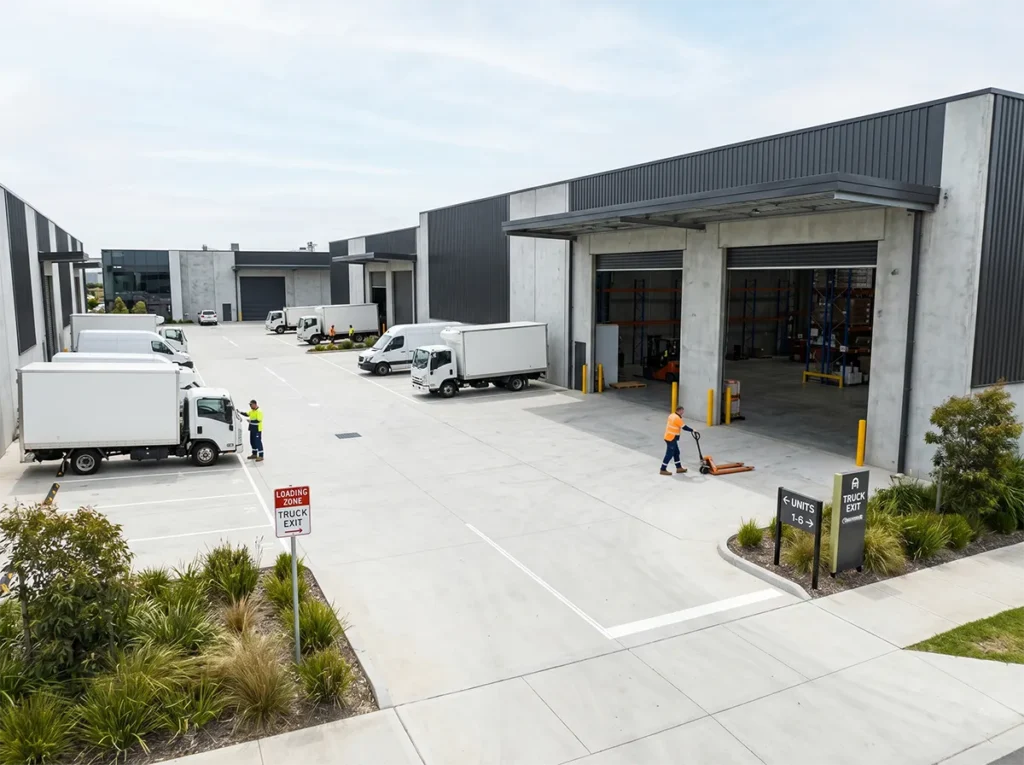
Dandenong and the surrounding South-East corridor have long been important for industrial and logistics activity.
For employers, that usually means access to:
- large warehouse precincts
- transport links
- manufacturing facilities
- food production operations
- dispatch and distribution centres
- and an established blue-collar workforce base
That concentration is a strength.
But it also means labour demand can tighten quickly, especially when:
- several nearby sites are hiring at once
- demand peaks seasonally
- certain shifts become harder to fill
- or businesses need workers who are not just available, but ready for the actual conditions on site
In practical terms, a strong industrial hub creates both:
- opportunity
- and competition
That is why employers in Dandenong often need staffing support that feels:
- local
- responsive
- realistic
- and aware of what the surrounding market is doing
A generic staffing approach usually performs less well in a corridor where speed, reliability, and local fit matter so much.
What Employers in the South-East Are Commonly Up Against
1. Reliable Workers Are Harder to Find Than Available Workers
One of the most common staffing problems is not simply finding people.
It is finding people who are:
- reliable
- reachable
- suitable for the role
- and likely to turn up consistently once the shift pattern becomes real
That distinction matters.
A worker may be available on paper but still be a weak fit if:
- travel is too difficult
- the shift timing does not suit
- the warehouse pace is stronger than expected
- the site is more controlled than they are used to
- or the job was described too loosely in the first place
That is why reliable staffing usually depends on fit, not just supply.
2. Travel and Punctuality Still Shape Staffing Outcomes
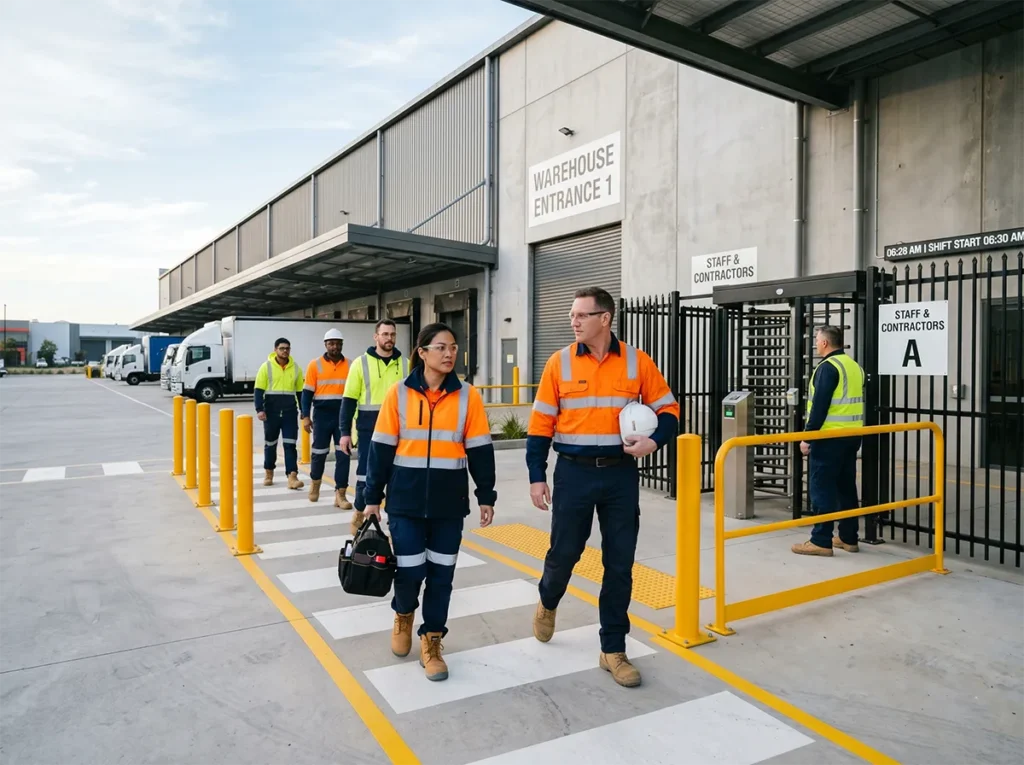
In South-East Melbourne, travel practicality still matters a great deal.
Even when workers are willing, the real conditions around:
- distance
- early starts
- public transport limitations
- cross-city travel
- and industrial-area access
can affect:
- punctuality
- attendance consistency
- shift acceptance
- and retention over time
For employers, this means local worker access can make a real difference.
A staffing plan that ignores transport reality often becomes weaker than expected once shifts are underway.
Our article on how transport and travel time affect shift reliability in South-East Melbourne looks more closely at why local travel practicality still shapes punctuality and attendance across the industrial corridor.
3. Seasonal Demand Changes the Market Quickly
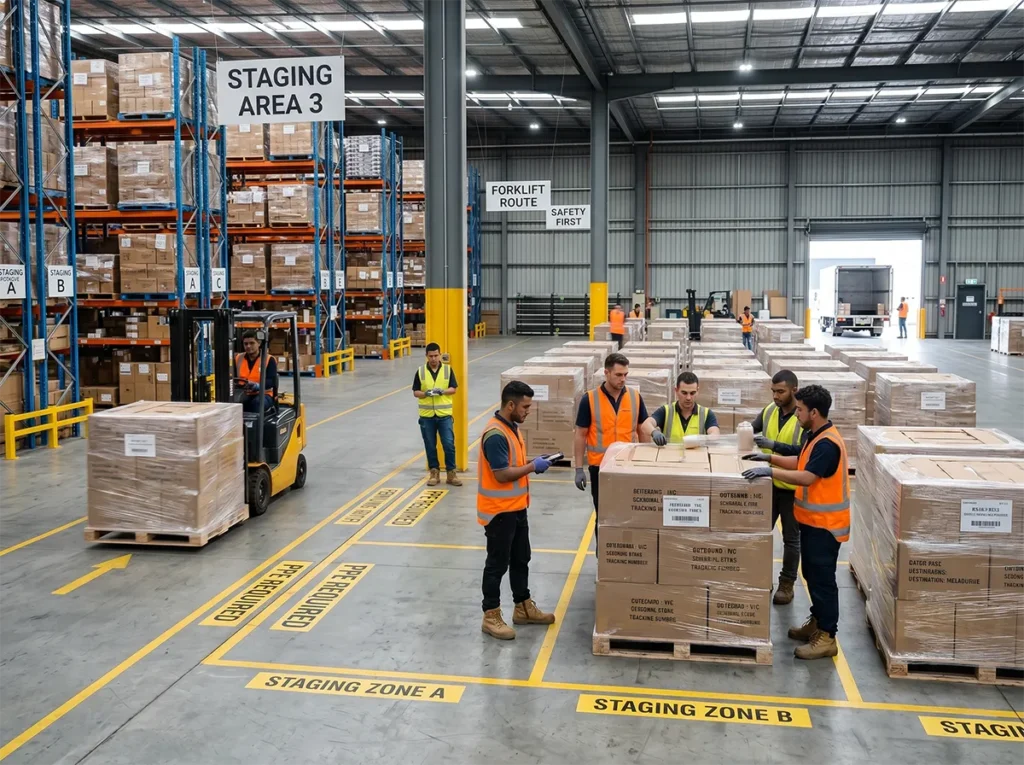
Many warehouse and factory employers in the South-East experience labour pressure in waves.
That may happen through:
- end-of-year demand
- retail-linked stock movement
- production surges
- leave coverage
- customer volume increases
- or short-term operational expansion
These periods can place real pressure on:
- staffing speed
- workforce stability
- supervisor time
- and onboarding capacity
A site that feels fully covered in one quarter can feel stretched a few weeks later.
That is why seasonal readiness matters.
Our guide to preparing your Dandenong warehouse for the end-of-year rush explains how employers can reduce staffing strain before peak demand starts building.
4. No-Shows and Last-Minute Gaps Still Disrupt Operations
Some of the biggest staffing problems are not about planned recruitment.
They are about short-notice disruption.
That includes:
- same-day absences
- repeated no-shows
- sudden gaps on critical shifts
- or a roster that looks full until the shift actually starts
For warehouse and factory employers, this does not just create inconvenience.
It can affect:
- output
- dispatch timing
- supervisor workload
- floor pressure
- and team morale
That is why staffing reliability matters operationally, not just administratively.
Our article on how to reduce no-shows and last-minute gaps in Dandenong warehouse shifts explains practical ways employers can tighten shift reliability before these gaps start disrupting operations.
5. Headcount Alone Does Not Solve Site Fit
A site can have enough people on paper and still be under-supported in practice.
That is because site fit matters.
For example:
- a worker may suit one warehouse but not another
- a casual may be fine for light packing but not a faster dispatch floor
- someone may be available for day shift but not sustainable for rotating starts
- or a candidate may look suitable generally but not for a more controlled factory environment
Good staffing is not only about numbers.
It is also about how well the worker fits:
- the pace
- the shift pattern
- the environment
- the supervision style
- and the expectations on site
That is where many staffing decisions become stronger or weaker.
Our guide to why site fit matters more than headcount in warehouse and factory staffing explains why labour quality and role match often matter more than simply filling numbers quickly.
Why Local Staffing Support Often Performs Better
For Dandenong and South-East employers, local staffing support can offer practical advantages.
That often includes:
- better understanding of the surrounding labour market
- stronger awareness of industrial areas and site types
- more realistic view of travel and punctuality factors
- easier site familiarity
- and more relevant matching between workers and nearby environments
This does not mean every local solution is automatically strong.
It does mean that local knowledge usually helps with:
- faster communication
- better site understanding
- more grounded staffing conversations
- and better response when labour pressure changes suddenly
For employers operating in the South-East, this can make workforce support feel:
- more responsive
- more practical
- and more aligned with the realities of the corridor
That is especially useful when the business cannot afford to spend days correcting poor match decisions after the shift has already started.
Our article on why South-East Melbourne employers need faster, more local staffing support explains why local responsiveness and site understanding can make workforce coverage more dependable in active industrial areas.
What Good South-East Staffing Usually Looks Like in Practice
When staffing is working well in this corridor, it usually feels:
- clearer
- more local
- more dependable
- and easier to manage operationally
In practice, that often means:
- the worker can reach site reliably
- the shift timing is realistic
- the role has been explained properly
- local site conditions have been considered
- supervisors are not spending the first shift fixing avoidable mismatch
- and the staffing support feels connected to how South-East Melbourne actually works
It should not feel like:
- workers are coming from impractical distances without enough thought
- the site is receiving bodies rather than better-matched support
- or every staffing need has to be solved from scratch under pressure
Good staffing in the South-East is usually built on better local judgement, not just faster placement.
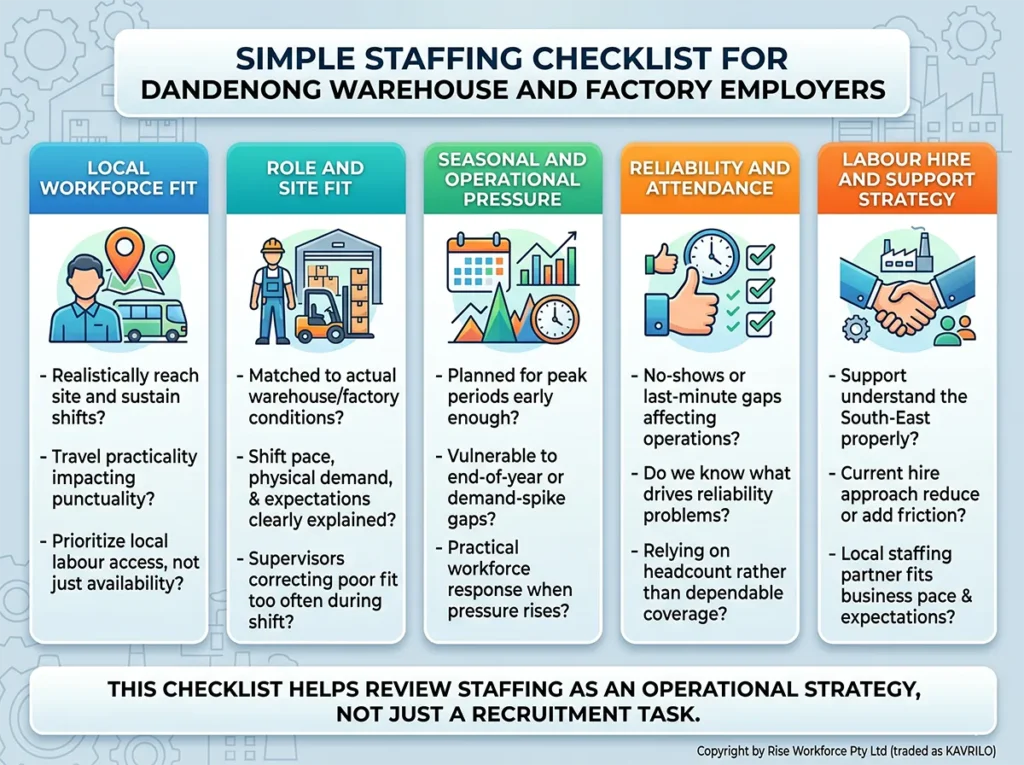
A Simple Staffing Checklist for Dandenong Warehouse and Factory Employers
Here is a practical checklist employers can use when reviewing their current staffing position.
Local Workforce Fit
- Are we using workers who can realistically reach site and sustain the shift pattern?
- Is punctuality being affected by travel practicality?
- Are we thinking enough about local labour access, not just general availability?
Role and Site Fit
- Are workers being matched to the real warehouse or factory conditions?
- Are shift pace, physical demand, and site expectations being explained clearly enough?
- Are supervisors correcting poor fit too often after the shift has already begun?
Seasonal and Operational Pressure
- Have we planned for peak periods early enough?
- Are we vulnerable to end-of-year or demand-spike staffing gaps?
- Do we have a practical workforce response when labour pressure rises quickly?
Reliability and Attendance
- Are no-shows or last-minute gaps affecting operations too often?
- Do we know what is driving those reliability problems?
- Are we relying on headcount rather than dependable labour coverage?
Labour Hire and Support Strategy
- Are we using staffing support that understands the South-East properly?
- Does our current labour hire approach reduce friction or add to it?
- Do we have a local staffing partner that fits the actual pace and expectations of our business?
This kind of checklist helps employers review staffing in the South-East as an operational strategy, not just a recruitment task.
Final Word
Staffing South-East Melbourne successfully is not just about finding workers.
For warehouse and factory employers in Dandenong and the broader South-East, it is about building a workforce approach that reflects:
- local industrial demand
- travel and punctuality reality
- seasonal pressure
- site fit
- and the need for reliable labour that can actually support the floor
That is what helps reduce:
- avoidable no-shows
- weak shift coverage
- poor worker fit
- unnecessary first-shift friction
- and the repeated stress of solving labour problems too late
Because in a corridor like the South-East, staffing works best when it is:
- local
- practical
- responsive
- and connected to the real conditions employers are operating in every day
That is not just better labour coverage.
It is better operational control.
Need Practical Labour Hire Support for Warehousing and Manufacturing in Melbourne’s South-East?
KAVRILO is building its approach around safety-aware workforce support, stronger local responsiveness, and clearer operational discipline for warehouse and industrial environments.
Whether your site needs support during busy periods, stronger shift reliability, or more dependable labour coordination across the South-East, KAVRILO is focused on practical workforce support that fits controlled warehouse and factory environments.
Need warehouse and factory labour hire support with stronger local responsiveness and more dependable shift coverage? Talk to KAVRILO about workforce support across Melbourne’s South-East.
Article Disclaimer
This article is provided for general information only and does not constitute legal, workplace relations, safety, taxation, payroll or other professional advice. Please seek advice specific to your circumstances before acting on this information.
Please read our Website Disclaimer for more information.