

For warehouse employers, one missing worker is rarely just one missing worker.
A same-day absence or last-minute gap can quickly affect:
- dispatch flow
- team workload
- supervisor pressure
- forklift and picking coordination
- shift handover
- and how calmly the operation runs once the day begins
Across Dandenong and the wider South-East Melbourne corridor, these problems are especially frustrating because warehouse work often depends on:
- timing
- sequence
- reliable attendance
- and enough labour being present at the right point in the shift, not just eventually
That is why no-shows matter so much.
A worker who does not arrive, calls late, or drops out at short notice can create more disruption than the headcount suggests. The site may need to:
- reallocate work quickly
- stretch regular staff
- delay lower-priority tasks
- shift supervisors into coverage mode
- or scramble to find support once the shift is already underway
For busy warehouse operations, that is not just an inconvenience.
It is an operational risk.
That is why good employers do not only react after no-shows happen.
They look earlier at what is driving them and how the site can reduce avoidable gaps before they start disrupting the floor.
For the broader local market overview, see our Staffing South-East Melbourne pillar guide for Dandenong warehouse and factory employers.
Why No-Shows and Last-Minute Gaps Hurt Warehouse Operations So Quickly
Warehouse work often runs on sequence.
That means one missing worker can affect more than their own task.
For example:
- one missing picker can slow dispatch preparation
- one absent process worker can place more pressure on packing or staging
- one late forklift operator can delay movement in other areas
- and one unfilled shift can force team leaders to spend more time solving labour problems than coordinating the floor
That is why no-shows are especially disruptive in industrial environments.
They create pressure quickly because:
- there is less time to adapt
- the work usually cannot wait long
- and replacement options are often harder once the shift has already started
A warehouse may cope with one isolated gap occasionally.
But repeated no-shows create a different problem:
- weaker planning confidence
- more strain on good workers
- and a site that becomes more reactive than it should be
That is why reducing no-shows is not just an attendance issue.
It is a shift stability issue.
What Usually Sits Behind Repeated Shift Gaps
A no-show is often treated like a worker issue.
Sometimes it is.
But repeated gaps are often driven by a mix of wider factors such as:
- poor role fit
- unrealistic travel expectations
- weak pre-shift communication
- unclear shift expectations
- poor engagement with casual workers
- or labour support that is too generic for the site’s actual needs
That is why good employers look beyond:
“Why didn’t this person turn up?”
They also ask:
- Was this shift realistic for the worker?
- Was the travel practical?
- Did the role match what was explained?
- Were the expectations clear enough?
- Are we seeing a one-off issue or a repeated pattern in how the site is staffed?
That is where better prevention begins.
10 Practical Ways to Reduce No-Shows and Last-Minute Gaps
1. Review Whether Travel Practicality Is Part of the Problem
In South-East Melbourne, travel still shapes reliability.
A worker may accept the shift and still struggle later if:
- the commute is too long
- the route is inconsistent
- the start time is too early
- the industrial-area access is awkward
- or the daily travel becomes too hard to sustain once the role becomes routine
This matters because some attendance problems are not really attitude problems.
They are travel practicality problems.
Good employers review whether repeated lateness or no-shows are being driven partly by:
- distance
- route complexity
- or unrealistic shift-to-commute matching
Our article on how transport and travel time affect shift reliability in South-East Melbourne explains why commute practicality still plays a major role in punctuality, attendance, and worker retention.
2. Tighten Role Fit Before the Worker Starts
A worker who is the wrong fit for the site is more likely to drop off early.
That may happen when:
- the pace is stronger than expected
- the work is more physical than described
- the shift pattern is less practical than it first sounded
- the environment is more controlled or demanding than the worker is used to
- or the role was sold too broadly and only became clear after the first shifts
This matters because no-shows often begin after weak role-fit decisions.
A better fit usually improves:
- attendance
- shift acceptance
- and the worker’s willingness to keep turning up once the real nature of the job becomes clear
Our guide to why site fit matters more than headcount in warehouse and factory staffing explains why better worker-to-site matching often reduces avoidable shift gaps more effectively than simply filling numbers quickly.
3. Make Shift Expectations Clear From the Beginning

Some no-shows grow out of weak expectation-setting.
That can happen when the worker is not fully clear on:
- exact start time
- location details
- break structure
- physical demands
- shift length
- overtime likelihood
- or what the site really expects in the first few days
Good employers reduce this by making sure:
- the role is described clearly
- the shift is explained properly
- and the worker is not turning up to a very different reality than the one they thought they had accepted
Clarity early usually reduces dropout later.
4. Confirm Shifts Properly Instead of Assuming They Are Locked In
A shift on the roster does not always mean the coverage is truly secure.
Good employers and stronger labour partners usually make sure shift communication is:
- clear
- timely
- practical
- and not left too vague close to start time
This matters especially for:
- casual workers
- short-notice coverage
- changing shift patterns
- and roles where multiple workers are moving through the same labour pool
A site does not need to create unnecessary admin.
But it does need enough clarity that workers know:
- when they are expected
- where they are going
- and what the shift actually involves
Weak confirmation processes can quietly increase same-day failure risk.
5. Use Local Labour Support Where Practical
Local workforce support often improves reliability because it reflects:
- more realistic travel patterns
- better knowledge of the industrial corridor
- faster communication
- and stronger understanding of which workers are more likely to sustain the shift in practice
This is especially useful in Dandenong, where industrial demand is strong and short-notice staffing can become difficult quickly once the day is already under pressure.
A more local labour pool may improve:
- punctuality
- response speed
- and same-day coverage practicality
That does not solve every attendance issue.
But it often improves the odds of steadier shift support.
Our article on why local workers often improve punctuality and reduce turnover explains why local access often supports stronger attendance and lower labour instability over time.
6. Pay Attention to Patterns, Not Just Individual Incidents
A one-off no-show can happen for many reasons.
But when the same type of gap keeps happening, that usually points to a deeper issue.
Good employers review patterns such as:
- the same shift times failing repeatedly
- the same role being harder to retain
- the same travel corridor producing weaker attendance
- or the same part of the site seeing constant refill pressure
This matters because repeated shift gaps are rarely random forever.
Patterns usually point to something practical that can be improved.
That may be:
- fit
- travel
- communication
- shift structure
- or the type of labour support being used
7. Protect Good Casual Workers Before They Drift Away

One of the best ways to reduce no-shows is to keep dependable casual workers engaged.
That means noticing:
- who turns up consistently
- who handles the shift well
- who supports short-notice gaps reliably
- and who is proving sustainable over time
If good casual workers are treated exactly the same as weak ones, the site can lose some of its strongest coverage options without realising it until later.
Good employers think about:
- who is worth prioritising
- who should receive steadier shifts
- and whether some strong casuals may deserve a clearer pathway or longer-term retention plan
Our article on when good casual workers become permanent explains what employers should think about when dependable casual workers start standing out as longer-term options.
8. Reduce First-Shift Friction So Workers Do Not Drop Off Early
Some no-shows are really second-shift or third-shift drop-offs.
That often happens because the first shift was:
- confusing
- poorly organised
- mismatched to expectations
- harder to access than expected
- or more frustrating than it needed to be
Good employers reduce this risk by making the first shift feel:
- clear
- structured
- practical
- and more supportive
This includes:
- clear reporting instructions
- realistic role explanation
- visible supervision where needed
- and enough organisation that the worker does not leave the shift already deciding the role is unsustainable
Early stability matters.
9. Have a Real Response Plan for Same-Day Gaps
Even with stronger planning, some gaps will still happen.
That is why employers need a practical response plan, not just frustration when it occurs.
Good sites think early about:
- what roles are most critical to cover
- what tasks can be re-prioritised if the gap stays open
- what local support options exist
- and how the team can absorb pressure without creating avoidable safety or output problems
A response plan does not eliminate the absence.
But it reduces the amount of chaos the absence creates.
This is especially important during:
- peak season
- high dispatch periods
- and weeks where the site already has limited spare capacity
10. Work With Staffing Support That Reduces Friction Instead of Adding to It

A stronger labour support model should help reduce:
- weak fit
- slow communication
- unclear shift coverage
- and repeat attendance problems that keep landing back on the same supervisors
That means employers should think about whether their staffing support is:
- practical
- responsive
- local enough
- and realistic about what the site actually needs
A provider who understands Dandenong and South-East Melbourne properly is often better placed to support:
- shift coverage
- local worker matching
- faster fill response
- and more dependable labour continuity when the floor is already under pressure
Our article on why South-East Melbourne employers need faster, more local staffing support explains why local responsiveness often improves labour coverage when attendance pressure changes quickly.
What Better Shift Reliability Usually Looks Like in Practice
When no-shows and last-minute gaps are being managed better, the difference is usually visible in how the shift starts.
It tends to feel:
- steadier
- less reactive
- more predictable
- and easier for supervisors to manage
In practice, that often means:
- workers understand the shift properly
- travel practicality has been thought through
- stronger casuals are being retained better
- repeated problem patterns are being addressed
- the site has a response plan for unavoidable gaps
- and labour support is helping reduce attendance friction rather than recycle it
It should not feel like:
- every week begins with another avoidable staffing scramble
- the same roles keep dropping out without deeper review
- or supervisors are solving the same attendance problems over and over while still trying to run the floor
Good shift reliability usually comes from better planning earlier, not better recovery later.
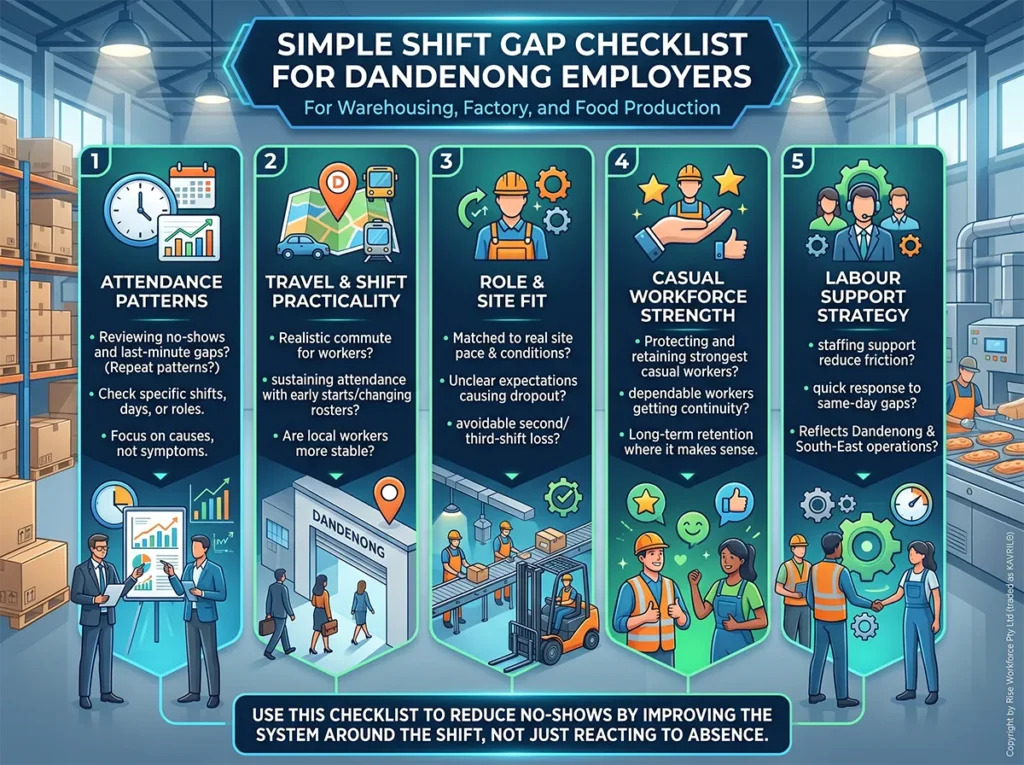
A Simple Shift Gap Checklist for Dandenong Warehouse Employers
Here is a practical checklist employers can use when reviewing no-shows and last-minute staffing gaps.
Attendance Patterns
- Are no-shows isolated, or are we seeing repeated patterns?
- Do certain shifts, days, or roles fail more often than others?
- Are we solving symptoms instead of reviewing causes?
Travel and Shift Practicality
- Is the commute realistic for the workers we are using?
- Are early starts or changing rosters making attendance harder to sustain?
- Are local workers proving more stable than those travelling further?
Role and Site Fit
- Are workers being matched to the real pace and conditions of the site?
- Are unclear expectations causing early dropout?
- Is weak fit driving avoidable second-shift and third-shift loss?
Casual Workforce Strength
- Are we protecting and retaining our strongest casual workers?
- Are dependable workers getting enough continuity to stay engaged?
- Are we thinking about longer-term retention where it makes sense?
Labour Support Strategy
- Does our staffing support reduce friction or add to it?
- Can it respond quickly to same-day gaps?
- Does it reflect how Dandenong and the South-East corridor actually operate?
This kind of checklist helps employers reduce no-shows by improving the system around the shift, not just reacting to the absence itself.
Final Word
Reducing no-shows and last-minute gaps in Dandenong warehouse shifts matters because these problems rarely stay small once the floor is active.
For warehouse employers across Dandenong and South-East Melbourne, stronger reliability usually comes from:
- more realistic travel thinking
- better role fit
- clearer shift communication
- stronger casual worker retention
- earlier response to repeated patterns
- and more practical labour support that fits the local corridor
That is what helps reduce:
- same-day disruption
- weak shift starts
- repeated refill pressure
- unnecessary supervisor strain
- and avoidable labour instability across the warehouse
Because a no-show is not just an attendance issue.
On an industrial site, it quickly becomes an operations issue too.
Need Practical Labour Hire Support for Warehousing and Manufacturing in Melbourne’s South-East?
KAVRILO is building its approach around safety-aware workforce support, stronger local responsiveness, and clearer operational discipline for warehouse and industrial environments.
Whether your site needs support during busy periods, stronger shift reliability, or more dependable labour coordination across the South-East, KAVRILO is focused on practical workforce support that fits controlled warehouse and factory environments.
Need warehouse and factory labour hire support with stronger local responsiveness and more dependable shift coverage? Talk to KAVRILO about workforce support across Melbourne’s South-East.
Article Disclaimer
This article is provided for general information only and does not constitute legal, workplace relations, safety, taxation, payroll or other professional advice. Please seek advice specific to your circumstances before acting on this information.
Please read our Website Disclaimer for more information.