


For warehouse and factory employers, labour reliability is often judged by what happens at the site:
- who turns up
- who arrives late
- who misses shifts
- and who stays long enough to become dependable
But in many cases, the issue starts much earlier.
It starts with the trip to work.
Across Dandenong and the wider South-East Melbourne corridor, transport and travel time still play a major role in whether a worker can:
- reach site consistently
- sustain early starts
- adapt to changing shifts
- accept short-notice work
- and keep attending once the routine becomes real over time
This matters because many industrial sites sit in areas where:
- public transport may be limited
- early-morning options are weaker
- travel between suburbs can be long
- and the practical effort of getting to work can become a bigger issue than employers first expect
That means shift reliability is not just about motivation.
It is also about whether the commute is realistic enough to support:
- punctuality
- attendance
- worker retention
- and stable labour coverage across the week
For employers in South-East Melbourne, especially in and around Dandenong, this is one of the most practical workforce issues to understand clearly.
Because a worker can be willing, capable, and available — and still become unreliable if the travel pattern is too hard to sustain.
For the broader local market overview, see our Staffing South-East Melbourne pillar guide for Dandenong warehouse and factory employers.
Why Travel Practicality Still Matters So Much in Industrial Staffing
Travel is easy to underestimate when a worker first accepts a role.
At that stage, the main question often feels simple:
Can they start?
But once the shifts begin, the real question becomes:
Can they keep doing this consistently?
That is where travel practicality matters.
For warehouse and factory roles, reliability depends partly on whether the worker can:
- leave early enough consistently
- arrive with enough margin for delay
- manage the route across multiple days
- and keep doing the trip without the commute becoming the reason the role starts to break down
This is especially relevant in industrial environments because:
- start times are often early
- sites may not sit close to major public transport lines
- shift patterns can change
- and the work itself can already be physically demanding before the commute is added on top
That is why transport should be treated as part of staffing reality, not an external issue outside it.
Where Travel and Transport Problems Usually Show Up
Travel-related reliability problems often appear through familiar patterns such as:
- repeated lateness
- same-day cancellations
- reluctance to accept certain shifts
- early dropout after a worker initially seemed positive
- increased absenteeism over time
- and a worker who performs well on site but struggles to sustain attendance consistently
These issues are often strongest when:
- the worker is travelling across multiple suburbs
- the route depends on multiple transport changes
- the shift begins very early
- late finishes make return travel harder
- or the site is in an industrial area that is harder to access than it first seemed
This is why employers need to look carefully at whether a reliability problem is really:
- an attitude problem
- a role-fit problem
- or a practical travel problem that was never properly addressed at the start
That distinction matters.
10 Practical Ways Travel Time Affects Shift Reliability
1. Longer Commutes Usually Reduce Punctuality Margin
A worker travelling a longer distance has less room for:
- normal delay
- traffic variation
- public transport timing issues
- or last-minute changes that would be manageable on a shorter route
This matters because punctuality is often not just about whether someone leaves on time.
It is also about how much buffer the trip allows.
A shorter, simpler commute usually gives the worker more practical margin to still arrive on time when normal disruption occurs.
That is one reason local workers often perform more consistently.
Our article on why local workers often improve punctuality and reduce turnover explains why shorter travel time and better local access often support stronger attendance and lower labour instability.
2. Early Starts Magnify Travel Problems Quickly
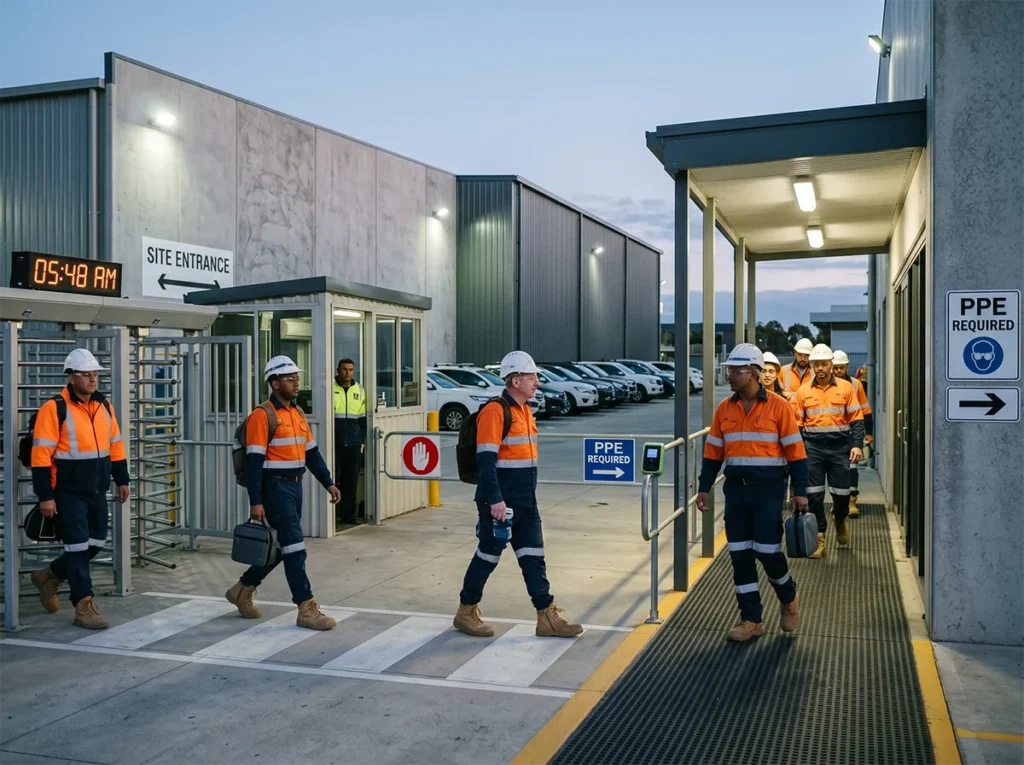
A shift that begins early can turn a manageable commute into a difficult one very quickly.
That is especially true when:
- public transport options are limited before dawn
- the worker needs multiple connections
- traffic patterns are unpredictable
- or the worker must leave extremely early just to arrive with enough margin
For some workers, the role is not unsustainable because of the work itself.
It becomes unsustainable because of the time and effort required to reach the site before the shift even begins.
That is why early-start staffing needs more practical travel thinking.
3. Long Travel Often Increases Fatigue Before the Work Starts
Commute pressure can affect more than attendance.
It can also increase:
- fatigue
- stress
- lower willingness to accept extra shifts
- and reduced sustainability over time
This is especially relevant for roles that already involve:
- physical work
- repetitive movement
- long hours
- or shift patterns that change week to week
A worker may still cope in the short term.
But over time, the combination of:
- difficult travel
- industrial work pace
- and limited rest margin
can push the role beyond what feels sustainable.
That often shows up later as:
- weaker punctuality
- more absences
- or earlier turnover than expected
4. Travel Complexity Often Matters as Much as Travel Distance
A worker does not always need to live far away for travel to be a problem.
Sometimes the real issue is complexity.
That may include:
- multiple transport changes
- poor industrial-area connections
- unreliable route timing
- difficulty reaching site from station or stop locations
- or a trip that looks manageable on paper but is impractical in real working hours
This matters because a “reasonable distance” does not always mean a reasonable commute.
Employers often get a better reliability picture when they think about:
- route practicality
not just - suburb-to-suburb distance
5. Short-Notice Shift Cover Becomes Harder with Longer Travel
When a site needs someone urgently, travel reality becomes even more important.
A worker may be willing to help, but still not be able to cover the shift if:
- they are too far away
- the trip takes too long
- transport timing does not support fast movement
- or the cost and effort of the commute makes the short-notice shift less practical
This matters for:
- absentee replacement
- late roster changes
- unexpected demand spikes
- and urgent warehouse or factory coverage
That is one reason local labour pools often provide stronger short-notice coverage in practice.
6. Shift Pattern Changes Can Make a Previously Manageable Commute Harder
A worker may perform reliably for one shift pattern and then struggle when the roster changes.
This often happens when:
- day shift changes to earlier starts
- rotating shifts are introduced
- overtime extends the return trip
- or weekend work changes how public transport or travel timing works
Employers sometimes see this as sudden unreliability.
But in some cases, the deeper issue is that the original commute was only sustainable under one pattern.
Once that changes, the worker’s reliability can weaken through no dramatic change in attitude.
That is why travel should be reviewed against the actual shift structure, not just the role title.
7. Travel Strain Often Affects Retention Quietly
Workers do not always say directly that travel is the problem.
Instead, employers may see:
- higher lateness
- more missed shifts
- reduced enthusiasm for extra coverage
- or resignation once a closer role becomes available
This is one reason travel-related turnover can be misunderstood.
The worker may have suited the site.
But the commute may not have suited the routine.
That is why retention strategy in South-East Melbourne often needs to include:
- commute realism
- local worker access
- and practical distance-to-site thinking
not just onboarding or pay rate discussion.
8. Industrial-Area Access Can Still Be a Hidden Barrier

Some sites are not hard to reach in theory.
They are hard to reach practically.
This can happen when:
- the final access into the industrial area is awkward
- public transport stops do not align well with shift start
- walking distance after transport is too long or unrealistic
- or the site’s location works well for drivers but poorly for some other workers
These issues can quietly weaken:
- punctuality
- shift acceptance
- and long-term attendance
Employers sometimes only realise this after repeated reliability issues start appearing.
That is why industrial-area access should be assessed honestly from the beginning.
9. Better Travel Practicality Often Supports More Stable Casual Staffing

Casual staffing often depends on workers being able to:
- accept shifts flexibly
- respond quickly
- and continue attending across changing weekly demand
Travel practicality affects all of those things.
A worker with a simpler, more local commute is often better placed to:
- accept coverage faster
- sustain changing start times
- and remain a useful casual over time without the travel burden becoming the main problem
That is one reason why some of the most dependable casual workers are also those with more practical site access.
10. Local Staffing Strategy Often Improves Reliability More Than Employers Expect
For many employers, transport-related labour problems are not solved by trying harder to manage unreliability after it appears.
They are improved earlier through:
- stronger local recruitment focus
- more realistic screening around commute practicality
- better labour matching by geography
- and staffing support that understands how South-East Melbourne industrial travel actually works
This is where local staffing strategy becomes valuable.
A business that pays attention to travel reality often improves:
- punctuality
- attendance
- casual stability
- and labour retention
without needing to overcomplicate the issue.
Our article on why South-East Melbourne employers need faster, more local staffing support explains why local responsiveness and practical corridor knowledge often improve workforce reliability for industrial employers.
What Employers Should Not Assume
A worker who lives further away is not automatically unreliable.
And a worker who lives close is not automatically dependable.
The point is not to reduce staffing decisions to postcode alone.
The point is that transport and travel practicality are often meaningful predictors of whether:
- a shift pattern is sustainable
- punctuality is realistic
- short-notice coverage is possible
- and the worker is likely to keep attending consistently once the job becomes routine
So employers should avoid two extremes:
- ignoring travel completely
- or treating geography as the only issue that matters
The better approach is to include travel realism as one practical part of workforce planning.
What Better Shift Reliability Usually Looks Like in Practice
When transport and travel are working with the staffing plan instead of against it, the result usually feels:
- steadier
- calmer
- more predictable
- and less exposed to avoidable attendance disruption
In practice, that often means:
- workers can reach site more realistically
- early starts are more sustainable
- short-notice cover is easier to manage
- turnover driven by commute pressure reduces
- and supervisors spend less time dealing with roster instability
It should not feel like:
- every shift depends on a long and fragile commute working perfectly
- new workers disappear once the travel routine becomes real
- or the site is solving the same travel-driven reliability problem again and again
Good shift reliability is often supported by better labour planning before the attendance problem fully appears.
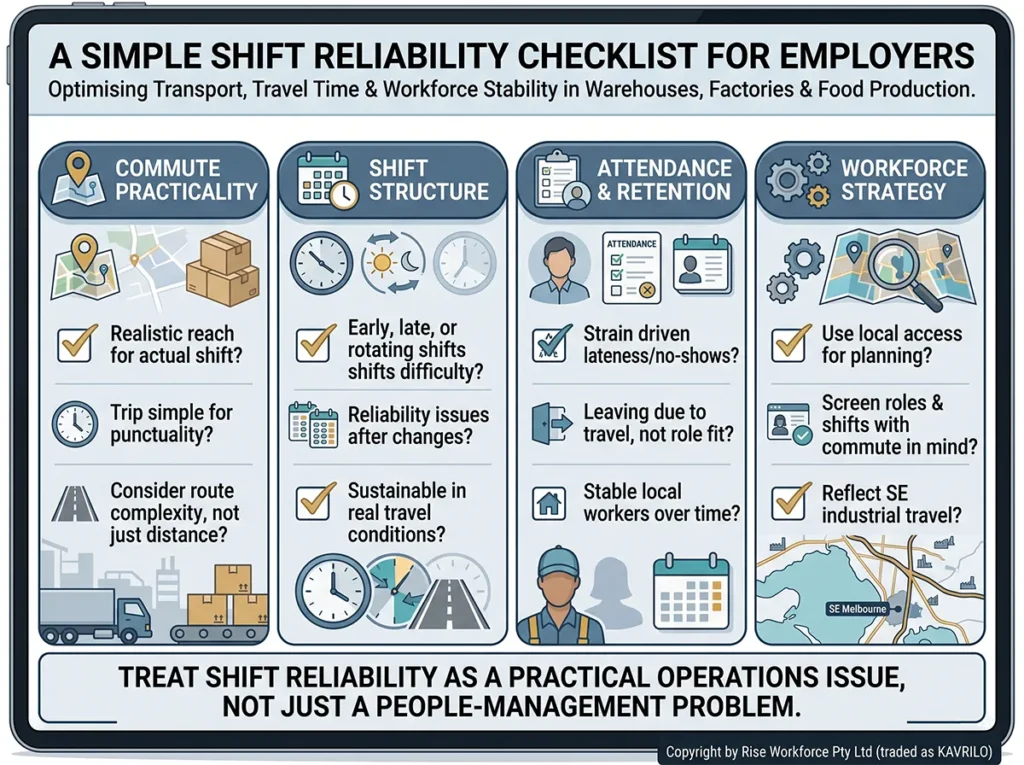
A Simple Shift Reliability Checklist for Employers
Here is a practical checklist employers can use when thinking about transport, travel time, and labour reliability.
Commute Practicality
- Are workers realistically able to reach site for the actual shift pattern?
- Is the trip simple enough to support reliable punctuality?
- Are we considering route complexity, not just distance?
Shift Structure
- Do early starts, late finishes, or rotating shifts make the commute harder?
- Have reliability issues increased after roster changes?
- Are we testing whether the shift pattern is sustainable in real travel conditions?
Attendance and Retention
- Are repeated lateness or no-shows partly driven by commute strain?
- Are workers leaving because the role is wrong, or because the travel is too hard?
- Are stronger local workers proving more stable over time?
Workforce Strategy
- Are we using local access as part of smarter staffing planning?
- Are we screening roles and shifts with commute practicality in mind?
- Does our labour support reflect how South-East Melbourne industrial travel actually works?
This kind of checklist helps employers treat shift reliability as a practical operations issue, not just a people-management problem.
Final Word
Transport and travel time affect shift reliability in South-East Melbourne because workforce stability depends on more than willingness alone.
For warehouse and factory employers across Dandenong and the wider South-East, better labour reliability often comes from:
- more realistic commute thinking
- stronger local worker access
- better match between travel and shift pattern
- and staffing support that reflects how industrial travel actually works in the corridor
That is what helps reduce:
- avoidable lateness
- attendance disruption
- short-notice coverage problems
- and turnover driven more by commute pressure than by site performance
Because in industrial staffing, a worker’s ability to reach the site consistently and sustain the route over time often matters more than employers expect.
That is not just a transport issue.
It is a staffing and operations issue too.
Need Practical Labour Hire Support for Warehousing and Manufacturing in Melbourne’s South-East?
KAVRILO is building its approach around safety-aware workforce support, stronger local responsiveness, and clearer operational discipline for warehouse and industrial environments.
Whether your site needs support during busy periods, stronger shift reliability, or more dependable labour coordination across the South-East, KAVRILO is focused on practical workforce support that fits controlled warehouse and factory environments.
Need warehouse and factory labour hire support with stronger local responsiveness and more dependable shift coverage? Talk to KAVRILO about workforce support across Melbourne’s South-East.
Article Disclaimer
This article is provided for general information only and does not constitute legal, workplace relations, safety, taxation, payroll or other professional advice. Please seek advice specific to your circumstances before acting on this information.
Please read our Website Disclaimer for more information.