

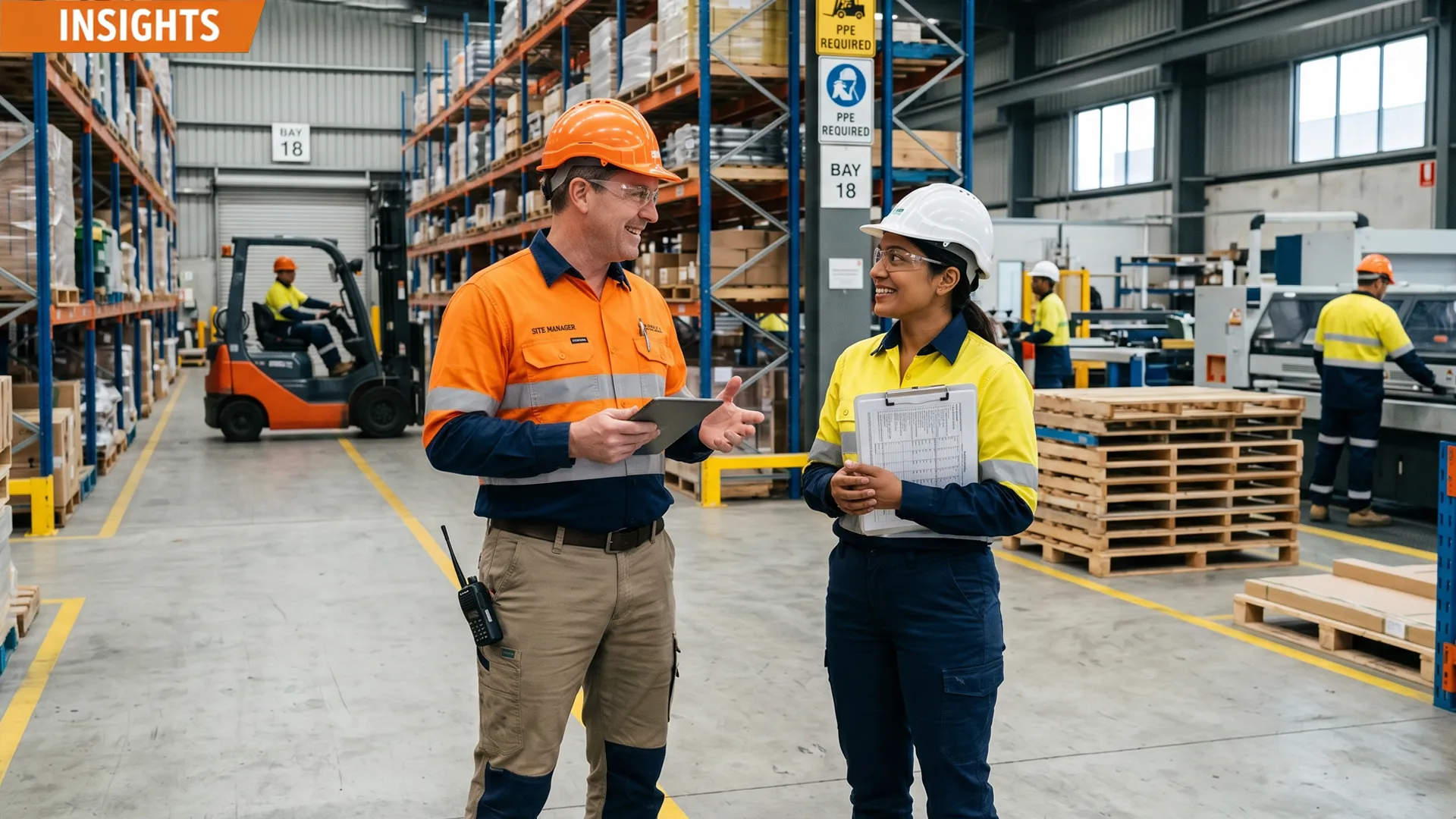
Using labour hire can be a practical way to support operations.
For many employers across Melbourne’s South-East, labour hire helps cover:
- absences
- peak periods
- project work
- seasonal demand
- production pressure
- and growth that permanent staffing alone cannot always absorb
That flexibility matters in warehousing, logistics, food production, and manufacturing. But using labour hire is not just a staffing decision. It is also a compliance and operational control decision.
For host employers, labour hire works best when the placement is not treated as:
- a quick transaction
- a simple headcount solution
- or a responsibility that sits mainly with the provider
In practice, labour hire compliance depends on what the host employer gets right on site.
That includes:
- the role brief
- the worker fit
- the day-one induction
- the supervision structure
- the traffic and movement rules
- the reporting pathway
- and the consistency of safety expectations once the worker starts
A labour hire worker may not be directly employed by the host. But once they enter the site, they are still exposed to the host employer’s:
- layout
- plant
- traffic flow
- task demands
- pace of work
- supervision quality
- and operational discipline
That is why good host employers take labour hire compliance seriously from the beginning.
If you are also reviewing wider site safety systems, our broader safety compliance guide explains how practical hazard control, induction, and supervision support stronger day-to-day control.
They understand that good placements do not happen by accident.
They are built through clearer preparation, stronger coordination, and more practical site control from day one.
If you are reviewing your wider safety systems, our WorkSafe Victoria compliance in manufacturing and warehousing guide explains how practical hazard control, induction, and supervision support stronger day-to-day site compliance.
What Victorian Labour Hire Compliance Means in Practice
A lot of employers hear the word compliance and think mainly about:
- legal obligations
- documentation
- licences
- policies
- and formal process
Those things matter. But on a live warehouse or factory floor, labour hire compliance is also practical.
In practice, it means asking:
- Is the worker suitable for the role?
- Was the role described properly?
- Does the worker understand the site before starting?
- Are supervision and reporting lines clear?
- Are safety expectations visible, not assumed?
- Is the provider and host communication strong enough to support the placement properly?
This is where many problems begin.
The worker may arrive on time.
The site may be busy.
The role may be urgent.
But if the setup is weak, then avoidable risk can build quickly through:
- confusion
- poor fit
- mixed messages
- rushed induction
- weak reporting
- or unclear ownership of the worker once they are on site
That is why Victorian labour hire compliance should not be viewed as something separate from operations.
It sits inside how the placement is prepared, received, supervised, and managed in real conditions.
Why Host Employers Need to Think Beyond “Worker Supply”
One of the easiest ways to weaken labour hire performance is to treat the process as though the only question is:
“Can someone be sent?”
A worker being available is not the same as a placement being ready.
Good host employers usually think earlier and more clearly about:
- what the person will actually be doing
- what area of the site they will enter
- what hazards are present
- what pace and physical demand the role carries
- how much induction is needed
- and what kind of supervision the first shift will require
That matters because labour hire can either:
- reduce pressure on the site
or - create more of it
The difference usually comes down to how well the placement has been set up.
A good provider helps support that.
But the host employer still controls the site environment the worker enters.
That is why the host employer’s role in compliance is so important.
Where Labour Hire Compliance Usually Breaks Down
Most labour hire problems do not begin with one major failure.
They usually begin with smaller issues that compound.
Common breakdown points include:
- vague role briefs
- poor worker fit
- rushed or weak induction
- unclear traffic and movement rules
- no obvious supervisor on day one
- weak reporting expectations
- mixed messages across supervisors
- and poor follow-up when the first shift shows signs of strain
These problems often feel manageable in the moment.
But together they can create:
- extra supervision pressure
- unsafe assumptions
- preventable confusion
- repeated correction
- slow settling-in
- and avoidable exposure around traffic, manual handling, plant, or site layout
That is why compliance needs to be treated as something that lives inside the placement process itself — not just in documents or provider selection.
10 Things Host Employers Need to Get Right
1. Role Clarity Before the Placement Starts
A good placement starts with a clear role brief.
That should include more than the title.
The host employer should be clear about:
- the actual task
- the physical demands
- the pace
- the hazards in the work area
- the PPE requirements
- the site type
- and whether the worker will be operating near forklifts, machinery, dispatch pressure, or controlled production zones
This matters because labels such as:
- warehouse worker
- process worker
- picker packer
- production worker
- forklift operator
can mean very different things from site to site.
The more accurately the role is described, the stronger the chances of worker fit and safer placement from day one.
Our article on choosing the right labour hire provider in Victoria explains why role clarity, worker fit, and practical communication matter so much before the first shift begins.
2. Shared Safety Duties and Clear Coordination
Using labour hire does not remove the need for strong host-employer safety control.
Once the worker enters your site, they are exposed to your:
- floor conditions
- layout
- movement systems
- plant
- task demands
- and supervision structure
That means host employers need to coordinate clearly with the labour hire provider around:
- role expectations
- site hazards
- onboarding
- reporting
- and worker readiness
If the host and provider are not aligned early, confusion usually shows up on the floor later.
Our guide to labour hire and shared safety duties looks more closely at how host employers and labour hire providers should coordinate site safety, supervision, and reporting from the start.
3. Day-One Site Induction

A labour hire worker should not be expected to “just follow the others”.
Good host employers make sure the worker understands:
- where to report
- who supervises them
- where to walk
- what hazards matter most
- what PPE applies
- what areas are restricted
- and how reporting works if something goes wrong
This matters even for experienced workers.
A person can have strong warehouse or factory experience and still be unfamiliar with:
- your layout
- your traffic flow
- your blind spots
- your access rules
- and the local habits that already exist around your floor
A short but clear induction is one of the strongest labour hire controls available on day one.
Our article on site safety inductions for labour hire workers breaks down what host employers should cover on day one to reduce avoidable confusion and early-shift exposure.
4. Traffic and Movement Control
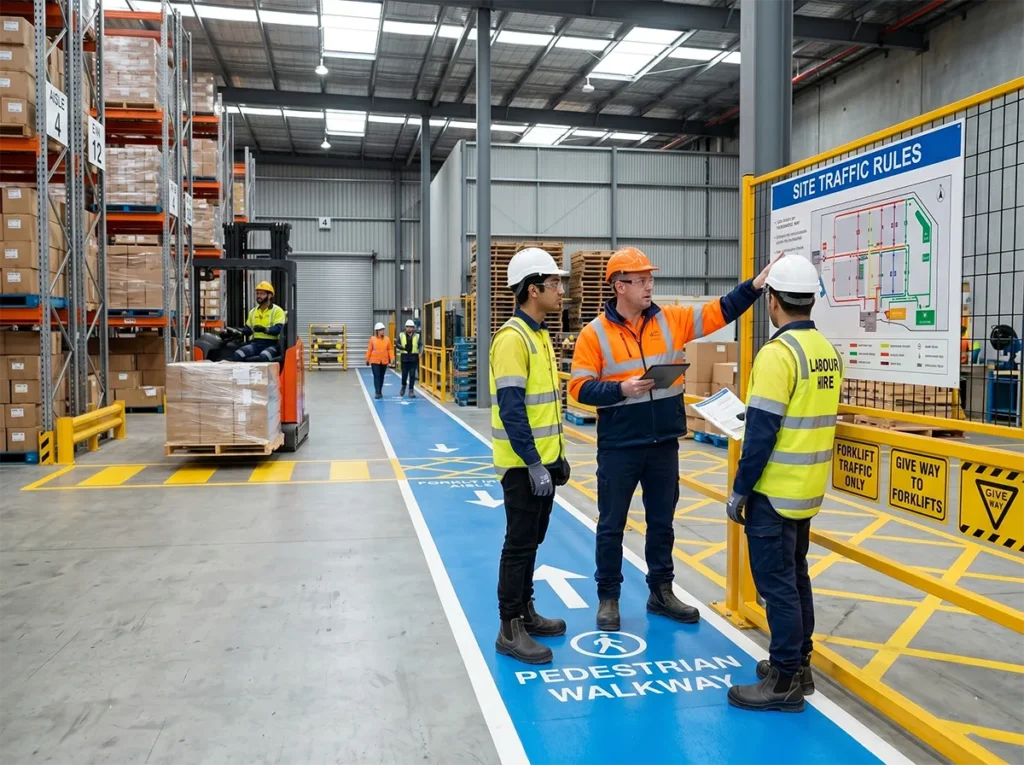
For many warehouse and industrial environments, traffic risk is one of the clearest site-specific hazards.
That includes:
- forklift and pedestrian interaction
- blind spots
- loading dock pressure
- crossings
- active dispatch zones
- and workers entering areas they do not yet understand well
A labour hire worker should not be expected to learn these through trial and error.
Host employers need to make traffic rules visible and practical from the beginning.
Our guide to warehouse traffic management explains how employers can reduce forklift and pedestrian risk through clearer layout, stronger supervision, and better day-one movement control.
5. PPE and Site Discipline Expectations
A placement is more exposed when the worker is unclear on:
- what PPE is required
- how it should be worn
- which areas have stricter rules
- and what site discipline looks like in practice
Host employers should not assume:
- PPE is self-explanatory
- the worker will copy others correctly
- or the provider has already covered the site-specific detail
A stronger placement starts when:
- PPE expectations are shown clearly
- site rules are explained practically
- and poor habits are corrected early
6. Supervision That Matches the Worker’s Familiarity With the Site
A common mistake is to treat a labour hire worker as though they are fully settled as soon as they arrive.
That is rarely true.
Good host employers make sure:
- the worker knows who supervises them
- a visible person owns the early shift
- questions can be raised easily
- and unsafe assumptions are corrected before they become repeated behaviour
This is especially important where:
- the layout is active
- the task is repetitive
- traffic is heavy
- machinery is nearby
- or the role is more physically demanding than it sounds from the title alone
A worker can be capable and still need closer support early.
7. Reporting Pathways That Are Clear From the First Shift
A labour hire worker should know:
- what to report
- who to tell
- how quickly to escalate
- and whether the labour hire provider also needs to be informed
That includes:
- hazards
- near misses
- injuries
- blocked walkways
- equipment issues
- unsafe behaviour
- and anything else creating uncertainty on the floor
Weak reporting creates delay.
Delay creates risk.
A strong host employer makes reporting feel simple, clear, and expected from the beginning.
8. Realistic Task Fit and Work Conditions
Sometimes the biggest issue is not the worker.
It is the mismatch between the worker and the actual conditions of the role.
Good host employers review:
- whether the task is more physical than expected
- whether repetition is stronger than the brief suggested
- whether the pace is realistic
- whether the worker is being placed too close to traffic or machinery too soon
- and whether the site environment is harder to settle into than it first sounded
This is especially important where roles sit in:
- busy dispatch zones
- repetitive manual handling
- controlled food production
- active machinery areas
- or mixed warehouse-factory spaces
A poor fit often looks like a poor worker.
Sometimes it is really a poor setup.
Our article on manual handling risks in warehouses and factories explains why task design, repetition, layout, and pace need review early if you want safer placements and fewer avoidable injuries.
9. Consistency Across Supervisors and Managers
Placements weaken quickly when different people on site say different things.
For example:
- one supervisor enforces the walkway rule
- another tells the worker to cut through
- one person insists on PPE
- another is relaxed about it
- one manager expects questions
- another makes the worker feel like asking is a problem
This creates confusion fast.
Good host employers reduce that by keeping key messages consistent across:
- managers
- supervisors
- team leaders
- and anyone directing the worker on shift
Consistency is one of the simplest ways to make a placement safer and easier to manage.
10. Early Review of the First Shift

The first shift usually tells you a lot.
Good host employers review early:
- whether the worker understood the induction
- whether they seem clear on movement and access
- whether the role fit is right
- whether basic correction keeps repeating
- whether the site setup needs improving
- and whether the worker is settling in safely, not just attending
This matters because the first signs of placement weakness are often visible early.
If they are ignored, the site usually ends up spending more time later dealing with:
- repeated confusion
- unsafe habits
- poor task fit
- and preventable friction that should have been addressed sooner
Our article on when labour hire placements go wrong explains the most common host-employer mistakes that create avoidable risk during the first shifts of a placement.
What Good Labour Hire Compliance Usually Looks Like in Practice
When labour hire is being managed well, the placement usually feels:
- clearer
- calmer
- easier to supervise
- easier to induct into
- and less exposed to avoidable early-shift problems
In practice, that often means:
- the provider understands the actual role
- the host has prepared the site properly
- induction is practical and visible
- the worker knows where to report
- reporting expectations are clear
- and small issues are corrected before they spread
It should not feel like:
- the worker is being passed around informally
- nobody is sure who briefed them
- traffic and access rules are being guessed
- or the host is discovering the real gaps only after the shift is underway
Good labour hire compliance is visible in how smoothly and safely the placement lands.
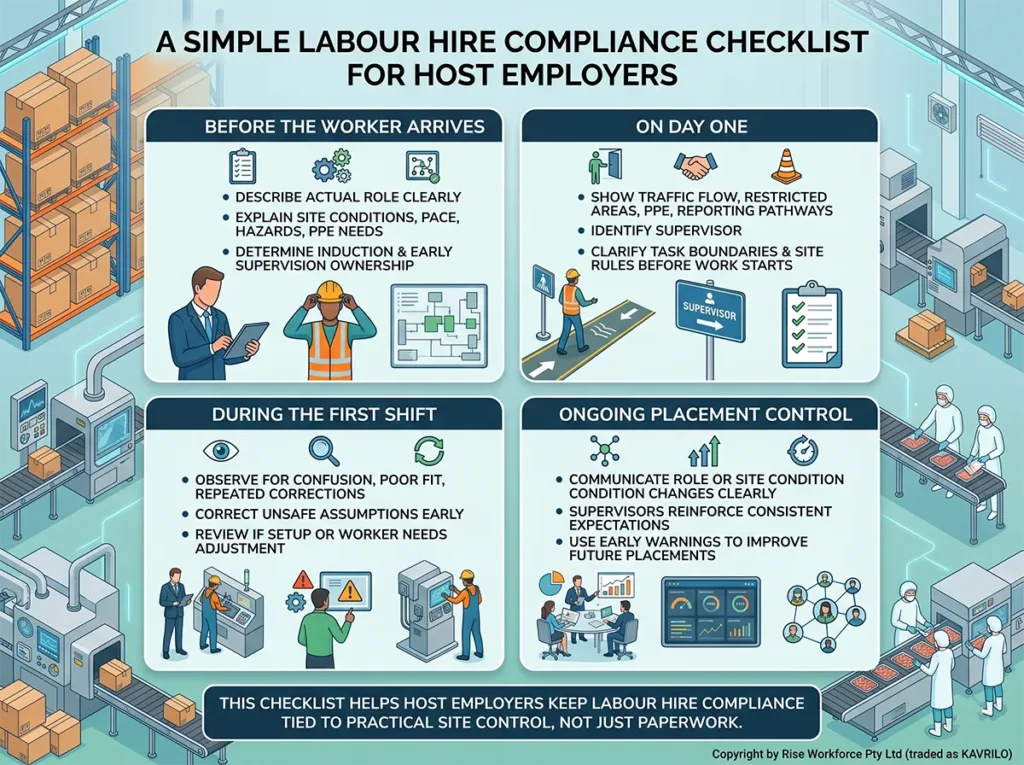
A Simple Labour Hire Compliance Checklist for Host Employers
Here is a practical checklist employers can use before and during labour hire placements.
Before the Worker Arrives
- Have we described the actual role clearly?
- Have we explained the real site conditions, pace, hazards, and PPE needs?
- Do we know who will own the induction and early supervision?
On Day One
- Has the worker been shown traffic flow, restricted areas, PPE, and reporting pathways?
- Do they know who supervises them?
- Have task boundaries and site rules been made clear enough before work starts?
During the First Shift
- Are we seeing signs of confusion, poor fit, or repeated correction?
- Are unsafe assumptions being corrected early?
- Are we reviewing whether the setup, not just the worker, needs adjustment?
Ongoing Placement Control
- Are role changes or site condition changes being communicated clearly?
- Are supervisors reinforcing the same expectations?
- Are early warning signs being used to improve future placements?
This kind of checklist helps host employers keep labour hire compliance tied to practical site control, not just paperwork.
Final Word
Victorian labour hire compliance is not just about whether labour hire is used lawfully.
For host employers, it is also about whether the placement is set up in a way that is:
- clear
- practical
- safer
- better supervised
- and easier to manage from the first shift onward
Across Melbourne’s South-East, the host employers who get this right usually focus on:
- stronger role briefs
- better worker fit
- clearer induction
- visible supervision
- practical reporting
- consistent site messages
- and early review of how the placement is actually landing
That is what helps reduce:
- avoidable confusion
- weak onboarding
- unnecessary friction
- preventable safety exposure
- and repeated first-shift problems
Because good labour hire compliance is not just about sending a worker.
It is about making sure the worker can operate safely and clearly in the real conditions of your site.
That is not just better compliance.
It is better operational control.
Need Practical Labour Hire Support for Warehousing and Manufacturing in Melbourne’s South-East?
KAVRILO is building its approach around safety-aware workforce support, clearer communication, and stronger operational discipline for warehouse and industrial environments.
Whether your site needs better shift coverage, stronger day-one worker readiness, or more dependable labour coordination, KAVRILO is focused on practical workforce support that fits controlled warehouse and factory environments.
Need warehouse and factory labour hire support with stronger day-one readiness and a practical safety-aware approach? Talk to KAVRILO about workforce support across Melbourne’s South-East.
Article Disclaimer
This article is provided for general information only and does not constitute legal, workplace relations, safety, taxation, payroll or other professional advice. Please seek advice specific to your circumstances before acting on this information.
Please read our Website Disclaimer for more information.