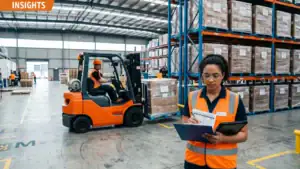

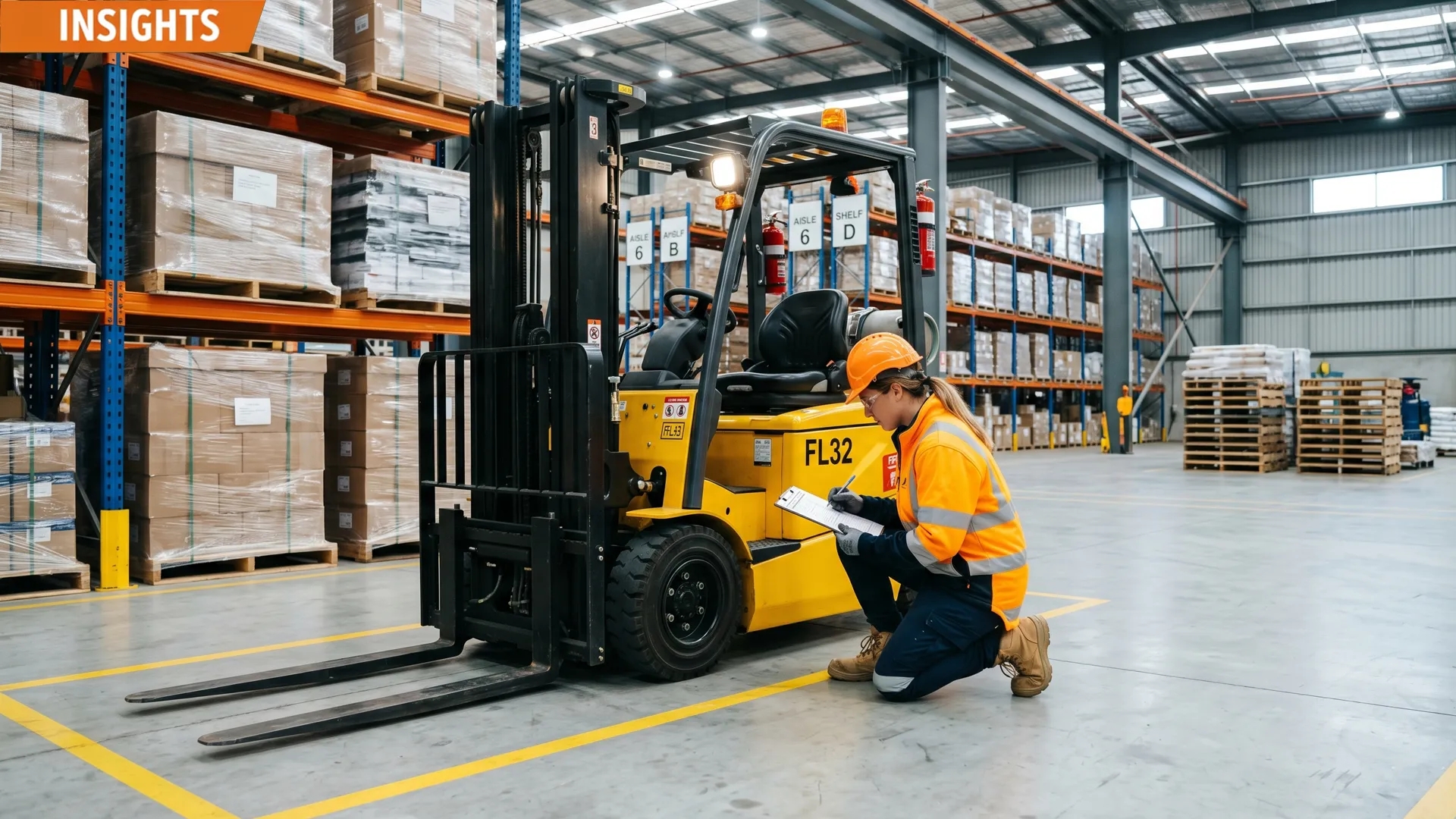
A forklift shift does not begin when the machine starts moving.
It begins before that — with the checks that help confirm the forklift, the operator, and the immediate work area are ready for safe use.
Across Melbourne’s South-East, forklifts are part of daily warehouse and logistics activity. They move stock, service racking, support replenishment, and keep dispatch flowing. Because they are so familiar, there is always a risk that pre-start discipline becomes rushed, casual, or treated like a formality.
That is where problems begin.
A daily forklift safety check is not just an admin task before “real work” starts. It is one of the first practical controls available before the machine enters:
- active traffic lanes
- shared pedestrian areas
- dock zones
- aisle intersections
- staging areas
- and time-pressure conditions on a busy warehouse floor
Good employers understand that pre-start checks help identify:
- visible equipment issues
- obvious defects
- control concerns
- warning light problems
- tyre or fork damage
- and machine conditions that should not be ignored
They also help reinforce something just as important:
operator discipline.
Because a forklift operator who starts the shift by checking the machine properly is more likely to approach the floor with the right level of attention from the beginning.
For the broader employer overview, see our forklift safety and licence checks in Victoria pillar guide on licence fit, induction, traffic control, and early-shift supervision.
Why Daily Forklift Checks Matter More Than Many Sites Realise
A forklift can look usable at a glance and still carry problems that matter.
That is why good employers do not reduce pre-start checks to:
- habit
- memory
- or a rushed visual glance before movement begins
Daily checks matter because they help catch issues before the forklift enters:
- active traffic
- narrow aisles
- dock approaches
- pedestrian interaction areas
- or high-pressure warehouse movement
They also matter because a weak pre-start routine often signals a wider issue:
- rushed operators
- weak supervision
- poor reporting discipline
- or a site that is slowly becoming too casual about equipment safety
A strong daily check is not just about defects.
It is also about the standard the site sets before the shift even starts.
What a Good Daily Forklift Safety Check Should Actually Do
A useful pre-start check should help answer a few simple questions:
- Is this forklift visibly safe to use?
- Is anything damaged, loose, missing, or behaving abnormally?
- Are the controls, warnings, and movement basics functioning properly?
- Is the immediate area around the forklift safe enough for startup?
- If there is a problem, does the operator know what to do next?
That is why a good check should be:
- practical
- consistent
- clear
- and easy to follow under real warehouse conditions
It should not feel like:
- paperwork for its own sake
- a memory test
- or a form that gets completed after the machine is already moving
The best daily checks are simple enough to use properly and strong enough to stop the wrong machine entering the floor.
What Good Operators Review Before Shift Start
1. Overall Visible Condition of the Forklift
A good pre-start begins with a practical visual review.
The operator should look for signs of:
- obvious damage
- loose parts
- visible wear
- leaks
- broken lights
- cracked mirrors
- missing guards
- damaged mast components
- and anything else that looks clearly wrong before startup
This first check matters because visible problems are often the easiest ones to spot — and also the easiest to miss when the shift is rushed.
A forklift that “probably looks fine” is not the right standard.
The better question is:
“Does anything on this machine look like it needs attention before use?”
2. Forks, Mast, and Lifting Components
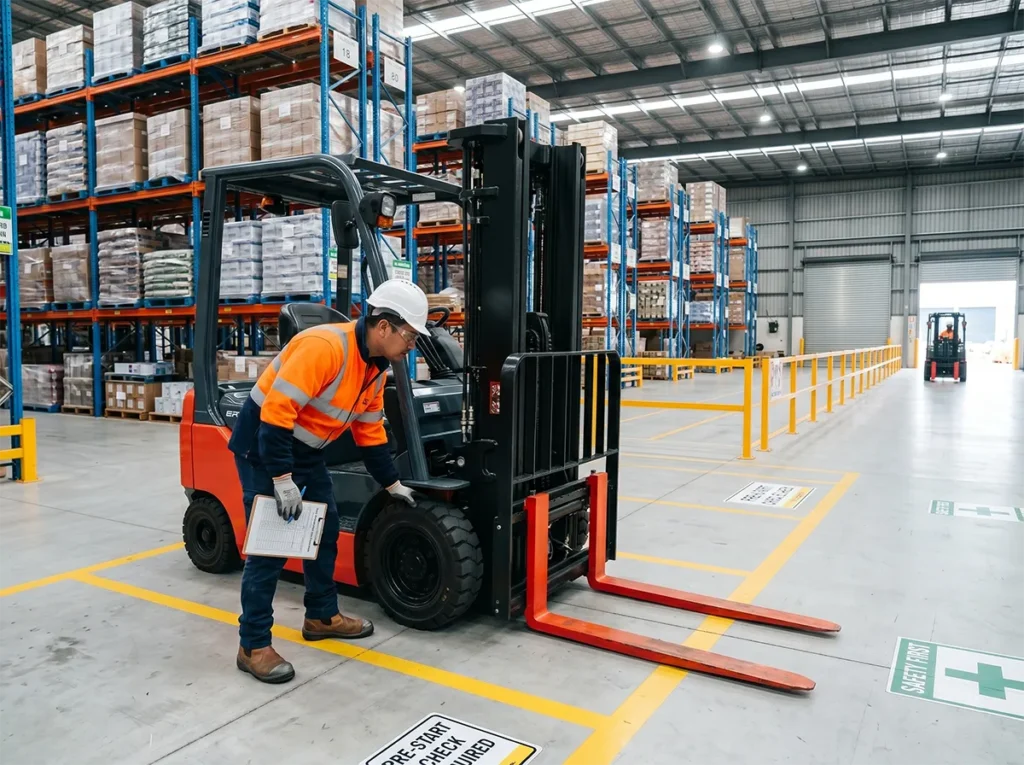
Fork-related and mast-related issues should be treated seriously.
Operators should check for things like:
- visible fork damage
- bending
- cracking
- unusual wear
- misalignment
- obvious issues around lifting components
- and any signs that the mast or related hardware is not in normal condition
This matters because the forklift’s lifting function is central to the task.
If the lifting components are compromised, the risk does not stay isolated to the forklift itself. It can affect:
- load stability
- racking interaction
- visibility
- and the safety of nearby workers
Good operators should not treat mast or fork irregularities as minor cosmetic issues.
3. Tyres and Wheels
Tyres matter because they affect:
- grip
- balance
- stability
- steering feel
- and safe movement across the warehouse floor
Operators should check for:
- obvious tyre damage
- excessive wear
- low pressure where relevant
- missing chunks
- or wheel-related issues that look abnormal
This is especially important in environments with:
- smooth concrete
- dock transitions
- uneven surfaces
- wet patches
- or tight turning requirements
A forklift operating on poor tyres can become harder to control even before the site pressure starts building.
4. Controls, Steering, and Braking Response
The operator should make sure the forklift’s basic operating controls feel normal before entering active work.
That includes checking:
- steering response
- brake response
- general control function
- and whether anything feels delayed, loose, irregular, or not as expected
This is not a technical workshop diagnosis.
It is a practical operator check.
If the forklift does not feel right in the most basic movement functions, that should not be ignored.
A machine that is “probably okay” can still create unnecessary risk once it enters a live warehouse floor.
5. Horn, Warning Devices, and Lights
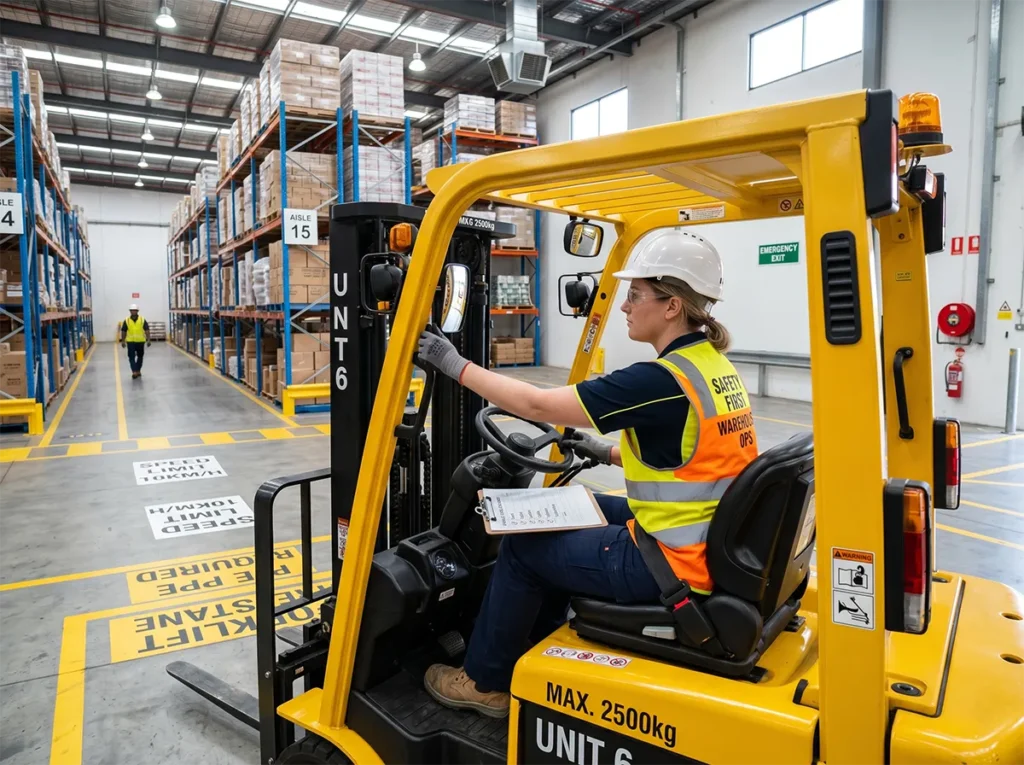
Forklift safety relies heavily on visibility and awareness.
That means warning devices matter.
Operators should check:
- horn function
- warning alarms where relevant
- visible lights
- and any other basic alert features the forklift depends on for safe operation
This is especially important on warehouse floors with:
- blind corners
- aisle intersections
- shared pedestrian routes
- lower visibility areas
- or active dock movement
A warning system that is not functioning properly weakens one of the forklift’s most practical interaction controls.
6. Mirrors, Visibility, and Operator Line of Sight
Before shift start, the operator should make sure they can see properly from the machine.
That includes checking:
- mirrors
- obvious visibility issues
- obstructions on the forklift
- and whether the setup supports safe awareness of the surrounding floor
This matters because the operator’s ability to read:
- crossings
- pedestrians
- dock space
- aisles
- and staged goods
depends partly on what the machine allows them to see clearly.
A forklift entering the floor with weak visibility is already operating under reduced control.
7. Battery, Fuel, or Power Condition
The operator should check the basic power condition relevant to the forklift type being used.
That includes whether:
- battery condition appears normal
- connectors or cables appear secure where relevant
- or fuel / power status looks appropriate for safe and uninterrupted use
The point is not to turn pre-start into a maintenance role.
The point is to identify obvious issues before the forklift enters live work and then creates:
- unplanned stoppage
- awkward shutdown points
- or unsafe workarounds under pressure
Good employers want the machine entering shift in a state that supports controlled operation, not avoidable interruption.
8. Immediate Area Around the Forklift
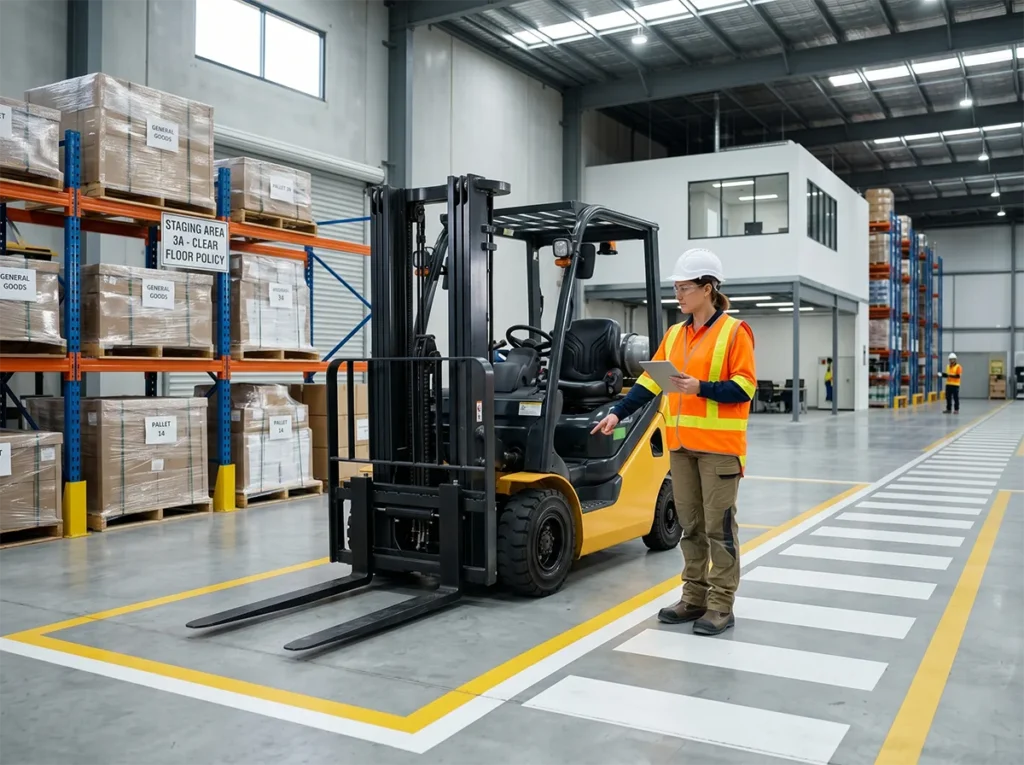
A good pre-start check includes more than the machine itself.
Operators should also review the immediate area around the forklift for:
- obstacles
- clutter
- blocked access
- loose wrapping
- staged stock too close to startup space
- or anything else that makes initial movement less safe than it should be
This matters because a forklift can begin the shift in a weak environment even if the machine itself is fine.
The startup area should support safe movement from the first metre, not force awkward manoeuvres immediately.
Our guide to warehouse housekeeping standards explains how clutter, wrapping, blocked access, and weak floor discipline can quickly make forklift movement less safe than it appears.
9. Whether the Operator Knows What to Do if Something Is Wrong
A check is only useful if the operator knows what happens next.
That means they should know:
- what counts as a concern worth raising
- who to report it to
- whether the forklift should remain out of use
- and what the site expects if something does not feel right
A weak site may still create pressure such as:
- “just use it for now”
- “it should be fine”
- or “we’ll look at it later”
Good employers reduce that pressure by making reporting clear and visible before the shift begins.
That is how pre-start checking becomes a real control rather than a formality.
10. Whether the Check Is Being Done Properly Every Shift
One of the biggest practical issues is not whether a checklist exists.
It is whether the site is using it properly every day.
Good employers review:
- whether checks are genuinely happening before use
- whether operators understand what they are looking for
- whether concerns are being raised consistently
- and whether the process still holds up when the warehouse is busy
This matters because pre-start discipline often weakens gradually.
At first, the site still has the form.
Later, the form remains but the quality of checking drops.
That is usually when equipment and reporting risk start to creep in quietly.
What Weak Pre-Start Culture Usually Looks Like
Most sites show warning signs before pre-start checking becomes a bigger problem.
Those signs may include:
- operators rushing straight onto the machine
- checks happening after movement has already started
- repeated small defects being treated casually
- unclear reporting pathways
- supervisors not noticing whether checks are being done properly
- or a general culture that treats pre-start as routine paperwork rather than a control
These signs matter.
Because weak pre-start culture usually affects more than the checklist.
It often reflects:
- weaker site discipline
- weaker equipment reporting
- weaker supervision
- and a greater chance that the forklift will enter active operation in a condition that should have been questioned earlier
Good employers notice that before something bigger happens.
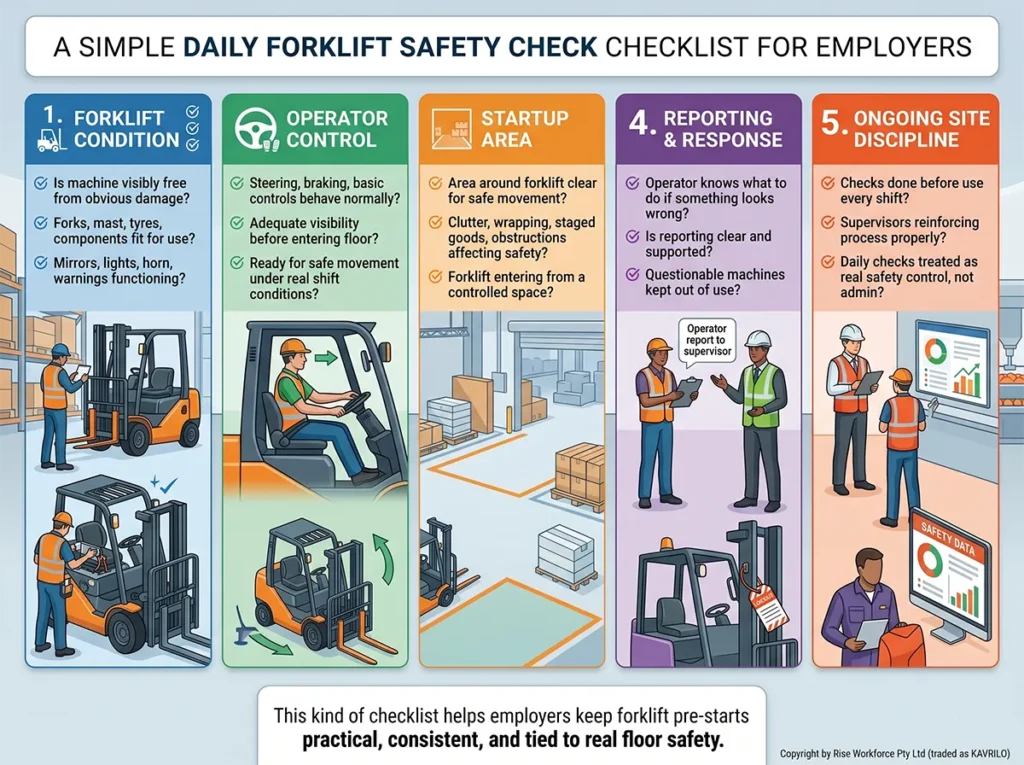
A Simple Daily Forklift Safety Check Checklist for Employers
Here is a practical checklist employers can use to review pre-start discipline on site.
Forklift Condition
- Is the machine visibly free from obvious damage or abnormal issues?
- Do the forks, mast, tyres, and visible components appear fit for use?
- Are mirrors, lights, horn, and basic warnings functioning properly?
Operator Control
- Are steering, braking, and basic controls behaving normally?
- Does the operator have adequate visibility before entering the floor?
- Does the machine appear ready for safe movement under real shift conditions?
Startup Area
- Is the area around the forklift clear enough for safe movement?
- Are clutter, wrapping, staged goods, or obstructions affecting startup safety?
- Is the forklift entering the shift from a controlled space?
Reporting and Response
- Does the operator know what to do if something looks wrong?
- Is reporting clear and supported?
- Are questionable machines being kept out of use until reviewed properly?
Ongoing Site Discipline
- Are pre-start checks actually being done before use every shift?
- Are supervisors reinforcing the process properly?
- Is the site treating daily checks as a real safety control rather than an admin habit?
This kind of checklist helps employers keep forklift pre-starts practical, consistent, and tied to real floor safety.
Final Word
Daily forklift safety checks matter because the shift begins before movement begins.
For warehouse employers across Melbourne’s South-East, stronger pre-start discipline usually helps support:
- better equipment awareness
- stronger operator habits
- clearer reporting
- earlier defect detection
- and safer first movement onto the warehouse floor
That is what helps reduce:
- rushed starts
- missed warning signs
- weak equipment reporting
- and avoidable forklift risk in active traffic environments
Because a forklift pre-start check is not just about ticking a form.
It is about making sure the machine and the operator are ready for safe use before the floor gets busy.
That is not just better checking.
It is better warehouse control.
Need Practical Labour Hire Support for Warehousing and Manufacturing in Melbourne’s South-East?
KAVRILO is building its approach around safety-aware workforce support, clearer communication, and stronger operational discipline for warehouse and industrial environments.
Whether your site needs better shift coverage, stronger day-one worker readiness, or more dependable labour coordination for forklift-related work, KAVRILO is focused on practical workforce support that fits controlled warehouse and factory environments.
Need warehouse and factory labour hire support with stronger day-one readiness and a practical safety-aware approach? Talk to KAVRILO about workforce support across Melbourne’s South-East.
Article Disclaimer
This article is provided for general information only and does not constitute legal, workplace relations, safety, taxation, payroll or other professional advice. Please seek advice specific to your circumstances before acting on this information.
Please read our Website Disclaimer for more information.