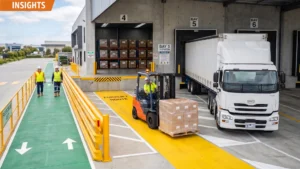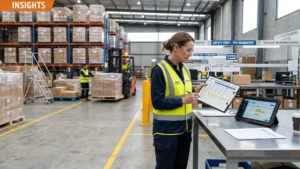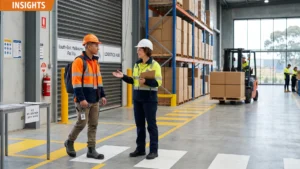

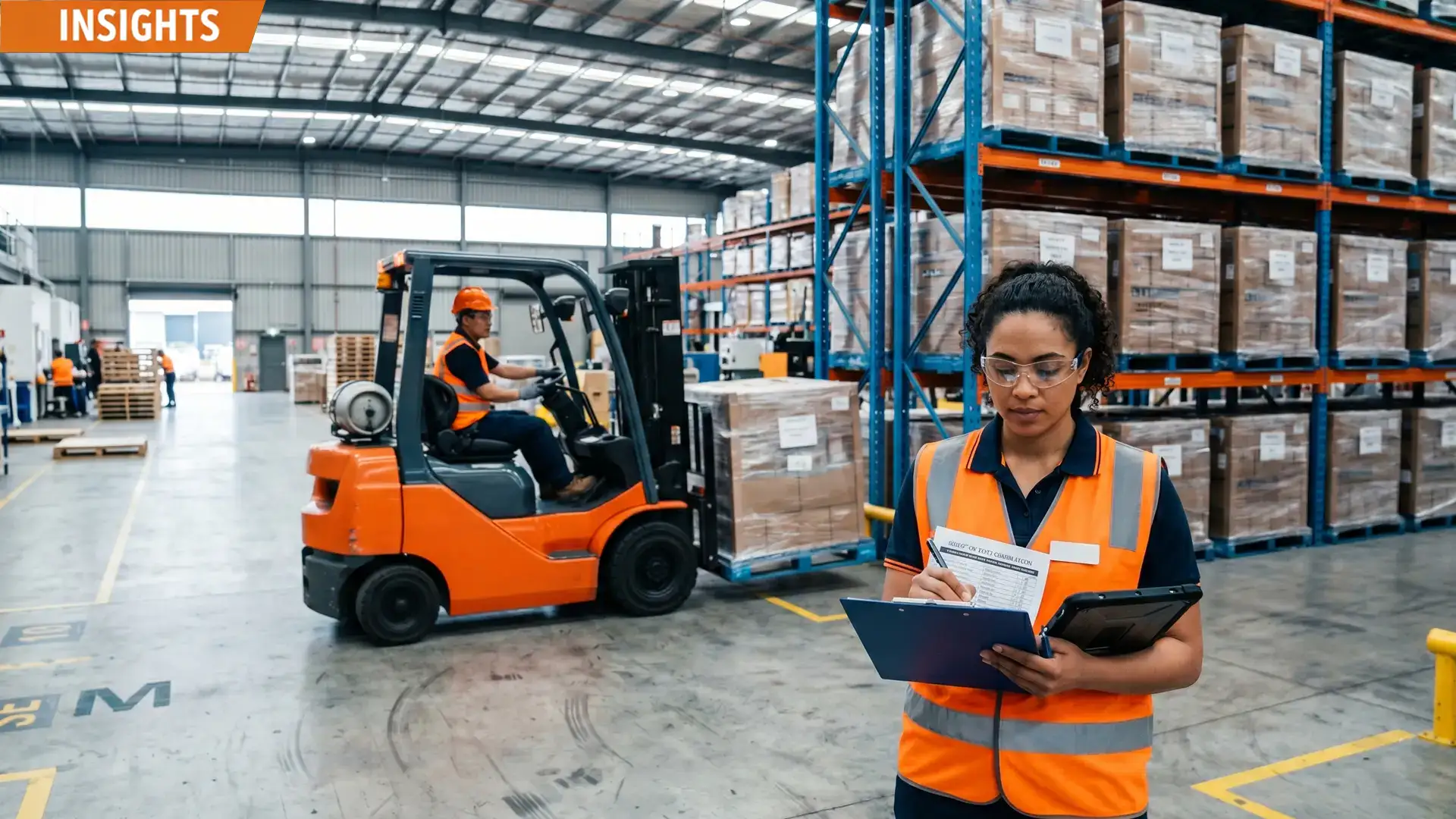
When you’re short a forklift driver, it’s tempting to fill the gap fast and hope for the best. But one wrong operator can cost you more than a missed shift — damaged racking, product loss, near-misses, and a WorkSafe headache.
If you’re using forklift labour hire in South-East Melbourne (Dandenong South, Hallam, Keysborough, Braeside and nearby industrial areas), here’s the practical checklist to reduce risk and keep your floor moving.
1) Confirm the right licence: LF vs LO
First, make sure the role actually matches the licence.
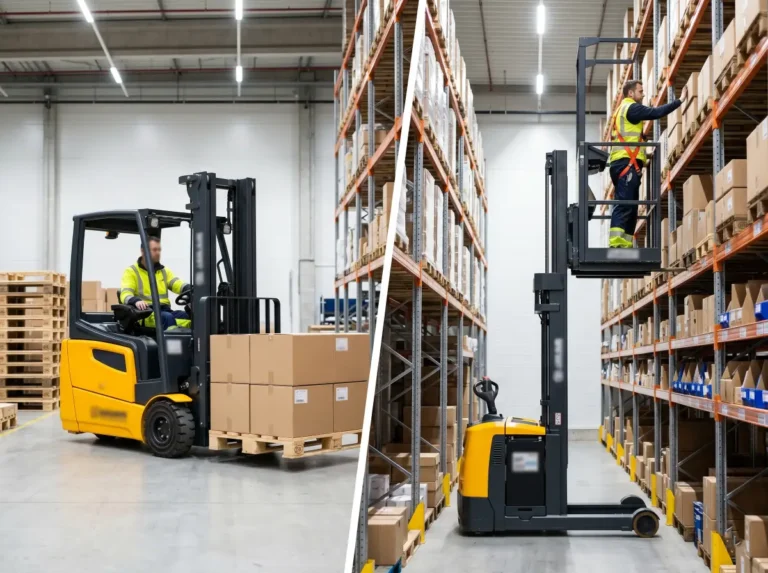
- LF (Forklift Truck): your standard counterbalance forklift work — loading/unloading, pallets, staging, put-aways.
- LO (Order Picking Forklift): order picker/high-lift work (typically elevated platform), often used in racking aisles and high-reach style tasks.
Tip: Don’t assume an LO driver is comfortable on every style of forklift, and don’t assume an LF driver is ready for order picker work. Ask what equipment they’ve used recently.
2) Verify recent experience (not just a ticket)
“Forklift driver” is not one job. Before a labour hire operator starts, confirm:
- forklift type(s) used (counterbalance, crown/BT style, order picker)
- indoor/outdoor work
- narrow aisles vs wide bays
- loading docks, container work, uneven surfaces
- handling fragile/high-value products
- pallet quality issues (broken pallets create chaos fast)
A driver who’s great in wide bays can struggle in narrow aisles, and vice versa.
3) Match the operator to your equipment and site conditions
A licence is the baseline. What matters is recent, relevant seat time.
Ask:
- When was your last forklift shift?
- What environment? (3PL, FMCG, manufacturing, cold storage)
- What were your main tasks? (put-aways, replenishment, picking, loading)
- Any comfort limits? (tight aisles, high racking, fast-paced docks)
This is how you avoid “ticketed but rusty” operators.
4) Safety behaviour is a bigger KPI than speed
The fastest forklift driver is useless if they create incidents.
Watch for red flags in the first 15 minutes:
- rushing turns and cutting corners
- ignoring pedestrian zones
- lifting loads with poor visibility
- travelling with forks too high
- “one-handed” steering while using phone/radio
- trying to impress instead of working to the site process
A safe, steady operator is almost always more productive over a full shift.
5) Check the basics that stop shift-killers
These simple checks prevent the most common labour hire forklift issues:
- Start time + commute reality (late starts destroy docks)
- PPE: steel caps, hi-vis, any site requirements
- Manual handling expectations (many forklift roles include wrapping, strapping, paperwork)
- Manual handling expectations (many forklift roles include wrapping, strapping, paperwork)
- RF scanning / WMS basics (if your forklifts scan tasks)
- English communication level for safety (doesn’t need to be perfect, but must be safe)
If your site is in South-East Melbourne, local placement helps reduce no-shows and fatigue.
6) Don’t skip induction essentials (even when you’re busy)
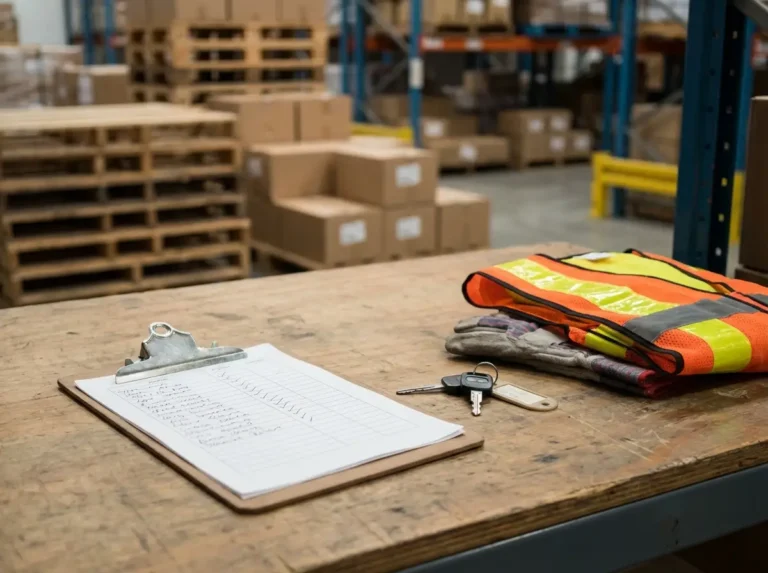
A forklift induction doesn’t need to be long — it needs to be site-specific.
Minimum induction items:
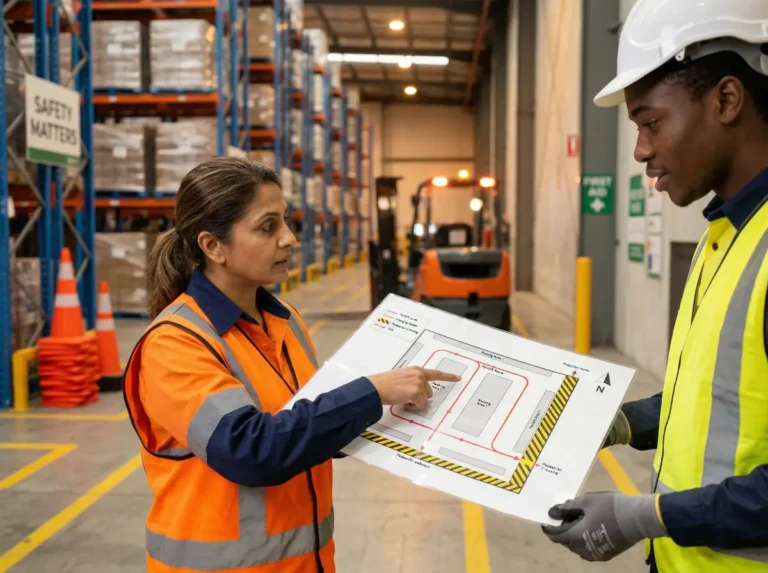
- pedestrian exclusion zones + right of way
- speed limits, corners, blind spots, horn points
- dock plates, trailers, container safety
- damaged pallet procedure
- racking rules (no contact, no “nudging”)
- spill / incident reporting process
- who the operator reports to on shift
If you’re using labour hire regularly, keep a 1-page forklift induction checklist your supervisors can run through in 3–5 minutes.
7) Make performance measurable early
If you want a smooth shift, set expectations before the first pallet moves:
- main tasks for the first 2 hours
- main tasks for the first 2 hours
- break rules and changeover process
- what “good” looks like (safe pace, correct scanning, no rework)
Then do a quick check-in at the 60–90 minute mark. Most problems show up early: wrong pace, wrong zones, wrong process.
8) Have a “replacement plan” before the shift starts
Even with checks, sometimes the fit isn’t right. The key is having a plan that protects your operation:
- who flags issues (leading hand / supervisor)
- what triggers replacement (unsafe behaviour, repeated errors, can’t follow process)
- how quickly you can swap without disrupting the floor
This is exactly why a labour hire partner should be able to replace quickly and keep you moving.
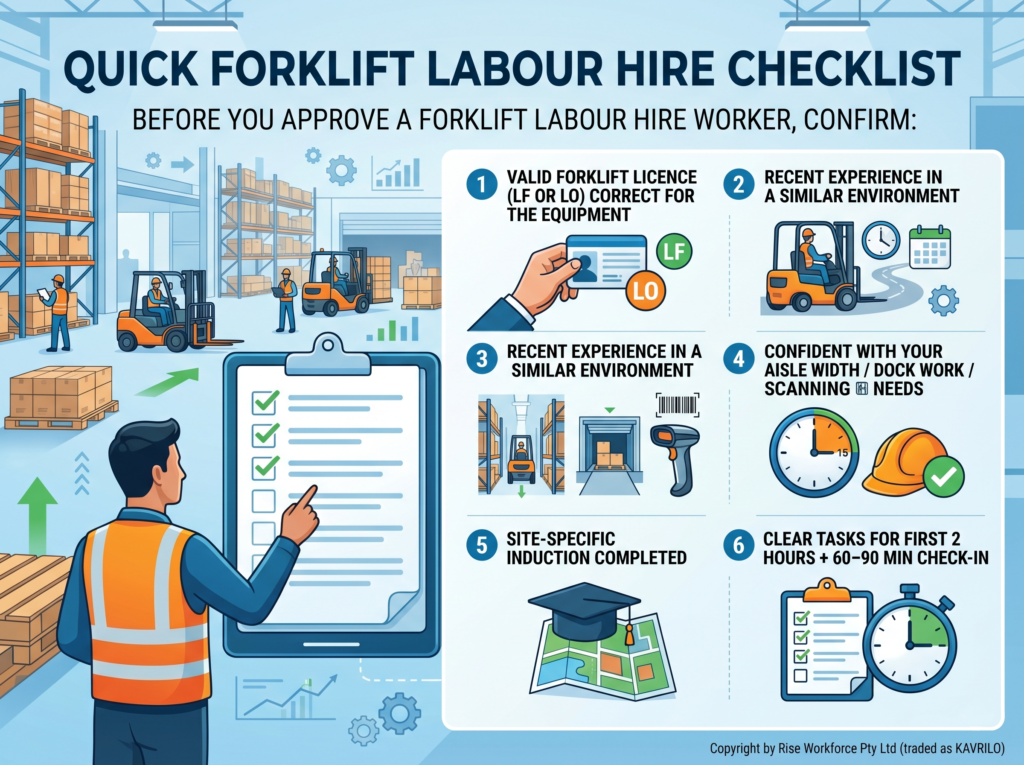
Quick forklift labour hire checklist
Before you approve a forklift labour hire worker, confirm:
- LF or LO (correct for the equipment)
- recent experience in a similar environment
- confident with your aisle width / dock work / scanning needs
- safety behaviour in first 15 minutes
- site-specific induction completed
- clear tasks for first 2 hours + 60–90 min check-in
This is exactly why a labour hire partner should be able to replace quickly and keep you moving.
Need LF/LO forklift labour hire in South-East Melbourne?
If you’re short on forklift coverage in Dandenong South, Hallam, Keysborough, Braeside or nearby South-East industrial precincts, KAVRILO can help you deploy ticketed operators who understand safety and shift discipline.
Get staff pricing & availability — and we’ll confirm the tickets, role fit, and site expectations before anyone steps onto your floor.
Disclaimer
This article is provided for general information only and does not constitute legal, workplace relations, safety, taxation, payroll or other professional advice. Please seek advice specific to your circumstances before acting on this information.
Please read our Website Disclaimer for more information.