
For many warehouse employers, the decision is not whether they need workers.
It is how they should bring them in.
Across Dandenong and the wider South-East Melbourne corridor, that often means comparing:
- casual labour hire
- direct hiring
- or a mix of both depending on the site’s pressure points
At first glance, the choice can look simple.
One model may seem more flexible.
The other may seem more stable.
One may look faster.
The other may feel more controlled.
But in practice, the difference between casual labour hire and direct hiring is not just about where the worker comes from.
It changes how the business handles:
- speed of coverage
- workforce flexibility
- attendance risk
- onboarding pressure
- site fit
- supervision load
- and the way labour problems affect operations when demand changes quickly
That matters a lot in South-East Melbourne, where warehouse employers often operate under:
- short-notice shift pressure
- seasonal peaks
- higher industrial competition
- attendance variability
- and the need to keep dispatch and floor movement stable even when labour conditions shift quickly
That is why the better question is not:
“Which model is better in theory?”
It is:
“What changes operationally for our site if we use one model, the other, or both?”
That is a much more useful way to make the decision.
For the broader local market overview, see our Staffing South-East Melbourne pillar guide for Dandenong warehouse and factory employers.
Why This Decision Matters More Than Many Employers Expect
A warehouse can live with the wrong labour model for a while.
But over time, the wrong model often creates pressure in places the business feels every day.
That can include:
- repeated coverage gaps
- weaker shift flexibility
- slower response during sudden demand spikes
- more supervision burden than expected
- poor fit decisions made under urgency
- or a workforce plan that looks acceptable until the site gets busy
That is why the choice between casual labour hire and direct hiring matters operationally.
It affects:
- how quickly workers can be brought onto the floor
- how exposed the site is to no-shows or sudden gaps
- how much time supervisors spend on onboarding and correction
- and whether the business can scale labour up or down without creating extra instability
In short, the labour model changes more than payroll structure.
It changes how the operation absorbs pressure.
What Casual Labour Hire Usually Changes
Casual labour hire usually changes the business in a few key ways.
It often gives employers:
- more flexibility around short-term coverage
- faster access to workers during busy periods
- more support for absenteeism or seasonal demand
- and a practical way to increase labour without committing immediately to permanent growth
That can be very useful in active warehouse environments.
But it also means the host employer still needs to think carefully about:
- site fit
- induction
- supervision
- and whether the labour support actually reduces friction rather than simply supplying headcount
Casual labour hire can work very well.
But it works best when it is treated as a practical workforce tool, not a shortcut around workforce planning.
What Direct Hiring Usually Changes
Direct hiring often changes the workforce in a different way.
It may give the employer:
- more long-term continuity
- stronger internal retention opportunity
- clearer direct control over the employment relationship
- and a stronger sense of building the team internally over time
That can be valuable, especially for roles where:
- the site wants lower turnover
- the business is planning for more stable long-term volume
- and worker familiarity with the operation becomes more useful over time
But direct hiring also changes the pressure points.
It may mean:
- slower response when labour is needed urgently
- more internal recruitment effort
- more risk if the worker turns out to be a poor fit
- and less flexibility if demand changes quickly
That is why direct hiring is not always “better”.
It is simply different in what it asks the employer to manage directly.
10 Practical Differences Warehouse Employers Should Think About
1. Speed of Coverage
One of the clearest differences is how quickly the business can respond when labour is needed.
Casual labour hire often helps when the site needs:
- urgent shift support
- absentee replacement
- short-term volume coverage
- or a faster response during operational pressure
Direct hiring usually makes more sense where:
- the need is more stable
- the business can recruit with more lead time
- and the role is not being created under same-day or short-notice pressure
For many South-East Melbourne warehouses, this is one of the biggest practical differences.
2. Flexibility Around Demand Changes
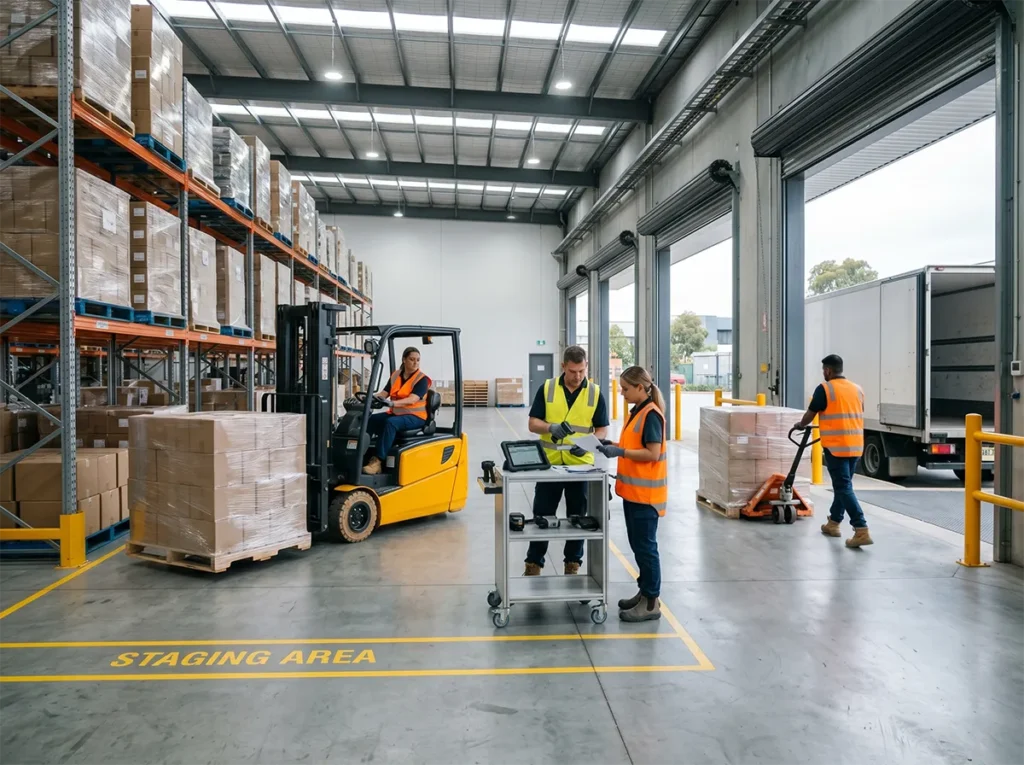
Warehouse demand is not always steady.
Volume may rise through:
- seasonal peaks
- customer pressure
- dispatch spikes
- leave periods
- or temporary growth that may not stay permanent
Casual labour hire often gives the business more flexibility to respond to those changes without committing to a longer-term staffing structure immediately.
Direct hiring can still work in growth periods, but it usually suits:
- more stable labour demand
- clearer long-term need
- and roles where the business is confident the ongoing workload will remain
This is one reason many warehouses use a mix of both models.
3. Risk of Poor Fit
Poor fit matters under either model.
But the way the business feels that risk is different.
With direct hiring, a poor-fit decision often creates:
- slower correction
- more internal management time
- and a longer process if the role clearly is not working
With casual labour hire, the site may be able to adjust faster, but only if the labour support is actually practical and fit-aware.
That is why the real question is not just:
“Which model has less risk?”
It is:
“Which model lets us manage fit risk more realistically for this role and this site?”
Our guide to why site fit matters more than headcount in warehouse and factory staffing explains why worker suitability often affects operations more than the staffing model alone.
4. First-Shift and Onboarding Pressure
No matter which model the business uses, the site still needs to onboard workers properly.
But the pressure can feel different.
Casual labour hire often requires the site to think carefully about:
- faster induction
- practical day-one role clarity
- and whether the operation is ready to settle the worker in safely and efficiently
Direct hiring may create more space for longer-term integration, but it still requires:
- supervisor time
- onboarding effort
- and realistic role explanation from the start
In both cases, weak onboarding creates unnecessary friction.
The model does not remove the need for practical first-shift discipline.
5. Supervisor Load
This is one of the most important real-world differences.
A labour model may look good on paper, but still increase supervisor pressure if:
- workers are poor fits
- onboarding is rushed
- expectations are unclear
- or the business is using the wrong model for the type of demand it actually has
Casual labour hire can reduce supervisor stress when:
- the labour support is practical
- the fit is stronger
- and the site is not left fixing the same avoidable mismatch repeatedly
Direct hiring can reduce supervisor churn when:
- the role is stable
- the worker suits the site long term
- and retention becomes stronger over time
The better model is often the one that makes the floor easier to manage, not just the one that looks simpler administratively.
6. Reliability Under Short-Notice Pressure
When the site is already under pressure, the labour model shows its strengths or weaknesses quickly.
Casual labour hire often helps with:
- urgent gap coverage
- same-day or next-day replacement
- and shorter-term labour flexibility when timing matters most
Direct hiring is usually less suited to urgent coverage but stronger where:
- the labour need is ongoing
- the role is stable
- and the business wants to reduce repeated external reliance over time
For many warehouses, the real answer is not one or the other everywhere.
It is knowing where each model fits best.
Our article on how to reduce no-shows and last-minute gaps in Dandenong warehouse shifts explains why some labour models cope with short-notice pressure more effectively than others depending on the site’s real needs.
7. Workforce Stability and Retention
Direct hiring often makes more sense where the site is trying to build:
- long-term continuity
- stronger internal familiarity
- and lower medium-term labour churn
Casual labour hire may still contribute to stability, especially when:
- dependable casuals are retained well
- stronger workers are used consistently
- and the business is practical about who it wants to keep close
That is why this decision is not always a straight line between:
- flexibility
and - stability
Sometimes casual labour hire supports stability better than expected when the workforce support is local, practical, and well matched.
8. Cost Thinking vs Operational Thinking
Many employers first compare these models through cost only.
Cost matters, of course.
But operational impact matters too.
A cheaper decision is not always the better decision if it creates:
- more no-shows
- weaker fit
- more correction
- slower output
- or more supervisor strain
Likewise, a model that looks more expensive in one part of the process may still deliver better value if it:
- reduces disruption
- improves coverage speed
- stabilises shift performance
- and lowers repeated workforce friction
That is why employers usually make better choices when they think beyond:
- labour cost
and include: - operating stability
- floor pressure
- and time lost to weak staffing decisions
9. Local Labour Knowledge Makes a Bigger Difference Than Employers Think
In South-East Melbourne, local labour knowledge changes outcomes.
A staffing approach that understands:
- Dandenong and surrounding industrial areas
- travel practicality
- local shift reality
- warehouse pace
- and the wider labour market competition
is often much stronger than one that treats every warehouse role the same.
This matters under both models.
But it is especially useful when using casual labour hire, because local responsiveness and practical worker matching often determine whether the labour support feels genuinely helpful or just transactional.
Our article on why South-East Melbourne employers need faster, more local staffing support explains why local responsiveness and corridor knowledge often improve worker matching, speed, and labour reliability.
10. Many Warehouses Actually Need a Hybrid Approach

For many warehouse employers, the best answer is not:
- casual labour hire only
or - direct hiring only
It is a more practical mix.
That may mean:
- direct hiring for more stable long-term roles
- casual labour hire for peaks, leave cover, and short-notice pressure
- and a clear internal understanding of which parts of the operation need stability first and which need flexibility most
This often gives the site:
- better control
- better responsiveness
- and a workforce structure that matches how warehouse demand really behaves
That is usually more effective than trying to force one model onto every labour problem.
What Better Labour Model Decisions Usually Look Like in Practice
When the labour model fits the operation properly, the difference is usually visible.
It tends to feel:
- more stable
- more realistic
- more responsive
- and easier to manage under pressure
In practice, that often means:
- urgent gaps are handled without panic
- stable roles are built more thoughtfully
- poor-fit risk is reduced earlier
- supervisors are not overloaded by weak setup
- and the workforce plan reflects the actual behaviour of the warehouse, not just the ideal version of it
It should not feel like:
- every labour issue is being solved with the same blunt approach
- the site is overcommitting to one model that does not suit its real demand pattern
- or labour decisions are being made too narrowly around price without enough operational thought
Better staffing decisions usually come from better fit between:
- the labour model
- the site pressure
- and the nature of the role
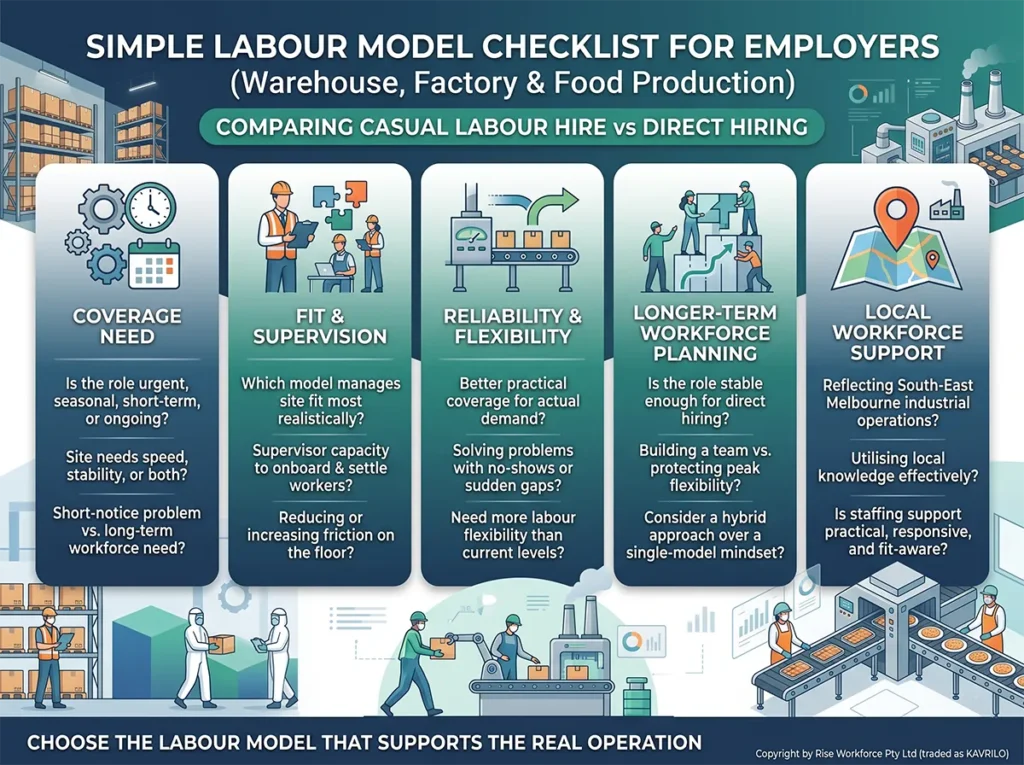
A Simple Labour Model Checklist for Warehouse Employers
Here is a practical checklist employers can use when reviewing casual labour hire versus direct hiring.
Coverage Need
- Is this role urgent, seasonal, short-term, or ongoing?
- Does the site need speed, stability, or both?
- Are we solving a short-notice problem or a longer-term workforce need?
Fit and Supervision
- Which model will help us manage site fit more realistically?
- Do we have the supervisor capacity to onboard and settle workers in properly?
- Are we likely to reduce or increase friction on the floor?
Reliability and Flexibility
- Which model gives us better practical coverage for the type of demand we actually face?
- Are repeated no-shows or sudden gaps part of the problem we are trying to solve?
- Does the operation need more labour flexibility than we currently have?
Longer-Term Workforce Planning
- Is this role likely to remain stable enough for direct hiring to make sense?
- Are we building a team, protecting peak flexibility, or both?
- Would a hybrid approach suit the site better than a single-model mindset?
Local Workforce Support
- Does our labour approach reflect how South-East Melbourne industrial sites really operate?
- Are we using local knowledge well enough?
- Is our staffing support practical, responsive, and fit-aware?
This kind of checklist helps employers choose the labour model that supports the real operation, not just the roster.
Final Word
Casual labour hire vs direct hiring matters because the labour model changes how a warehouse responds to pressure.
For employers across Dandenong and South-East Melbourne, the better decision usually comes from understanding:
- how urgent the labour need is
- how stable the role really is
- how much flexibility the site needs
- how much fit risk exists
- and whether the workforce plan matches the real behaviour of the operation
That is what helps reduce:
- rushed staffing decisions
- weak fit
- repeated labour instability
- unnecessary supervisor pressure
- and workforce plans that look reasonable on paper but struggle on the floor
Because this choice is not just about where workers come from.
It is about how the site actually works when demand changes and pressure rises.
That is not just better hiring strategy.
It is better operational strategy too.
Need Practical Labour Hire Support for Warehousing and Manufacturing in Melbourne’s South-East?
KAVRILO is building its approach around safety-aware workforce support, stronger local responsiveness, and clearer operational discipline for warehouse and industrial environments.
Whether your site needs support during busy periods, stronger shift reliability, or more dependable labour coordination across the South-East, KAVRILO is focused on practical workforce support that fits controlled warehouse and factory environments.
Need warehouse and factory labour hire support with stronger local responsiveness and more dependable shift coverage? Talk to KAVRILO about workforce support across Melbourne’s South-East.
Article Disclaimer
This article is provided for general information only and does not constitute legal, workplace relations, safety, taxation, payroll or other professional advice. Please seek advice specific to your circumstances before acting on this information.
Please read our Website Disclaimer for more information.