

Forklifts are part of everyday warehouse operations.
Across Melbourne’s South-East, they help move pallets, support receiving and dispatch, replenish stock, service racking, and keep logistics sites running under pressure. In many operations, they are essential to productivity. But they also sit inside one of the clearest and most serious risk areas on the warehouse floor.
That is why forklift safety matters so much.
For employers, this is not just about whether a worker says they can drive. It is also not just about whether a licence number exists somewhere in a file.
In practice, good forklift safety depends on getting several things right at once:
- checking the right licence type
- confirming the operator suits the actual task
- making traffic and movement rules clear
- giving new or temporary operators proper site induction
- supervising the first shifts properly
- and keeping pedestrian and plant interaction under stronger control
This is especially important when using:
- new starters
- labour hire workers
- temporary forklift operators
- or workers moving into a different warehouse layout than the one they are used to
A forklift operator can hold the right licence and still be unfamiliar with:
- your site
- your traffic flow
- your blind spots
- your crossings
- your dock pressure
- or the habits your floor has already normalised
That is why good employers do not reduce forklift safety to “licence equals ready”.
They understand that safe forklift use depends on both:
- operator capability
- and site control
That is where stronger compliance and safer warehouse operations begin.
For a broader employer overview, see our WorkSafe Victoria compliance in manufacturing and warehousing guide for practical hazard control, induction, and stronger day-to-day site discipline.
Why Forklift Safety Needs More Than a Licence Check
A forklift licence matters.
But it is not the whole control.
A common employer mistake is treating licence verification as the final step instead of the starting point.
In practice, a licensed operator may still be exposed if:
- the site layout is unfamiliar
- the traffic system is unclear
- pedestrian routes are weak
- loading areas are congested
- supervision is loose
- or the worker has not been shown how this specific warehouse actually operates
That is because forklift risk is rarely just about the machine itself.
It also sits in:
- the movement around the machine
- the floor conditions
- the layout
- the staging
- the sightlines
- the shift pressure
- and the interaction between drivers and pedestrians
That is why good employers think beyond:
“Do they have a forklift licence?”
They also ask:
- Is it the right licence for the task?
- Do they understand this site?
- Have we shown them the traffic flow?
- Are they being supervised properly on day one?
- Can the floor around them actually support safe operation?
That is a much stronger forklift safety mindset.
Understanding LF and LO in Practical Terms
In warehouse environments, the most common high-risk forklift licence classes are:
- LF
- LO
From a practical employer point of view, what matters most is not just recognising the licence code, but understanding whether the licence matches the actual work being done on your site.
A stronger check means asking:
- what forklift type will the worker use here
- what tasks will they actually perform
- whether the licence class fits those tasks
- and whether the worker has worked in a similar operating environment before
This matters because warehouse employers sometimes assume forklift work is one general category.
In reality, the demands can vary depending on:
- racking height
- aisle width
- stock type
- dispatch pressure
- traffic density
- replenishment frequency
- and whether the operator is working in a more open floor or a more controlled, narrow-access environment
A licence class should be treated as a necessary check, but not the only one.
Our article on LF and LO forklift licence checks in Victoria looks more closely at what employers should verify before a worker starts shift.
Where Forklift Risk Usually Builds on Warehouse Floors
Forklift incidents do not usually come out of nowhere.
Risk often builds in familiar pressure areas such as:
- aisle intersections
- pallet staging zones
- replenishment lanes
- dispatch areas
- loading docks
- roller door entries
- narrow access points
- battery charging areas
- and mixed spaces where pedestrians and plant movement overlap
Risk also tends to increase during:
- shift start and finish
- high-volume dispatch periods
- peak replenishment windows
- late afternoon fatigue
- temporary overflow storage
- onboarding of new operators
- and busy periods when floor discipline starts slipping
That is why forklift safety should always be reviewed in the context of:
- layout
- traffic
- supervision
- and site behaviour
not just the forklift itself.
10 Things Warehouse Employers Need to Get Right
1. Check the Right Licence Before Shift Start
A good forklift placement should begin with a clear licence check.
That means confirming:
- the worker holds the licence needed for the task
- the licence details are checked before work begins
- and the site is not making assumptions based on prior conversation alone
This is basic, but it still matters.
A rushed site can sometimes slide into:
- verbal confirmation
- outdated assumptions
- or incomplete checking because the shift needs covering quickly
Good employers keep this simple and consistent:
check first, then start.
2. Make Sure the Licence Matches the Actual Work
This is where employers need to go one step further.
The right question is not only:
“Do they have a forklift licence?”
It is:
“Does this licence and operator fit the actual equipment and warehouse conditions on this site?”
That includes thinking about:
- machine type
- task type
- aisle condition
- racking environment
- floor congestion
- and whether the worker is entering a setting that is tighter, busier, or more complex than what they may be used to
A worker can be licensed and still be a weak fit for a particular environment if the actual job conditions were not thought through properly.
3. Treat Site Induction as Essential Even for Licensed Operators
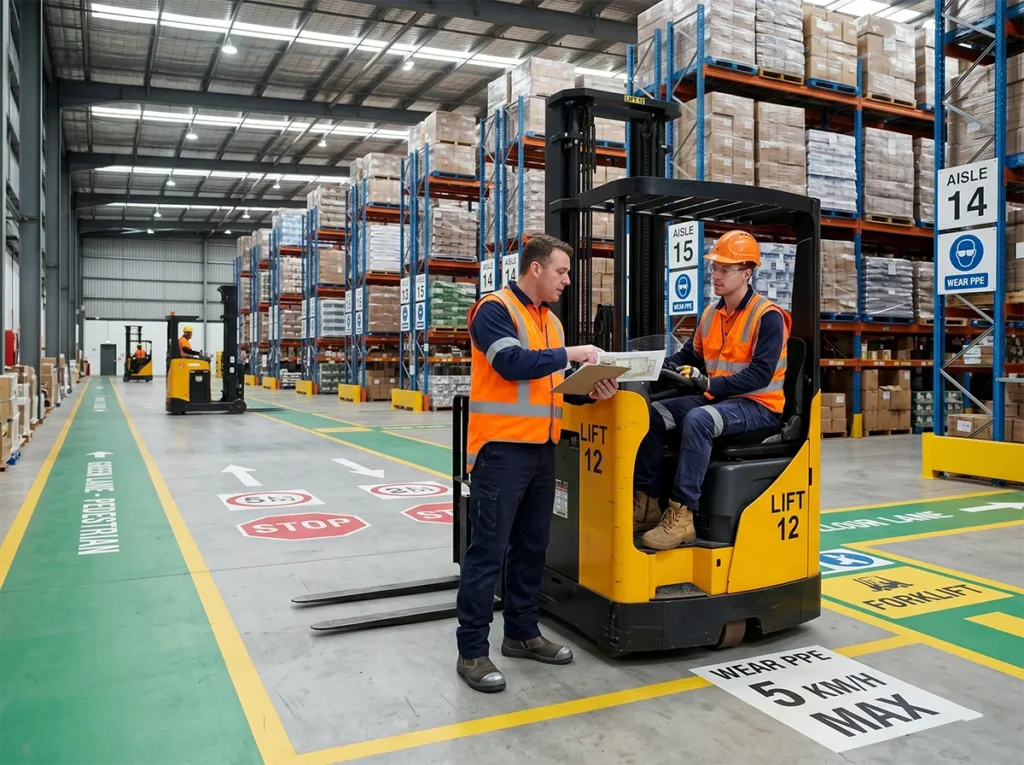
A forklift operator may know how to operate the machine.
That does not mean they know your site.
A strong day-one induction should cover:
- pedestrian routes
- forklift lanes
- blind spots
- dock rules
- crossings
- exclusion zones
- staging areas
- speed expectations
- reporting pathways
- and who supervises the operator on shift
This matters even more for:
- labour hire operators
- temporary drivers
- operators moving between sites
- and workers returning after time away from the floor
A licensed operator still needs site-specific orientation.
Our article on forklift inductions for new and temporary operators explains what employers should cover on day one before a licensed driver starts moving through an unfamiliar site.
4. Control Forklift and Pedestrian Interaction Properly
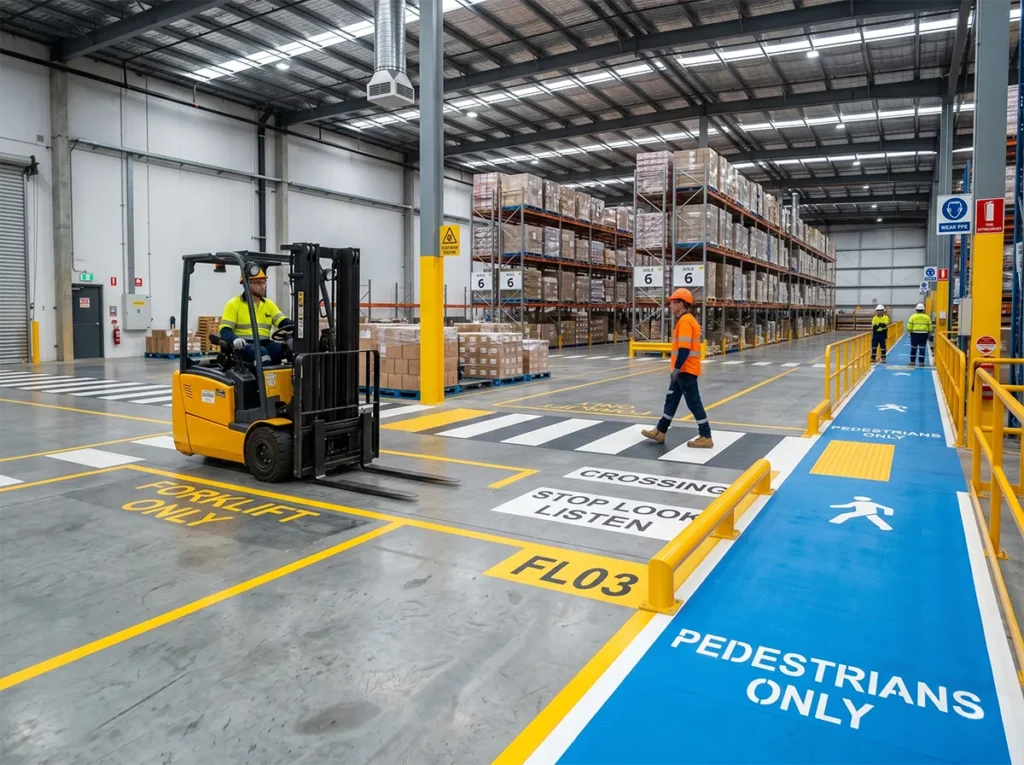
This is one of the most important forklift safety issues on warehouse floors.
Good employers make sure operators understand:
- where pedestrians walk
- where crossings are located
- where visibility is weakest
- which routes are one-way
- and where congestion makes extra caution necessary
At the same time, the site should not rely on operator behaviour alone.
The floor itself should support safer movement through:
- visible walkways
- controlled crossings
- barriers where practical
- and stronger layout discipline
Forklift safety is much weaker when pedestrian control is weak.
Our guide to warehouse traffic management shows how stronger movement rules, clearer layout, and better supervision help reduce forklift and pedestrian risk.
5. Supervise Temporary and New Operators Closely at the Start
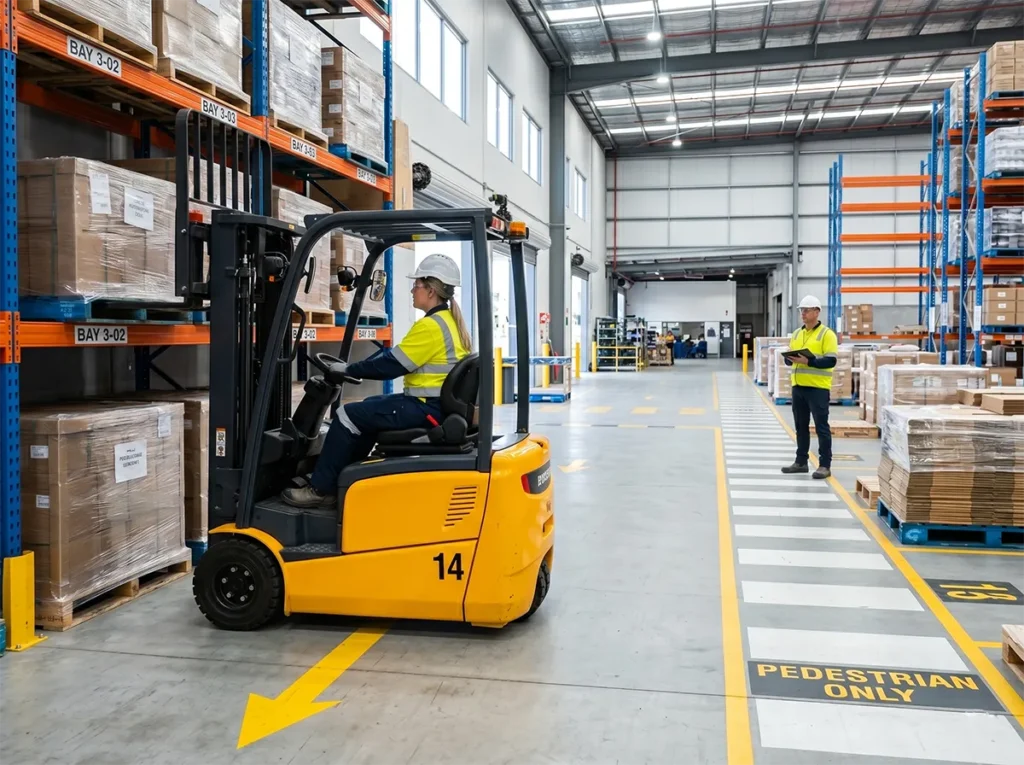
A common mistake is assuming a forklift operator is fully settled once they start the machine.
That is rarely true.
Good employers make sure:
- the operator knows who supervises them
- questions can be raised easily
- unsafe assumptions are corrected early
- and the first shifts are monitored with more attention than later routine work
This matters because new operators may still be learning:
- local traffic pressure
- how the site stages stock
- how busy crossings behave in practice
- and where the floor becomes harder to read during peak periods
Early supervision is one of the strongest forklift controls available.
6. Review Daily Pre-Start and Safety Check Discipline
Forklift safety depends partly on what happens before movement starts.
Good sites make sure operators understand and follow:
- pre-start safety checks
- equipment condition review
- visible defect reporting
- and the expectation that concerns are raised before the machine enters active work
This should not be treated as paperwork for its own sake.
A pre-start check is one of the earliest opportunities to identify:
- equipment issues
- obvious damage
- control problems
- warning light issues
- and conditions that should not be ignored on a busy floor
Our article on daily forklift safety checks looks more closely at what good operators should review before shift start and why those checks matter in real warehouse conditions.
7. Correct Bad Driving Habits Early
Unsafe forklift behaviour often builds quietly.
For example:
- rushing corners
- poor reversing awareness
- inconsistent horn use
- cutting too close to pedestrian space
- overconfidence in familiar areas
- poor speed judgment near intersections
- or casual behaviour in loading zones
If these habits are not corrected early, they become normal.
Good employers make sure supervisors:
- recognise these patterns
- intervene early
- reinforce the site’s movement expectations
- and do not let unsafe habits settle in because “nothing has happened yet”
That is usually how avoidable incidents start building.
Our guide to common forklift driving habits that increase risk explains the behaviours supervisors should correct early before they become normalised on the warehouse floor.
8. Review the Site Layout Around the Forklift Task
Forklift safety is heavily influenced by the floor around the operator.
Good employers review:
- aisle width
- turning space
- staging pressure
- line of sight
- crossing points
- loading zone congestion
- and whether overflow stock is quietly changing traffic conditions
A safe operator on a weak floor can still be exposed.
This is why good forklift safety depends not just on operator behaviour, but also on:
- layout quality
- floor discipline
- and whether the site environment still supports safe movement under real conditions
9. Treat Near Misses as Early Warnings
A near miss involving a forklift matters even if no injury occurred.
For example:
- a pedestrian steps into the lane and the forklift stops in time
- an operator rounds a corner too fast but avoids contact
- a blocked crossing forces awkward movement
- or stock staging reduces visibility enough to create a close call
These are not small issues to ignore.
They are often early signs that:
- traffic design is weakening
- supervision is too light
- worker familiarity is low
- or floor conditions are making safe forklift movement harder than they should be
Good employers use near misses to improve control before a more serious incident forces attention.
10. Review Forklift Risk Again Whenever the Site Changes
Forklift risk does not stay fixed.
It should be reviewed when:
- layout changes
- new racking is added
- dispatch pressure increases
- temporary overflow storage builds up
- more temporary operators are brought in
- product flow changes
- or the site starts moving differently under new demand
Even small changes can create:
- new blind spots
- awkward crossings
- tighter turns
- and more pressure on both drivers and pedestrians
A site that was safe under one layout can become weaker under another without anyone noticing straight away.
That is why good employers review forklift safety after change, not just after an incident.
What Good Forklift Safety Usually Looks Like in Practice
When forklift safety is being managed well, the site usually feels:
- clear
- visible
- controlled
- and hard to misunderstand
In practice, that often means:
- the licence check is done properly
- the task matches the operator
- site induction is clear
- traffic rules are visible
- walkways stay usable
- supervisors intervene early
- and near misses are treated as useful warnings, not background noise
It should not feel like:
- operators are guessing local movement rules
- pedestrians are drifting into lanes
- supervisors are correcting the same basics repeatedly
- or the floor layout is quietly working against safe movement
Good forklift safety is visible in how the site runs, not just in what policy says.
A Simple Forklift Safety Checklist for Warehouse Employers
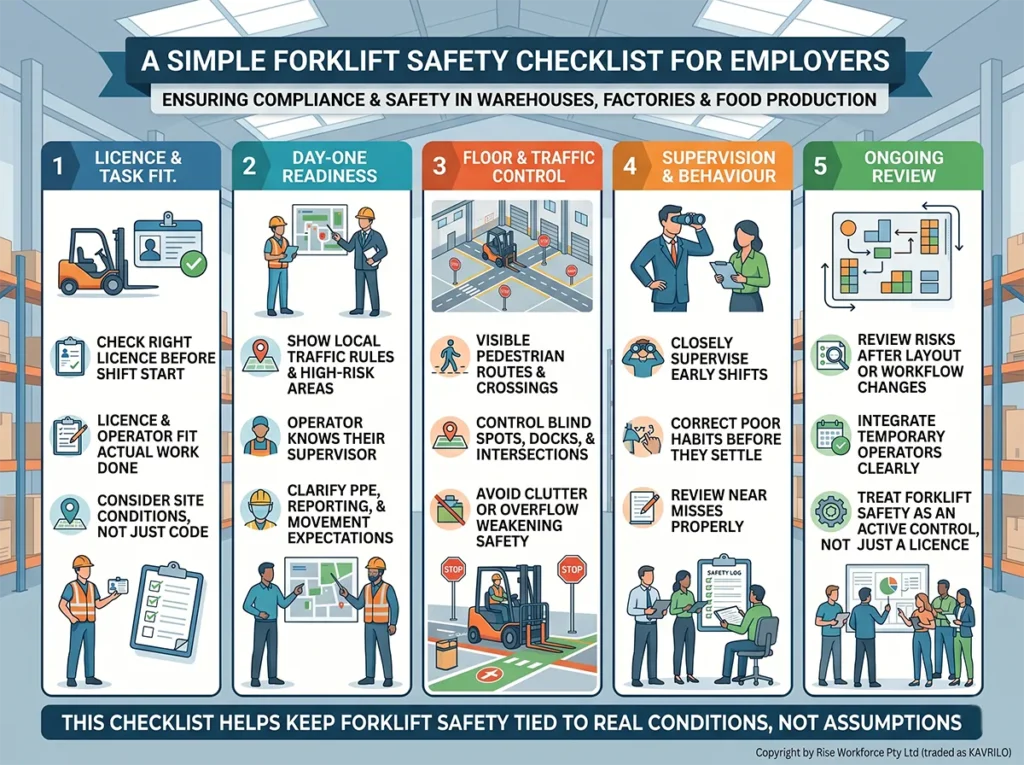
Here is a practical checklist employers can use when reviewing forklift safety and operator readiness.
Licence and Task Fit
- Have we checked the right licence before shift start?
- Does the licence and operator fit the actual work being done here?
- Have we thought about site conditions, not just the licence code?
Day-One Readiness
- Has the operator been shown local traffic rules and high-risk areas?
- Do they know who supervises them?
- Are PPE, reporting, and movement expectations clear?
Floor and Traffic Control
- Are pedestrian routes and crossings visible and usable?
- Are blind spots, dock areas, and intersections controlled properly?
- Is overflow stock or clutter weakening traffic safety?
Supervision and Behaviour
- Are early shifts being supervised closely enough?
- Are poor habits being corrected before they settle in?
- Are near misses being reviewed properly?
Ongoing Review
- Has forklift risk been reviewed after layout or workflow change?
- Are temporary operators being integrated clearly?
- Is the site treating forklift safety as an active control, not just a licence issue?
This kind of checklist helps employers keep forklift safety tied to real warehouse conditions, not assumption.
Final Word
Forklift safety and licence checks in Victoria matter because forklift risk is never just about whether someone can operate the machine.
For warehouse employers across Melbourne’s South-East, stronger control usually comes from:
- checking the right licence
- matching the operator to the actual task
- giving proper site induction
- controlling pedestrian interaction
- supervising the first shifts properly
- correcting unsafe habits early
- and reviewing the floor whenever the site changes
That is what helps reduce:
- avoidable confusion
- weak onboarding
- risky movement
- repeated near misses
- and preventable exposure around active warehouse traffic
Because good forklift safety is not just about operator competence.
It is about whether the site around that operator is being managed properly too.
That is not just better compliance.
It is better warehouse control.
Need Practical Labour Hire Support for Warehousing and Manufacturing in Melbourne’s South-East?
KAVRILO is building its approach around safety-aware workforce support, clearer communication, and stronger operational discipline for warehouse and industrial environments.
Whether your site needs better shift coverage, stronger day-one worker readiness, or more dependable labour coordination for forklift-related work, KAVRILO is focused on practical workforce support that fits controlled warehouse and factory environments.
Need warehouse and factory labour hire support with stronger day-one readiness and a practical safety-aware approach? Talk to KAVRILO about workforce support across Melbourne’s South-East.
Article Disclaimer
This article is provided for general information only and does not constitute legal, workplace relations, safety, taxation, payroll or other professional advice. Please seek advice specific to your circumstances before acting on this information.
Please read our Website Disclaimer for more information.