
Industrial sites are usually designed around people who already know how the floor works.
Permanent staff know:
- where the forklift lanes are
- which areas are restricted
- who supervises what
- how plant movement works
- and what local shortcuts or pressure points exist on the site
Contractors and visitors usually do not.
That is why contractor and visitor safety needs more attention than many businesses realise.
Across Melbourne’s South-East, warehouses, logistics facilities, food production sites, and manufacturing operations often bring in people who are not part of normal daily site flow, including:
- maintenance contractors
- cleaners
- service technicians
- delivery drivers
- auditors
- inspectors
- clients
- and office-based visitors entering operational areas
These people may only be on site briefly. But that does not make the risk small.
In practice, non-routine site access can create exposure because the person:
- may not understand the layout
- may not know where to walk
- may not recognise the real hazard points
- may not know which PPE applies
- and may not realise which “safe-looking” areas are actually active risk zones
That is why good employers do not treat contractors and visitors as a side issue.
They treat site access, movement, and supervision as practical safety controls that need to work just as clearly for non-routine people as they do for regular staff.
For a broader employer overview, see our WorkSafe Victoria compliance in manufacturing and warehousing guide for practical hazard control, induction, and stronger day-to-day site discipline.
Why Contractor and Visitor Safety Matters More Than It First Appears
A common mistake is assuming that short time on site means lower risk.
Sometimes the opposite is true.
A person who is unfamiliar with the environment may actually be more exposed because they do not know:
- the traffic flow
- the machine boundaries
- the restricted areas
- the blind spots
- the reporting chain
- or the local rules that regular staff already take for granted
That can create problems quickly.
For example:
- a contractor walks through an active forklift route because no one explained the pedestrian path
- a visitor steps into a staging area without understanding plant movement
- a service technician starts work near active equipment without enough local control
- a driver stands in an unsafe place during loading activity
- or an external cleaner accesses a high-risk area without enough site-specific briefing
These are not unusual failures.
They are common coordination failures.
That is why good employers review contractor and visitor safety early, especially on active sites where movement, plant, product, or dispatch activity can change the risk quickly.
Where Contractor and Visitor Safety Usually Breaks Down
Problems often begin where the site assumes too much.
That can include:
- no clear sign-in control
- unclear visitor escort expectations
- weak traffic briefing
- poor PPE instruction
- contractors being told to “just go through there”
- no clear site contact person
- restricted areas not being explained properly
- or maintenance access happening without enough local coordination
These gaps are often small.
But on an industrial floor, small gaps can quickly lead to:
- unsafe movement
- access into active zones
- poor visibility around plant
- exposure to manual handling hazards
- interference with workflow
- and slow or confused response if something goes wrong
That is why contractor and visitor safety needs to be built into the site system, not managed casually on the spot each time.
10 Practical Things Good Employers Review Early
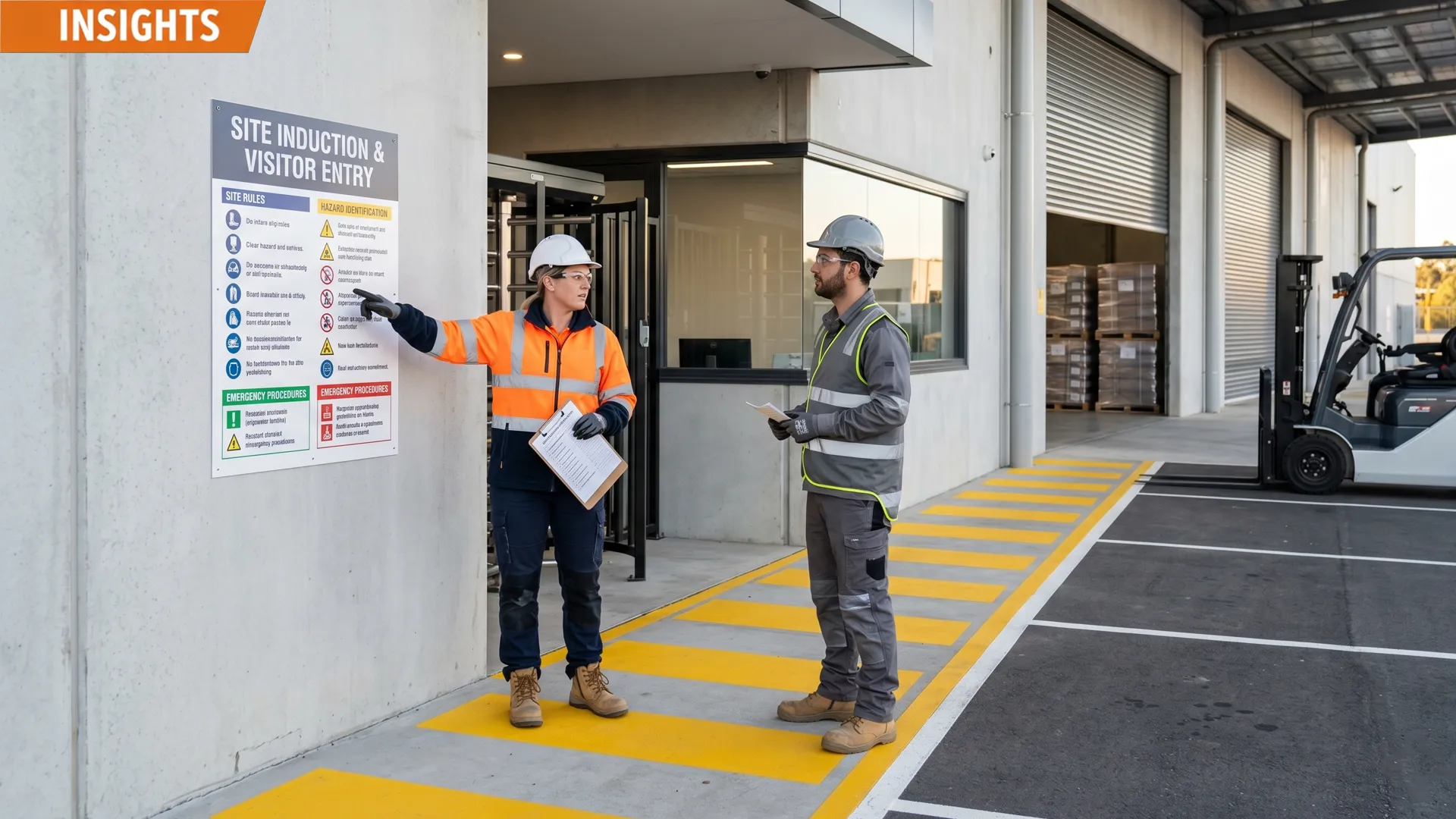
1. Whether Site Entry Is Controlled Properly

The first control starts before the person reaches the floor.
Good employers review:
- where contractors and visitors report on arrival
- whether sign-in is mandatory
- whether the right contact person is identified clearly
- whether access is allowed only after briefing
- and whether the site can tell who is present and why
A weak entry process creates confusion from the start.
If people can drift into site areas before the business has confirmed:
- who they are
- what they are doing
- where they need to go
- and what risks apply
then the site is already carrying unnecessary exposure.
2. Whether Non-Routine People Are Given a Practical Site Briefing
A contractor or visitor does not always need a full worker induction.
But they do need enough briefing to move safely in that environment.
That usually means covering:
- where they can and cannot go
- pedestrian routes
- forklift or plant areas
- PPE requirements
- emergency basics
- who their site contact is
- and what to do if they are unsure
Good employers do not rely on:
- “common sense”
- “they’ve been to sites before”
- or “they’ll just follow someone”
A short but practical site briefing is usually far more effective than assumption.
3. Whether Traffic and Movement Rules Are Made Clear Enough
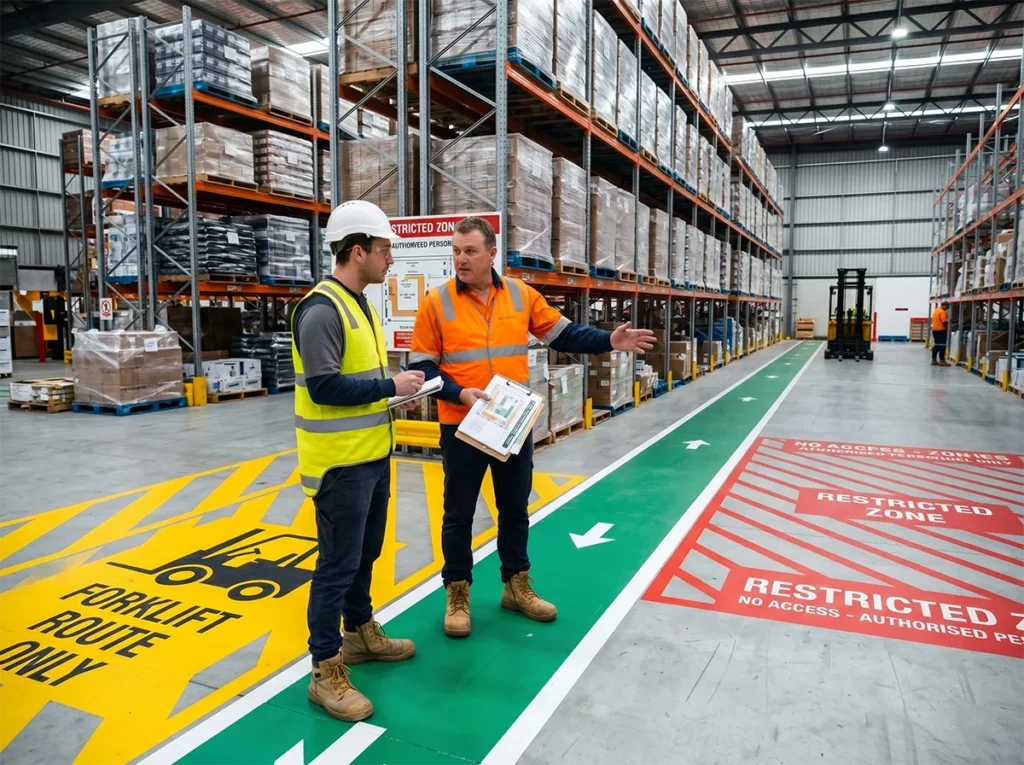
This is one of the biggest risk areas for visitors and contractors.
If a person does not know:
- where pedestrians walk
- where forklifts travel
- where crossings are
- which routes are restricted
- or which zones are active
they can very easily move into exposure without realising it.
Good employers review whether traffic rules are:
- obvious visually
- explained verbally where needed
- reinforced through signage and escort
- and practical for someone unfamiliar with the site
If traffic safety depends on “just knowing the floor”, visitors and contractors are at greater risk immediately.
Our guide to warehouse traffic management looks more closely at how employers can reduce forklift and pedestrian risk through stronger layout, supervision, and movement control.
4. Whether PPE Expectations Are Clear Before Access Is Given
A visitor or contractor should not be left guessing:
- what PPE is required
- where it must be worn
- whether site-issued PPE is needed
- and what areas have stricter rules
This may include:
- high-vis clothing
- safety footwear
- hearing protection
- safety glasses
- hard hats
- hairnets or protective clothing in food environments
- or any other site-specific requirements
Good employers make sure PPE is:
- explained clearly
- available where needed
- and linked to the actual areas being entered
PPE should not be treated as an afterthought once the person is already on the floor.
5. Whether Restricted Areas Are Really Controlled
Restricted areas matter because they often involve:
- active machinery
- loading activity
- chemical storage
- high-care production
- maintenance work
- battery charging
- dispatch pressure
- or other elevated site risk
Good employers review:
- how restricted areas are identified
- whether access rules are clear
- whether visitors can accidentally enter those zones
- and whether people are being escorted where necessary
A site does not really have a restricted area if the rule exists only in policy but not in visible day-to-day control.
6. Whether Contractors Are Coordinated Properly Before Work Begins
Contractors often create a different kind of exposure because they may be:
- bringing tools
- working at height
- isolating equipment
- entering machine areas
- handling maintenance access
- or performing tasks outside the site’s normal routine
That means the host employer should review:
- what the contractor is actually there to do
- what hazards sit around that task
- what local controls are needed
- who is coordinating the work
- and how the contractor’s activity affects the rest of the floor
Good contractor safety usually depends on clear coordination before the work starts — not just during it.
7. Whether Supervision or Escort Is Needed
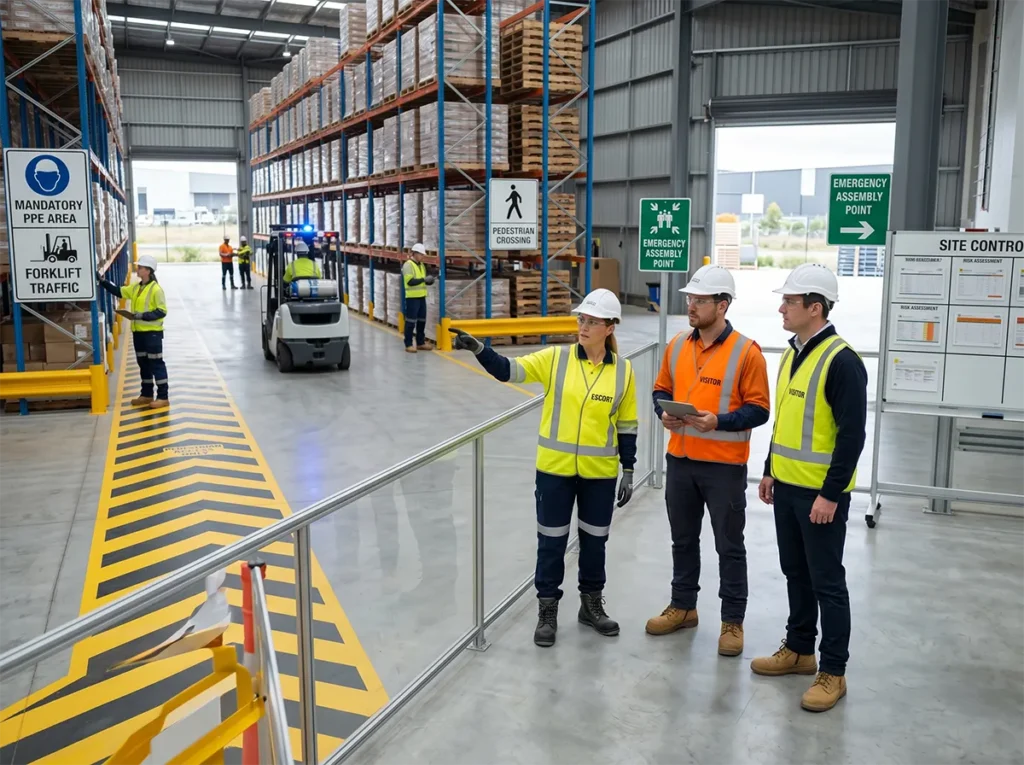
Not every visitor needs to be escorted at all times.
But some do.
Good employers review whether the person:
- is familiar with the site
- understands the risks
- needs access to active areas
- will be moving independently
- or may create exposure if left to navigate alone
For example:
- a brief office visitor may need very limited access
- a truck driver may need strict loading-zone direction
- a contractor may need a site contact and controlled access around plant
- an auditor may need escort into active operational areas
The point is not to over-control everything.
It is to match supervision and access control to the actual exposure.
8. Whether Reporting and Emergency Expectations Are Clear
If something goes wrong, the person on site should know:
- who to contact
- what to report
- where to go
- and what the immediate response expectation is
That includes:
- injury
- near miss
- plant issue
- blocked access
- chemical spill
- or any other site-specific problem that needs escalation
Good employers do not assume contractors or visitors will automatically know the reporting pathway.
They make it simple and visible from the start.
9. Whether Site Standards Stay Consistent for Non-Routine People
One of the easiest ways to weaken site control is to make exceptions too casually.
For example:
- allowing a visitor to walk through a restricted area “just this once”
- letting a contractor skip part of a briefing because they are in a hurry
- allowing PPE shortcuts because the visit is short
- or sending someone across the floor informally without proper site guidance
These exceptions often feel minor in the moment.
But they teach the site that rules are flexible when the pressure is on.
Good employers keep standards consistent, even when the person is only on site for a short time.
10. Whether the Site Reviews Non-Routine Access After Change
Contractor and visitor safety should be reviewed whenever the site changes.
That includes:
- layout changes
- new machinery
- new traffic routes
- busy dispatch periods
- temporary staging
- maintenance shutdowns
- construction or repair activity
- or new high-care production controls
A site that was manageable for visitors six months ago may be more exposed now if movement, congestion, or access routes have changed.
Good employers review non-routine access conditions after change, not just after an incident.
What Contractor and Visitor Risk Usually Looks Like Before Something Goes Wrong
Sites often get warning signs first.
Those signs may include:
- visitors looking unsure where to walk
- contractors standing in active traffic areas
- people asking multiple workers for direction because no one owns the handover
- PPE confusion at entry
- restricted areas being entered too casually
- loading-zone visitors standing too close to activity
- or site staff saying “they’ll be fine” without checking what the person actually understands
These are useful warnings.
Because contractor and visitor risk often builds through:
- weak control
- weak access clarity
- weak supervision
- and weak ownership of who is actually responsible for the person once they are on site
Good employers notice that before a more serious event forces the issue.
A Simple Contractor and Visitor Safety Checklist for Employers
Here is a practical checklist employers can use to review non-routine site access.
Entry and Access
- Do contractors and visitors report properly on arrival?
- Is sign-in controlled and visible?
- Is the right site contact clearly identified?
Briefing and Movement
- Are pedestrian routes, restricted areas, and traffic rules explained clearly?
- Is PPE clarified before access is given?
- Are non-routine people told where they can and cannot go?
Supervision and Coordination
- Do contractors have the right local coordination before work starts?
- Is escort or closer supervision being used where exposure is higher?
- Are site standards being applied consistently, even for short visits?
Reporting and Emergency Clarity
- Do contractors and visitors know who to contact if something goes wrong?
- Are emergency basics explained clearly enough?
- Is reporting simple enough for someone unfamiliar with the site?
Review and Improvement
- Has non-routine access been reviewed after layout or operational change?
- Are small access issues being noticed before they become bigger ones?
- Is the site treating contractor and visitor safety as a real control issue rather than an administrative detail?
This kind of checklist helps employers keep non-routine access tied to real site control, not assumption.

Final Word
Contractor and visitor safety on industrial sites matters because unfamiliar people can become exposed very quickly when:
- movement rules are unclear
- access is too casual
- site contacts are vague
- PPE expectations are weak
- and supervision does not match the risk
For employers across Melbourne’s South-East, stronger control usually comes from:
- clearer entry processes
- practical site briefing
- stronger traffic and area control
- better contractor coordination
- and more visible ownership of who is responsible for the person while they are on site
That is what helps reduce:
- avoidable confusion
- poor movement
- weak access control
- and preventable exposure around active warehouse and manufacturing environments
Because non-routine site access is still site access.
And if the site is active, the risk is still real.
That is not just better visitor management.
It is better operational discipline.
Need Practical Labour Hire Support for Warehousing and Manufacturing in Melbourne’s South-East?
KAVRILO is building its approach around safety-aware workforce support, clearer site coordination, and stronger operational discipline for warehouse and industrial environments.
Whether your site needs better shift coverage, stronger day-one worker readiness, or more dependable labour coordination in active operations, KAVRILO is focused on practical workforce support that fits controlled warehouse and factory environments.
Need warehouse and factory labour hire support with stronger day-one readiness and a practical safety-aware approach? Talk to KAVRILO about workforce support across Melbourne’s South-East.
Article Disclaimer
This article is provided for general information only and does not constitute legal, workplace relations, safety, taxation, payroll or other professional advice. Please seek advice specific to your circumstances before acting on this information.
Please read our Website Disclaimer for more information.