

A forklift operator can hold the right licence and still be new to your floor.
That matters more than many employers realise.
Across Melbourne’s South-East, many warehouses and logistics sites bring in:
- new forklift operators
- temporary drivers
- labour hire operators
- returning staff
- or workers moving between different sites and layouts
In each case, the operator may already know how to operate the machine. But they may still not know:
- your traffic flow
- your pedestrian routes
- your blind spots
- your dock pressure
- your staging layout
- your crossings
- your restricted areas
- or your local site habits
That is why day-one induction matters.
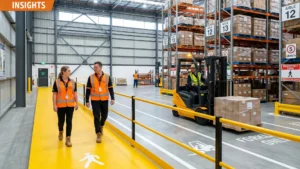
A forklift induction should not be treated as a quick handover before the machine starts moving. It is one of the most practical controls an employer has before an operator enters live traffic, active aisles, or a congested dispatch area.
Good warehouse employers use induction to make the floor easier to read, easier to move through safely, and harder to misunderstand.
That is especially important for temporary operators, because they may be:
- capable
- licensed
- confident
- and experienced
but still unfamiliar with the site-specific conditions that shape real forklift risk.
A strong induction reduces that gap early.
For the broader employer overview, see our forklift safety and licence checks in Victoria pillar guide on licence fit, traffic control, supervision, and day-one readiness.
Why Day-One Forklift Induction Matters So Much
A licensed operator can still be exposed if they do not understand the site.
That is because forklift safety depends not just on driving skill, but on how well the operator understands:
- the floor
- the traffic logic
- the movement pressure
- the pedestrian interaction
- and the site rules that govern how plant is expected to move
A new operator does not yet know what long-term staff may take for granted.
They may not know:
- which crossing is busiest
- where dispatch congestion builds
- which aisle has weak sightlines
- what route pedestrians often use incorrectly
- how loading dock movement works here
- or which corners require extra caution even though they look routine
If those things are not explained early, the operator may still begin the shift licensed but underprepared.
That is why a strong induction is not optional extra detail.
It is part of safer forklift control.
What a Good Forklift Induction Should Actually Do
A good forklift induction should do more than pass on information.
It should help the operator:
- understand the site quickly
- recognise where the real traffic pressure sits
- avoid preventable movement mistakes
- know the site’s traffic and reporting logic
- understand who supervises them
- and begin the shift with less uncertainty
In practice, that means a strong induction should reduce:
- confusion
- wrong-way movement
- weak pedestrian awareness
- poor crossing behaviour
- dock-related risk
- and unsafe assumptions based on habits from another site
This matters because forklift incidents rarely begin with a licence issue alone.
They often begin with a site-familiarity issue.
10 Things Employers Should Cover on Day One
1. Site Entry, Reporting, and Shift Start Expectations
The operator should know exactly:
- where to report
- who to ask for
- who owns their first-shift supervision
- what the start-of-shift process is
- and what must happen before the forklift task begins
This sounds basic, but confusion early often creates weak starts.
If the operator begins the shift unsure:
- who they report to
- who is briefing them
- or whether they are cleared to move yet
then the floor is already more exposed than it should be.
A smoother and clearer start sets the tone for better control across the rest of the shift.
2. Traffic Flow and Forklift Routes

This is one of the most important induction topics.
The operator should be shown:
- which routes are used for forklift movement
- which areas are one-way
- where congestion usually builds
- which aisles require more caution
- where staging can change turning space
- and which routes should not be improvised even during busy periods
Good employers do not assume:
- floor markings explain everything
- or a licensed driver will automatically read the site correctly
Traffic rules should be shown clearly, not guessed on the move.
Our guide to warehouse traffic management shows how stronger layout, movement rules, and supervision reduce forklift and pedestrian risk on active warehouse floors.
3. Pedestrian Interaction and Crossing Points
Forklift operators need more than route awareness.
They also need people-awareness.
A strong induction should explain:
- where pedestrians walk
- where crossings are located
- where mixed traffic risk is highest
- where sightlines are weaker
- and where extra caution is expected even during normal movement
This matters because many close calls happen not because the operator lacks skill, but because:
- pedestrian behaviour on the site is not yet familiar
- the crossing logic is not obvious
- or the floor carries more mixed movement than expected
An operator should not have to discover these patterns through near misses.
4. Blind Spots, Tight Corners, and Local Pressure Areas
Every site has local pressure points.
These may include:
- aisle ends
- roller door entries
- dock approaches
- blind intersections
- narrow turns
- and areas where stock staging reduces visibility
A good induction should identify these clearly.
This is especially important for temporary operators, because they may arrive with good general skills but still not know where:
- the floor becomes harder to read
- the line of sight drops
- or local habits make movement less predictable
That site-specific insight is one of the most valuable parts of induction.
5. Loading Dock and Dispatch Movement Rules
Loading docks and dispatch zones often carry some of the highest forklift pressure on site.
The operator should be shown:
- how movement works in that area
- where people may still be present
- where trucks or trailers create visibility problems
- which waiting zones apply
- and what special caution or restrictions apply around dock activity
A worker who has driven forklifts elsewhere may still not understand how your dock area behaves under pressure.
That is why these zones need stronger explanation than general floor space.
6. Pre-Start Expectations and Equipment Concerns
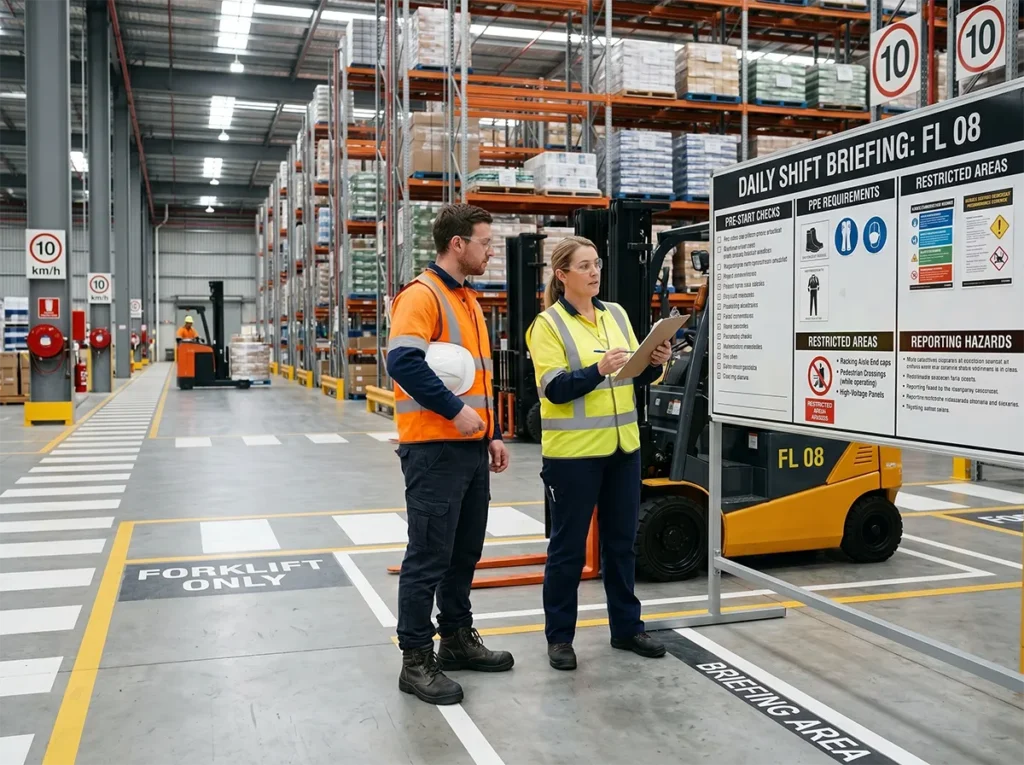
Before shift movement begins, the operator should be clear on:
- what pre-start checks are expected
- how equipment concerns are reported
- what to do if the machine or the area does not feel right
- and whether the forklift should remain out of use until the concern is reviewed
This matters because good forklift safety depends partly on the discipline around what happens before the machine enters active operation.
Operators should not feel pressure to “just get started” if something is not right.
Our article on daily forklift safety checks explains what good operators should review before shift start and why those checks matter under real warehouse conditions.
7. PPE, Site Discipline, and Restricted Areas
A forklift operator should know:
- what PPE is required
- what areas carry stricter rules
- what restricted areas must not be entered casually
- and what site discipline is expected when the floor is under pressure
This includes understanding:
- where the forklift should and should not go
- where pedestrians may appear unexpectedly
- and where site rules tighten because traffic, product, or equipment risk is higher
Good induction reduces the chance that a temporary operator brings habits from another site into the wrong environment here.
8. Reporting, Near Misses, and Who to Tell
A forklift operator should not start the shift unsure about:
- what to report
- who to report it to
- and how quickly an issue should be escalated
That includes:
- near misses
- blocked crossings
- visibility problems
- equipment concerns
- pedestrian interaction issues
- unstable staging
- or any floor condition that makes safe operation harder
A good induction makes reporting simple from the start.
That matters because forklift-related warnings often appear early through:
- small close calls
- repeated congestion
- awkward turns
- or poor pedestrian behaviour
If the operator does not know how to raise those issues, the site loses useful warning information.
9. Who Supervises the First Shift
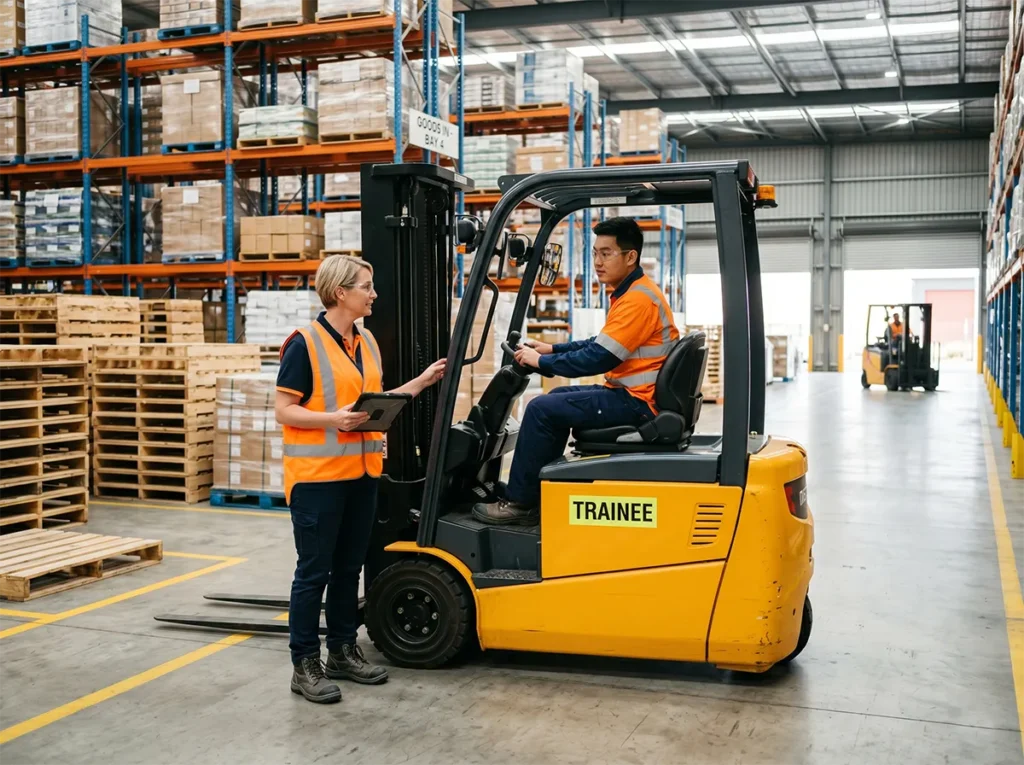
A temporary or new forklift operator should know:
- who owns their first-shift oversight
- who they should go to with a question
- and who is watching whether the placement is settling in safely
This is one of the strongest practical controls available on day one.
A visible supervisor helps:
- correct poor assumptions early
- reinforce local traffic logic
- answer practical questions quickly
- and reduce the risk of the operator trying to interpret the floor alone
Even good operators benefit from stronger first-shift visibility.
10. What a Safe First Shift Looks Like on This Site
This is often overlooked, but it is very useful.
The operator should understand what “good” looks like on day one.
That might mean:
- reporting correctly
- following the designated traffic routes
- slowing appropriately in pressure areas
- respecting pedestrian separation
- asking before entering unclear zones
- reporting concerns early
- and accepting site-specific correction calmly
If the operator knows what a strong first shift looks like, the site has a much better chance of settling the placement in safely and with less friction.
What Employers Should Not Assume
There are a few common assumptions that weaken forklift induction quickly.
Do not assume:
- a licence means no induction is needed
- previous experience means site familiarity
- floor markings explain everything clearly
- a confident operator needs less support
- loading dock rules are self-evident
- traffic pressure will be understood on observation alone
- or the first shift will settle itself without visible supervision
These assumptions often create the exact conditions where:
- wrong turns
- awkward movement
- weak crossing behaviour
- and preventable near misses
begin to appear.
That is why induction matters most before the floor becomes busy.
What Good Forklift Induction Usually Looks Like in Practice
A strong day-one forklift induction usually feels:
- clear
- calm
- practical
- visible
- and difficult to misunderstand
It usually includes:
- direct explanation
- visual route guidance
- identification of local high-risk areas
- pedestrian interaction briefing
- pre-start expectations
- reporting clarity
- and visible first-shift supervision
It should not feel like:
- a rushed handover in the middle of other tasks
- a vague verbal briefing with no walk-through
- or a licensed operator being expected to “just get going”
The best inductions do not overload the worker with theory.
They make the most important site rules obvious before active movement begins.
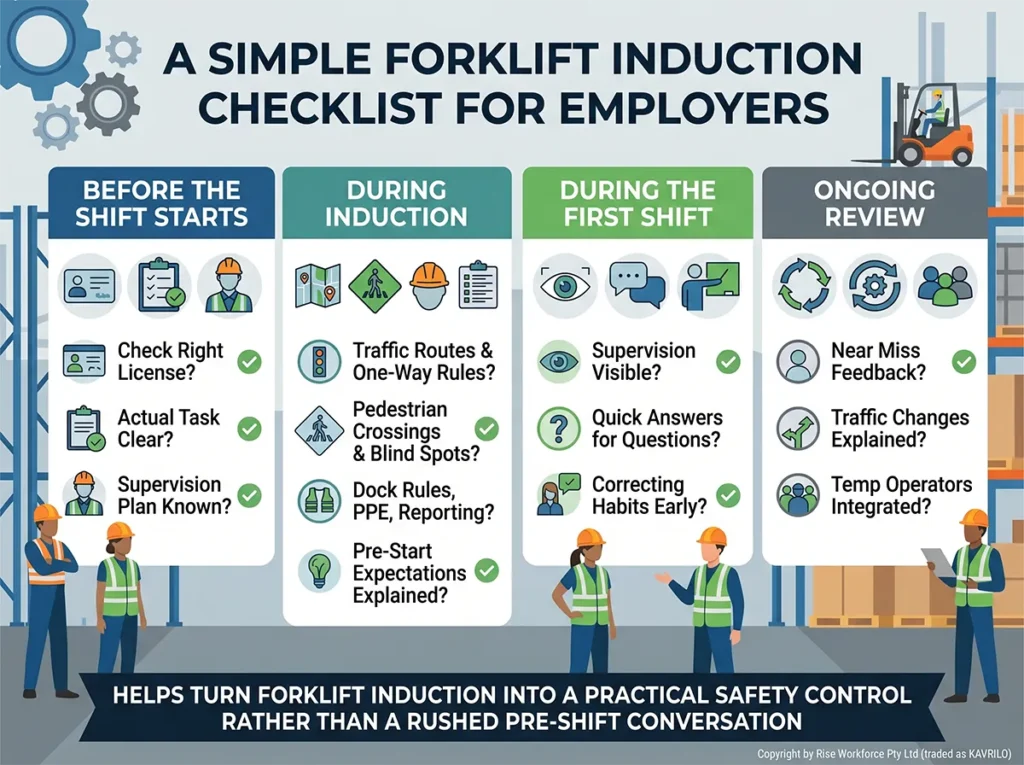
A Simple Forklift Induction Checklist for Employers
Here is a practical checklist employers can use before a new or temporary forklift operator starts work.
Before the Shift Starts
- Have we checked the right licence?
- Is the operator’s actual task clear?
- Do we know who will supervise the first shift?
During Induction
- Have traffic routes and one-way rules been shown clearly?
- Have pedestrian crossings and blind spots been explained?
- Have dock rules, PPE, restricted areas, and reporting been covered?
- Has pre-start expectation been explained properly?
During the First Shift
- Is the operator being supervised visibly enough?
- Are local site questions being answered quickly?
- Are unsafe assumptions or poor habits being corrected early?
Ongoing Review
- Are near misses or congestion issues feeding back into operator guidance?
- Are traffic changes being re-explained when the site changes?
- Are temporary operators being integrated properly into the site’s actual movement system?
This kind of checklist helps employers turn forklift induction into a practical safety control rather than a rushed pre-shift conversation.
Final Word
Forklift inductions for new and temporary operators matter because site familiarity is one of the biggest parts of forklift safety.
For warehouse employers across Melbourne’s South-East, stronger first-shift control usually comes from:
- clearer traffic guidance
- better explanation of crossings and blind spots
- stronger dock-area briefing
- clearer reporting
- visible supervision
- and a more practical day-one setup overall
That is what helps reduce:
- avoidable confusion
- weak movement decisions
- poor interaction with pedestrians
- near misses in local pressure areas
- and preventable risk on unfamiliar floors
Because a licensed operator can still be new to the site.
And that is exactly where induction becomes one of the most valuable controls you have.
That is not just better onboarding.
It is better warehouse control.
Need Practical Labour Hire Support for Warehousing and Manufacturing in Melbourne’s South-East?
KAVRILO is building its approach around safety-aware workforce support, clearer communication, and stronger operational discipline for warehouse and industrial environments.
Whether your site needs better shift coverage, stronger day-one worker readiness, or more dependable labour coordination for forklift-related work, KAVRILO is focused on practical workforce support that fits controlled warehouse and factory environments.
Need warehouse and factory labour hire support with stronger day-one readiness and a practical safety-aware approach? Talk to KAVRILO about workforce support across Melbourne’s South-East.
Article Disclaimer
This article is provided for general information only and does not constitute legal, workplace relations, safety, taxation, payroll or other professional advice. Please seek advice specific to your circumstances before acting on this information.
Please read our Website Disclaimer for more information.