

Peak demand in food production is when quality failures spike.
In South-East Melbourne — across ready meals, bakery, dairy, meat processing, and temperature-controlled operations — packing lines often run harder and longer to meet dispatch windows. The pressure is real: orders stack up, product has shelf-life, and customers expect on-time delivery.
But “go faster” is not a plan. In food packing, speed without control creates:
- label and date coding errors
- incorrect weights or counts
- seal failures and leaks
- allergen mix-ups
- damaged packs and rework
- quality holds that stop the line
The goal is simple: keep output high while keeping rejects low.
That requires a few strong operational controls — not more paperwork.
This guide is a practical employer playbook to reduce rejects during peak periods, including high-care environments that feel pharma/cleanroom-like and cold chain contexts such as dairy and cold storage.
1) Start with the truth: rejects are usually a process problem
When rejects rise, most sites blame the workforce. In reality, rejects typically come from:
- unclear standards under peak pressure
- rushed changeovers and poor allergen discipline
- inconsistent supervision and checks
- equipment issues (printers, sealers, scales)
- fatigue (hands get sloppy late shift)
So the fix is not “push harder.” It’s tighten the system.
2) The “critical-to-quality” points you must control
In most food packing environments, quality failures cluster around a small set of checkpoints:
A) Label + date code
Common failures:
- wrong label roll
- incorrect date/time setting
- code placement inconsistency
- smudged or unreadable codes
B) Weight / count accuracy
Common failures:
- incorrect portion
- underweight packs
- missing items in multipacks
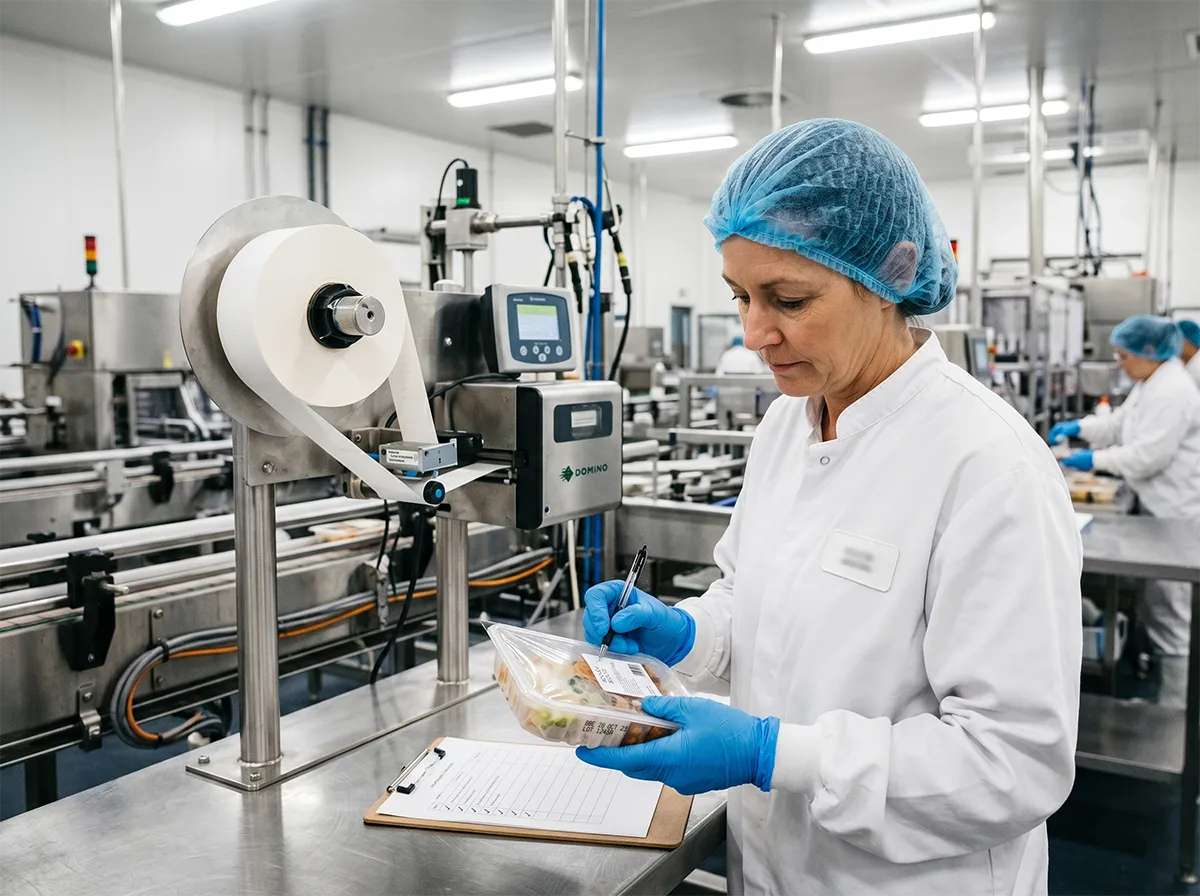
C) Seal integrity and pack presentation
Common failures:
- incomplete seals
- contamination in seal area (crumbs/sauce)
- damaged film
- poor wrap tension

D) Allergen and zone discipline
Common failures:
- tools/tubs crossing zones
- gloves not changed on changeover
- line not cleared properly between runs
Whether you pack ready meals, bakery, dairy, or meat, these points remain the same. Your controls should target them directly.
3) Peak demand increases risk—so reduce variation, not standards
During peak, leaders often “relax” standards to hit volume. That backfires because the cost of rework destroys output.
A better strategy is:
- simplify tasks
- reduce variation
- tighten checking rhythm
You maintain throughput by keeping the line predictable.
Peak principle: fewer exceptions = fewer rejects.
4) Build a simple “quality rhythm” into the line (it prevents drift)
Most packing failures happen because standards drift over time, especially late shift.
Use a simple rhythm:
- Start-up check (first 10 minutes): label, code, weight, seal
- Hourly mini-check: one pack from line verified
- Changeover check: allergen/label/code reset verified
- End-of-shift check: confirm settings matched the run
This takes minutes, not hours. But it prevents the most expensive failures: running wrong labels or codes for a full hour.
In cleanroom-like/high-care environments, this rhythm also supports audit readiness.
5) Make one person accountable for “CTQ checks”
Accountability prevents confusion.
Assign a role (QA, leading hand, or trained line lead) to own:
- label roll verification
- date code confirmation
- seal check procedure
- escalation when out-of-spec is found
The biggest cause of rejects is “everyone thought someone else checked it.”
6) Changeovers: the moment most reject spikes start
Changeovers are where food packing breaks down, especially in ready meals and bakery where ingredients and allergens change frequently.
A peak-safe changeover includes:
- clear-down of old stock (no leftovers)
- correct label roll loaded and verified
- code settings reset and verified
- allergen tool separation confirmed
- glove changes and handwash steps enforced
- line restart only after a quick “first pack check”
Allergen control tip: Use distinct bins/tubs/tools per allergen class where practical, and keep them in separated storage. In peak demand, physical separation is stronger than “remember the rule.”

7) Cold chain and condensation: protect seals and labels
Cold environments (common in dairy, chilled ready meals, and cold storage dispatch) create specific issues:
- condensation can weaken labels
- cold hands reduce dexterity and increase handling errors
- slip risks and rushed movement increase damage
Controls that help:
- ensure label stock is suitable for cold conditions
- keep hands warm enough for dexterity (gloves that still allow grip)
- maintain clean, dry packing surfaces
- rotate staff between cold exposure and warmer tasks when possible
Cold chain failures are expensive because they often trigger broader product holds.
8) Fatigue management is a quality control
As fatigue rises:
- pack handling becomes rougher
- labels get misapplied
- seals get contaminated
- attention drops and mistakes increase
Peak period controls:
- enforce break schedule
- rotate repetitive tasks (packing/stacking/checking)
- avoid “last hour sprinting”
- hydrate and manage heat where relevant (bakery environments can be warm)
Fatigue management reduces rejects and safety incidents at the same time.
9) Labour hire integration: how to use casuals without quality failures
Labour hire can help you scale during peak, but you need structure to prevent quality drift.
Best practice:
- use a repeat bench of workers familiar with your line
- keep tasks clear and consistent for new workers
- pair new labour with an experienced line lead
- use a 5-minute induction focused on CTQs: hygiene, zones, labels/codes, escalation
In high-care environments, don’t “drop” new workers into the most sensitive checkpoints until they’ve demonstrated discipline.
10) The “stop, quarantine, reset” rule (make it non-negotiable)
When something is wrong (label, code, seal), the worst move is trying to fix it quietly.
Train a simple rule:
- Stop the affected line flow
- Quarantine suspect product
- Reset settings/tools
- Escalate to the nominated lead
This prevents a small mistake becoming a batch-wide issue.
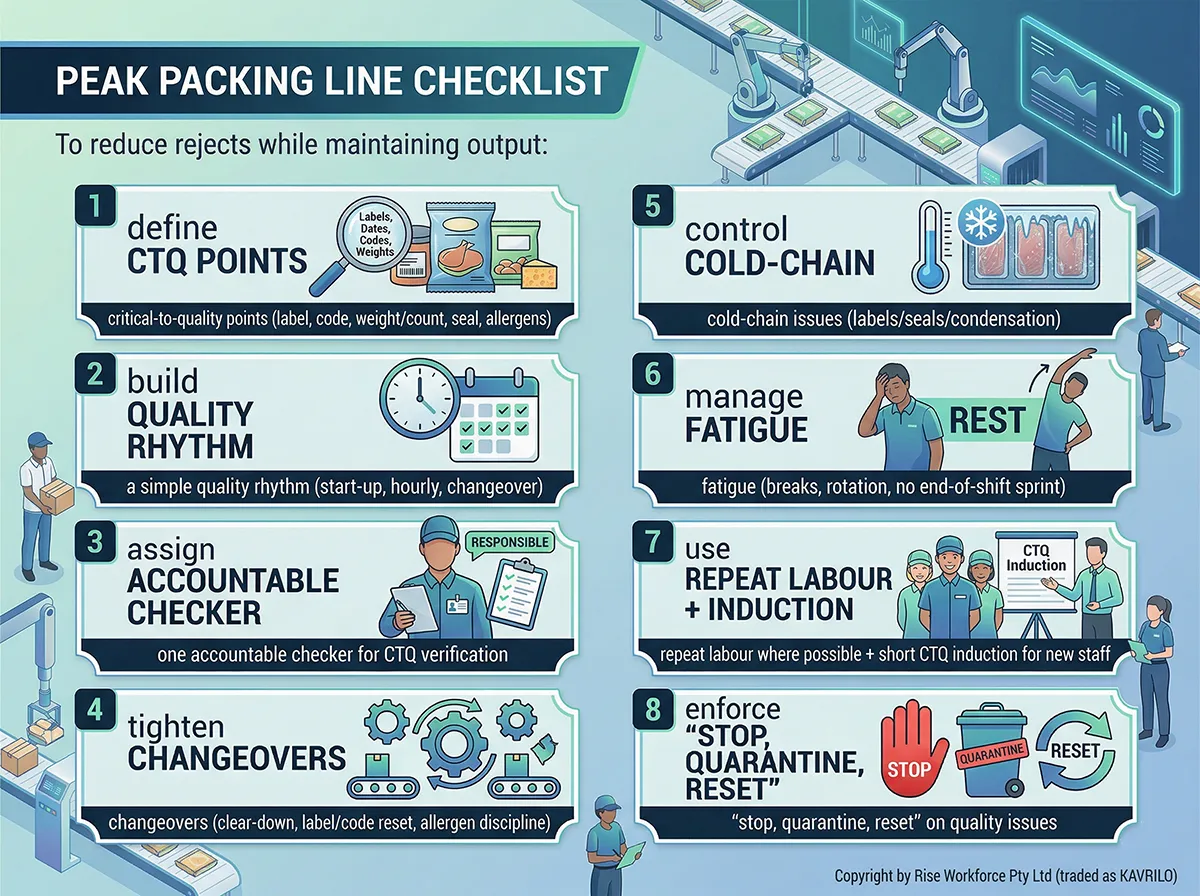
Peak Packing Line Checklist
To reduce rejects while maintaining output:
- define critical-to-quality points (label, code, weight/count, seal, allergens)
- build a simple quality rhythm (start-up, hourly, changeover)
- assign one accountable checker for CTQ verification
- tighten changeovers (clear-down, label/code reset, allergen discipline)
- control cold-chain issues (labels/seals/condensation)
- manage fatigue (breaks, rotation, no end-of-shift sprint)
- use repeat labour where possible + short CTQ induction for new staff
- enforce “stop, quarantine, reset” on quality issues
Final takeaway
High output doesn’t require relaxed standards. It requires stable process control.
If you want peak packing performance without reject spikes, focus on:
- CTQ checkpoints
- checking rhythm
- clean changeovers
- fatigue control
- disciplined integration of labour hire
That’s how you keep the line moving — and keep product compliant.
Article Disclaimer
This article is provided for general information only and does not constitute legal, workplace relations, safety, taxation, payroll or other professional advice. Please seek advice specific to your circumstances before acting on this information.
Please read our Website Disclaimer for more information.