
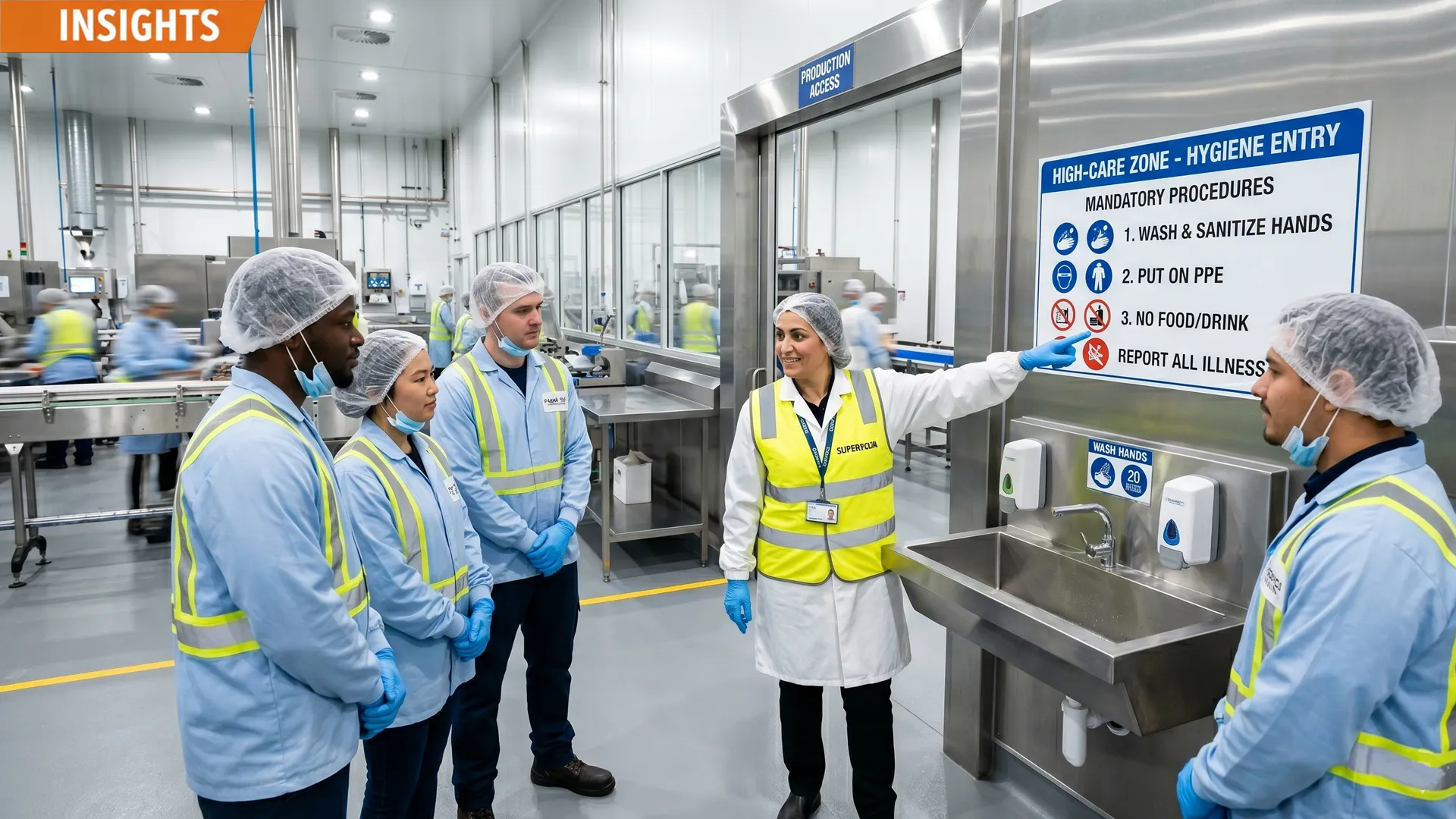
In food production, the fastest way to lose output isn’t a slow pick rate — it’s a quality hold.
One hygiene breach, one allergen mix-up, or one worker crossing zones incorrectly can trigger:
- product rework or disposal
- line stoppages
- extra sanitation
- audit questions
- missed dispatch windows
Across South-East Melbourne (Dandenong South, Hallam, Keysborough, Braeside and nearby industrial areas), food sites span ready meals, bakery, dairy, meat processing, cold storage, and high-care environments that look and feel pharma/cleanroom-like. Different products, same principle: controlled behaviour protects the line.
The good news: most line stops are preventable with one thing done well — a short, site-specific induction that workers actually remember and follow.
This article gives you a practical induction structure you can run consistently with labour hire staff (and direct hires) without creating paperwork overload.
1) What “GMP induction” should achieve (in plain English)
A GMP-style induction is not a lecture. It’s an operational control. It should achieve three outcomes:
- Stop contamination behaviours before they happen
- Protect allergen controls (no cross-contact)
- Create a clear escalation path when something goes wrong
If a worker can’t answer “what do I do if I contaminate my gloves?” your induction is not finished.
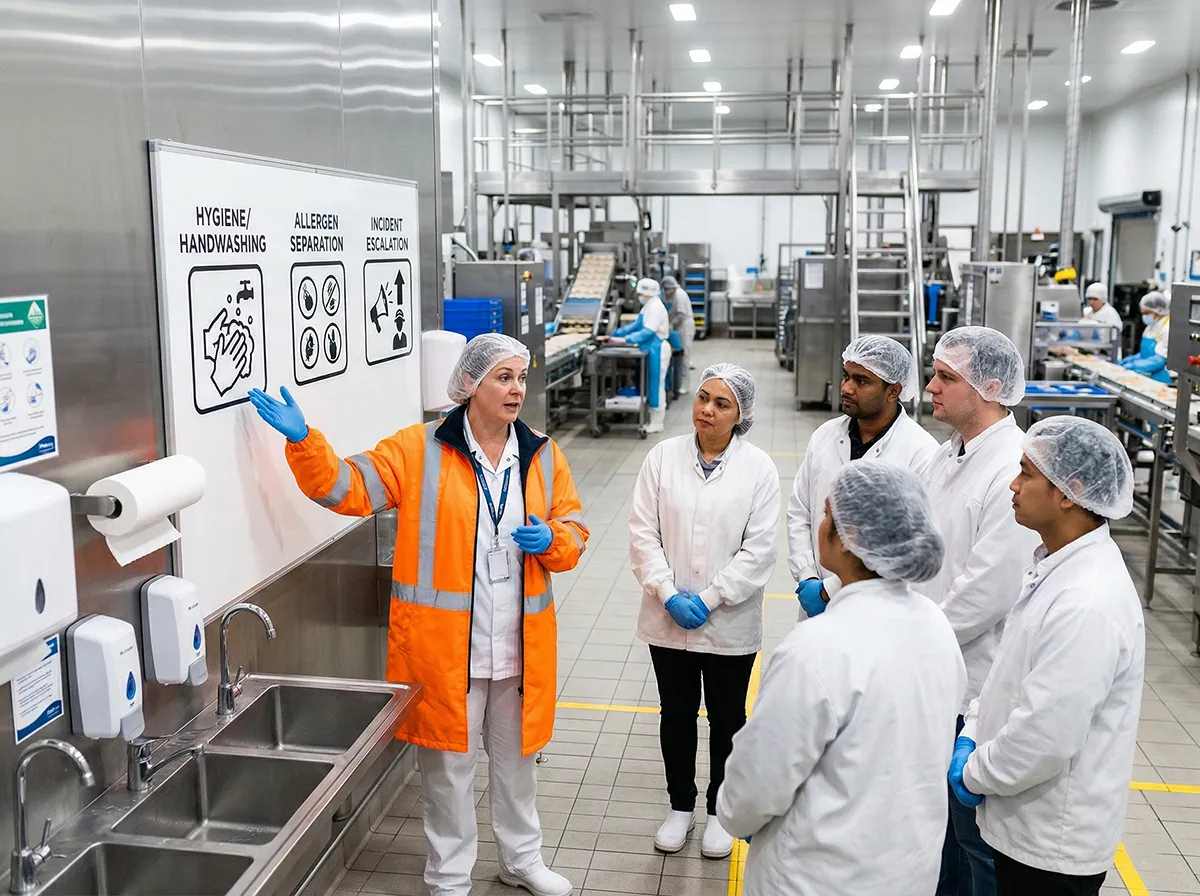
2) Keep it short: 12 minutes beats 60 minutes
Food sites often over-induct and under-control. The best inductions are short and focused.
A good structure:
- 8–10 minutes: non-negotiable hygiene + zone rules
- 2–3 minutes: role-specific risks (packing, processing, cold room, etc.)
- 60 seconds: teach-back questions
Workers retain what’s simple, repeated, and shown on the floor.
3) The “Top 8” induction points that prevent line stops
These eight items cover most contamination and allergen incidents in real sites.
1) Illness reporting (the most ignored rule)
Workers must understand:
- don’t work with vomiting/diarrhoea/fever symptoms
- report illness immediately (before shift if possible)
- follow site rules for return-to-work
This is a major control in ready meals, dairy, and high-care environments.
2) Jewellery, nails, and personal items
Set the rule clearly:
- no jewellery (rings, watches, visible piercings)
- no false nails
- short, clean nails
- no phones on the production floor
This prevents contamination events and audit issues.
3) Handwashing: when, how, and how often
Don’t just say “wash hands.” Specify triggers:
- entering production
- after touching non-food surfaces
- after breaks
- after handling waste/returns
- after coughing/sneezing
If you have a required method (soap time, sanitiser step), demonstrate it.
4) Gloves: when to wear, when to change
Glove misuse is a common contamination cause. Clarify:
- gloves don’t replace handwashing
- change gloves after touching non-food surfaces
- change gloves when damaged
- don’t wear gloves outside controlled areas (if that’s your rule)
This is critical in meat processing and high-care packing.
5) Hairnets, beard snoods, and PPE discipline
If the site requires:
- hairnet
- beard snood
- gown/apron
- dedicated footwear
Make it non-negotiable. Show the correct fit and disposal process.
6) Zone rules and “no crossing”
This is where many labour hire placements fail: workers try to help and accidentally breach zones.
Define:
- which doors and paths are allowed
- what colour zones mean (if used)
- who grants permission to cross zones
- what to do if they accidentally enter the wrong zone
High-care/low-care discipline is especially important in ready meals and dairy.
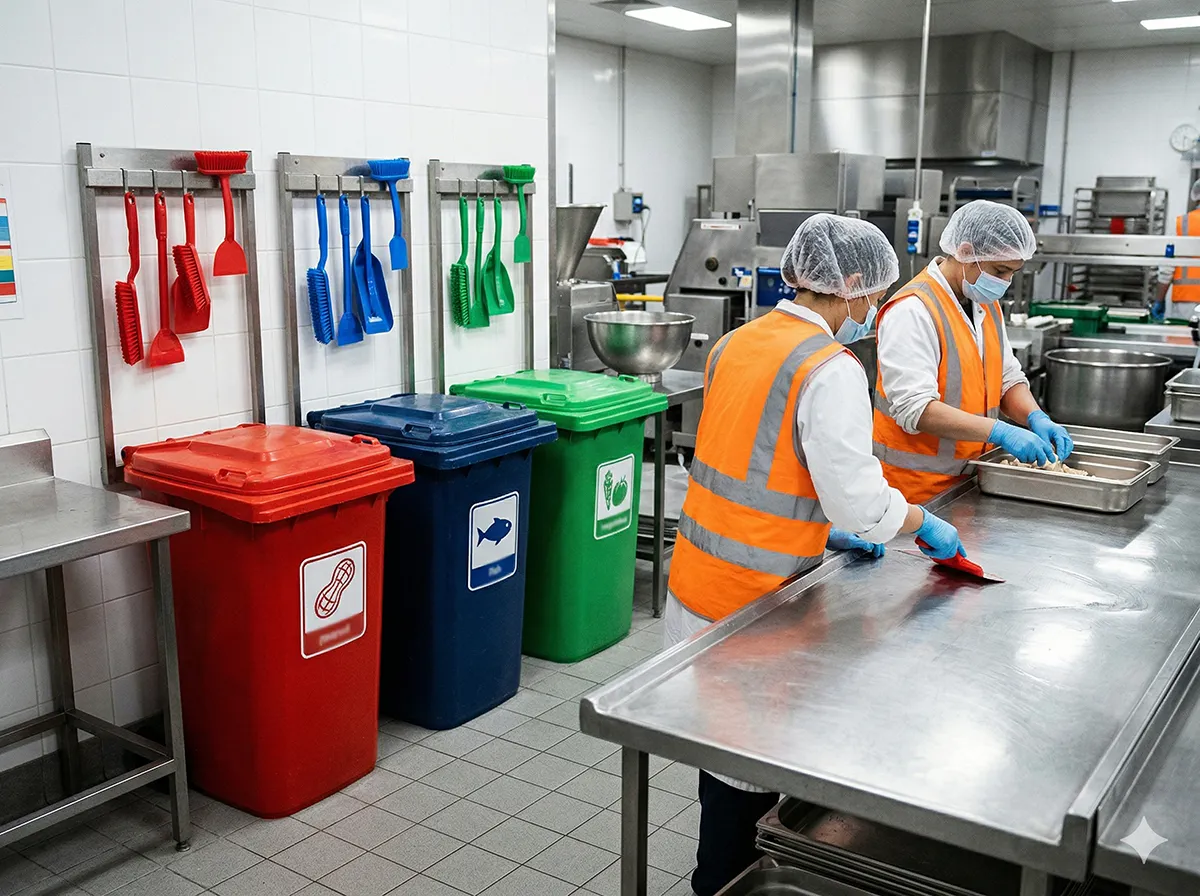
7) Allergen controls (simple, practical)
Allergen incidents often come from:
- touching allergen product then touching non-allergen product
- using the wrong tools
- moving bins or tubs between lines
- not changing gloves during changeovers
Your induction should include:
- which allergens exist on site (examples)
- what “cross-contact” looks like
- what to do during changeovers
- where allergen waste goes
This is essential for bakery and ready meals where ingredients change frequently.
8) What to do when contamination is suspected
Workers need one simple instruction:
Stop, report, and isolate.
They must know:
- who to report to (supervisor/QA contact)
- where to place suspect product (quarantine area)
- not to “fix it quietly”
Quiet fixes are how small issues become large holds.
4) Role-specific add-ons (2 minutes each)
Keep the core induction the same, then add a short add-on based on role.
Packing line (ready meals, bakery, dairy)
- date coding / label checks
- seal integrity checks
- foreign object awareness
- reject process (what to do with damaged packs)
Processing / production
- machine guarding awareness (don’t reach into moving equipment)
- tool handling rules (if used)
- product handling and waste procedure
Meat processing
- stricter PPE/hygiene discipline
- cut resistance or tool safety where required
- sanitation rules and “clean/dirty” separation
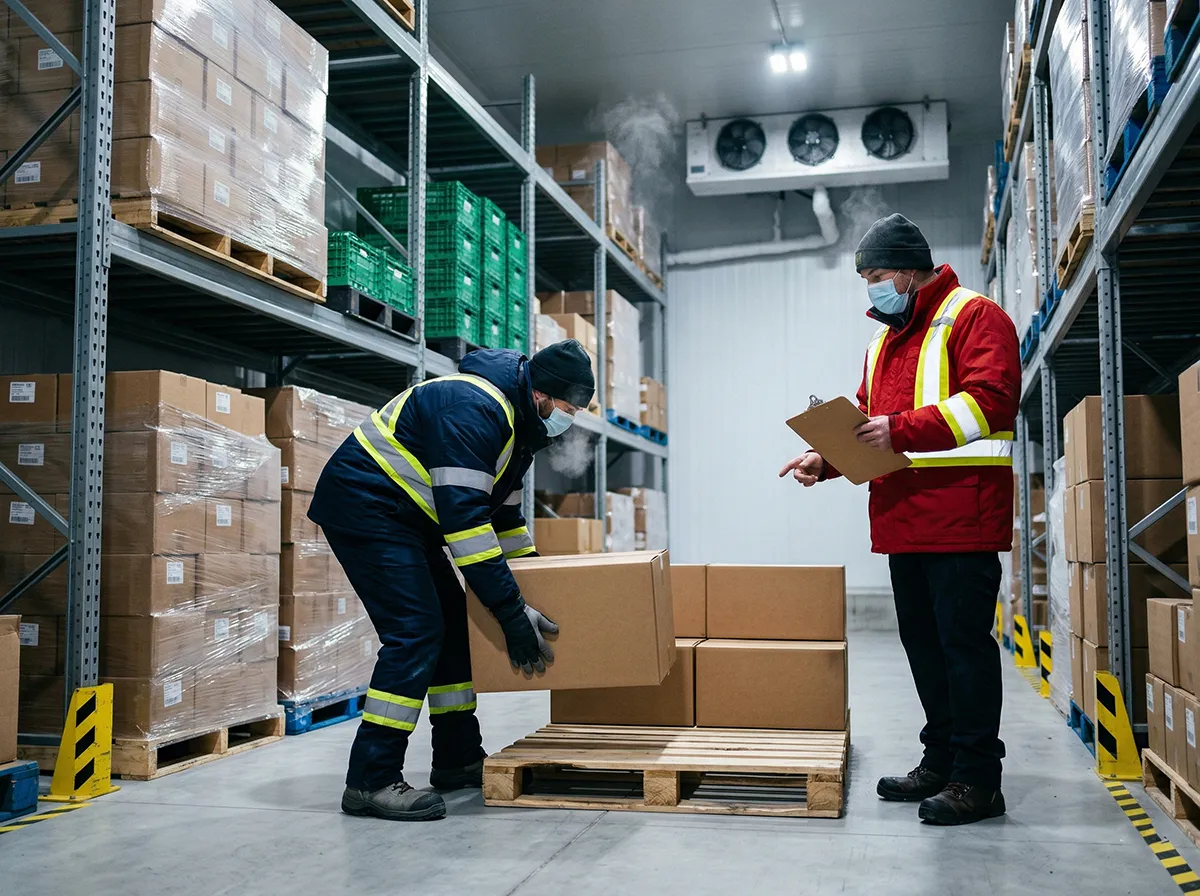
Cold storage / freezer
- PPE and cold stress awareness
- anti-slip expectations
- rotation/warm-up break rules
- safe lifting with reduced grip
High-care / cleanroom-like lines
- gowning steps and behaviour standards
- limited movement between zones
- documentation checks if required (basic verification steps)
5) Teach-back: the fastest way to confirm understanding
Teach-back is not a test. It’s a safety control — and it’s excellent for diverse language backgrounds.
Ask three questions:
- “When do you change gloves?”
- “Can you move between zones? What’s the rule?”
- “What do you do if you suspect contamination?”
If they can answer in their own words, your induction is working. If not, repeat the key rule in plain language.
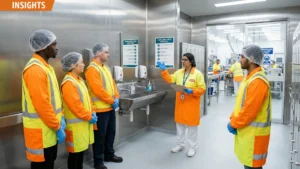
6) Visual control beats paperwork: show it on the floor
Inductions succeed when workers can see the controls:
- zone signs
- handwash station
- PPE points
- allergen bins
- quarantine area
- walkway markings
A 3-minute walk-through often prevents more mistakes than a 30-minute document.
7) Repeat workers reduce induction load and reduce risk
If you rely heavily on labour hire during peak demand, the safest system is a repeat bench:
- workers who already understand your zones
- workers who’ve proven hygiene discipline
- workers who are rebooked regularly
This reduces:
- induction time
- errors and rework
- supervision load
In South-East Melbourne, local repeat workers also reduce no-shows.
8) Induction documentation: keep it clean and audit-ready
You don’t need a complicated record. You need proof of control.
Record:
- worker name + date
- role and line/zone assigned
- induction topics covered (checkbox)
- supervisor/assessor sign-off
- any extra coaching required
This supports compliance without creating admin overload.
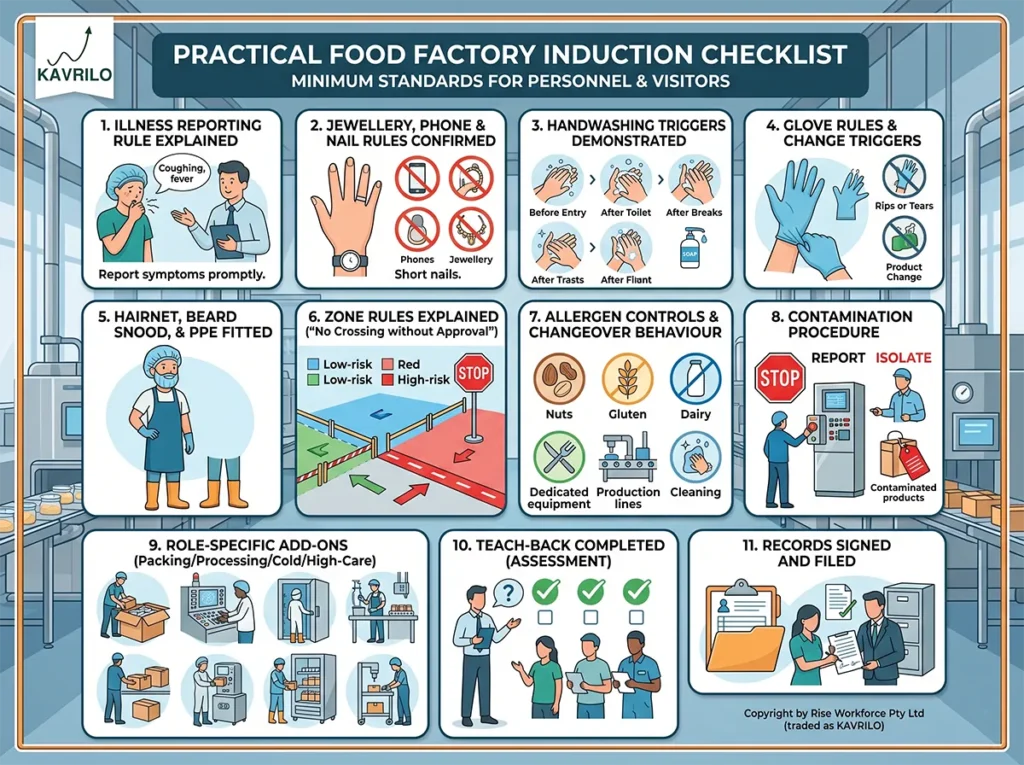
A practical “food factory induction” checklist
Use this as your minimum standard:
- illness reporting rule explained
- jewellery/phone/nail rules confirmed
- handwashing triggers demonstrated
- glove rules explained + change triggers
- hairnet/beard/PPE fitted correctly
- zone rules explained (“no crossing without approval”)
- allergen controls explained + changeover behaviour
- contamination procedure: stop/report/isolate
- role-specific add-on (packing/processing/cold/high-care)
- teach-back completed (3 questions)
- record signed and filed
Final takeaway
Costly line stops are usually preventable. A short, site-specific induction that focuses on hygiene, zones, and allergens protects your output, your quality, and your compliance.
If you use labour hire in food production, the safest model is:
- clear induction standards
- repeat workers where possible
- teach-back confirmation
- simple documentation
That’s how you keep the line moving.
Article Disclaimer
This article is provided for general information only and does not constitute legal, workplace relations, safety, taxation, payroll or other professional advice. Please seek advice specific to your circumstances before acting on this information.
Please read our Website Disclaimer for more information.