


In labour hire, nothing damages trust faster than a pay issue.
For warehouse and factory sites in South-East Melbourne (Dandenong South, Hallam, Keysborough, Braeside and nearby), most payroll disputes don’t come from “bad intentions.” They come from avoidable process gaps: unclear start/finish times, missing supervisor approvals, break confusion, or late submissions.
The good news is this is one of the easiest problems to prevent. A clean timesheet and sign-off process protects workers, hosts, and your operation — and it keeps shifts running without admin chaos.
Here’s a practical system you can implement immediately.
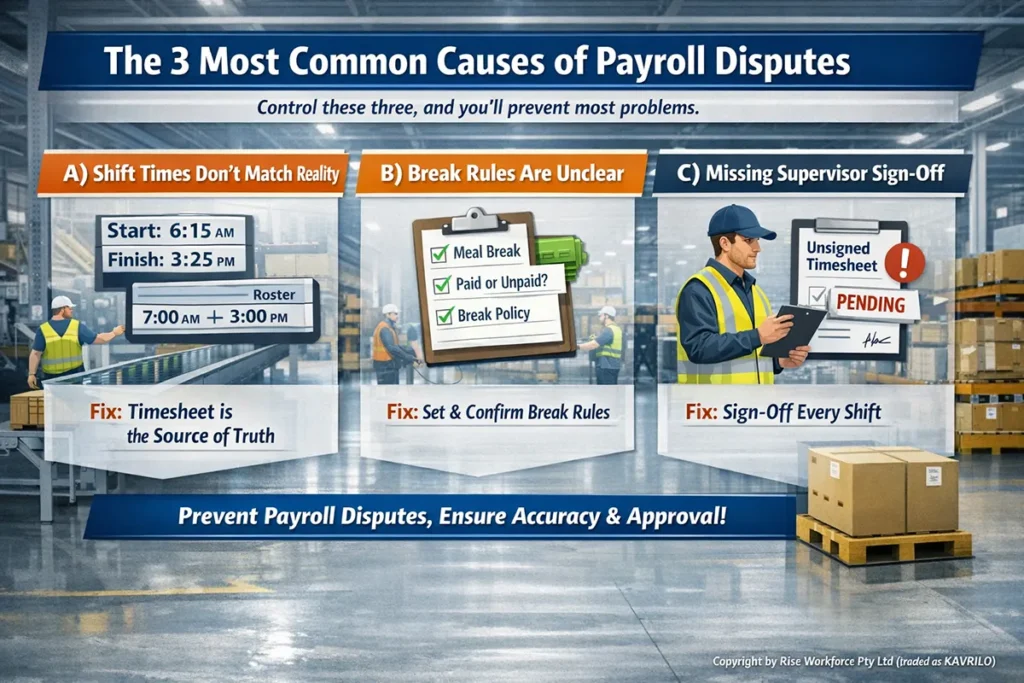
1) The 3 most common causes of payroll disputes
If you can control these three, you’ll prevent most problems.
A) Start/finish times don’t match the roster reality
Shift changes, early starts, overtime, or “stay back 20 minutes” happen daily in warehousing. If the timesheet doesn’t reflect reality, disputes follow.
Fix: Make the timesheet the single source of truth — not the roster. The roster is the plan. The timesheet is what happened.
B) Breaks are unclear (paid vs unpaid)
Break rules vary by site and role. If workers aren’t clear, they record breaks differently, and payroll becomes a dispute.
Fix: Confirm break rules at induction and keep them consistent:
- meal break duration
- paid vs unpaid
- how to record breaks
- who approves variations (supervisor only)
C) Supervisor sign-off is missing or delayed
Unsigned timesheets are the number one reason payroll gets delayed. It usually happens because the supervisor is busy, not because the worker did anything wrong.
Fix: Build sign-off into the end-of-shift routine (more on this below).
2) The “gold standard” process: simple and repeatable
You don’t need a complicated system. You need a consistent one.
Step 1 — Worker submits timesheet before leaving site
The worker records:
- start time
- finish time
- breaks (as required)
- role/location (if your site has multiple zones)
Rule: No “I’ll do it later.” Later becomes forgotten.
Step 2 — Supervisor checks and signs off same day
Supervisor verifies:
- attendance
- correct times
- break compliance
- overtime approval (if applicable)
Rule: Sign-off should happen before the worker leaves, or at least by shift end.
Step 3 — Payroll processes only approved timesheets
This protects everyone:
- prevents workers being underpaid or overpaid
- reduces back-and-forth
- reduces disputes
3) Make sign-off easy for supervisors (this is the real key)
Warehouse supervisors don’t have time for admin at the wrong moment. So don’t design a process that requires “extra time.” Build it into flow.
Practical options:
- End-of-shift sign-off station (one clipboard/tablet)
- Supervisor QR/approval link (if you use digital timesheets)
- Sign-off during shift changeover (when supervisors are already present)
The rule is simple:
If sign-off takes more than 30 seconds, it won’t happen consistently.

4) Use clear rules for overtime and shift extensions
Overtime disputes are common because they’re often informal.
Set a site standard:
- Overtime must be approved by the host supervisor
- Overtime must be recorded on the timesheet
- If a worker is asked to stay back, the supervisor confirms end time
This prevents the “I was told to stay” vs “we didn’t approve it” argument.
5) Avoid the silent killer: late timesheets
Late timesheets delay payroll, frustrate workers, and create extra admin.
Fix it with two simple controls:
- Cut-off time for submissions (e.g., end of shift or a set weekly time)
- Clear consequence: unapproved/late timesheets may delay processing to the next pay run
This isn’t punishment — it’s operational reality. Clear expectations reduce drama.
6) Site accuracy protects safety as well as payroll
Timesheet disputes are not just an admin issue. They affect safety and compliance.
Accurate records support:
- fatigue management (excess hours)
- incident investigations (who was on site)
- WorkCover and reporting accuracy
- compliance audits
If your records are messy, your risk increases.
A clean timesheet process is a safety control.
7) Fix disputes fast: one calm workflow
Even the best systems will have occasional mistakes. The goal is resolving them quickly and fairly.
A simple dispute workflow:
- Worker reports the issue within 24–48 hours
- Compare timesheet, roster, and supervisor confirmation
- Correct if needed and document the change
- Communicate the outcome clearly (no ambiguity)
Avoid long back-and-forth. Most disputes can be solved in minutes if sign-off is solid.

8) A short “timesheet briefing” for workers (use this on day one)
This reduces confusion immediately:
- Record your start and finish times accurately
- Record breaks as per site rules
- Get supervisor sign-off before leaving
- Submit on time — late timesheets may delay payroll
- If there’s an error, report it immediately
This is simple, but it prevents most disputes.
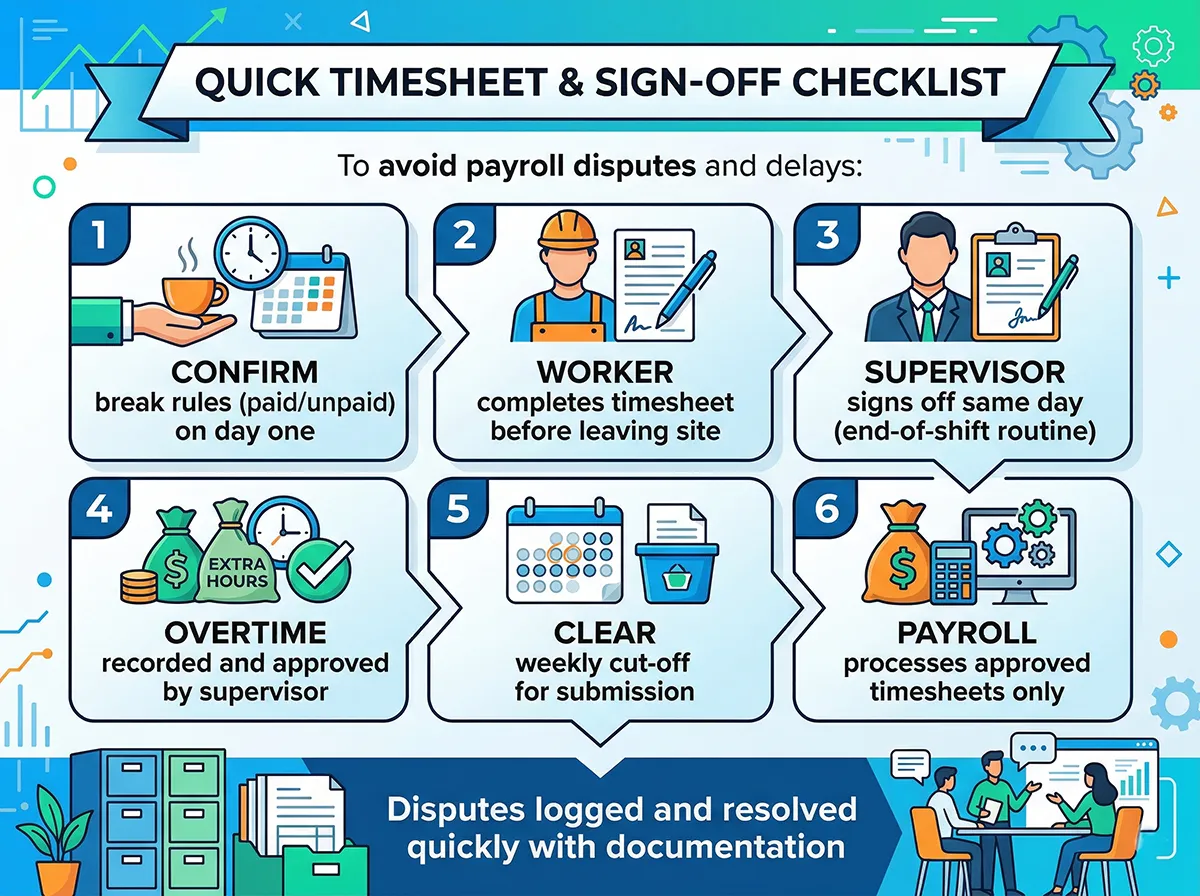
Quick Timesheet & Sign-Off Checklist
To avoid payroll disputes and delays:
- Confirm break rules (paid/unpaid) on day one
- Worker completes timesheet before leaving site
- Supervisor signs off same day (end-of-shift routine)
- Overtime recorded and approved by supervisor
- Clear weekly cut-off for submission
- Payroll processes approved timesheets only
- Disputes logged and resolved quickly with documentation
South-East Melbourne practical note
Many warehouses in the South-East run tight dispatch windows and shift changeovers. If you make sign-off part of changeover, it becomes automatic — and payroll becomes predictable.
Predictable payroll = reliable workforce.
Final takeaway
Timesheet problems are avoidable. A consistent sign-off process:
- reduces payroll delays
- reduces disputes
- improves worker trust
- supports safety and compliance
If you want smoother pay runs, make timesheets a routine — not an afterthought.
Need labour hire support with clear payroll processes in South-East Melbourne? KAVRILO uses structured timesheet approval to help keep shifts, payroll, and operations running smoothly.
Article Disclaimer
This article is provided for general information only and does not constitute legal, workplace relations, safety, taxation, payroll or other professional advice. Please seek advice specific to your circumstances before acting on this information.
Please read our Website Disclaimer for more information.